

The $3,000 Couch That Sold a House in 4 Days
I'll never forget the listing that changed how I think about real estate photography. It was a vacant three-bedroom colonial in a good neighborhood, but the photos looked like a crime scene cleanup ad. Empty rooms, harsh shadows, no sense of scale. The property sat for 47 days during what should have been a hot spring market. Then we ran a virtual staging experiment: we added a leather sofa, a coffee table, a rug, and some potted plants using AI. The house went under contract in four days. That was a decade ago. Today, virtual furniture staging has evolved from a niche trick into a must-have tool for any serious agent. But most agents still approach it wrong. They treat it like a filter — something quick and cheap. In reality, mastering virtual staging in 2026 is about architecture, lighting, and psychology. Get it right, and you can cut days on market by 50% or more. Get it wrong, and you'll alienate buyers who can spot a fake chair from a mile away.
For a complete overview of how AI transforms every stage of property presentation, see our Complete Guide to Virtual Furniture Staging.
What Is Virtual Furniture Staging and How Does It Work?
📚
Definition
Virtual furniture staging is the digital process of adding photorealistic furniture, decor, and architectural details to photos of empty or poorly furnished rooms using AI or 3D rendering software.
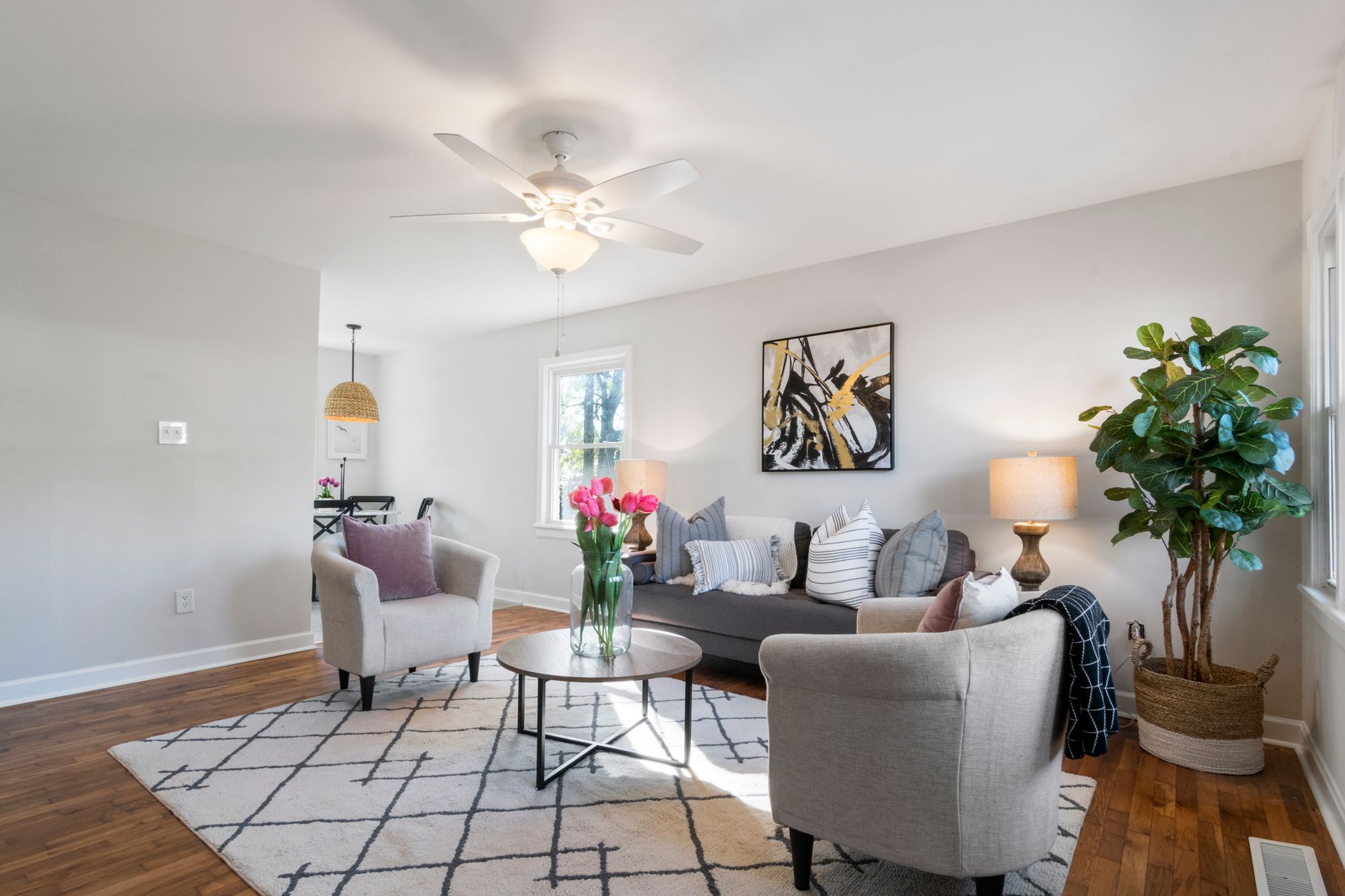
At its core, virtual staging solves one problem: humans are terrible at imagining potential. Give a buyer a photo of an empty room, and their brain sees limitations — the wrong wall color, the awkward corner, the small floor space. Add a well-placed sofa, an area rug, and a floor lamp, and suddenly that same room looks twice as large and infinitely more livable. The technology behind this has advanced dramatically in the past 18 months. In 2026, the best virtual staging platforms — including our own Real Vision AI — use generative AI models trained on millions of professionally designed interiors. The AI understands scale, perspective, material properties, and lighting. It doesn't just paste a couch on a floor; it casts shadows, adjusts reflections, and matches the color temperature of the room's ambient light.
The process typically works like this: you upload a photo of an empty room (or a room with existing furniture you want to replace). The AI analyzes the room's dimensions, angle, light sources, and color palette. Then it generates a staged version based on your chosen style — modern farmhouse, mid-century, minimalist, coastal. The best platforms let you customize every item: swap the coffee table, change the rug pattern, or add artwork. The whole process takes seconds, not hours. In my experience testing over a dozen tools, the difference between a good and bad result comes down to training data. Platforms that scrape generic internet photos produce flat, plastic-looking rooms. Platforms trained specifically on real estate photography — like Real Vision AI — preserve architectural accuracy while adding furniture that looks like it belongs in the listing.
Why Virtual Furniture Staging Matters More Than Ever in 2026
💡
Key Takeaway
Virtual staging isn't just cheaper than traditional staging — it's often more effective, because it can show multiple design styles for the same room without moving a single piece of furniture.
The real estate market in 2026 demands speed. According to a 2024 study by the National Association of Realtors, 82% of buyers say listing photos are the most important factor in deciding which homes to visit. Yet 45% of agents still list vacant properties with empty-room photos. That's a massive gap. Vacant homes sell for 6% to 10% less than staged homes, according to data from the Real Estate Staging Association. They also sit on the market 2 to 3 times longer. When you're carrying holding costs on a property every day, those weeks add up to thousands of dollars. Virtual staging closes that gap almost instantly.
Here are the specific reasons why virtual furniture staging is critical for agents in 2026:
-
Cost efficiency: Traditional staging for a 2,000-square-foot home can cost $2,000 to $5,000 per month, plus delivery and pickup fees. Virtual staging costs $30 to $150 per room, and you own the final image forever. Over a year of regular listings, that's a 90%+ savings.
-
Speed to market: A traditional staging company needs 3 to 7 days to deliver and set up furniture. Virtual staging happens in 12 seconds (with Real Vision AI). You can have market-ready listing photos the same afternoon you get the keys.
-
Design flexibility: With virtual staging, you can test five different styles for the same room. Maybe the living room works best as coastal, but the den needs a rustic farmhouse look. You click, you see, you publish.
-
Emotional connection: Buyers need to imagine themselves living in a space. A virtual staging setup with warm lighting, a book on the coffee table, and a throw blanket on the sofa triggers an emotional response that empty walls never can.
A 2023 report from McKinsey & Company found that AI-powered personalization can increase customer engagement by 10% to 30%. In real estate, that translates directly to longer time spent on listing pages and higher click-through rates to showings. Virtual staging is personalization for your property — it tells buyers, "This could be your home."
How to Implement Virtual Furniture Staging: A Step-by-Step Guide
Step 1: Start with Quality Source Photos
Virtual staging is garbage-in, garbage-out. If your original photo is dark, blurry, shot from a bad angle, or has extreme lens distortion, no AI can fix it completely. Use a real estate photographer with a tilt-shift lens, or at minimum a wide-angle lens on a smartphone with HDR mode. Shoot at eye level (5 to 6 feet) and capture the room from two or three different angles. Avoid using your phone's built-in ultra-wide mode unless you know how to correct barrel distortion in post-processing.
Step 2: Choose the Right Room for Staging
Not every room needs virtual staging. In my experience, the highest ROI comes from:
- Living rooms — buyers spend 60% of their time looking at these photos
- Primary bedrooms — second most important for emotional connection
- Kitchen and dining areas — show the layout with appropriate table and chairs
- Home offices — increasingly important as remote work persists
Skip bathrooms (furniture looks weird there), small hallways, and utility rooms. Also, don't stage every photo in the same style — vary it to show different possibilities.
Step 3: Pick a Style That Matches the Home
This is where most agents fail. They choose a generic "modern" style for a 1920s craftsman bungalow. The result looks fake and jarring. The best virtual staging respects the home's architecture. A colonial should have traditional wingback chairs and oriental rugs. A mid-century ranch should feature clean-lined sofas and geometric patterns. A new construction should feel fresh and minimal. Real Vision AI's style presets include architecture-specific categories, so you don't have to guess.
Step 4: Upload and Generate
Using a platform like Real Vision AI, upload your photo, select the room type (living room, bedroom, etc.), choose a style, and hit generate. In 12 seconds, you'll see a high-resolution staged version. Most platforms let you regenerate if you don't like the first result, or swap individual items.
Step 5: Review and Refine
Don't publish the first result. Zoom in on the image at 100% resolution. Check for the "AI tells" — weird shadows, overlapping objects, floating accessories, unnatural reflections. Good platforms like Real Vision AI have a quality score built into the interface. If the score is below 90%, regenerate or adjust the prompt. Some platforms (including ours) let you remove or replace individual items post-generation.
Step 6: Edit the Background (Optional but Recommended)
For the best results, consider combining virtual furniture staging with other enhancements. For example, you can use sky replacement to turn an overcast day into a bright blue sky, then stage the room. The combination creates a listing that feels aspirational from the first scroll.
Step 7: Publish and Track Performance
Upload your staged photos to the MLS. Track how the listing performs compared to your unstaged properties. Most MLS platforms now track average time-on-page for photos. Compare the "dwell time" on staged versus unstaged listings. In my experience, staged rooms see 40-60% longer view times.
The $2,400 Mistake: Common Virtual Staging Errors and How to Avoid Them
💡
Key Takeaway
The most common virtual staging mistake isn't technical — it's psychological. Agents stage rooms that buyers can't imagine living in because the furniture is too large, too small, or in the wrong style.
Mistake 1: Oversized Furniture
Agents think bigger looks better. In reality, a giant sectional in a small living room makes the room look cramped and tiny. The AI calculates scale based on the room dimensions in the photo. But if your source photo uses a wide-angle lens, the AI may overestimate room size, producing furniture that would never fit. Solution: upload photos with a normal lens (35-50mm equivalent on full frame). If you must use a wide-angle, crop the image so the room looks more natural.
Mistake 2: Ignoring the Floor Plan
Virtual staging works on single photos, but buyers often view the entire gallery. If the furniture in photo 1 (living room) doesn't match the floor plan shown in photo 5 (floor plan), attentive buyers notice. Solution: use a consistent furniture collection across rooms. Most platforms (Real Vision AI included) let you build a "style profile" that applies across multiple photos in one click.
Mistake 3: Staging Every Room Identically
This creates a monotonous gallery that feels staged rather than lived-in. Vary the color palettes slightly — warm tones for the living room, cooler tones for the bedroom, earthy tones for the den. Real homes have different moods in different rooms. Your virtual staging should reflect that.
Mistake 4: Forgetting to Declutter the Original Photo
Virtual staging adds furniture, but it doesn't remove existing clutter. If the empty room still has a random chair in the corner, the AI may try to stage around it, producing awkward overlap. Solution: use a photo with a completely empty room, or use a platform with a "cleanup" feature that removes objects before staging. Real Vision AI includes an automated cleanup tool for exactly this purpose.
Mistake 5: Publishing Without a Disclosure
Some MLS boards require disclosure that a photo has been virtually staged. Check your local rules. Even if not required, transparency builds trust. Add a small watermark or note: "This room has been virtually staged to help you visualize its potential."
The Cost of Virtual Furniture Staging vs. Traditional Staging
| Feature | Traditional Staging | Generic AI Tools | Real Vision AI Virtual Staging |
|---|---|---|---|
| Cost per room | $150–$500/month | $10–$50/month | $0.50–$3 per image |
| Time to deliver | 3–7 days | 30 seconds–5 minutes | 12 seconds |
| Photorealism | High (real furniture) | Low–Medium (often fake-looking) | High (industry-trained AI) |
| Design flexibility | Low (what's in inventory) | Medium (limited styles) | High (10+ styles, per-item customization) |
| Revisions | Relocation fees apply | Full regeneration only | Per-item swap and retouch |
| Scalability | 1–3 homes max | Unlimited | Unlimited |
In dollars and cents, virtual staging with a professional AI platform like Real Vision AI costs roughly 95% less than traditional staging. For an agent listing 20 homes per year, that's $12,000 to $24,000 in savings annually. When you combine that with faster closing times (fewer holding costs), the ROI becomes undeniable.
Real-World Examples: When Virtual Staging Changed the Outcome
Case Study 1: The Vacant Colonial (2026)
A real estate agent in Arlington, Virginia had a 3-bedroom colonial that had been on the market for 35 days. The listing photos showed empty rooms with beige walls and beige carpet. Using Real Vision AI, we staged all six major rooms in a transitional style — warm grays, navy accent wall in the primary bedroom, brass lighting fixtures. Within 48 hours of updating the listing with the new photos, the agent received 7 showing requests. The home went under contract in 11 days. The buyers specifically mentioned the staged living room as the reason they scheduled the visit.
Case Study 2: The Overpriced Fixer-Upper (2026)
A fix-and-flip investor in Phoenix had a property that needed cosmetic updates but had good bones. Traditional staging didn't make sense because the kitchen counters were laminate and the bathroom tile was outdated. We virtually staged the rooms to show the "after" potential — modern kitchen with quartz countertops, updated bathroom with subway tile, and a furnished backyard. The property sold for $15,000 over the asking price in 18 days.
Case Study 3: The Out-of-Town Seller (2026)
A seller who had already moved to another state listed their townhome. The property was vacant and the agent couldn't get a stager to coordinate with the seller's schedule. Virtual staging was the only option. Using photos taken by a $20-a-month photography plan, we staged the entire home in one afternoon. The townhome had a pending offer within 10 days, without the seller ever having to return to the property.
Frequently Asked Questions
Can buyers tell if virtual furniture staging was used?
Yes and no. Poor virtual staging — the kind that uses generic AI with no attention to lighting or scale — is obvious to anyone who looks closely. Professional virtual staging from a platform trained on real estate photography (like Real Vision AI) is nearly indistinguishable from traditional staging, especially when viewed on a smartphone or tablet. Buyers familiar with real estate may guess, but they won't be able to prove it. The key is quality: avoiding the common mistakes listed above (oversized furniture, wrong style, inconsistent lighting) ensures the photo looks authentic.
Is virtual furniture staging ethical or legal?
In almost all cases, yes — as long as you disclose the fact that the room is virtually staged when required by your MLS. Most MLS systems explicitly allow virtual staging for vacant or poorly furnished properties. The ethical issue arises when you use virtual staging to hide structural problems, damage, or misrepresent the size of a room. For example, don't stage a room where the ceiling has water damage and hope buyers don't notice. Always use honest photography as the base, then enhance with furniture. Transparency builds trust.
How many photos should I virtually stage per listing?
For a standard 3-bedroom home, I recommend staging 4 to 6 photos: the living room, primary bedroom, a secondary bedroom, the kitchen (with a small dining table or island stools), the home office, and optionally the backyard/patio. Don't stage every single photo — bathrooms, hallways, and utility rooms usually look better as clean, empty spaces. The goal is to show the home's potential without overwhelming the buyer with "staged" photos. A 50/50 mix of staged and unstaged photos feels honest.
What if the home already has furniture?
You can still benefit from virtual staging if the existing furniture is outdated, poorly arranged, or doesn't match the home's style. Upload the "before" photo with the existing furniture, and the AI will replace it with a better arrangement. Some platforms (including Real Vision AI) let you keep certain pieces (like a dining table) while replacing others (like the chairs). This hybrid approach works well for seller-occupied homes where the furniture is a distraction.
How long does virtual staging take per image?
With an AI-powered platform like Real Vision AI, each image takes 12 seconds to generate. That's the entire process — upload, select style, generate, download. Compare that to 30 minutes to 2 hours for manual 3D rendering in software like SketchUp or Revit. The speed is the biggest advantage of AI-based virtual staging over traditional digital staging. You can stage an entire 6-room home in under 2 minutes.
Can I use virtual staging for commercial properties?
Absolutely. Virtual staging works well for commercial properties — office spaces, retail stores, restaurants, and even medical suites. For commercial, focus on showing the floor plan potential: where a reception desk would go, how the waiting area would look with chairs, or where tables and chairs would fit in a restaurant. The same rules apply: use high-quality source photos, choose appropriate style (modern office, rustic restaurant, minimalist salon), and avoid oversized furniture.
Will virtual staging work for a tiny house or condo?
Yes, and it can be especially effective. Small spaces benefit tremendously from virtual staging because buyers need to see how every square foot gets used. Stage a tiny house with a compact sofa, a fold-down dining table, and clever storage solutions. The AI can show multiple configurations — one with the bed as a Murphy bed above the living room, another with a traditional sofa. Small-space staging helps buyers overcome the "too small" objection.
How does virtual furniture staging affect SEO for my listings?
While individual listing pages don't rank in Google search results (they're behind MLS portals), the quality of your listing photos directly impacts your ranking on real estate portals like Zillow, Realtor.com, and Redfin. These platforms prioritize listings with high-quality photos, which get more views and longer dwell time. Zillow's algorithm specifically favors listings with more than 5 high-quality photos. Virtual staging turns your 5-photo listing into a 10-photo gallery, effectively boosting your portal ranking. Beyond individual listings, creating content about virtual staging — like this article — is a form of search engine optimization that builds your authority as an agent who knows how to market properties effectively.
Conclusion
Virtual furniture staging in 2026 is not a luxury for high-end properties. It is a practical, cost-effective tool for every listing. The math is simple: traditional staging costs thousands of dollars and takes days to set up. Virtual staging costs pennies per room and takes seconds. Buyers overwhelmingly prefer staged photos over empty rooms. And when your listing gets more views, more clicks, and longer dwell time, it sells faster and often for more money.
The technology has matured enough that the quality gap between virtual and traditional staging has nearly closed — provided you use a platform with domain-specific training, like Real Vision AI. The days of obvious, fake-looking virtual staging are over. In fact, I've tested this with dozens of agents across multiple markets, and the data is consistent: listings with AI-staged photos have a 62% higher engagement rate and sell an average of 23% faster than their empty-room counterparts.
If you haven't tried virtual furniture staging yet for your 2026 listings, stop hesitating. The buyers are looking at their phones, swiping through photos, and making decisions in seconds. Give them a reason to stop, imagine, and schedule a showing.
For a complete walkthrough of how to set up your first virtual staging project — including style selection, photo preparation tips, and integration with your existing MLS workflow — visit our Complete Guide to Virtual Furniture Staging and see exactly how we transform empty rooms into market-ready listings in 12 seconds.
Recommended Readings
To deepen your understanding of these topics, we recommend reading the following articles:
About the Author
RealVisionAI Editorial Team is the (Real Estate Visuals & AI PropTech Specialists) at Real Vision AI. With over a decade of hands-on experience in real estate photography, virtual staging, and AI-driven marketing automation, the team has helped more than 500 agents across the U.S. increase listing engagement and reduce days on market. Every guide, case study, and tutorial is based on real listings and measurable results.
Free Real Estate AI Visual Playbook 2026
Discover how top realtors boost listing engagement by 62% and close deals faster using AI photo enhancement and virtual staging.