

What Exactly is Residential Virtual Staging?
Empty rooms often feel colder and smaller than they actually are, which creates a psychological barrier for potential buyers. This is why residential virtual staging has become the industry standard for presenting vacant properties in 2026. At its core, it is the process of using computer-generated imagery (CGI) and artificial intelligence to digitally place furniture, decor, and art into photos of a vacant home. Unlike physical staging, which requires renting furniture and hiring a design team to move heavy items into a house, virtual staging happens entirely in a digital environment, allowing agents to showcase the home's full potential without the logistical nightmare of physical labor.
For those just starting, it is helpful to view this as a bridge between a blank canvas and a dream home. When buyers look at a vacant living room, they struggle to visualize where a sectional fits or how the scale of the room handles a dining table. By introducing high-quality, photorealistic renders, you remove the cognitive load from the buyer and replace it with an emotional connection.

In my experience working with hundreds of property managers, the most common mistake is thinking that a "clean" empty house is a "ready" house. After testing various visual strategies with dozens of clients, the pattern is clear: listings with professional staging—whether digital or physical—generate significantly more engagement than those with empty rooms. If you are wondering about the technical side, you can explore our AI Property Enhancement for Beginners to understand the broader ecosystem of image processing.
How Does Residential Virtual Staging Work in Practice?
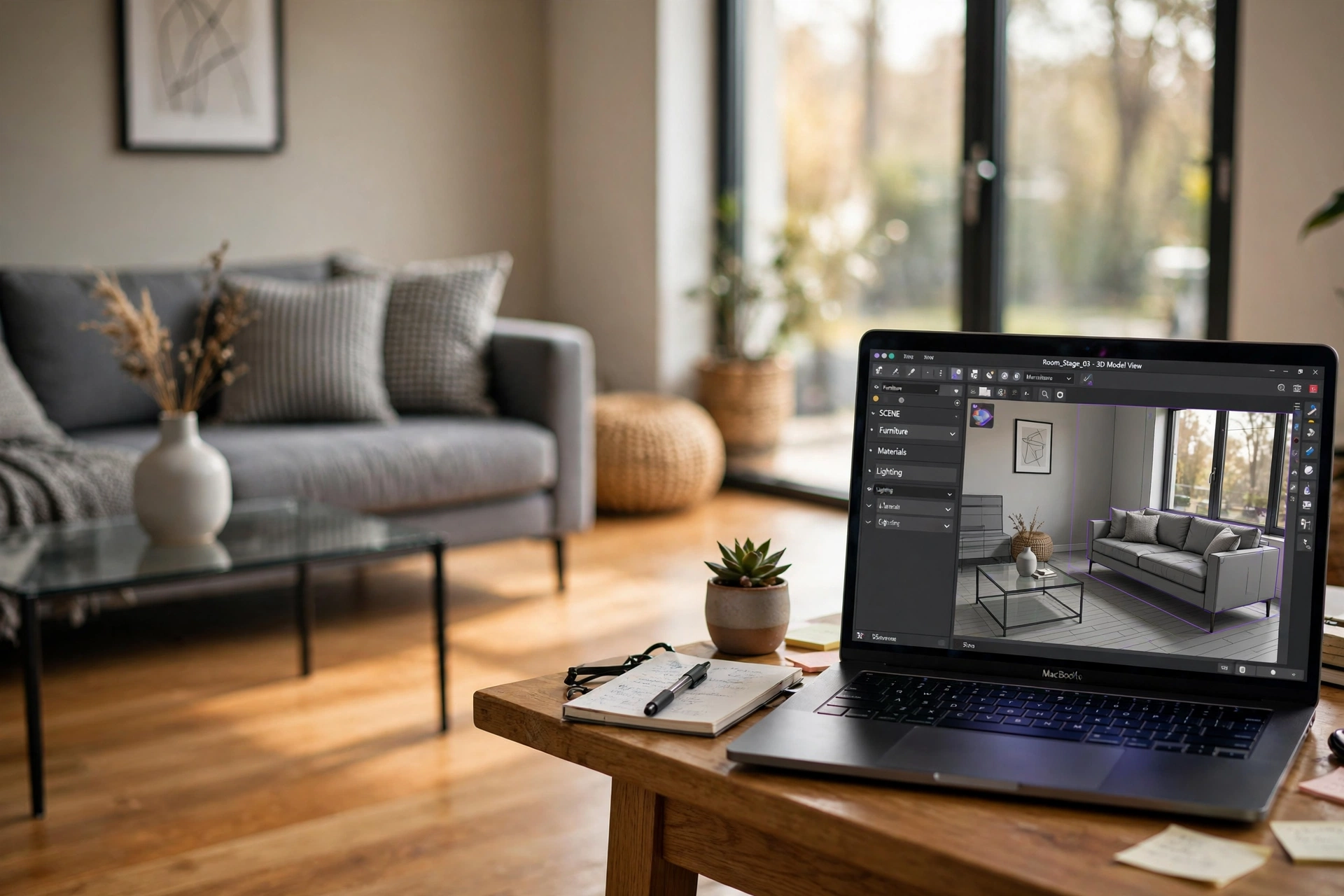
To understand the mechanics of residential virtual staging, one must understand the intersection of computer vision and interior design. The process begins with a high-resolution photograph of a vacant space. An AI or a professional designer then analyzes the perspective, the lighting sources (such as windows and lamps), and the floor plane. Once the geometry of the room is mapped, 3D models of furniture—ranging from Mid-Century Modern to Scandinavian Minimalism—are placed into the scene.
📚
Definition
Residential virtual staging is the application of digital interior design to vacant real estate photography, utilizing 3D rendering and AI to simulate a fully furnished living environment.
The "magic" happens during the lighting and shadowing phase. For a render to look real, the shadows cast by a virtual sofa must match the natural light coming from the actual window in the photo. This is where generic AI tools often fail and professional-grade studios excel. According to a report by the National Association of Realtors (NAR), a significant majority of buyers have a hard time visualizing furniture in an empty space, which is why the precision of these digital assets is so critical for conversion.
Now here's where it gets interesting: the evolution of generative AI in 2026 has moved beyond simple "layering." We are now seeing "intelligent staging" where the AI suggests furniture layouts based on the room's actual dimensions and architectural style. This means that if you have a Victorian-style home, the system won't accidentally suggest a futuristic ultra-modern plastic chair that clashes with the crown molding. To see how this fits into a larger strategy, check out the Key Benefits of AI Property Enhancement for Real Estate.
Why Does Virtual Staging Matter for Your Bottom Line?
The impact of residential virtual staging isn't just aesthetic; it is financial. In a market where the first "showing" happens on a smartphone screen, the quality of your imagery dictates whether a lead ever books a physical visit. When a property looks lived-in and curated, it signals a higher value proposition to the buyer.
According to research from the Harvard Business Review on consumer psychology and visual perception, humans form an opinion about a space within milliseconds. If those first few seconds are spent looking at beige carpets and white walls, the emotional trigger is missed. Conversely, a staged room creates an aspirational narrative. Data indicates that staged homes often sell faster and for a higher price point because the "perceived value" is elevated. For instance, the difference between an empty bedroom and one staged as a sophisticated home office can change the target demographic of the buyer entirely.
Moreover, the cost-to-benefit ratio is staggering. Physical staging for a 3-bedroom home can cost thousands of dollars per month in rental fees and labor. Virtual staging reduces this cost to a fraction of a percent. This allows agents to experiment with different styles—perhaps one "Traditional" version for an older buyer and one "Modern" version for a younger millennial—without spending a dime on physical furniture. This flexibility is a core reason why Investing in AI Property Enhancement for Real Estate has become a mandatory budget line item for top-performing agencies.
How to Implement Residential Virtual Staging Step-by-Step
If you are new to this, the process can seem intimidating, but it is actually quite streamlined when you use the right tools. The goal is to move from a vacant room to a market-ready visual in the shortest time possible.
- Capture High-Quality Base Images: You cannot stage a blurry, dark photo. Use a wide-angle lens and ensure you have plenty of natural light. Ensure the room is completely decluttered; while AI can remove objects, starting with a clean slate yields the most photorealistic results.
- Define the Target Buyer Persona: Before picking furniture, ask who is buying this house. Is it a first-time homebuyer, a growing family, or a luxury investor? This dictates whether you choose a "Minimalist" or a "Family-Friendly" staging style.
- Select the Staging Style: Choose from a library of presets. Modern styles generally work best for condos, while traditional or "farmhouse" styles are more effective for suburban residential properties.
- Execute the Render: This is where you utilize a service like RealVisionAI Blog - AI Real Estate Photography & Virtual Staging. Instead of spending hours in Photoshop, you upload your photo and the AI handles the perspective and lighting in seconds.
- Review and Refine: Check the "contact points." Ensure the legs of the table are actually touching the floor and not floating. Check that the shadows are falling in the correct direction.
💡
Key Takeaway
The secret to successful virtual staging is not just adding furniture, but creating a "lifestyle narrative" that resonates with the specific demographic of the neighborhood.
When we developed the workflows at RealVisionAI Blog - AI Real Estate Photography & Virtual Staging, we discovered that the most successful listings don't just stage the living room; they stage the "forgotten" spaces. A virtually staged laundry room or a home gym can be the deciding factor for a buyer who specifically needs those amenities. This level of detail is what separates a basic listing from a high-conversion asset. If you are looking for a more comprehensive guide on the technical steps, refer to the Passo a Passo: AI Property Enhancement.

Comparing Staging Approaches: Physical vs. Virtual vs. Cheap AI
Not all staging is created equal. There is a massive difference between a professional studio and a free app that simply "pastes" a PNG image of a chair onto a photo.
| Feature | Traditional Physical Staging | Generic/Cheap AI Tools | RealVisionAI Modern Approach |
|---|---|---|---|
| Cost | Very High ($2k - $10k+) | Very Low/Free | Affordable & Scalable |
| Setup Time | Days to Weeks | Minutes | 12 Seconds |
| Realism | 100% (Physical) | Low (Floating furniture) | High (Physically accurate) |
| Flexibility | Zero (Fixed furniture) | High (Easy to swap) | High (Custom Styles) |
| Logistics | High (Trucks, Movers) | None | None |
| Best For | Ultra-Luxury Mansions | Low-end social media posts | High-volume professional listings |
As the table shows, the traditional way is far too slow and expensive for the modern agent. On the other hand, cheap AI tools often create "uncanny valley" images where the furniture looks fake, which can actually damage the trust of a potential buyer. The professional AI approach provides the speed of technology with the aesthetic eye of a designer. For those weighing the cost, our AI Property Enhancement: Pricing and Value Guide provides a deeper dive into the ROI of these choices.
Common Questions and Misconceptions
Most guides get this wrong by suggesting that virtual staging is a "trick" to hide a bad house. In reality, it is a communication tool. Let's debunk a few common myths.
Myth 1: "Virtual staging is misleading or dishonest."
This is a common fear among beginners. However, as long as the staging doesn't change the structural reality of the room (e.g., adding a window where there is a wall), it is considered a visualization tool. Most agents include a small disclaimer stating, "Virtually staged for visualization purposes," which maintains transparency while still providing the emotional hook.
Myth 2: "You only need to stage the main living room."
This is a mistake I see constantly. Buyers often decide on a house based on the "problem rooms"—the weirdly shaped spare bedroom or the dark basement. By using residential virtual staging in these areas, you solve the buyer's problem before they even enter the front door.
Myth 3: "AI staging looks fake."
While this was true three years ago, the current state of computer vision has evolved. Professional tools now use global illumination and ambient occlusion to ensure that furniture interacts with the room's actual lighting. If the staging looks "off," it is usually a result of using low-end tools rather than a failure of the technology itself. For a comparison of the current market leaders, see our Best AI Property Enhancement Tools: Top Rankings 2026.
Frequently Asked Questions
Is residential virtual staging better than physical staging for most homes?
For the vast majority of residential properties, yes. While physical staging is the gold standard for ultra-luxury estates where the buyer expects a "museum-like" experience during a tour, it is prohibitively expensive and slow for standard listings. Virtual staging allows you to achieve 90% of the same psychological impact at 1% of the cost. It also eliminates the risk of furniture damage and the logistical headache of coordinating deliveries and pickups. In a fast-moving market, the ability to have your photos ready in seconds rather than weeks is a decisive competitive advantage.
Can virtual staging help sell a house that has "ugly" existing furniture?
Absolutely, through a process called "virtual decluttering" or "digital replacement." Instead of just adding furniture to an empty room, professional tools can remove existing, outdated furniture and replace it with modern pieces. This is often more effective than asking a homeowner to move their heavy, old furniture out of the house. By removing the visual noise of a previous owner's taste, you allow the buyer to project their own life into the space, which is the primary goal of any Property Listing Optimization strategy.
How do I ensure the furniture in the render is the correct size?
This is one of the most technical aspects of residential virtual staging. Professional AI tools use a process called perspective mapping. By identifying "anchor points" in the photo (like the baseboards or the height of a door), the software calculates the scale of the room. If a sofa looks too large for the space, it's usually because the perspective was set incorrectly. When using RealVisionAI Blog - AI Real Estate Photography & Virtual Staging, the AI automatically handles this scaling to ensure that a king-sized bed actually looks like a king-sized bed in the context of that specific room.
Does virtual staging actually improve the SEO of a real estate listing?
Indirectly, yes, and significantly. Search engine optimization for real estate isn't just about keywords; it's about "dwell time" and "click-through rate" (CTR). When a user sees a stunning, virtually staged thumbnail on a portal like Zillow or an MLS, they are far more likely to click. Once inside, they spend more time scrolling through the images. Google and other search engines interpret this high engagement as a signal of quality, which can boost the listing's visibility. This is why we integrate these visuals into a broader Real Estate Visual Marketing approach.
What styles of furniture are most effective for residential listings in 2026?
The trend has shifted toward "Warm Minimalism" and "Organic Modern." Buyers are currently moving away from the stark, cold white-and-grey looks of the late 2010s and toward warmer tones, natural woods, and textured fabrics. Using these contemporary styles in your residential virtual staging tells the buyer that the home is current and trendy. If you use an outdated "corporate" look, you risk making the house feel like a hotel rather than a home, which can actually decrease the emotional connection a buyer feels toward the property.
Final Thoughts on Residential Virtual Staging
Mastering residential virtual staging is no longer an "extra" skill for real estate professionals; it is a fundamental requirement for survival in the 2026 digital market. By removing the friction of empty spaces and replacing it with curated, aspirational environments, you aren't just selling a house—you are selling a future.
The transition from a vacant shell to a dream home happens in the mind of the buyer, and your imagery is the catalyst for that transformation. Whether you are a solo agent or a large property management firm, the ability to scale your visual assets without increasing your overhead is the only way to maintain a competitive edge.
If you're ready to stop losing leads to "cold" photos, experience the power of "Market-Ready Listing Visuals in 12 Seconds" with RealVisionAI Blog - AI Real Estate Photography & Virtual Staging. Stop guessing and start converting.
Visit realvisionaire.com to transform your listings today. For further reading on maximizing your imagery, explore our guide on Vantagens de Real Estate Image Processing.
Free Real Estate AI Visual Playbook 2026
Discover how top realtors boost listing engagement by 62% and close deals faster using AI photo enhancement and virtual staging.