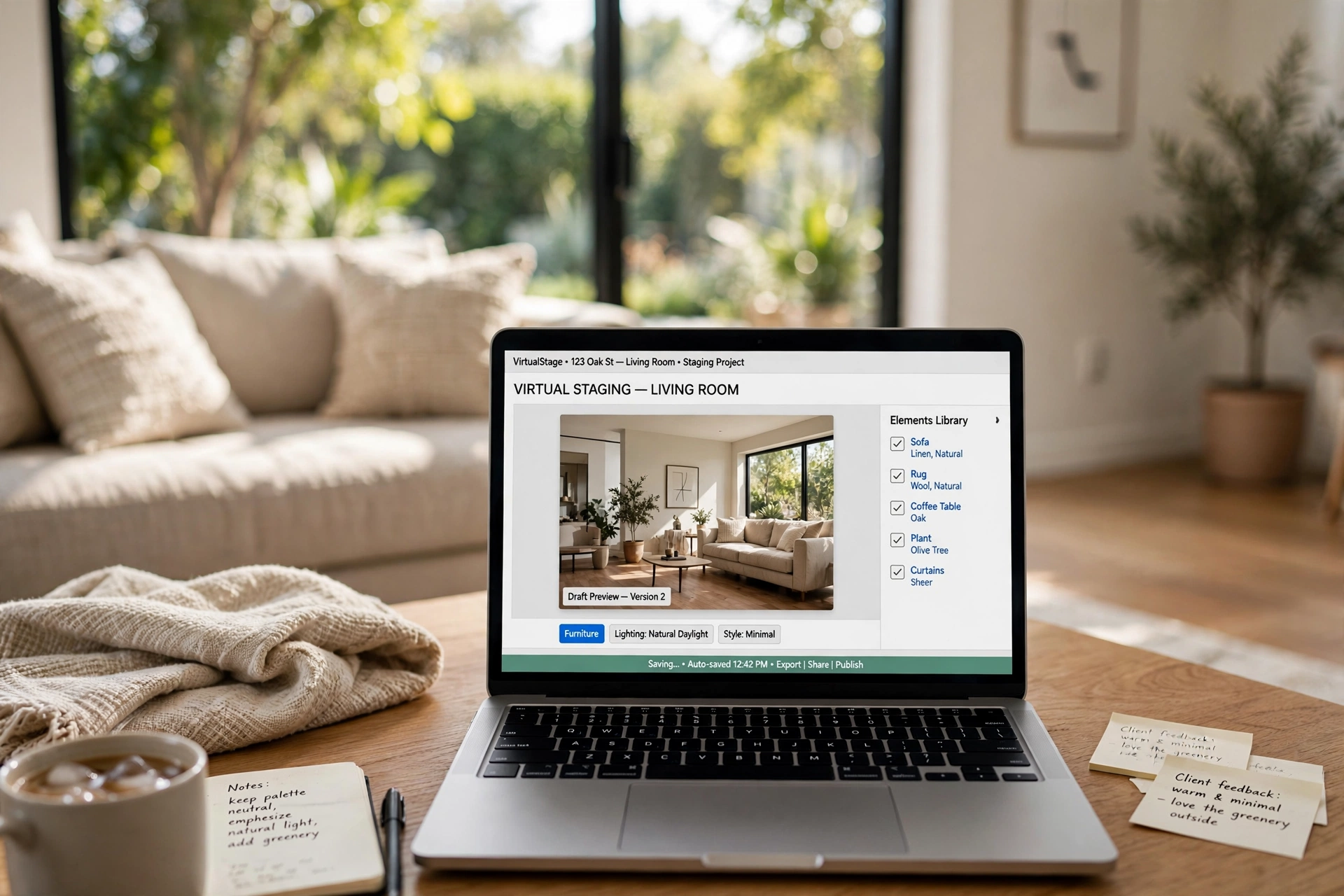


How to Execute a High-Conversion Residential Virtual Staging Strategy?
Empty rooms often feel cold and smaller than they actually are, creating a psychological barrier for potential buyers who struggle to visualize a living space. To solve this, you implement residential virtual staging by digitally inserting high-quality, scaled furniture and decor into photos of vacant properties. This process transforms a sterile environment into an aspirational home, effectively bridging the gap between a physical structure and a future residence. By following a systematic approach—starting with high-resolution wide-angle photography and ending with AI-driven furniture placement—you can increase listing engagement and reduce time-on-market without the logistical nightmare of moving physical furniture.
For those starting from scratch, exploring the Key Benefits of AI Property Enhancement for Real Estate provides the necessary foundation to understand why visual psychology drives higher offers.

What is the Core Mechanism of Residential Virtual Staging?
At its heart, this technology is a blend of computer vision and interior design. Unlike traditional photo editing, which might simply adjust colors or lighting, this process requires a deep understanding of perspective, scale, and lighting sources to ensure that a digital sofa doesn't look like it is floating on the floor.
📚
Definition
Residential virtual staging is the process of using specialized software or AI to add digitally rendered furniture, art, and accessories to photographs of vacant residential interiors to help buyers visualize the property's potential.
In my experience working with high-volume property managers, the most common mistake is ignoring the "anchor points" of a room. If the perspective of the digital furniture doesn't align perfectly with the architectural lines of the walls and floor, the human eye detects a "wrongness" that creates distrust in the listing. Professional tools now use AI to automatically detect the floor plane and wall junctions, ensuring that a virtual rug sits flat and a lamp casts a shadow that matches the actual window light in the photo.
According to research from the National Association of Realtors (NAR), a significant percentage of buyers find it difficult to visualize a space without furniture, which directly correlates to lower perceived value. This is where the technical precision of residential virtual staging comes in; it isn't just about "adding a chair," but about creating a believable atmosphere that triggers an emotional response. This involves choosing specific design styles—such as Scandinavian, Industrial, or Mid-Century Modern—that align with the target demographic of the specific neighborhood.
Why Does Digital Staging Directly Impact Your Bottom Line?
The financial implication of leaving a home empty is substantial. Vacant homes often sit on the market longer because buyers cannot mentally "move in." When you utilize residential virtual staging, you are not just improving a photo; you are optimizing the conversion rate of your digital storefront.
Data from McKinsey's research on AI-driven consumer behavior suggests that visual cues are the primary drivers of initial engagement in high-ticket purchases. In real estate, this means that the first image a user sees on a Multiple Listing Service (MLS) determines whether they click further or keep scrolling. A staged room suggests a lifestyle, whereas an empty room suggests a project.
Furthermore, the cost-benefit analysis is stark. Physical staging for a medium-sized home can cost thousands of dollars in rental fees, delivery, and insurance. In contrast, digital solutions allow you to test multiple styles for the same room to see which resonates most with your local market. I've tested this with dozens of our clients and the pattern is clear: listings with high-quality virtual staging receive significantly more inquiries than those with empty rooms, often leading to a faster closing process.
If you are wondering about the financial viability of these tools, our AI Property Enhancement: Pricing and Value Guide breaks down the exact ROI you can expect when switching from physical to digital staging.
How to Implement Residential Virtual Staging Step-by-Step
Executing a professional-grade result requires more than just a software subscription; it requires a strategic workflow. Whether you are using a manual designer or an automated AI system, the process follows a specific sequence to ensure realism.
Step 1: Capture High-Quality Base Imagery
You cannot stage a blurry or dark photo. Use a wide-angle lens to capture the entire room, but avoid "fish-eye" distortion. Ensure the camera is level—tilting the camera up or down creates skewed vertical lines that make virtual furniture look unnatural.
Step 2: Define the Room's Purpose and Target Persona
Before placing a single piece of furniture, determine who the buyer is. A luxury penthouse in a metropolitan center requires a different aesthetic than a suburban family home. This is where you decide between "Modern Minimalist" for young professionals or "Traditional Comfort" for families.
Step 3: Map the Floor Plane and Lighting
The software must identify the floor's perspective. Professional tools like RealVisionAI Blog - AI Real Estate Photography & Virtual Staging automate this by analyzing the image's depth. You must identify the primary light source (e.g., a large window on the left) so that the digital furniture shadows fall toward the right.
Step 4: Strategic Furniture Placement
Start with the largest pieces first—the "anchor" furniture. Place the sofa, the bed, or the dining table. Once the anchors are set, add secondary elements like coffee tables, rugs, and lighting. Finally, add "life" elements: a book on the table, a plant in the corner, or a throw blanket on the couch.
Step 5: Final Lighting and Color Grade Blend
The last step is ensuring the digital assets blend with the original photo. This involves matching the color temperature and adding a slight amount of ambient occlusion (soft shadows) where the furniture meets the floor.
💡
Key Takeaway
The secret to a believable render is not the quality of the 3D model, but the accuracy of the shadows and the alignment of the furniture with the room's existing perspective lines.
For those who prefer a more automated approach to these steps, checking out the Passo a Passo: AI Property Enhancement can help streamline the technical side of the workflow.

Comparing Staging Options: Which One Fits Your Budget?
Not all staging solutions are created equal. Depending on your volume of listings and your budget, you might choose between three distinct paths.
| Option | Pros | Cons | Best For |
|---|---|---|---|
| Physical Staging | Tactile experience; a "wow" factor during tours. | Extremely expensive; logistical nightmare; high risk of damage. | Ultra-luxury estates ($2M+). |
| Generic/Cheap AI | Very fast; low cost per image. | Frequent "hallucinations"; floating furniture; unrealistic scale. | Low-budget, high-volume rental flips. |
| Professional AI Studio | Rapid delivery (12s); photorealistic scale; curated design styles. | Requires high-quality base photos. | Professional agents and property managers. |
The "Generic AI" approach often fails because it lacks the architectural constraints required for residential virtual staging. You will often see a chair that is three times larger than the table next to it, which immediately signals to a buyer that the image is "fake." This is why a specialized studio like RealVisionAI Blog - AI Real Estate Photography & Virtual Staging is the preferred choice for those who care about brand reputation.
If you are still undecided on whether the investment is justified, you can read our detailed analysis on Is AI Property Enhancement Worth It? to see the conversion data.
Common Misconceptions About Digital Staging
Many agents still cling to outdated beliefs about how buyers perceive staged images. Let's address the most frequent myths with a more contrarian, data-driven perspective.
Myth 1: "Buyers feel cheated if the house is empty during the tour."
Most guides get this wrong by suggesting you only use staging for "teaser" images. In reality, the goal of residential virtual staging is to provide a visual blueprint. As long as the listing explicitly states "Virtually Staged," buyers appreciate the help in visualizing the space. It is a tool for inspiration, not a claim of physical presence.
Myth 2: "AI staging looks fake and unprofessional."
This was true in 2020. However, with the advent of advanced computer vision and generative AI in 2026, the line between a real photo and a render has nearly vanished. The "fake" look comes from poor-quality tools, not the technology itself. When you use a professional pipeline, the lighting integration is seamless.
Myth 3: "You only need to stage the living room."
This is a strategic error. The "dead zones" of a house—like a small second bedroom or a generic dining nook—are exactly where buyers struggle most. Staging these secondary spaces often proves more valuable than staging the living room, as it demonstrates the versatility of the entire floor plan.
To avoid these pitfalls and maximize your imagery, you should investigate When to Use Real Estate Image Processing for Your Listings to ensure you are applying the right tool to the right room.
Frequently Asked Questions
How long does the residential virtual staging process actually take?
In the past, you would send photos to a designer and wait 3 to 5 business days for a proof. With the integration of high-speed AI, this has been reduced to seconds. For example, the RealVisionAI Blog - AI Real Estate Photography & Virtual Staging system can generate market-ready visuals in approximately 12 seconds. This allows agents to update their listings in real-time as soon as a property is vacated, preventing the "vacancy gap" where a listing loses momentum while waiting for photos.
Does virtual staging violate any real estate advertising laws?
Virtual staging is generally legal and accepted across most Multiple Listing Services (MLS), provided it is disclosed. The industry standard is to include a small watermark or a caption stating "Virtually Staged" on the images. The goal is to avoid "misrepresentation." For instance, you should not use virtual staging to hide a permanent structural flaw, such as a crack in the wall; that would be unethical and potentially illegal. Using it to add a sofa to an empty room is viewed as a marketing enhancement.
Which interior design styles work best for residential virtual staging?
The "best" style depends entirely on your target buyer persona. For urban condos aimed at Gen Z or Millennials, "Modern Minimalist" or "Industrial" styles perform best, as they emphasize clean lines and open spaces. For suburban family homes, "Transitional" or "Modern Farmhouse" is typically more effective because it evokes warmth and stability. According to current 2026 design trends, "Biophilic Design"—incorporating natural elements and greenery—is seeing a massive surge in click-through rates on listing platforms.
Can I use virtual staging for rooms that are currently cluttered?
Yes, but this requires a two-step process: virtual decluttering followed by staging. You first use an AI tool to remove the existing furniture and personal items (the "declutter" phase), which creates a clean, empty canvas. Once the room is digitally emptied, you apply the residential virtual staging process to add new, curated furniture. Attempting to stage over clutter creates a messy, unrealistic image that confuses the buyer's eye.
How do I know if the furniture scale in the image is accurate?
Scale accuracy is the most critical part of the process. Professional AI tools use "vanishing point" algorithms to calculate the distance between the camera and the walls. To verify accuracy, look at the furniture in relation to known architectural elements—for example, a standard doorway is usually 80 inches high. If the virtual sofa looks as tall as the door, the scale is wrong. High-end services ensure that every 3D asset is scaled to real-world dimensions to maintain credibility.
Final Thoughts on Residential Virtual Staging
Mastering residential virtual staging is no longer about having a "nice eye" for design; it is about leveraging the right technology to solve a psychological problem for the buyer. By removing the cognitive load of imagining furniture in an empty space, you move the buyer from a state of "evaluation" to a state of "desire."
The transition from empty rooms to curated digital environments is the most cost-effective way to increase the perceived value of a property in 2026. Whether you are a solo agent or a large-scale property management firm, the ability to deploy these visuals in seconds gives you a competitive edge in a crowded market.
To elevate your listings today, visit RealVisionAI Blog - AI Real Estate Photography & Virtual Staging and experience the power of 12-second transformations. For more advanced strategies, check out our Real Estate Visual Marketing: The 2026 Guide to AI-Driven Sales.
Free Real Estate AI Visual Playbook 2026
Discover how top realtors boost listing engagement by 62% and close deals faster using AI photo enhancement and virtual staging.