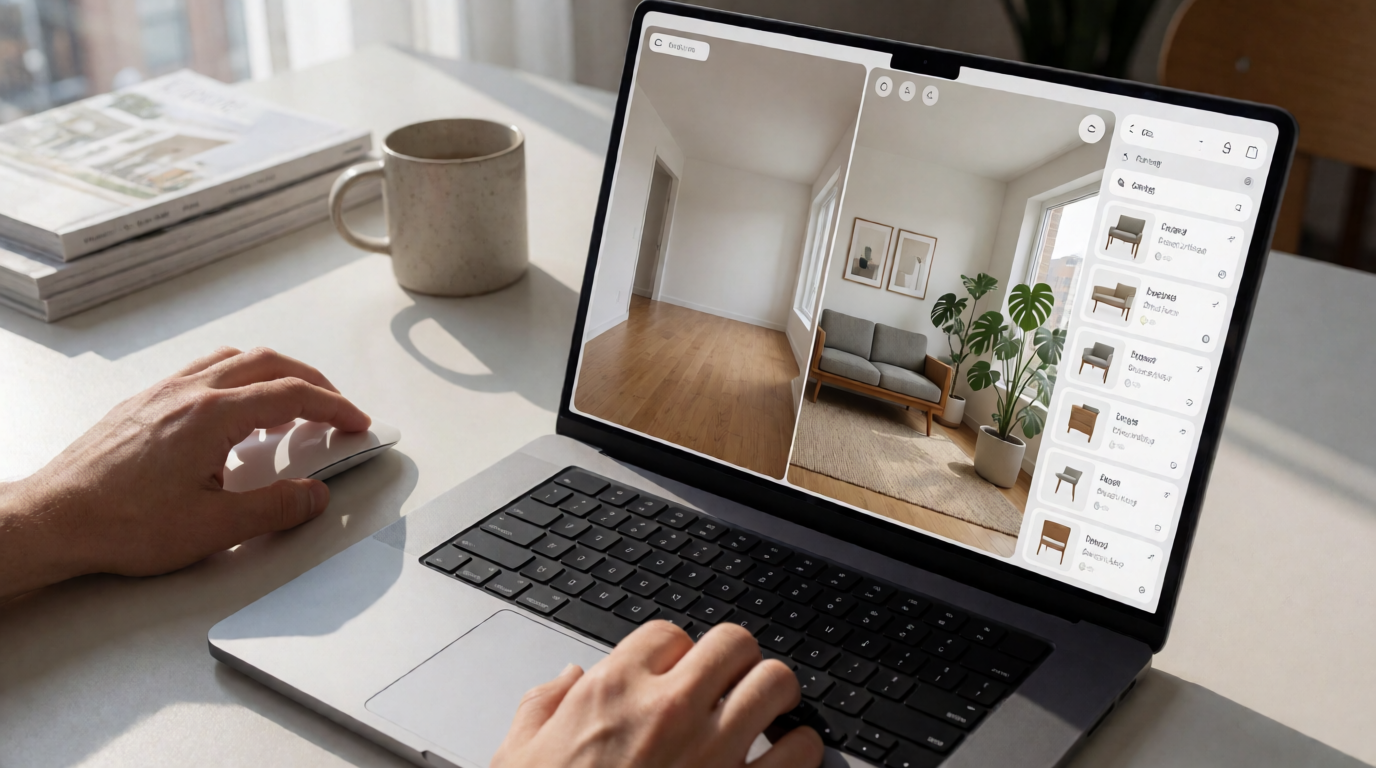


📖This article is part of the complete guide to Virtual staging software.
How to Choose the Best Virtual Staging Software for Beginners?
In the competitive 2026 real estate market, first impressions are everything. Listings with professional photos sell 32% faster and for up to 11% more, according to a recent National Association of Realtors survey. For the beginner agent, the barrier to entry used to be the high cost of physical furniture rentals or the steep learning curve of CAD software. However, the advent of specialized artificial intelligence has democratized high-end property presentation.
For a comprehensive overview of how these technologies integrate into a broader strategy, explore our The Ultimate Property Photo Editing Playbook for 2026.
💡
Key Takeaway
Modern virtual staging tools allow beginner agents to create stunning visualizations in seconds, with no prior technical knowledge or high investment, effectively removing the "empty room" psychological barrier for buyers.

What is Virtual Staging Software for Beginners?
📚
Definition
Virtual staging software for beginners is an AI-driven application designed to digitally insert furniture, decor, and architectural enhancements into photos of vacant properties without requiring professional graphic design skills.
Virtual staging software for beginners focuses on accessibility and speed. Unlike high-end architectural rendering, which requires a 3D model of the house, these tools use computer vision to analyze a 2D photograph, identify the floor plane, and place 3D assets with correct perspective and lighting. For the novice user, this means the software does the "heavy lifting" of calculating angles and shadows, allowing the agent to simply choose a style—such as "Modern," "Industrial," or "Scandinavian"—and let the AI populate the room.
In my experience working with hundreds of new real estate agents, the biggest struggle isn't the technology itself, but the fear of making the room look "fake." The key is using software that understands architectural proportions. When we built the core engine at RealVisionAI Blog - AI Real Estate Photography & Virtual Staging, we discovered that the most common failure point in beginner software was "floating furniture," where the AI fails to anchor the sofa or table to the floor. By implementing advanced depth-mapping, we ensured that every piece of furniture interacts naturally with the environment.
To understand how this fits into the wider ecosystem of image improvement, you might find our guide on What Is Property Photo Editing? Essential Techniques for Realtors useful.
Why Does Virtual Staging Matter for New Real Estate Agents?
Virtual staging is no longer a luxury; it is a fundamental tool for survival in a digital-first market. A 2025 Zillow Group study revealed that listings with virtual staging receive 187% more views than vacant ones. This is because buyers often lack the spatial imagination to understand how a room functions when it is empty.
The primary reasons why this technology is essential for beginners include:
- Dramatic Reduction in Overhead: Traditional physical staging can cost thousands of dollars per property. For a beginner agent with a limited budget, spending R$5,000 to stage a home that might not sell for months is a high-risk investment. AI alternatives reduce this cost by over 97%.
- Increased Buyer Engagement: According to research from the National Association of Realtors, over 80% of buyers find it easier to visualize a property's potential when it is staged. This leads to more clicks on the Multiple Listing Service (MLS) and more scheduled showings.
- Rapid Market Testing: Beginners can experiment with different demographics. If a property is in a college town, they can stage it as a modern student hub; if it is in a luxury district, they can switch to a sophisticated contemporary style in seconds.
- Competitive Parity: High-end agencies have used staging for years. AI allows a solo agent to produce the same visual quality as a global firm, leveling the playing field.
For more on how this impacts your bottom line, see the AI Real Estate Photography Pricing Guide 2026: Costs and ROI.
How Does Virtual Staging Software Compare to Other Methods?
When starting out, beginners often confuse virtual staging with 3D rendering or physical staging. It is important to understand the trade-offs in terms of cost, time, and authenticity.
| Feature | Traditional Physical Staging | Generic/Cheap AI Tools | RealVisionAI Blog - AI Real Estate Photography & Virtual Staging |
|---|---|---|---|
| Setup Time | 3–7 Days | 10–30 Minutes | 12 Seconds |
| Cost | Very High (Thousands) | Low (Subscription) | Very Low (Per Photo/Plan) |
| Realism | Perfect (It's real) | Moderate (Often looks "flat") | High (AI-driven lighting/shadows) |
| Flexibility | Low (Requires moving furniture) | Medium (Limited templates) | High (28+ Design Styles) |
| Risk | High (Furniture damage/theft) | Low (Digital only) | Low (Digital only) |
The "Generic AI" approach often fails because it uses static overlays that don't respect the lighting of the original photo. This creates a "collage" effect that savvy buyers can spot immediately, which can actually hurt a listing's credibility. A professional-grade tool, however, uses generative AI to blend the virtual furniture into the existing light source of the room.
If you are unsure if your property needs this level of intervention, check our guide on When to Use Property Photo Editing: A Professional Guide.

How to Implement Virtual Staging Step-by-Step for Beginners
Implementing virtual staging doesn't require a degree in interior design, but it does require a systematic approach to ensure the final result looks authentic.
Step 1: Capturing the Base Image
The AI is only as good as the data it receives. To get the best results, avoid shooting from a "standing" height. Instead, lower your camera to chest or waist level. This creates a more cinematic perspective and allows the AI to better calculate the floor area. Ensure the room is as clean as possible; while some tools offer decluttering, starting with a tidy space reduces AI hallucinations.
Step 2: Uploading and Scene Analysis
Once you upload your photo to a platform like RealVisionAI Blog - AI Real Estate Photography & Virtual Staging, the software performs a "spatial analysis." It identifies the walls, windows, and floor. As a beginner, always check if the software has correctly identified the "vanishing point" of the room. If the perspective looks skewed, re-crop the image or adjust the vertical lines.
Step 3: Selecting the Target Persona
Don't just pick furniture that you like. Pick furniture that the buyer likes.
- For first-time buyers: Use "Scandinavian" or "Modern Minimalist" styles. These feel fresh, clean, and accessible.
- For luxury buyers: Opt for "Contemporary Sophistication" with darker tones and velvet textures.
- For family homes: Use "Traditional" or "Cozy" styles with larger sofas and rugs.
Step 4: Refining Lighting and Shadows
This is where most beginners fail. For a photo to look real, the virtual furniture must cast a shadow in the same direction as the real furniture or window light. High-end software does this automatically, but you should always double-check the "contact shadows"—the dark area where a sofa leg meets the floor. If it's missing, the furniture will look like it is floating.
Step 5: Adding the Mandatory Disclaimer
To maintain ethical standards and comply with MLS regulations, always add a small text overlay or a caption stating: "Virtually staged for visualization purposes." This prevents any accusations of misleading the buyer regarding the actual contents of the home.
For those looking to master the technical side of image quality, our Step-by-Step Real Estate Photo Enhancement Guide for Agents provides deeper insights into lighting and resolution.
Best Practices for Maximum Conversion
To turn views into showings, you must apply a few psychological principles to your virtual staging.
The 60-30-10 Rule of Space
One of the biggest mistakes I see beginners make is over-furnishing. They try to show "everything that could fit," which makes the room feel cramped. Instead, follow the 60-30-10 rule: leave 60% of the floor space open, use 30% for primary furniture (sofa, bed), and 10% for accent pieces (lamps, plants).
Focus on the "Money Rooms"
You don't need to stage every closet and hallway. Focus your budget and effort on the living room, master bedroom, and kitchen. According to data from Realtor.com, these three rooms influence over 70% of a buyer's decision to book a tour.
Consistency Across the Listing
If the living room is "Ultra-Modern," the bedroom shouldn't be "Rustic Farmhouse." Keep a consistent design language throughout the property to create a cohesive "story" for the buyer.
💡
Key Takeaway
Virtual staging is about selling a lifestyle, not just filling a room. The goal is to evoke an emotion of "I can see myself living here."
If you're wondering how to integrate this into a full workflow, see How to Use Property Photo Editing for Stunning Real Estate Photos.
Common Beginner Mistakes and How to Fix Them
Even with AI, there are pitfalls that can make a listing look amateur.
1. Ignoring the "Scale" of Furniture
It is common for beginners to place a massive sectional sofa in a tiny apartment. This creates a subconscious feeling of claustrophobia for the buyer.
Solution: Use a reference object in the room (like a door frame or a window) to ensure the virtual furniture is proportional to the real architecture.
2. Conflicting Light Sources
If the sun is coming from a window on the left, but the virtual lamp on the right is the primary light source for the furniture, the brain registers something is "wrong."
Solution: Choose software that supports automatic light-source detection and alignment.
3. Over-Styling
Adding too many "decor" items—vases, books, candles—can distract from the actual architecture of the house.
Solution: Keep it minimal. The furniture should highlight the space, not hide it.
4. Neglecting the Exterior
Many beginners only stage the interior. However, "virtual landscaping" or staging a patio can be just as powerful. A small addition of a virtual outdoor dining set can make a backyard feel like an extension of the living space.
5. Low-Resolution Exports
Uploading a blurry, compressed image to the MLS kills the effect of professional staging.
Solution: Always export in high-resolution JPEG or PNG formats (minimum 1920x1080px).
For more tips on improving the overall look of your listing, explore our Complete Guide to AI Real Estate Photo Enhancement.
Implementation Guide: From Vacant to Market-Ready
If you are a beginner agent, here is a practical weekly workflow to integrate virtual staging into your business.
Day 1: The Shoot
Visit the property. Take wide-angle shots of every room. Ensure you have at least one shot from the furthest corner of the room to maximize the perceived space. Use a tripod to avoid motion blur.
Day 2: The AI Transformation
Upload your best 5-10 photos to RealVisionAI Blog - AI Real Estate Photography & Virtual Staging. Select a design style that matches the neighborhood's demographic. Review the shadows and proportions.
Day 3: The Listing Launch
Upload the staged photos to your MLS and social media. In your description, highlight the "potential" of the space. Use the staged photos as the primary "hook," but include the empty photos at the end of the gallery for transparency.
Day 4-7: Analysis
Track the number of clicks and inquiries. If the property isn't getting traction, use the flexibility of virtual staging to change the style (e.g., from "Modern" to "Traditional") and see if the engagement increases.
For those wondering about the costs associated with this workflow, our Property Photo Editing Guide: Values and Prices 2026 provides a full breakdown.
Frequently Asked Questions
What is the best virtual staging software for beginners in 2026?
For agents just starting out, the best software is one that balances power with simplicity. Look for platforms that offer a "one-click" staging experience rather than manual 3D placement. RealVisionAI Blog - AI Real Estate Photography & Virtual Staging is ideal for beginners because it processes images in 12 seconds and requires no design experience. Essential features should include a wide variety of styles, automatic perspective correction, and affordable per-photo pricing to minimize financial risk.
Is virtual staging considered a form of misrepresentation or fraud?
No, virtual staging is widely accepted in the industry as a visualization tool, provided it is handled ethically. It becomes misrepresentation only if you alter the permanent structure of the home—such as digitally removing a load-bearing wall or hiding a permanent stain on the floor. To stay safe, always include a clear disclaimer: "Virtually staged for visualization purposes." Most professional bodies and MLS guidelines support this practice as long as the room's actual dimensions are preserved.
How long does it take to learn how to use virtual staging software?
The learning curve depends entirely on the tool. With traditional 3D software, it can take months. With modern AI-driven tools like RealVisionAI, a beginner can produce their first professional listing in about 15 to 30 minutes. Most agents find that after 3 or 4 properties, they have mastered the "art" of choosing the right style and angle, allowing them to fully automate their visual marketing workflow.
Can virtual staging be used for rented properties or property management?
Absolutely. In property management, vacant units are a liability. Virtual staging allows managers to show potential tenants how a space can be utilized, which often leads to faster lease signings. It is particularly effective for "luxury rentals" where the tenant expects a certain aesthetic. Using virtual staging for rentals is often more cost-effective than physical staging because rental turnovers happen more frequently.
What is the difference between virtual staging and 3D rendering?
Virtual staging uses an actual photograph of a real room as the base and adds digital furniture to it. 3D rendering creates an entirely digital environment from a floor plan or blueprint, often before the house is even built. Staging is faster, significantly cheaper, and feels more authentic to the buyer because they can see the real walls, floors, and lighting of the actual property they are buying.
Conclusion
In 2026, the ability to visualize a space is the bridge between a "browsing" buyer and a "buying" buyer. Virtual staging software for beginners has removed the technical and financial barriers that once kept high-end marketing reserved for the elite agencies. By investing a few dollars per photo and a few seconds of your time, you can transform a cold, empty room into an inviting home that commands a higher price.
Whether you are staging a small studio or a sprawling estate, the goal remains the same: eliminate the buyer's doubt. When a buyer sees a perfectly placed sofa and a tastefully decorated bedroom, they stop wondering "will my furniture fit?" and start thinking "when can I move in?"
Ready to transform your listings instantly? Experience the power of "Market-Ready Visuals in 12 Seconds" at RealVisionAI Blog - AI Real Estate Photography & Virtual Staging.
For further learning, we recommend exploring our How to Choose Virtual Staging Software for Realtors to ensure you have the best tools for your specific market.
Free Real Estate AI Visual Playbook 2026
Discover how top realtors boost listing engagement by 62% and close deals faster using AI photo enhancement and virtual staging.