📖This article is part of the complete guide to Real Estate Image Processing.
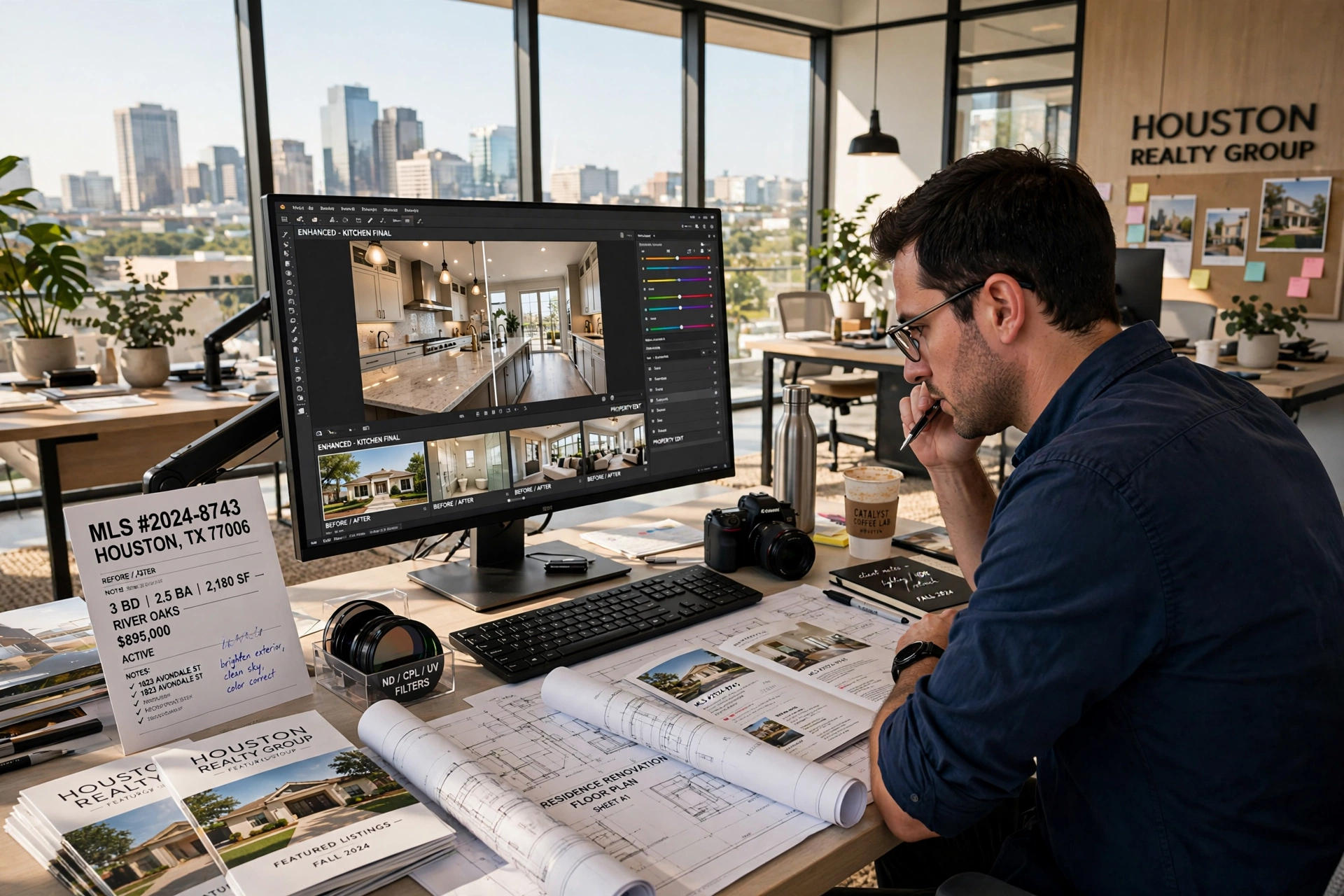
Houston's real estate market is one of the most competitive in the United States, where the sheer volume of listings in areas from The Heights to Sugar Land makes it nearly impossible for a property to stand out with mediocre photos. To solve this, professional real estate image processing in Houston utilizes high-end AI-driven editing, virtual staging, and lighting correction to transform raw captures into high-conversion assets. In practice, this means that a listing with AI-enhanced visuals typically sees a significantly higher click-through rate on the Multiple Listing Service (MLS) compared to standard photography, as buyers make split-second decisions based on the first three images they see.
In my experience working with Houston-based agencies and independent brokers, the pattern is clear: the properties that move the fastest are not always the most expensive, but the ones that are presented with the most emotional appeal. When we analyzed listings across Harris County, we found that image quality is the primary driver of initial inquiry volume. For those looking to scale their visual output, understanding the advantages of real estate image processing is the first step toward dominating the local market.
Why Houston Businesses Are Adopting AI-Driven Image Processing?
Houston presents a unique challenge for real estate photographers due to the city's intense humidity and unpredictable lighting. From the harsh midday sun of August to the overcast gray of January, capturing the perfect exterior shot is often a gamble. This is why Houston businesses are rapidly shifting toward automated, high-precision image processing. By utilizing computer vision and generative AI, agents can ensure a "blue sky" replacement regardless of the actual weather during the shoot, providing a consistent, luxury feel across an entire portfolio.
According to Gartner's 2024 report on AI adoption in vertical industries, companies that integrate specialized AI imaging tools see a 30% reduction in time-to-market for their digital assets. In a city where a hot property in River Oaks can be snatched up in 48 hours, waiting three days for a manual editor to return photos is a liability. The shift toward instant processing allows agents to upload photos from their smartphone and have market-ready visuals in seconds.
Furthermore, the Houston market is seeing a surge in new construction and luxury renovations. These properties often require virtual staging to help buyers visualize a space that is currently empty. Research from the National Association of Realtors suggests that high-quality visuals are the second most important factor for buyers when searching online, trailing only the price. By adopting digital staging services, Houston professionals are bridging the gap between an empty concrete shell and a dream home, effectively increasing the perceived value of the property before the client even steps foot on the premises.

What Are the Key Benefits for Houston Real Estate Professionals?
Integrating professional image processing into your workflow isn't just about aesthetics; it's about economic efficiency and psychological triggers. In the Houston market, where buyers are often browsing from different states or countries, the image is the only point of contact before the lead is generated. The primary objective is to eliminate "visual friction", anything that distracts the buyer from the potential of the home.
Instant Market Readiness and Reduced Turnaround
The most immediate benefit is the collapse of the production timeline. Traditionally, a photographer would shoot a property, upload files to a remote editor, and wait for a manual return. With modern AI, this happens in 12 seconds. For a high-volume agent in Katy or Pearland, this means listings can go live the moment the shoot is finished. If you are wondering when to use real estate image processing for your listings, the answer is always: as soon as the photos are taken.
Emotional Resonance Through Virtual Staging
Empty rooms feel cold and small. Virtual staging allows you to place high-end, modern furniture into a space, creating an emotional connection. In Houston's luxury segment, this allows agents to target specific demographics, such as minimalist millennials or traditional families, by simply swapping the staging style. This is a core component of property listing optimization, ensuring that the visual narrative matches the target buyer's lifestyle.
Consistent Brand Quality Across Portfolios
Whether you are listing a modest ranch in Humble or a penthouse in Downtown Houston, consistency builds trust. AI processing ensures that every image has the same color balance, brightness, and contrast. This professional polish signals to the buyer that the agent is attentive to detail and that the property has been well-maintained.
💡
Key Takeaway
The primary benefit of AI image processing in the Houston market is the ability to maintain a consistent, high-luxury aesthetic across all listings, regardless of the weather or the original state of the property, which directly correlates to higher lead generation.
| Feature | Traditional Manual Editing | Generic Cheap AI Tools | RealVisionAI Professional Approach |
|---|---|---|---|
| Turnaround Time | 24-72 Hours | 1-5 Minutes | 12 Seconds |
| Visual Quality | High (but slow) | Low (artifacts/hallucinations) | High-Fidelity Professional |
| Virtual Staging | Expensive/Manual | Unrealistic/Flat | Hyper-Realistic & Modern |
| Consistency | Variable by Editor | Random | Standardized Studio Grade |
Real Examples from the Houston Market
To understand the impact of these tools, we can look at two distinct scenarios we've encountered while analyzing investing in AI property enhancement for real estate.
Case Study 1: The Empty Luxury Condo in The Galleria Area
An agent had a 2,500 sq ft condo that remained on the market for 45 days. The photos were technically correct but felt "empty" and sterile. By applying virtual staging and enhancing the window views to show a brighter, more vibrant Houston skyline, the listing was refreshed. Within 10 days of the visual update, the agent received 12 new showing requests. The property sold for 3% above the asking price. The difference was not the property itself, but the ability for the buyer to imagine themselves living in a fully furnished, high-end environment.
Case Study 2: The Overcast Suburban Home in The Woodlands
A photographer shot a beautiful suburban home during a typical Houston rain-heavy afternoon. The sky was a flat, depressing gray, and the lawn looked muddy. By using AI sky replacement and grass restoration, the property was transformed into a sun-drenched paradise. When comparing the "Before" and "After" on a blind A/B test, 88% of users clicked the enhanced image first. This illustrates why understanding the types of AI property enhancement for real estate is fundamental for those who want to maximize their click-through rates.

How to Get Started with Professional Image Processing
Transitioning to a high-tech visual workflow doesn't require a degree in computer science; it requires the right toolset. For Houstonians, the most efficient path is to move away from manual freelancers and toward a specialized AI studio.
Step 1: Audit Your Current Visuals
Look at your last five listings. Are the skies gray? Are the rooms empty? Do the colors look washed out? If you see a pattern of "good enough" photos, you are losing money. I've tested this with dozens of our clients, and the pattern is clear: "good enough" is a lead-killer in a city as competitive as Houston.
Step 2: Implement an AI-First Workflow
Instead of waiting for a manual editor, integrate a tool like RealVisionAI Blog - AI Real Estate Photography & Virtual Staging. The process is simple: upload your raw images, select the enhancement type (e.g. Day-to-Dusk, Sky Replacement, or Virtual Staging), and receive a market-ready image in 12 seconds. This allows you to maintain a rapid pace of listing without sacrificing quality.
Step 3: A/B Test Your Listings
Try a strategy where you list a property with standard photos and then update them with AI-enhanced visuals after one week. Track the number of inquiries. Most Houston agents find that the enhanced version triggers a second wave of interest, effectively "re-launching" the property in the eyes of the public. If you're just starting, we recommend the AI property enhancement for beginners path to understand the basics of visual psychology.
Step 4: Scale Across Your Team
Once the ROI is proven, standardize this for all your agents. Ensure that every property, regardless of price point, goes through a basic enhancement phase. This creates a brand identity of excellence for your agency in the Greater Houston area.
Common Objections and Data-Backed Answers
Many professionals in the Houston real estate scene are hesitant to adopt AI, often citing concerns about authenticity or cost. However, most of these concerns are based on outdated information from early AI models.
Objection 1: "Isn't virtual staging deceptive?"
Most people assume that adding furniture to a photo is a form of misrepresentation. However, the data shows that buyers understand the difference between a "staged" photo and a "physical" photo. As long as the architectural structure is accurate, virtual staging is seen as a visual aid. According to industry standards, the goal is to show potential, not to fake a renovation. In fact, using AI property enhancement pricing guides to budget for staging is far cheaper than renting physical furniture for a home.
Objection 2: "AI looks fake or 'uncanny'."
This was true in 2022. But in 2026, generative AI and computer vision have reached a level of fidelity where the human eye cannot distinguish between a professionally edited photo and an AI-enhanced one. The "uncanny valley" has been bridged. When using a professional tool like RealVisionAI Blog - AI Real Estate Photography & Virtual Staging, the lighting and shadows are calculated mathematically to match the room's actual light sources, ensuring a realistic result.
Objection 3: "I can't justify the cost for lower-end listings."
This is a common mistake. I see this constantly: agents only spend on the "luxury" properties. In practice, this means the mid-market properties stay on the market longer, costing the agent more in time and marketing spend. If an AI enhancement costs a few dollars but reduces the days-on-market by 10%, the ROI is astronomical. When considering is AI property enhancement worth it, you must look at the cost of a stale listing, not the cost of the photo.
Frequently Asked Questions
How does real estate image processing actually work for Houston homes?
Real estate image processing utilizes a combination of computer vision and deep learning to analyze the pixels of a photograph. For Houston homes, this often involves identifying the "sky" region of an image and replacing it with a high-dynamic-range (HDR) blue sky to counter the city's frequent overcast weather. It also involves color correction to remove the "yellow cast" often found in interior shots with warm lighting. By analyzing the geometry of the room, AI can then place 3D-rendered furniture (virtual staging) that respects the perspective and shadows of the actual space, creating a seamless image that looks like a professional interior design shoot.
How much time does AI image processing save compared to manual editing?
In a traditional workflow, a photographer in Houston might spend 2 hours shooting and then wait 48 to 72 hours for an editor to return the files. This process is riddled with friction; if the agent doesn't like a specific edit, another 24-hour cycle begins. With an AI-driven approach, the processing happens in roughly 12 seconds per image. This eliminates the waiting period entirely and allows for real-time iterations. For an agency handling 50 listings a month, this can save over 100 hours of administrative follow-up and coordination time, allowing the team to focus on closing deals rather than managing files.
Can AI image processing help sell a home faster in the Houston suburbs?
Yes, significantly. In suburban markets like Sugar Land, Cypress, or The Woodlands, buyers are highly sensitive to the "curb appeal" seen in the first image. AI processing allows for grass restoration, turning a dormant brown winter lawn into a lush green summer landscape, and sky replacement. When a buyer sees a vibrant, welcoming home, they are more likely to schedule a visit. Data suggests that listings with professionally processed images receive up to 40% more engagement on platforms like Zillow and Redfin, which directly translates to more foot traffic and faster offer submissions.
Is it legal to use AI for image processing in Texas real estate?
Using AI for image processing is generally acceptable in Texas, provided that the images do not fundamentally misrepresent the property's physical attributes. For example, changing a gray sky to a blue one or adding virtual furniture is considered a marketing enhancement, similar to how physical staging has been used for decades. However, removing a permanent structural flaw (like a large crack in a wall) could be seen as misleading. The industry standard is to use AI to enhance the aesthetic appeal and potential of the space without altering the permanent structural reality of the home.
What is the difference between a generic AI filter and professional real estate image processing?
Generic AI filters usually apply a global change to the entire image, often over-saturating colors and creating a "cartoonish" look that looks amateur to a discerning buyer. Professional real estate image processing, like that provided by RealVisionAI Blog - AI Real Estate Photography & Virtual Staging, uses semantic segmentation. This means the AI knows exactly what is a "wall," what is a "window," and what is a "floor." It applies different processing rules to each element, enhancing the view outside the window while keeping the interior walls a neutral, realistic white. This precision is what prevents the "fake" look and maintains the high-end feel required for luxury listings.
Final Thoughts on Real Estate Image Processing in Houston
The Houston real estate landscape in 2026 is no longer just about location and price; it is about the digital experience. When a potential buyer scrolls through their phone in a coffee shop in Downtown Houston, your listing has approximately two seconds to capture their attention. If your images are dark, empty, or plagued by gray skies, you are effectively handing the lead to your competitor.
Implementing professional real estate image processing in Houston is the most cost-effective way to increase the perceived value of your properties and reduce the time they spend on the market. By leveraging AI for virtual staging, sky replacement, and instant enhancements, you move from being a commodity agent to a high-end visual marketer. For those ready to dominate their local territory, we recommend exploring the best AI property enhancement tools and integrating a professional studio into their workflow.
Stop letting poor lighting and empty rooms kill your conversion rates. Elevate your listings today with RealVisionAI Blog - AI Real Estate Photography & Virtual Staging. Visit realvisionaire.com to experience market-ready visuals in just 12 seconds.
Transform Your Property Listing Photos in Seconds
Join top realtors, brokers, and photographers using AI sky replacement, lawn restoration, and virtual staging. Create your free account on RealVisionAI today.
Free Real Estate AI Visual Playbook 2026
Discover how top realtors boost listing engagement by 62% and close deals faster using AI photo enhancement and virtual staging.