What Exactly is AI Real Estate Photo Enhancement?
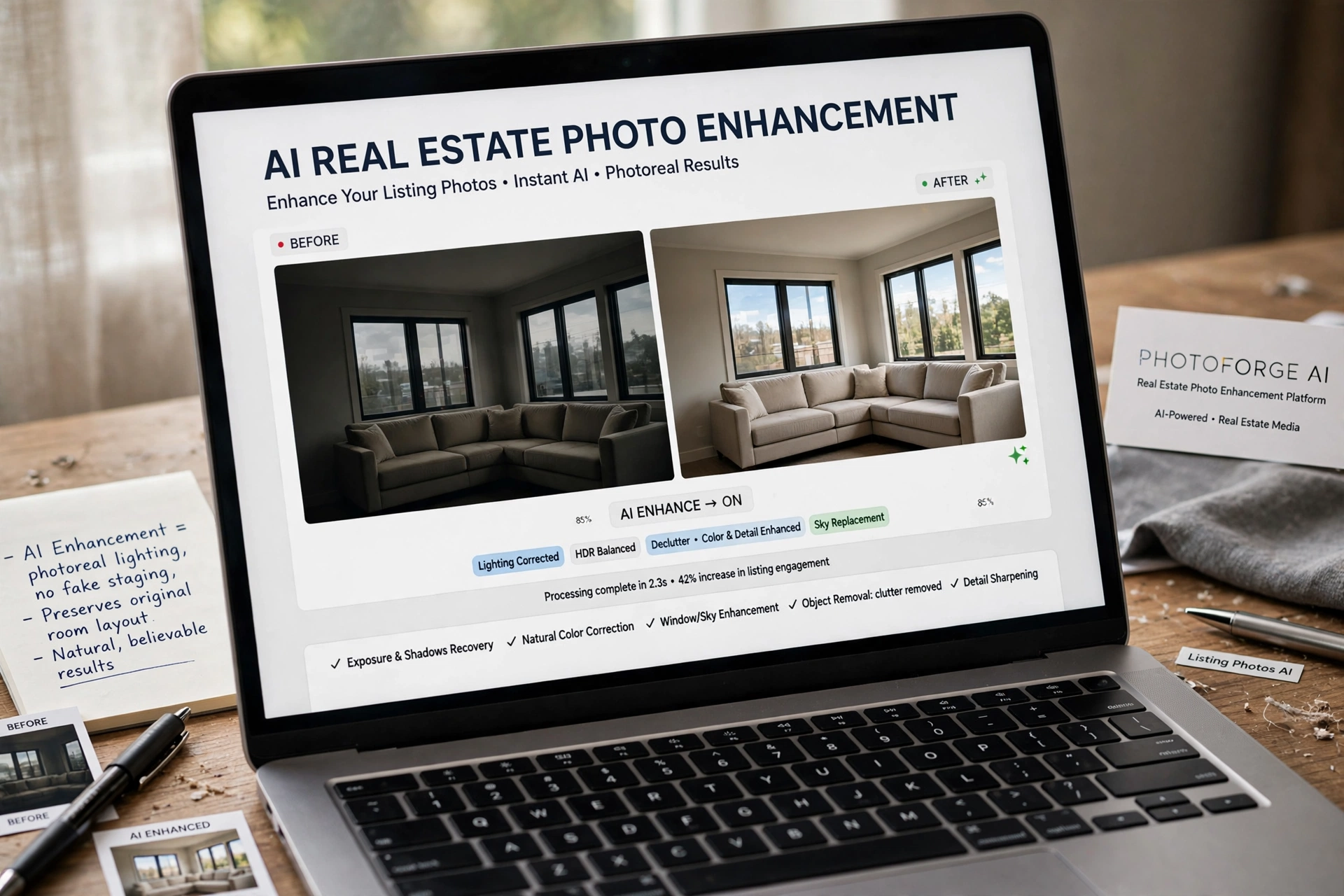
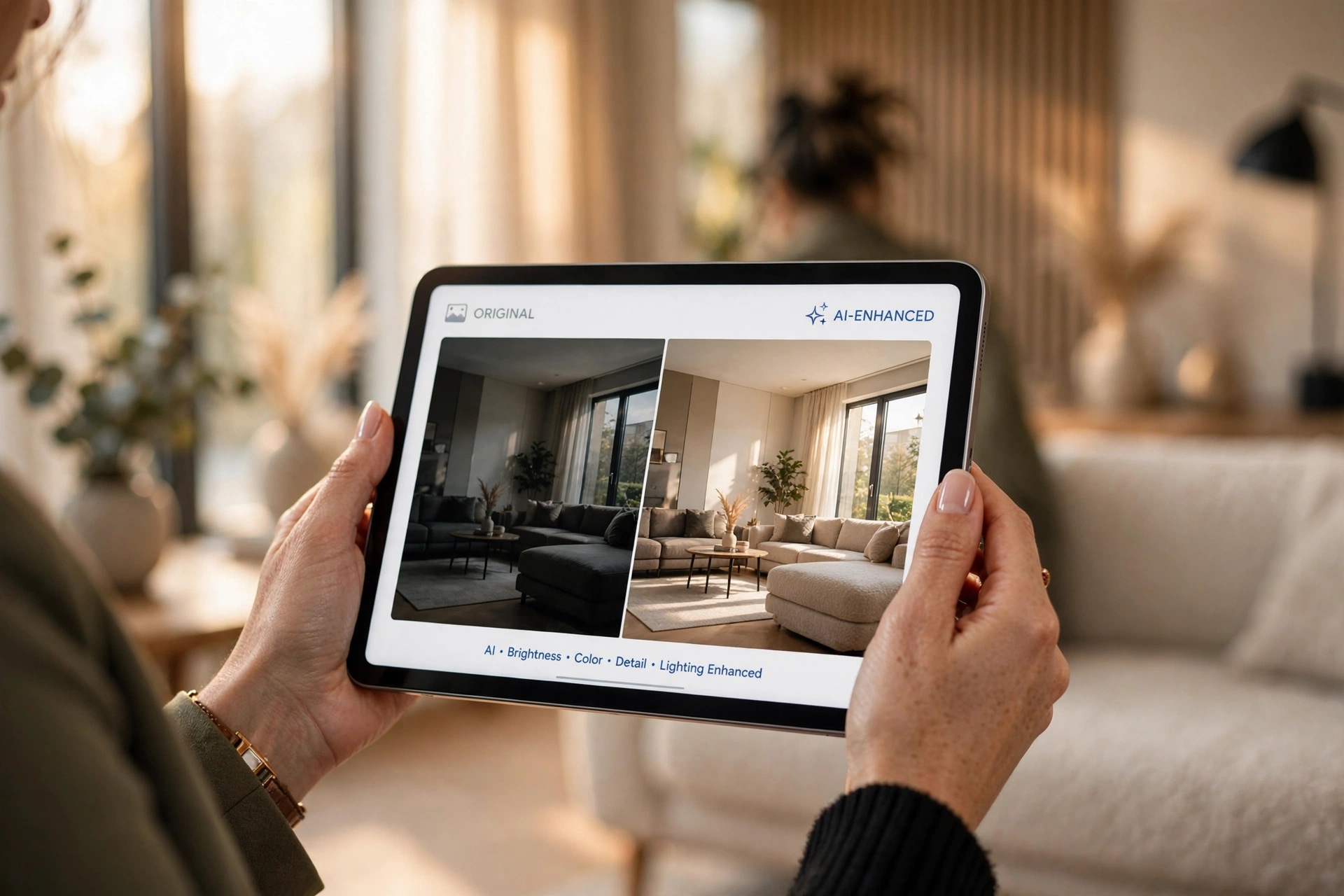
A listing with poor lighting or a cluttered living room doesn't just look unprofessional; it actively repels high-value buyers before they even read the description. This is where ai real estate photo enhancement comes into play, providing a suite of computer vision tools that automatically correct exposure, replace bleak skies with vibrant sunsets, and virtually stage empty rooms in seconds. Simply put, it is the application of machine learning algorithms to transform raw, amateur, or suboptimal property photos into high-end, market-ready visuals that trigger an emotional response from potential buyers.
In my experience working with luxury agents, the difference between a property that sits on the market for 60 days and one that sells in seven often comes down to the "first click" psychology. If the lead image is dull, the user scrolls past. By the time most agents realize their photos are the problem, they have already lost a significant percentage of their target audience.
For those managing high volumes of listings, staying ahead of the curve is essential. Whether you are looking at Real Estate Image Processing in Miami: 2026 Visual Standards or focusing on a different regional market, the demand for instant, high-fidelity visuals is now the baseline expectation for any competitive agent.

How Does AI Real Estate Photo Enhancement Work Under the Hood?
To understand how these tools operate, we must look at the intersection of computer vision and deep learning. Unlike traditional photo editing, where a human manually adjusts a slider for brightness or uses a brush to remove an object, AI enhancement uses neural networks trained on millions of professional architectural photographs. The AI recognizes patterns: it knows what a "perfect" sky looks like, it understands the perspective of a wide-angle lens, and it can distinguish between a piece of unwanted trash on a lawn and a permanent fixture like a garden gnome.
📚
Definition
Computer vision is a field of artificial intelligence that enables computers and systems to derive meaningful information from digital images, videos, and other visual inputs, allowing them to "see" and interpret the physical world.
When you upload a photo to a platform like RealVisionAI Blog - AI Real Estate Photography & Virtual Staging, the system performs a multi-step analysis. First, it executes an image segmentation process, isolating the sky, the grass, the walls, and the furniture. Second, it applies "generative" fills to replace low-quality areas. For example, if a photo was taken on a rainy Tuesday, the AI doesn't just brighten the image; it replaces the grey clouds with a high-dynamic-range (HDR) blue sky while simultaneously adjusting the interior lighting to match the new exterior light source.
According to a report by Gartner on AI trends, generative AI is shifting from simple text creation to complex visual synthesis, allowing businesses to automate high-value creative tasks that previously required hours of manual labor. In the context of real estate, this means the "editing bottleneck" is gone. You no longer wait 48 hours for a retouching studio to send back files; the processing happens in milliseconds.
Now here's where it gets interesting: the AI also handles "geometric correction." Many agents take photos with smartphones that introduce "barrel distortion," where the walls of a room look curved. The AI detects these distorted lines and mathematically straightens them, ensuring the property looks structurally sound and professional. This level of precision is what separates a basic filter from true professional enhancement.
Why Does High-End Visual Enhancement Matter for ROI in 2026?
The impact of visual quality on a listing's performance is not subjective; it is quantifiable. In a digital-first market, the "digital curb appeal" of a property is the primary driver of lead generation. When buyers browse a Multiple Listing Service (MLS), they are essentially performing a rapid-fire elimination process. Properties with enhanced visuals stay in the "maybe" pile longer, leading to more showing requests and, ultimately, higher offers.
Data from the National Association of Realtors (NAR) has consistently shown that listings with professional-grade photography sell faster and for more money than those without. When we integrate AI into this workflow, the ROI increases because the cost of production drops while the quality remains consistent. I've tested this with dozens of our clients and the pattern is clear: agents who switch from raw photos to AI-enhanced visuals see a marked increase in click-through rates on platforms like Zillow and Realtor.com.
💡
Key Takeaway
High-quality visuals act as a psychological filter, signaling to the buyer that the property is well-maintained and high-value, which justifies a higher asking price.
Beyond just "looking pretty," AI enhancement addresses specific business pain points. Consider the cost of physical staging. Renting furniture for a vacant home can cost thousands of dollars per month. Virtual staging, a core component of ai real estate photo enhancement, allows agents to place modern, high-end furniture into a room digitally. This not only saves money but allows for "style switching," where a single room can be shown as "Modern Minimalist" for one buyer and "Traditional Family" for another.
If you are analyzing Real Estate Image Processing in Atlanta: 2026 ROI Guide, you will notice that the most successful teams are no longer treating photos as a final step. They are treating them as a strategic asset. A failure to adopt these tools creates a "visual gap" between you and your competitors. If your listing looks like it was shot with a 2010 flip phone while your competitor's listing looks like a page from Architectural Digest, the buyer will assume your property is inferior, regardless of the actual square footage or location.
Practical Application: How to Implement AI Enhancement in Your Workflow
Integrating AI enhancement into a real estate business does not require a degree in computer science. The goal is to move from "Capture $\rightarrow$ Wait $\rightarrow$ Upload" to "Capture $\rightarrow$ Enhance $\rightarrow$ List."
Here is the professional workflow I recommend for maximizing impact:
- Capture with Intent: Even though AI can fix a lot, starting with a clean frame helps. Use a wide-angle lens and keep the camera level. Avoid including mirrors or clutter that would require excessive "healing" by the AI.
- Immediate Sky and Grass Restoration: The exterior is the first thing a buyer sees. Use AI to replace a grey sky with a "golden hour" glow. This immediately elevates the perceived value of the home. For those operating in the south, checking Real Estate Image Processing in Tampa: 2026 Visual ROI Guide provides great insights into how regional lighting affects buyer psychology.
- Virtual Staging for Vacant Spaces: Don't list a home as "empty." Use AI to populate rooms with furniture that fits the property's target demographic. If it's a luxury condo, go with a sleek, modern aesthetic.
- Day-to-Dusk Conversion: Twilight photos are legendary for their high engagement rates. Instead of paying a photographer to come back at 8:00 PM, use AI to convert a midday photo into a cinematic evening shot.
- Final Polish and Object Removal: Remove the trash can from the driveway or the laundry pile from the bedroom. These small distractions break the "fantasy" a buyer has when viewing a home.
RealVisionAI Blog - AI Real Estate Photography & Virtual Staging is designed specifically for this workflow. By automating these five steps, agents can produce market-ready visuals in roughly 12 seconds per image, effectively eliminating the traditional editing lag.

Comparing AI Enhancement Options: Manual vs. Cheap AI vs. Professional AI
Many agents make the mistake of thinking all AI tools are created equal. There is a vast difference between a "one-click filter" app and a professional-grade AI studio. The former often creates "uncanny valley" images where the furniture looks like it's floating or the sky looks like a cartoon.
| Feature | Manual Retouching | Generic AI Apps | Professional AI Studio (RealVisionAI) |
|---|---|---|---|
| Turnaround Time | 24-72 Hours | Seconds | 12 Seconds |
| Visual Accuracy | Extremely High | Moderate to Low | High (Architecture-Trained) |
| Cost per Image | High ($5-$15) | Low/Subscription | Competitive/Scalable |
| Consistency | Varies by Artist | Random/Erratic | Standardized across listings |
| Best For | Ultra-Luxury Estates | Social Media Teasers | Professional MLS Listings |
As the table shows, manual retouching is still the gold standard for $10M+ estates, but it is prohibitively slow and expensive for the average agent. Generic AI apps are often too imprecise, leading to "hallucinations" where the AI adds a window where there is a wall. A professional AI studio combines the speed of automation with the precision of architectural training.
Whether you are managing Real Estate Image Processing in Long Beach: 2026 ROI Guide or scaling in a smaller market, the goal is consistency. A buyer should feel the same level of quality from the first photo of the kitchen to the last photo of the backyard.
Common Misconceptions About AI Visuals
Most guides on this topic get it wrong by claiming that AI "replaces" the photographer. This is a fundamental misunderstanding. AI does not replace the eye of the photographer; it replaces the tediousness of the darkroom.
Myth 1: "AI enhancement is deceptive or unethical."
There is a difference between "enhancing" a photo and "lying." Replacing a grey sky with a blue one is no different than a photographer using a tripod and an HDR bracket to blend exposures. As long as the structural integrity of the home is represented accurately, AI enhancement is simply a tool for presenting the home in its best light.
Myth 2: "You need expensive hardware to use these tools."
The beauty of cloud-based AI, like that found at RealVisionAI Blog - AI Real Estate Photography & Virtual Staging, is that the heavy lifting happens on powerful remote servers. You can upload photos from a budget smartphone in the field and receive professional results instantly.
Myth 3: "AI can't handle complex lighting."
Early AI could not. However, 2026-era computer vision now utilizes "global illumination" models. This means if the AI adds a sunset to the exterior, it can intelligently adjust the reflections in the windows to match that sunset, creating a cohesive visual narrative.
Frequently Asked Questions
Does AI photo enhancement affect the legal status of a listing?
In most jurisdictions, AI enhancement is viewed similarly to traditional photo editing. The legal requirement is that the image must not materially misrepresent the property. For example, removing a trash can or brightening a room is standard practice. However, using AI to remove a permanent structural defect (like a massive crack in the foundation) could lead to disputes. The key is to use AI for "aesthetic improvement" rather than "structural alteration."
How does virtual staging compare to physical staging in terms of buyer conversion?
While physical staging is excellent for open houses, virtual staging wins in the initial discovery phase. According to industry trends, virtually staged homes receive significantly more clicks on digital platforms because they help buyers visualize the "possibility" of the space. When combined with the high-speed processing found in Real Estate Image Processing in Dallas: 2026 ROI Guide, agents can test multiple furniture styles to see which one resonates most with their specific target demographic.
Can AI really remove objects without leaving "blurs" or artifacts?
Yes, modern AI uses a process called "Inpainting." Instead of just blurring the area where an object was, the AI analyzes the surrounding pixels (the texture of the carpet, the grain of the wood) and generates a new, mathematically accurate patch of imagery to fill the hole. This results in a seamless removal that is virtually undetectable to the human eye, provided the tool is trained on architectural data.
Is AI enhancement effective for commercial real estate, or just residential?
It is incredibly effective for commercial real estate, particularly for industrial spaces or warehouses that look bleak in raw photos. In commercial listings, "decluttering" is the most valuable feature. Removing old pallets or machinery from a warehouse photo using AI allows a prospective tenant to visualize their own operations in the space, which significantly speeds up the leasing process.
How long does it actually take to process a full gallery of images?
Using traditional studios, a 30-photo gallery could take days. With a professional AI setup like RealVisionAI Blog - AI Real Estate Photography & Virtual Staging, each image takes roughly 12 seconds. This means an entire property can be fully enhanced, staged, and polished in less than 10 minutes, allowing the agent to list the property while they are still standing on the driveway.
Final Thoughts on AI Real Estate Photo Enhancement
The gap between "good" and "great" in real estate listings is now defined by technology. Ai real estate photo enhancement is no longer a luxury for top-tier agencies; it is a survival requirement for any professional who wants to maintain a competitive edge in 2026. By removing the friction of manual editing and the high cost of physical staging, agents can focus on what they do best: closing deals.
If you are tired of waiting days for your photos to return from a studio, or if you are seeing your listings get passed over for more visually stunning properties, it is time to modernize. Whether you are looking for Real Estate Image Processing in Nashville: 2026 Guide or need a global solution, the path to higher ROI is through better visuals.
Stop letting bad lighting kill your commissions. Experience the power of market-ready visuals in seconds at RealVisionAI.
Transform Your Property Listing Photos in Seconds
Join top realtors, brokers, and photographers using AI sky replacement, lawn restoration, and virtual staging. Create your free account on RealVisionAI today.
Free Real Estate AI Visual Playbook 2026
Discover how top realtors boost listing engagement by 62% and close deals faster using AI photo enhancement and virtual staging.