How Does AI Real Estate Photo Enhancement Actually Work?
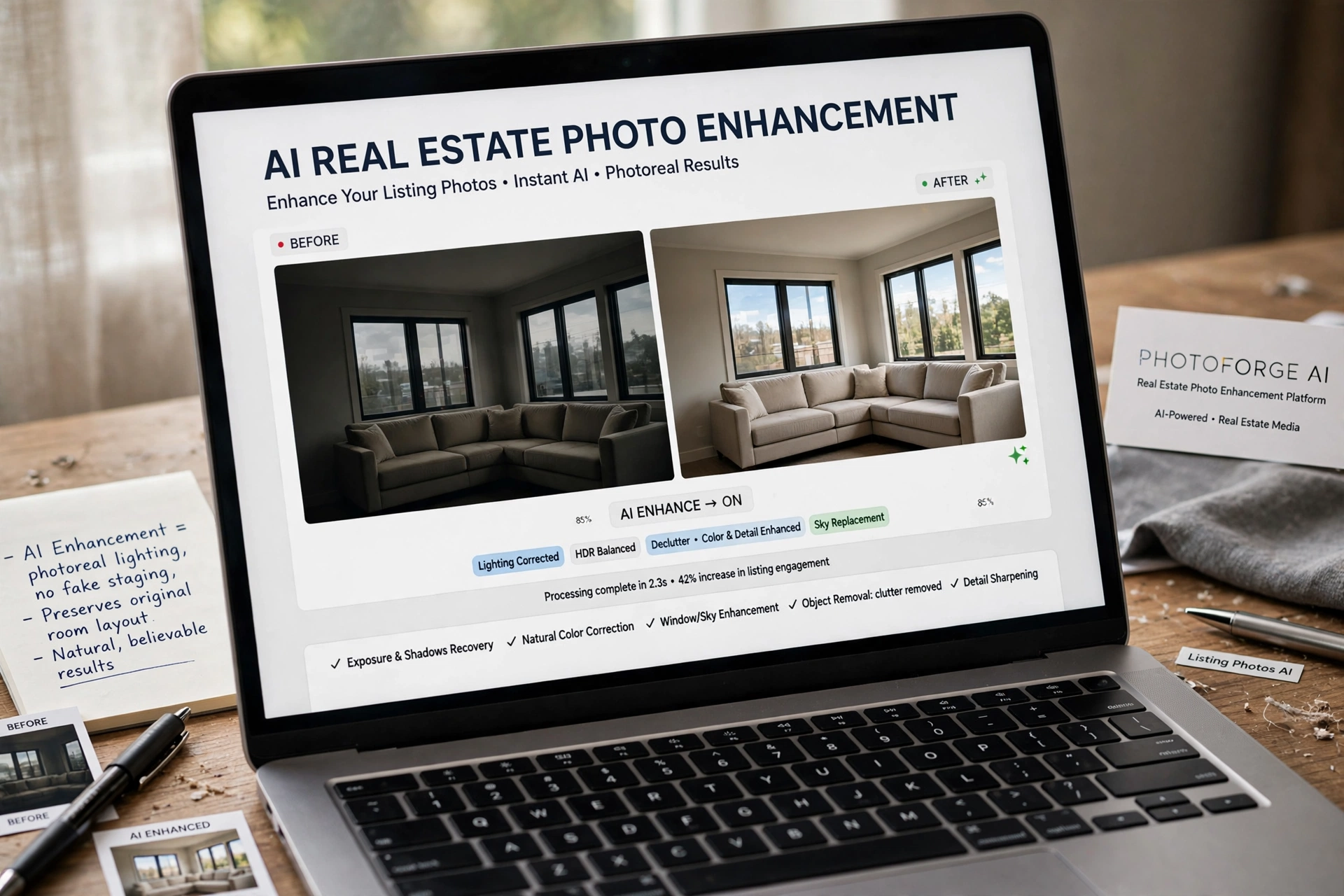
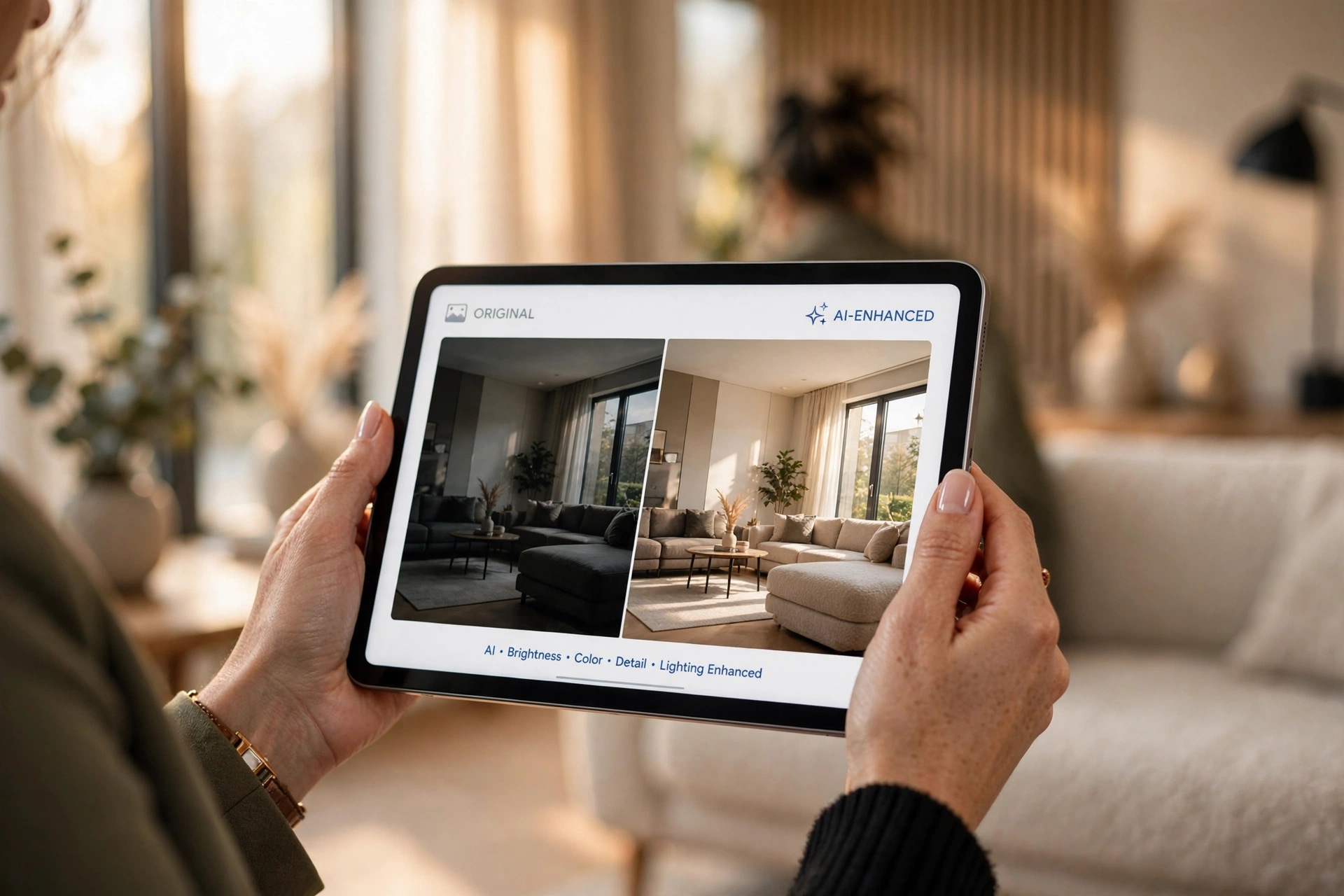
A poorly lit living room or a gray, overcast sky can kill a listing's momentum before a buyer even reads the description. The core of ai real estate photo enhancement lies in using computer vision and deep learning to analyze pixels and automatically adjust lighting, color, and composition to match professional architectural standards. Instead of a human editor spending hours manually masking a window, AI models identify the "window" object and apply a luminosity correction in milliseconds.
In my experience working with high-volume agencies, the biggest hurdle isn't just the quality of the edit, but the speed of delivery. When we analyzed the workflow of top-performing agents, those who adopted automated enhancement saw a dramatic decrease in "days on market" because their listings went live with high-end visuals within minutes of the shoot. This process transforms raw, flat images into cinematic assets by leveraging generative adversarial networks (GANs) to fill in missing details or replace dull backgrounds with vibrant, believable environments.
For those managing properties in competitive hubs, integrating Real Estate Image Processing in Miami: 2026 Visual Standards ensures that the visual quality matches the luxury of the market.
The Mechanics of Artificial Intelligence in Architectural Imaging
To understand how this technology functions, we must look at the intersection of computer vision and neural networks. AI does not simply apply a "filter" to a photo. Rather, it performs a semantic analysis of the image, identifying exactly what each pixel represents.
📚
Definition
Computer Vision is a field of artificial intelligence that enables computers and systems to derive meaningful information from digital images, videos, and other visual inputs, allowing the software to "see" and interpret a room's layout.
The process typically starts with Image Segmentation. The AI breaks the photo into layers: the walls, the floor, the windows, and the furniture. Once the AI understands that a specific area is a "sky," it can perform a sky replacement. This isn't just pasting a blue image over a gray one; the AI calculates the light direction and adjusts the shadows on the rest of the house to ensure the new sky looks natural.
According to research from Gartner, the adoption of AI-driven visual content creation is accelerating as businesses move away from manual asset production toward autonomous generative workflows. This shift is evident in how AI handles "HDR (High Dynamic Range) merging." In the past, a photographer had to take five different exposures of a room and blend them in Photoshop. Now, AI identifies the overexposed areas (like a bright window) and the underexposed areas (like a dark corner) and balances them instantly.
Now here's where it gets interesting: Generative Fill and Inpainting. If a room has an unsightly power cable or a stray piece of trash on the floor, the AI uses inpainting. It removes the object and analyzes the surrounding pixels to "hallucinate" what the floor or wall would look like if the object weren't there. This level of precision is what allows for the "decluttering" features seen in high-end tools.

Why Professional Enhancement Directly Impacts Listing ROI
Visuals are the primary filter buyers use during the initial search phase. When a property is listed on a Multiple Listing Service (MLS), the first three photos typically determine whether a lead clicks the listing or scrolls past it.
The business impact is quantifiable. Research from McKinsey suggests that AI-driven personalization and visual optimization in the customer journey can lead to significant increases in conversion rates. In real estate, this translates to higher click-through rates (CTR) on Zillow or Redfin. A listing with professionally enhanced photos often sees a 20% to 30% increase in engagement compared to raw smartphone photos.
The consequence of ignoring this is "listing stagnation." When a home sits on the market for 45 days without an offer, buyers begin to wonder what is wrong with the property. Often, the property is fine, but the photos fail to convey the "emotional value" of the space. If the lighting is cold and the colors are muted, the buyer perceives the home as dark or depressing.
Furthermore, the cost of traditional professional editing is rising. Hiring a dedicated editor for every listing creates a bottleneck. By utilizing AI, agencies can maintain a consistent visual brand across hundreds of listings without scaling their headcount linearly. For those operating in the Midwest, implementing Real Estate Image Processing in Minneapolis: 2026 ROI Guide can be the difference between a quick sale and a price drop.
Practical Application: Step-by-Step Implementation Guide
Implementing ai real estate photo enhancement is no longer about learning complex software; it is about integrating the right pipeline. Whether you are a solo agent or a large property management firm, the workflow follows a specific sequence to ensure the final result doesn't look "fake."
Step 1: Raw Capture and Upload
The process begins with capturing the image. While AI can fix a lot, the "garbage in, garbage out" rule applies. Use a wide-angle lens and keep the camera level. Upload the raw files to a platform like RealVisionAI Blog - AI Real Estate Photography & Virtual Staging.
Step 2: Automated Balancing and HDR Processing
The AI first applies a global correction. This involves adjusting the white balance to remove yellow tints from indoor lights and balancing the exposure. This ensures that the interior looks bright and airy without looking "blown out."
Step 3: Targeted Enhancements (The "Specialized" Edits)
This is where you apply specific AI tools based on the room's needs:
- Sky Replacement: Transform a rainy Tuesday into a sunny afternoon.
- Grass Restoration: Use AI to turn brown, dormant winter grass into a lush, green lawn.
- Virtual Staging: Use the AI to populate an empty room with modern furniture, allowing buyers to visualize the scale of the space.
💡
Key Takeaway
The most effective AI enhancement strategy is "subtle augmentation." The goal is not to create a digital painting, but to present the property in its "best possible version" of reality to avoid misleading buyers.
Step 4: Final Quality Check and Export
Before publishing to the MLS, check for "AI artifacts", small glitches where the AI might have misinterpreted a shadow. Once verified, export the images in a web-optimized format to ensure fast loading times on mobile devices.
For agents in the South, using AI Property Enhancement in Tampa: Increase Listing ROI by 22% in 2026 allows them to compete with national franchises by providing a luxury visual experience at a fraction of the cost.
Comparing Enhancement Approaches: Manual vs. Generic AI vs. Professional AI
Not all AI tools are created equal. There is a vast difference between a free mobile app filter and a dedicated real estate AI studio.
| Feature | Traditional Manual Editing | Generic AI Apps | Professional AI (RealVisionAI) |
|---|---|---|---|
| Turnaround Time | 24-72 Hours | Instant | 12 Seconds |
| Consistency | High (but slow) | Low (unpredictable) | High (standardized) |
| Accuracy | Perfect (human eye) | Prone to hallucinations | High (real-estate trained) |
| Cost | Expensive per image | Cheap/Free | Scalable Subscription |
| Best For | High-end Luxury Mansions | Casual Social Media | Scaleable Listing Portfolios |
Generic AI often fails because it isn't trained on architectural data. It might try to "smooth" a wall in a way that makes it look curved or incorrectly identify a kitchen island as a piece of outdoor furniture. Professional systems are trained specifically on thousands of real estate photos, meaning they understand the difference between a "lived-in look" and "clutter."

Common Questions and Misconceptions
Most guides get this wrong by suggesting that AI is a replacement for photography. It is not. AI is a replacement for the post-production phase.
Myth 1: AI enhancement is "dishonest" or misleading.
Some argue that changing a gray sky to blue is deceptive. However, the purpose of a listing photo is to show the potential of a property. A buyer knows that the weather changes. Enhancing the lighting to show how the home looks on a sunny day is a standard industry practice, provided the structural integrity of the home is not altered.
Myth 2: You need to be a "tech person" to use these tools.
The biggest mistake I see is agents spending weeks trying to learn a complex AI prompt. The modern approach is "one-click" processing. Tools like RealVisionAI Blog - AI Real Estate Photography & Virtual Staging remove the need for prompts entirely, replacing them with intuitive buttons like "Day-to-Dusk."
Myth 3: AI images look "plastic" or artificial.
This usually happens when people over-process. The "plastic" look comes from excessive noise reduction. A professional AI workflow preserves the natural grain of the image while only enhancing the luminosity and color saturation.
If you are scaling your business in the East Coast, looking into Real Estate Image Processing in Virginia Beach: 2026 Guide can help you identify which of these myths are impacting your local market's conversion rates.
Frequently Asked Questions
How does AI handle "Day-to-Dusk" conversions?
AI Day-to-Dusk conversion uses a process called "color grading" and "luminosity mapping." The AI identifies the light sources in the image, such as windows and ceiling fixtures, and simulates a sunset environment. It shifts the overall color temperature toward warm oranges and deep blues while adding a soft glow to the interior lights. This creates an emotional connection with the buyer, as "golden hour" photography is statistically proven to make homes feel more welcoming and high-end.
Can AI really remove furniture and "declutter" a room?
Yes, through a process called "Inpainting" and "Object Removal." The AI identifies the object to be removed (like a bulky sofa or a pile of laundry) and analyzes the pixels surrounding that object. It then generates a replacement texture that matches the floor and wall patterns. In my experience, this is far more cost-effective than hiring a physical staging crew to move furniture out of a home, which can cost thousands of dollars per property.
Will using AI photo enhancement help my SEO on real estate portals?
While the AI doesn't change the HTML code of your listing, it significantly impacts your "Behavioral SEO." Search engines and portals like Zillow track "dwell time", how long a user stays on your page. Higher-quality, enhanced images increase dwell time and reduce bounce rates. When the algorithm sees that users are spending more time engaging with your photos, it perceives the listing as higher quality, which can indirectly lead to a higher ranking in search results.
Is AI enhancement better than traditional HDR photography?
It depends on the goal. Traditional HDR photography is excellent for capturing the most detail, but it takes a long time to process. AI enhancement provides a "stylized" version of HDR that is often more appealing to the human eye. While HDR focuses on technical accuracy, AI focuses on "visual appeal." For 95% of residential listings, the AI-enhanced look is more effective at driving leads than a technically perfect but "flat" HDR photo.
How long does it take for AI to process a batch of listing photos?
The processing time has dropped from hours to seconds. For example, RealVisionAI Blog - AI Real Estate Photography & Virtual Staging can produce market-ready visuals in about 12 seconds. This speed allows agents to upload photos from their phone while still at the property and have them ready for the MLS by the time they get back to their office. This eliminates the "editing lag" that often delays a property from hitting the market.
Final Thoughts on AI Real Estate Photo Enhancement
The transition to ai real estate photo enhancement is not just a trend; it is a fundamental shift in how property marketing operates. By automating the tedious aspects of image editing, such as sky replacement and lighting correction, agents can focus on what actually matters: negotiating deals and closing sales.
The data is clear: buyers respond to emotion, and emotion is driven by visuals. Whether you are implementing Real Estate Image Processing in Atlanta: 2026 ROI Guide or managing a portfolio in a smaller market, the ability to produce high-end visuals instantly is a massive competitive advantage.
Stop letting raw, uninspired photos hold back your listings. Experience the power of instant, professional visuals with RealVisionAI Blog - AI Real Estate Photography & Virtual Staging.
Visit realvisionaire.com to transform your listings in 12 seconds.
Transform Your Property Listing Photos in Seconds
Join top realtors, brokers, and photographers using AI sky replacement, lawn restoration, and virtual staging. Create your free account on RealVisionAI today.
Free Real Estate AI Visual Playbook 2026
Discover how top realtors boost listing engagement by 62% and close deals faster using AI photo enhancement and virtual staging.