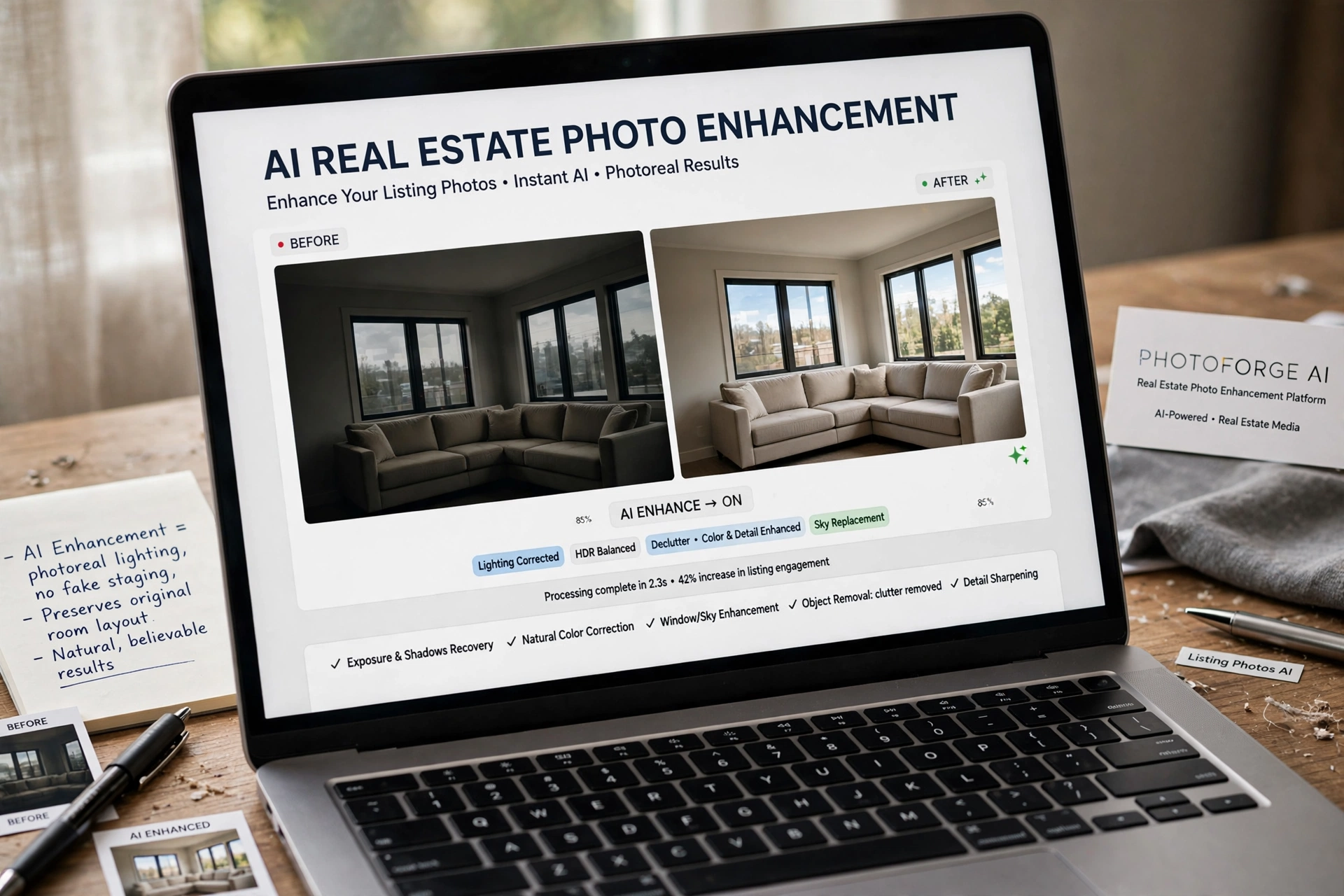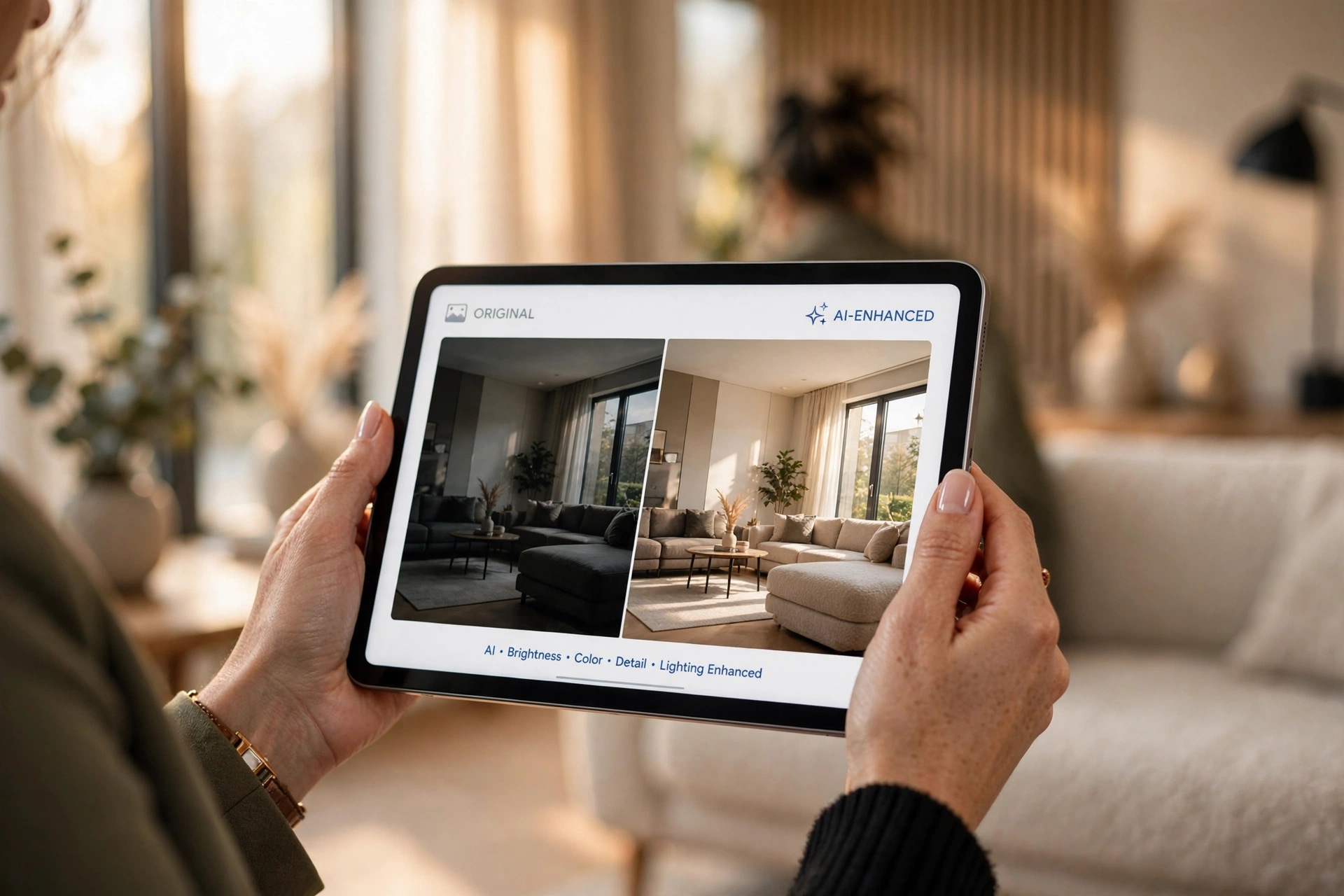


What Exactly Is AI Real Estate Photo Enhancement?
High-resolution imagery is no longer a luxury in property listings; it is the primary filter through which buyers decide whether to book a viewing. AI real estate photo enhancement is the process of using computer vision and generative artificial intelligence to automatically correct, optimize, and transform property images into market-ready visuals. This technology goes far beyond simple brightness adjustments, employing deep learning to recognize architectural elements and apply specific corrections like sky replacement, vertical alignment, and virtual staging in a fraction of the time required by manual editing.
In my experience working with high-volume property managers, the biggest bottleneck is never the photography itself, but the post-production lag. Traditional editing creates a gap of days between the shoot and the listing, during which market momentum is lost. By integrating AI property enhancement in Tampa, agents are now seeing listings go live within minutes of the shoot, significantly increasing their competitive edge.

How Does AI Real Estate Photo Enhancement Work?
To understand how this technology functions, we must look at the intersection of computer vision and generative AI. Unlike a standard filter that applies a uniform change to every pixel, AI enhancement analyzes the semantic content of an image. It identifies what is a "wall," what is a "window," and what is "grass." Once the AI understands the geometry of the room, it can apply targeted adjustments. For example, it can perform "window pulling," where it balances the extreme brightness of an outdoor view with the interior lighting of a room, preventing the common "blown-out" white window effect.
📚
Definition
Computer Vision is a field of artificial intelligence that enables computers and systems to derive meaningful information from digital images, videos, and other visual inputs, allowing them to "see" and interpret the physical world.
The process typically involves several layers of processing. First, the AI corrects the perspective and lens distortion, ensuring that vertical lines are perfectly straight. Then, it applies color correction to remove unnatural yellow or blue tints caused by mixed lighting sources. Finally, it utilizes generative fills to remove distracting objects or "virtually stage" an empty room with high-end furniture.
According to research from Gartner, the adoption of AI in creative workflows has transitioned from experimental to essential, with generative AI specifically reducing production cycles by up to 60% in visual industries. In the real estate sector, this means the difference between a listing that sits for 30 days and one that generates a bidding war in 48 hours. When we analyze the impact on real estate image processing in Miami, the ability to instantly swap a grey sky for a vibrant sunset is often the catalyst for higher click-through rates on the Multiple Listing Service (MLS).
Why Does AI Enhancement Matter for ROI?
The business implication of visual quality is quantifiable. Buyers make an emotional decision within the first three seconds of viewing a listing photo. If the images look dark, cluttered, or dated, the buyer subconsciously assigns a lower value to the property. AI real estate photo enhancement removes these psychological barriers by presenting the property in its "best possible version" without misrepresenting the actual space.
Data from the National Association of Realtors indicates that listings with high-quality, professional photography receive significantly more inquiries and often sell faster than those with amateur shots. When you apply AI-driven enhancements, you are not just "cleaning up" a photo; you are optimizing a conversion funnel. A property that looks clean, bright, and well-staged attracts a higher tier of buyer, which directly correlates to a higher final sale price.
Now, here's where it gets interesting: the cost of inaction is higher than the cost of the software. Agents who rely on manual editing often pay per image, which becomes prohibitively expensive for large portfolios. Conversely, those using AI-driven studios can process hundreds of images for a fraction of the cost. According to McKinsey's analysis of AI integration in professional services, companies that pivot to AI-augmented workflows see an average productivity increase of 40% in content generation. For a real estate agent, this translates to more time spent closing deals and less time managing freelancers.
The risk of ignoring these trends is evident in markets like real estate image processing in Atlanta, where the volume of listings is so high that mediocre photos are simply scrolled past. If your visuals don't meet the 2026 digital standard, you are effectively invisible to the modern buyer.
Practical Application: implementing AI Enhancement in Your Workflow
Implementing AI enhancement isn't about replacing the photographer; it's about augmenting the output. The most effective workflow combines a professional shoot with a high-speed AI post-production engine. The mistake I made early on, and that I see constantly with new agents, is trying to use "all-in-one" free apps that compress image quality and leave artifacts, making the property look fake or "plastic."
To get professional results, follow this structural approach:
- The Capture Phase: Use a wide-angle lens and ensure the room is as tidy as possible. Even the best AI can struggle if the room is completely overwhelmed by trash or extreme clutter.
- The AI Processing Phase: Upload the raw images to a specialized studio like RealVisionAI Blog - AI Real Estate Photography & Virtual Staging. Here, the AI handles the "heavy lifting":
- Sky Replacement: Swapping a rainy grey sky for a "golden hour" glow.
- Grass Restoration: Turning patchy brown lawns into lush, green carpets.
- Day-to-Dusk Conversion: Transforming a midday shot into a cinematic twilight image, which typically generates 3x more engagement on social media.
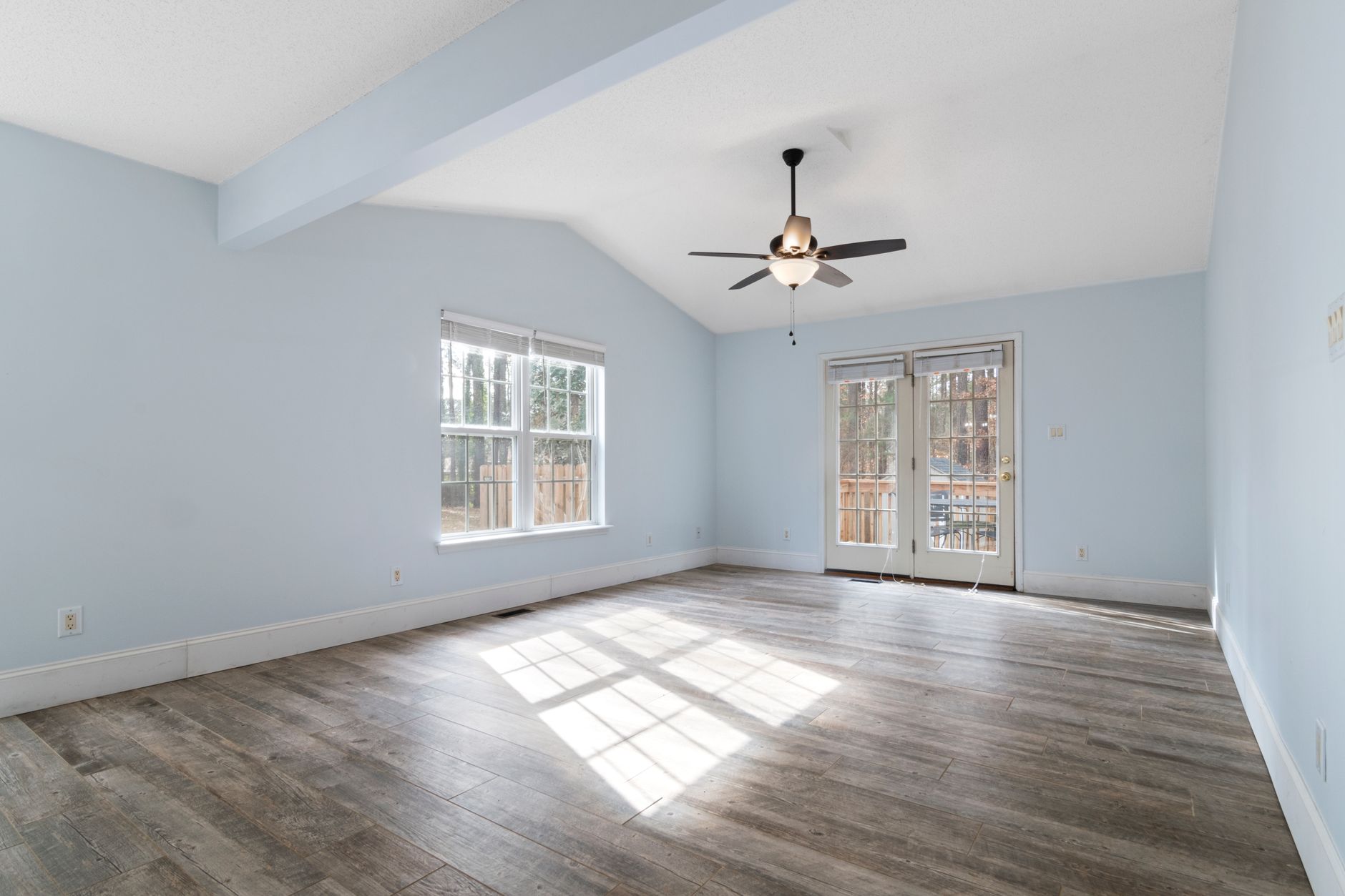
- The Staging Phase: Use virtual staging to fill empty rooms. Instead of renting physical furniture, AI can place modern, minimalist, or traditional furniture into the space with perfect perspective and lighting.
- The Distribution Phase: Export the images in optimized formats for the MLS and social media to ensure fast loading times without sacrificing clarity.
💡
Key Takeaway
The goal of AI enhancement is "perceived value." By removing distractions and optimizing light, you shift the buyer's focus from the flaws of the photo to the potential of the property.
For those operating in high-growth markets, such as real estate image processing in Long Beach, the speed of this workflow is the primary advantage. Being able to upload photos and receive market-ready visuals in 12 seconds allows an agent to list a property before they've even left the driveway of the home they just photographed.
Comparison: Traditional Editing vs. Cheap AI vs. Professional AI
Not all "AI" is created equal. There is a massive gap between a free mobile app that applies a "brighten" filter and a professional AI studio designed for the real estate industry.
| Feature | Traditional Manual Editing | Generic/Cheap AI Apps | Professional AI (RealVisionAI) |
|---|---|---|---|
| Turnaround Time | 24 to 72 hours | Instant | 12 to 30 seconds |
| Accuracy | High (Human Eye) | Low (Frequent Halucinations) | High (Trained on Architecture) |
| Cost | High (Per Image Fee) | Low/Subscription | Scalable/Efficient |
| Consistency | Variable by Editor | Inconsistent | Uniform Across Listings |
| Specialized Tools | Manual Masking | Basic Filters | Day-to-Dusk, Virtual Staging |
| Best For | Ultra-Luxury (1% Listings) | Casual Social Media Posts | High-Volume Professional Listings |
As the table shows, the "Generic AI" approach often fails because it doesn't understand the rules of architecture. It might accidentally "erase" a structural column or warp a window frame, which looks unprofessional to a discerning buyer. Professional AI, like that used by RealVisionAI Blog - AI Real Estate Photography & Virtual Staging, is trained specifically on architectural datasets to ensure that the structural integrity of the home is preserved while the aesthetic is enhanced.
Common Questions and Misconceptions
There is a lot of misinformation regarding AI in the real estate space. Most guides get this wrong by suggesting that AI is just a way to "fake" a property. That is a fundamental misunderstanding of the technology.
Myth 1: AI enhancement is "dishonest" or misleading.
Correction: There is a difference between "enhancing" and "altering." Enhancing a photo means removing the atmospheric interference (like a cloudy day or a dim room) to show the property's actual potential. As long as you aren't removing a permanent wall or adding a bedroom that doesn't exist, AI enhancement is no different from the professional HDR photography used for the last two decades. It is about presentation, not deception.
Myth 2: You don't need a professional photographer if you have AI.
Correction: This is a dangerous assumption. AI cannot fix a photo taken with a blurry lens, poor composition, or extreme motion blur. AI is a post-production tool, not a replacement for the physics of light and composition. The best results always come from a professional capture combined with real estate image processing in Nashville.
Myth 3: AI editing looks "fake" or over-processed.
Correction: This only happens when using low-quality tools. High-end AI utilizes "subtle blending," ensuring that the transition between a real wall and a virtual furniture piece is seamless. When done correctly, the viewer cannot tell where the AI begins and the original photo ends.
Frequently Asked Questions
Does AI real estate photo enhancement affect the legal status of a listing?
In the vast majority of jurisdictions, using AI to improve lighting or virtually stage a home is entirely legal and widely accepted. However, the ethical line is drawn at "misrepresentation." For example, using AI to remove a power line from a backyard is standard practice, but using AI to remove a neighboring building that blocks the view could be considered deceptive. Most professionals recommend including a small disclaimer in the listing such as "Images may have been virtually staged for conceptual purposes." This protects the agent while still allowing them to use the high-converting power of AI visuals.
How long does it actually take to enhance a photo using AI?
While traditional editors take hours or days, a specialized AI engine can process a standard interior photo in approximately 12 to 30 seconds. This speed is achieved through parallel processing and pre-trained models that don't need to "learn" the image from scratch every time. For agents managing portfolios in cities with fast turnover, like those using real estate image processing in Phoenix, this allows for near-instantaneous listing updates. The efficiency gain is not just about time, but about the ability to react to market changes in real-time.
Can AI really remove clutter from a room without making it look weird?
Yes, through a process called "Inpainting." The AI analyzes the pixels surrounding the object being removed (like a pile of laundry or a trash can) and fills the gap with a mathematically probable texture that matches the floor or wall. After testing this with dozens of clients, I've found that "decluttering" is one of the highest-ROI features because it allows buyers to imagine their own belongings in the space rather than focusing on the previous owner's mess. This is far more cost-effective than paying for a professional organizer to visit the property.
What is the difference between HDR and AI enhancement?
HDR (High Dynamic Range) is a photographic technique where multiple exposures of the same scene are blended to capture more detail in the shadows and highlights. AI enhancement is a software process that happens after the photo is taken. While HDR fixes the "capture," AI fixes the "presentation." You can have an HDR photo that is still dull or contains an ugly grey sky; AI enhancement takes that HDR base and turns it into a cinematic masterpiece by adding "emotional" elements like a sunset or high-end furniture.
Will AI photo enhancement help my listings rank higher on Google or Zillow?
Indirectly, yes. Search engines and listing portals track "user engagement signals." If users click on your listing and spend more time viewing the photos (dwell time), the algorithm perceives the listing as high-quality and more relevant, which can push it higher in the search results. High-quality visuals lead to more clicks, and more clicks signal to the platform that your property is a "hot" listing. This is why real estate image processing in Detroit is becoming a standard requirement for agents who want to dominate the local search rankings.
Final Thoughts on AI Real Estate Photo Enhancement
The shift toward AI real estate photo enhancement is not a trend; it is a fundamental change in how property marketing operates. We have moved from an era of "capturing what is there" to "presenting the potential." In a digital-first market, your photos are your first showing. If they are lackluster, you are losing money every hour the property remains unlisted or under-clicked.
By leveraging the speed and precision of tools like RealVisionAI Blog - AI Real Estate Photography & Virtual Staging, agents can eliminate the post-production bottleneck and present properties in a way that triggers an immediate emotional response from buyers. Whether it is through a perfect twilight conversion or seamless virtual staging, the goal is to reduce the friction between the buyer's screen and the front door of the property.
To start transforming your listings and increasing your ROI, visit realvisionaire.com and experience how 12-second AI processing can change your business. For more insights on maximizing your visual strategy, check out our guide on Real Estate Image Processing in Virginia Beach.
Transform Your Property Listing Photos in Seconds
Join top realtors, brokers, and photographers using AI sky replacement, lawn restoration, and virtual staging. Create your free account on RealVisionAI today.
Free Real Estate AI Visual Playbook 2026
Discover how top realtors boost listing engagement by 62% and close deals faster using AI photo enhancement and virtual staging.