What Is AI Real Estate Photo Enhancement and How Does It Work?
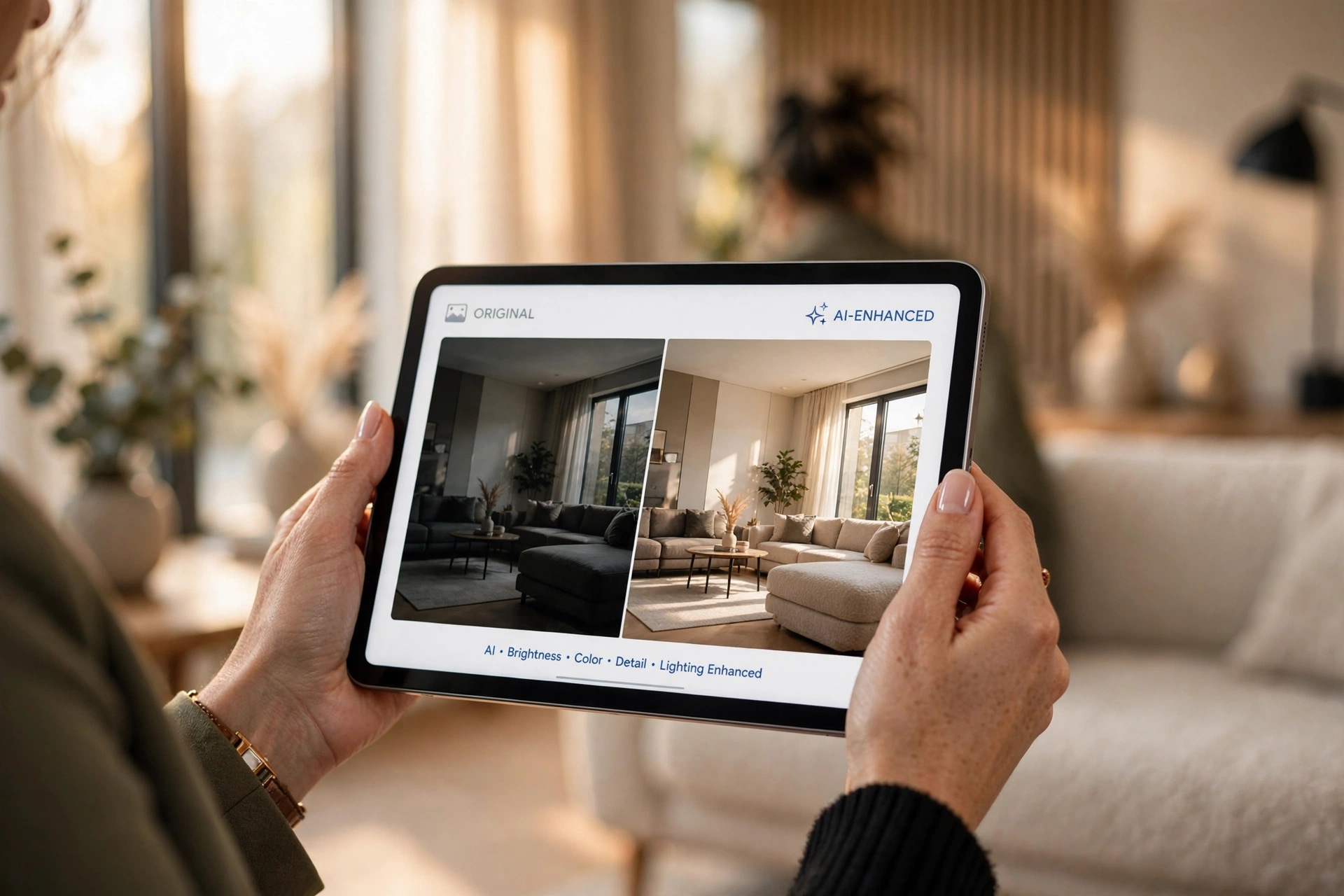
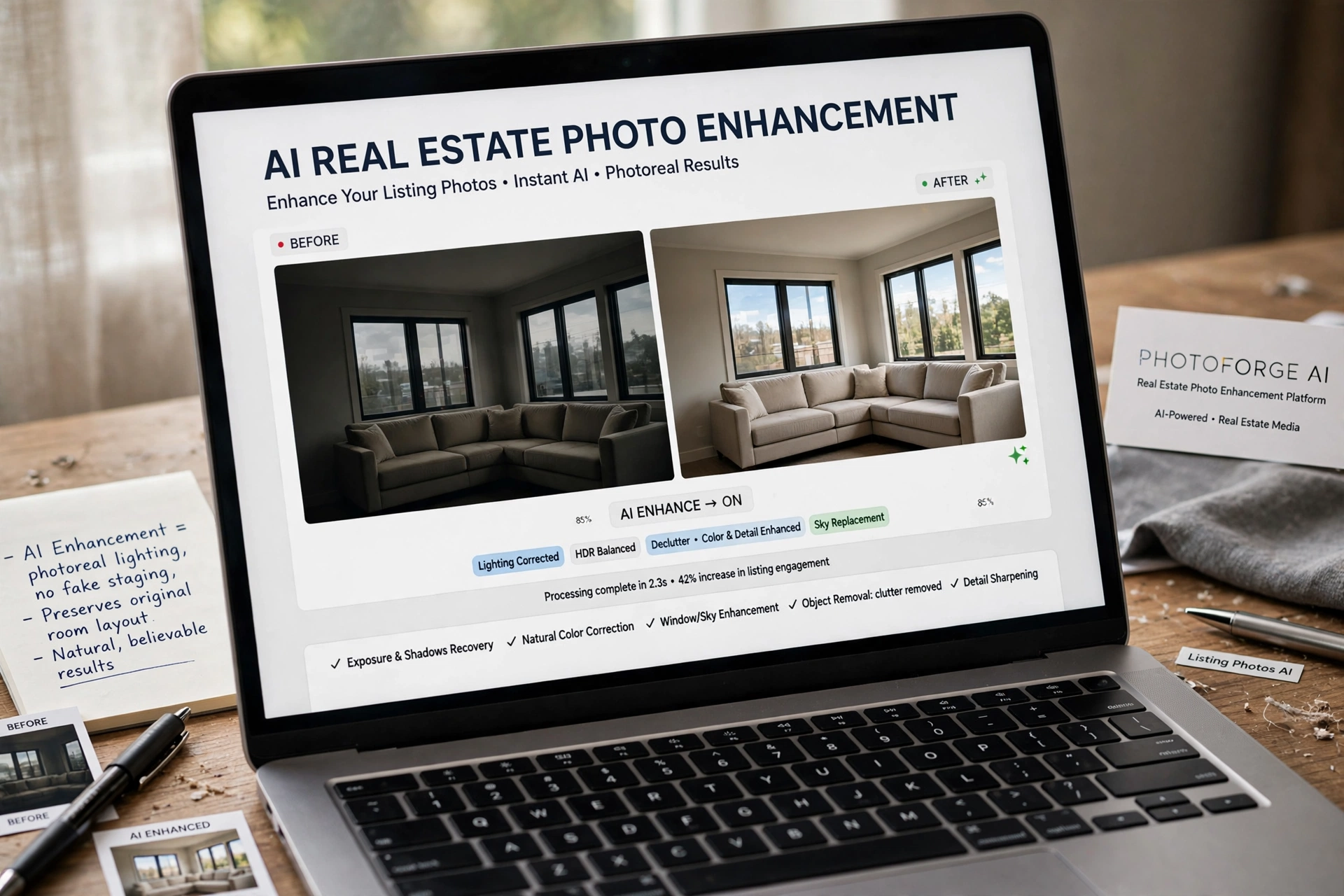
A poorly lit living room or a gray, overcast sky can kill a listing's momentum before a buyer even reads the price. AI real estate photo enhancement is the use of computer vision and deep learning algorithms to automatically correct lighting, color balance, and composition in property images. Unlike traditional editing, which requires a human to manually adjust sliders for every photo, these systems analyze the scene to identify walls, floors, and windows, applying precise corrections in seconds to create a "magazine-ready" look.
In my experience working with high-volume agencies, the biggest bottleneck isn't taking the photos, it's the 48-to-72 hour wait for an editor to return the files. When you transition to AI-driven workflows, that window shrinks to seconds. This shift is particularly vital when looking at Real Estate Image Processing in Miami: 2026 Visual Standards, where the high-end luxury market demands an almost impossible level of visual perfection to stand out.
📚
Definition
AI Real Estate Photo Enhancement is a specialized application of artificial intelligence that uses neural networks to automate the post-processing of architectural images, focusing on HDR blending, color correction, and object removal.
The core technology relies on "semantic segmentation," where the AI understands exactly what it is looking at. It doesn't just see a cluster of pixels; it recognizes a "window" and knows that the light coming through it should be balanced with the interior light to avoid "blown-out" whites. This process transforms a raw, flat image into a dynamic visual that evokes emotion and perceived value.

How Does AI Transformation Actually Change a Listing?
The impact of ai real estate photo enhancement is best understood through the lens of conversion rates. In the real estate world, the photo is the first "showing." According to a report by the National Association of Realtors, high-quality professional photography is a primary driver in how quickly a home sells and for how much. When AI handles this, the consistency across a 30-photo gallery is guaranteed, preventing the jarring transition between a bright kitchen and a dark hallway.
One of the most powerful applications is the "Day-to-Dusk" conversion. Instead of paying a photographer to return at 6:00 PM with expensive lighting rigs, AI can analyze the luminosity of the sky and the light spilling from the windows to simulate a twilight shot. This isn't just a filter; it is a complex recalculation of light paths. For those focusing on Real Estate Image Processing in Atlanta: 2026 ROI Guide, this capability is essential for creating that "luxury evening" vibe that attracts high-net-worth buyers.
Furthermore, AI enhancement handles "color cast" removal. Many interior photos suffer from a yellow tint due to tungsten bulbs or a blue tint from natural light. The AI identifies these temperature imbalances and neutralizes them, ensuring that the white walls actually look white. This prevents buyers from subconsciously perceiving a home as "dated" or "dingy."
According to Gartner's research on AI in the enterprise, the automation of visual content creation is reducing operational costs by up to 40% for service-oriented businesses. In real estate, this means the cost per listing drops significantly while the quality remains at a professional tier.
Why Is AI Enhancement Essential for Modern Property Management?
The stakes for visual presentation have never been higher. With the rise of "digital-first" home shopping, buyers are filtering out properties based on the first three photos they see. If the images look amateur, they assume the property is poorly maintained. This psychological link between photo quality and property condition is why AI enhancement is no longer a luxury, it is a baseline requirement for competitive listings.
The mistake I made early on, and that I see constantly with new agents, is believing that a high-end camera is enough. A $5,000 camera still produces a raw file that looks flat to the human eye. The "pop" that people associate with professional real estate photography happens in the edit. By leveraging ai real estate photo enhancement, property managers can ensure every single unit in a portfolio looks its best without hiring a full-time editor.
Consider the impact on the Multiple Listing Service (MLS). When a property is listed in a crowded market like Real Estate Image Processing in Phoenix: Boost Your 2026 Listings, the visual competition is fierce. AI enhancement allows for instant "Sky Replacement," turning a gloomy Tuesday afternoon into a bright, sunny day. This creates an immediate emotional response of optimism and warmth in the viewer.
Research from McKinsey suggests that AI-driven personalization and visual optimization can increase lead conversion by 15-20% across digital platforms. In real estate, "lead conversion" means more clicks on the listing, more showing requests, and ultimately, a faster closing date.
Practical Application: How to Implement AI Enhancement in Your Workflow
Implementing ai real estate photo enhancement doesn't require a degree in computer science. The goal is to move from a linear workflow (Shoot $\rightarrow$ Send $\rightarrow$ Wait $\rightarrow$ Receive) to a parallel workflow (Shoot $\rightarrow$ Enhance $\rightarrow$ List).
Here is the professional approach to integrating this technology:
- Capture with Intent: Even with AI, you need a decent base. Use a wide-angle lens and ensure the camera is level. Avoid extreme underexposure, as the AI needs some data to work with.
- Batch Uploading: Instead of editing one by one, upload the entire property gallery to a platform like RealVisionAI Blog - AI Real Estate Photography & Virtual Staging.
- Targeted Enhancements: Apply specific AI tools based on the room. Use "Grass Restoration" for the exterior, "Day-to-Dusk" for the main facade, and "AI Brightening" for the bathrooms and closets.
- Quality Audit: While AI is incredibly accurate, a quick human check ensures that no "hallucinations" occurred (such as a weirdly shaped chair leg or a floating artifact).
- Instant Deployment: Push the enhanced images directly to the MLS or social media platforms.
💡
Key Takeaway
The real power of AI enhancement is not just the visual quality, but the elimination of the "editing lag," allowing agents to list a property within minutes of leaving the premises.
For those operating in highly competitive zones, such as Real Estate Image Processing in Long Beach: 2026 ROI Guide, the speed of listing is a competitive advantage. Being the first to hit the market with stunning visuals can lead to a bidding war before other agents have even finished their raw edits.

Comparing Your Options: Manual vs. Cheap AI vs. Professional AI
Not all enhancement tools are created equal. Many agents make the mistake of using free "beauty filters" or generic AI apps that are designed for selfies, not architecture. These tools often over-saturate colors, making the grass look neon green and the sky look like a cartoon, which screams "amateur" to a sophisticated buyer.
| Feature | Manual Editing (Traditional) | Cheap/Generic AI | Professional AI (RealVisionAI) |
|---|---|---|---|
| Turnaround Time | 24-72 Hours | Instant | 12 Seconds |
| Visual Accuracy | High (Human Eye) | Low (Often Hallucinates) | High (Architectural Logic) |
| Cost Per Image | High (Hourly Rate) | Free/Cheap | Scalable Subscription |
| Consistency | Variable by Editor | Random | Standardized across Gallery |
| Best For | Ultra-Luxury ($10M+) | Personal Social Media | Professional Listings & Portfolios |
The "Cheap AI" approach often ignores the laws of physics. It might brighten a room but leave the windows looking like white voids. A professional system like RealVisionAI Blog - AI Real Estate Photography & Virtual Staging uses specific architectural training data to ensure that light behaves naturally, maintaining the integrity of the space while maximizing its appeal.
Common Questions and Misconceptions about AI Imaging
Most guides on this topic get it wrong by suggesting that AI is meant to "fake" a property's appearance. That is a dangerous path. The goal of ai real estate photo enhancement is optimization, not deception.
Myth 1: AI enhancement is "catfishing" the buyer.
Correction: There is a clear line between enhancing lighting and removing a permanent wall. Enhancing a photo is equivalent to cleaning the house and opening the blinds before a showing. It presents the home in its best possible light, not a false reality. As long as the structure and layout are accurate, AI enhancement is a standard professional practice.
Myth 2: You can't use AI for high-end luxury listings.
Correction: High-end buyers expect high-end visuals. In markets like Real Estate Image Processing in Oakland: 2026 ROI Guide, a lack of professional enhancement is actually a red flag. It suggests the agent isn't invested in the marketing of the property.
Myth 3: AI will replace the real estate photographer.
Correction: AI doesn't take the photo; it perfects it. A great photographer knows the angles and the composition. AI simply removes the tedious 5-hour editing process, allowing the photographer to take on more clients and increase their revenue.
Frequently Asked Questions
Is AI real estate photo enhancement legal and ethical?
Yes, it is widely accepted and legal, provided it is used for aesthetic improvement rather than deceptive alteration. Enhancing brightness, color, and contrast is standard in every professional photography workflow. However, ethics dictate that you should not use AI to remove permanent flaws, such as a massive crack in a foundation or a permanent stain on a ceiling. The goal is to show the property's potential, not to misrepresent its condition. When used responsibly, it simply ensures that the photo does justice to the actual physical space.
How long does it actually take to enhance a photo with AI?
Depending on the platform, it typically takes between 5 and 15 seconds per image. RealVisionAI Blog - AI Real Estate Photography & Virtual Staging, for instance, targets a 12-second window for market-ready visuals. This is a staggering difference compared to the traditional model, where a photographer might take the photos on Monday and the editor delivers them on Thursday. This speed allows agents to capitalize on "listing momentum," where the most interest is generated in the first 24 hours of a property hitting the market.
Can AI fix photos that were taken with a smartphone?
Yes, but there are limits. AI can significantly improve the lighting, straighten skewed horizons, and remove distracting objects from a smartphone photo. However, AI cannot "create" a wide-angle perspective if the photo was taken too close to the wall. For the best results, even when using a phone, use a wide-angle lens and plenty of light. The AI can then take that raw data and apply professional-grade color grading and HDR (High Dynamic Range) balancing to make it look like it was shot on a DSLR.
What is the difference between AI enhancement and virtual staging?
AI enhancement focuses on the "technical" quality of the image: lighting, color, sharpness, and clarity. Virtual staging is the process of adding digital furniture and decor to an empty room. While they are different processes, they are often used together. You first enhance the photo to ensure the lighting is perfect, and then you add the virtual furniture so that the lighting on the digital sofa matches the lighting of the actual room. This combination is what creates the most compelling listings in Real Estate Image Processing in Virginia Beach: 2026 Guide.
Does AI enhancement help with SEO and online visibility?
Indirectly, yes. While the AI doesn't change the metadata of the photo, high-quality images lead to longer "dwell time" on a listing page. When users spend more time looking at beautiful photos and clicking through a gallery, search engines perceive the content as more valuable. Furthermore, high-quality visuals are shared more frequently on social media, driving more organic traffic back to the listing. This creates a positive feedback loop that improves the property's overall digital footprint and visibility.
Final Thoughts on AI Real Estate Photo Enhancement
The transition toward ai real estate photo enhancement is not just a trend; it is a fundamental shift in how property value is communicated. In a world where the "first showing" happens on a smartphone screen, the ability to deliver crisp, vibrant, and emotionally resonant images is the difference between a listing that sits for months and one that sells in a weekend.
By automating the tedious aspects of post-production, agents can focus on what they do best: negotiating deals and managing client relationships. Whether you are scaling a portfolio in Real Estate Image Processing in New Orleans: 2026 Visual Trends or managing a few select luxury estates, the integration of AI is the most efficient way to maximize your ROI.
If you are ready to stop waiting days for your photos and start listing in seconds, experience the power of RealVisionAI. Get your listings market-ready in 12 seconds and give your properties the visual edge they deserve.
Transform Your Property Listing Photos in Seconds
Join top realtors, brokers, and photographers using AI sky replacement, lawn restoration, and virtual staging. Create your free account on RealVisionAI today.
Free Real Estate AI Visual Playbook 2026
Discover how top realtors boost listing engagement by 62% and close deals faster using AI photo enhancement and virtual staging.