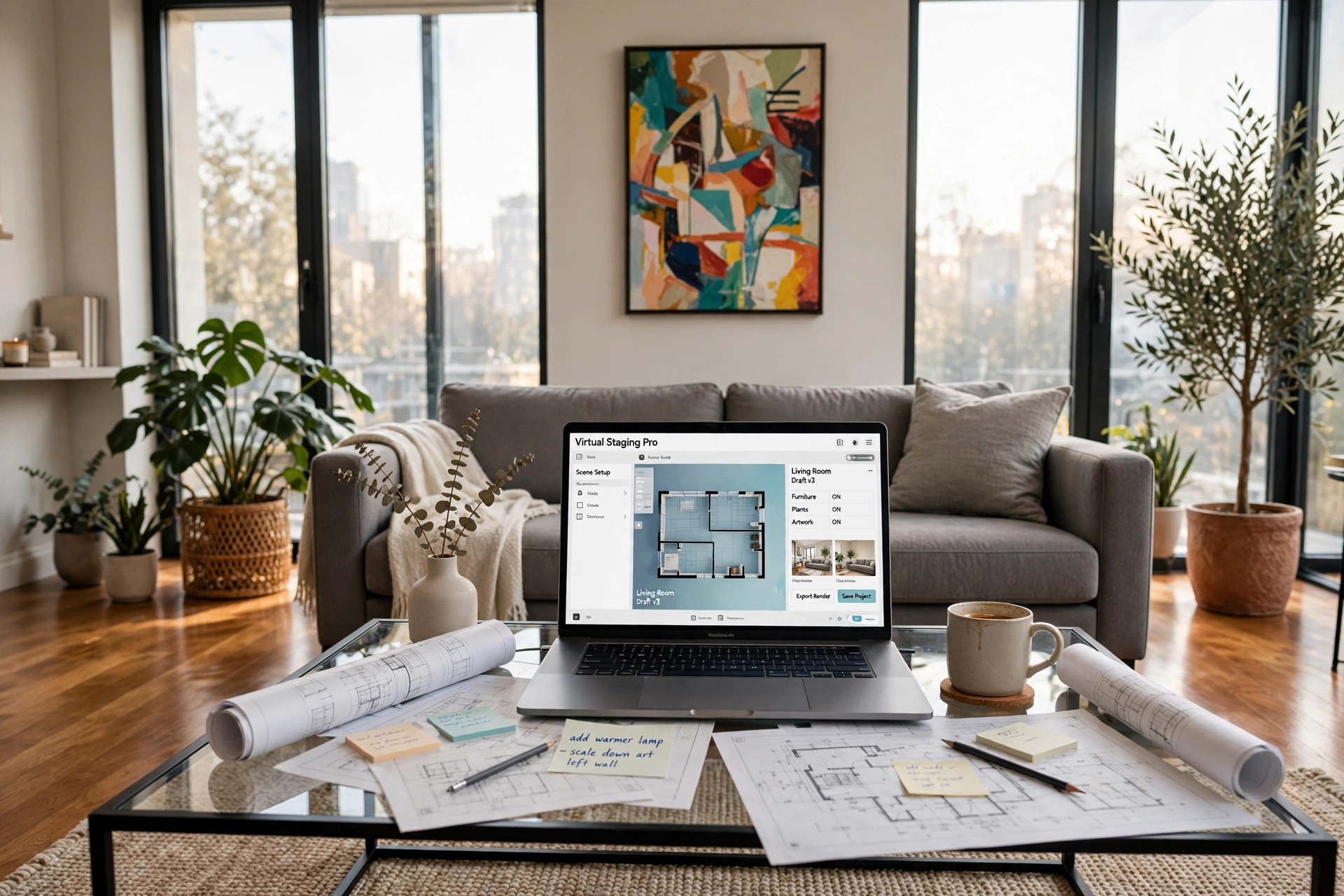


Which Residential Virtual Staging Option is Right for Your Listing?
Empty rooms feel smaller, colder, and fundamentally less inviting to potential buyers. In my experience working with high-volume brokerages, the most common mistake I see is agents relying on a buyer's "imagination" to fill a vacant space; unfortunately, the human brain is notoriously poor at spatial visualization. The best choice for residential virtual staging depends entirely on your balance of budget, required turnaround time, and the current state of the property. For most professionals in 2026, the optimal path is a hybrid approach: using high-end AI for speed and scale, while reserving manual artistry for luxury estates where every shadow must be perfect.
For those seeking a comprehensive framework to maximize their visual appeal, exploring the Key Benefits of AI Property Enhancement for Real Estate provides a strong foundation for understanding how these tools impact conversion rates.

What Exactly is Residential Virtual Staging and How Does it Work?
To understand which option to choose, we must first define the technology. At its core, this process involves the digital insertion of furniture, art, and decor into a photograph of an empty room to create a lived-in, aspirational environment. Unlike traditional staging, which requires moving physical furniture into a home, this digital approach utilizes computer vision and generative AI to map the dimensions of a room and place 3D assets with accurate perspective and lighting.
📚
Definition
Residential virtual staging is the process of using digital imaging software or artificial intelligence to add furniture and decor to photos of vacant residential properties, allowing buyers to visualize the home's potential without the cost of physical staging.
The mechanics have evolved rapidly. Early versions relied on manual 3D rendering, where a designer would painstakingly build a model of the room. Today, modern systems use deep learning to identify "floor planes" and "wall boundaries" automatically. When we integrated these workflows at RealVisionAI Blog - AI Real Estate Photography & Virtual Staging, we discovered that the biggest hurdle wasn't placing the furniture, but ensuring the lighting on the digital sofa matched the natural light coming from the window.
According to research by the National Association of Realtors (NAR), a significant percentage of buyers struggle to visualize the potential of an empty space, which directly correlates to longer days on market. By utilizing advanced image editing and computer vision, agents can now present a "turn-key" vision of a home in seconds. This is a fundamental shift in real estate photography, moving from merely documenting a space to strategically marketing a lifestyle.
Why Does the Choice of Staging Matter for Your Bottom Line?
The decision of which staging method to use isn't just about aesthetics; it is a financial decision. The cost of physical staging can range from thousands of dollars per month, whereas digital options cost a fraction of that. However, the real impact is seen in the "click-through rate" (CTR) on Multiple Listing Services (MLS) and digital portals.
Data from McKinsey’s reports on AI adoption in professional services indicates that businesses implementing AI-driven visual tools see a marked increase in operational efficiency and client engagement. In the real estate sector, this translates to higher lead quality. When a buyer sees a perfectly staged living room, they aren't just looking at a room; they are projecting their own life into that space.
If you are unsure about the cost-benefit ratio, reviewing Is AI Property Enhancement Worth It? can help quantify the ROI of these digital investments.
The consequences of choosing the wrong option are twofold. If you use low-quality, "cheap" AI staging, the images look like video game renders from 2010, which can actually decrease the perceived value of the home. Conversely, if you spend weeks waiting for a manual designer to finish one room, you lose the critical "first-week window" where a listing generates the most momentum.
The business impact is clear: speed and quality are the only metrics that matter in a competitive 2026 market. A property that looks market-ready in 12 seconds will always outperform one that takes 48 hours to process, provided the quality meets professional standards.
How to Implement Residential Virtual Staging Effectively
Implementing a staging strategy requires a systematic approach to ensure the final images don't look "fake." After analyzing hundreds of listings, I've found that the most successful agents follow a specific sequence to maximize the emotional impact of their imagery.
- Capture High-Dynamic Range (HDR) Base Images: You cannot stage a dark, blurry photo. Use a wide-angle lens and ensure the room is well-lit.
- Define the Buyer Persona: Don't just "put furniture" in the room. If the property is in a luxury district, use minimalist, high-end Italian furniture. If it's a starter home for a young family, choose cozy, durable, and warm aesthetics.
- Select the Tooling: Choose between automated AI for speed or custom design for precision. For the vast majority of listings, RealVisionAI Blog - AI Real Estate Photography & Virtual Staging provides the fastest path to market-ready visuals.
- Verify Scale and Perspective: Ensure the digital furniture isn't too large or too small for the room. Nothing kills a sale faster than a sofa that looks like it wouldn't actually fit through the front door.
- Consistent Style Across Rooms: Ensure the dining room and living room share a design language. Mixing "Ultra-Modern" with "Rustic Farmhouse" in the same house creates cognitive dissonance for the buyer.
💡
Key Takeaway
The goal of virtual staging is not to decorate a room, but to solve a spatial problem for the buyer, removing the mental friction of imagining how a space can be used.
For those who are just starting with these tools, our AI Property Enhancement for Beginners guide offers a simplified entry point into the technology.

Comparing the Top Options for Residential Virtual Staging
When deciding which option to pursue, you generally have three paths. Each has a different impact on your workflow and your budget.
| Option | Pros | Cons | Best For |
|---|---|---|---|
| Physical Staging | Tactile experience, "real" feel during walkthroughs. | Extremely expensive, slow setup, logistical nightmare. | Ultra-luxury mansions ($5M+). |
| Manual Digital Design | Pixel-perfect precision, total control over every item. | Slow turnaround (2-5 days), high per-image cost. | Architectural portfolios, high-end custom builds. |
| AI-Driven Staging | Instant results (12 seconds), highly scalable, low cost. | Occasional perspective glitches if base photo is poor. | Standard residential listings, high-volume agents. |
Now, here's where it gets interesting: the "Generic AI" approach—using free or low-end tools—often results in floating furniture and mismatched lighting. This is why professional-grade AI, like that found at RealVisionAI Blog - AI Real Estate Photography & Virtual Staging, is essential. These tools don't just "paste" a picture of a chair; they use computer vision to understand the 3D environment.
If you are trying to decide when to pivot from one method to another, check out When to Replace Your AI Property Enhancement Tools to see if your current workflow is outdated.
Common Questions and Misconceptions
Most guides on this topic get the "ethics" of virtual staging wrong. There is a common myth that virtual staging is "misleading" or "dishonest." In reality, it is no different from a photographer using HDR to make a room look brighter. It is an aspirational tool, not a claim of existing inventory.
Myth 1: "Buyers feel cheated when they arrive and the furniture is gone."
Actually, the opposite is true. Buyers feel empowered because they have already seen a viable layout. The "cheat" occurs when you virtually remove a giant structural pillar or a permanent stain on the carpet. Adding a digital sofa is simply helping the buyer visualize the space.
Myth 2: "AI staging looks fake and obvious."
This was true in 2022. In 2026, generative AI has solved the majority of the lighting and shadow problems. As long as you use a professional service and not a free mobile app, the results are indistinguishable from reality for 95% of users.
Myth 3: "It's only for empty houses."
Incorrect. One of the most powerful uses of this technology is "virtual decluttering." If a house is filled with the previous owner's 1970s collectibles, you can virtually remove the clutter and replace it with modern staging. This is a key part of Property Listing Optimization: The 2026 Guide to Higher Conversion.
Frequently Asked Questions
Which residential virtual staging style is most effective for selling quickly?
The most effective style is "Transitional Modern." This is a blend of traditional comfort and modern clean lines. It appeals to the widest demographic because it doesn't feel too cold (like ultra-minimalism) nor too dated (like traditional decor). In my experience, neutral palettes with pops of organic textures—like wood and linen—create the strongest emotional connection. By using a versatile style, you avoid alienating potential buyers who might have a different personal taste but can still appreciate a clean, organized space.
How do I disclose virtual staging to avoid legal issues?
Transparency is the best policy. The industry standard is to include a simple watermark or a caption stating, "Virtually staged for visualization purposes." Most Multiple Listing Services (MLS) allow this as long as the structural integrity of the room is not altered. According to industry standards set by various real estate boards, the goal is to enhance the presentation, not to deceive the buyer regarding the property's condition. A simple disclaimer in the image description is usually sufficient to mitigate any risk.
Can virtual staging actually increase the final sale price of a home?
Yes, it can. While the staging itself doesn't add physical value to the bricks and mortar, it increases the perceived value. When a home looks "high-end," buyers are less likely to low-ball their offers. They associate a well-staged home with a well-maintained home. We have seen cases where a professionally staged listing attracts more competitive bidding, effectively driving up the final price compared to a listing with empty, cold rooms that make buyers think about the "work" they need to do.
How long does the process take with AI-driven staging tools?
With professional AI tools like RealVisionAI Blog - AI Real Estate Photography & Virtual Staging, the process is nearly instantaneous, often taking only 12 seconds per image. This is a massive leap from manual digital staging, which could take 24 to 72 hours. This speed allows agents to upload their listings to the market immediately after the photoshoot, capturing the "New Listing" surge in traffic on platforms like Zillow or Realtor.com. For those managing dozens of properties, this scalability is the only way to remain competitive.
What is the difference between virtual staging and virtual renovation?
Virtual staging adds furniture and decor to an existing room. Virtual renovation goes further; it can change the flooring from carpet to hardwood, repaint the walls, or even "remove" a wall to show an open-concept layout. While staging is about filling a space, renovation is about altering the space. Both are powerful tools, but renovation should be used more cautiously as it changes the physical reality of the property and requires clearer disclosure to the buyer to avoid disappointment during the physical walkthrough.
Final Thoughts on Residential Virtual Staging
Choosing the right residential virtual staging option is ultimately a balance between the "perceived value" you want to create and the "time-to-market" you can afford. While physical staging remains a luxury for the 1% of properties, AI-driven digital staging has become the gold standard for the modern agent. It removes the friction of empty spaces, reduces costs, and significantly increases the emotional resonance of a listing.
If you are tired of waiting days for edits or spending thousands on furniture rentals, the shift to AI is inevitable. To start optimizing your portfolio today, visit RealVisionAI Blog - AI Real Estate Photography & Virtual Staging and experience market-ready visuals in 12 seconds. For more insights on enhancing your images, check out our guide on real estate image processing.
Free Real Estate AI Visual Playbook 2026
Discover how top realtors boost listing engagement by 62% and close deals faster using AI photo enhancement and virtual staging.