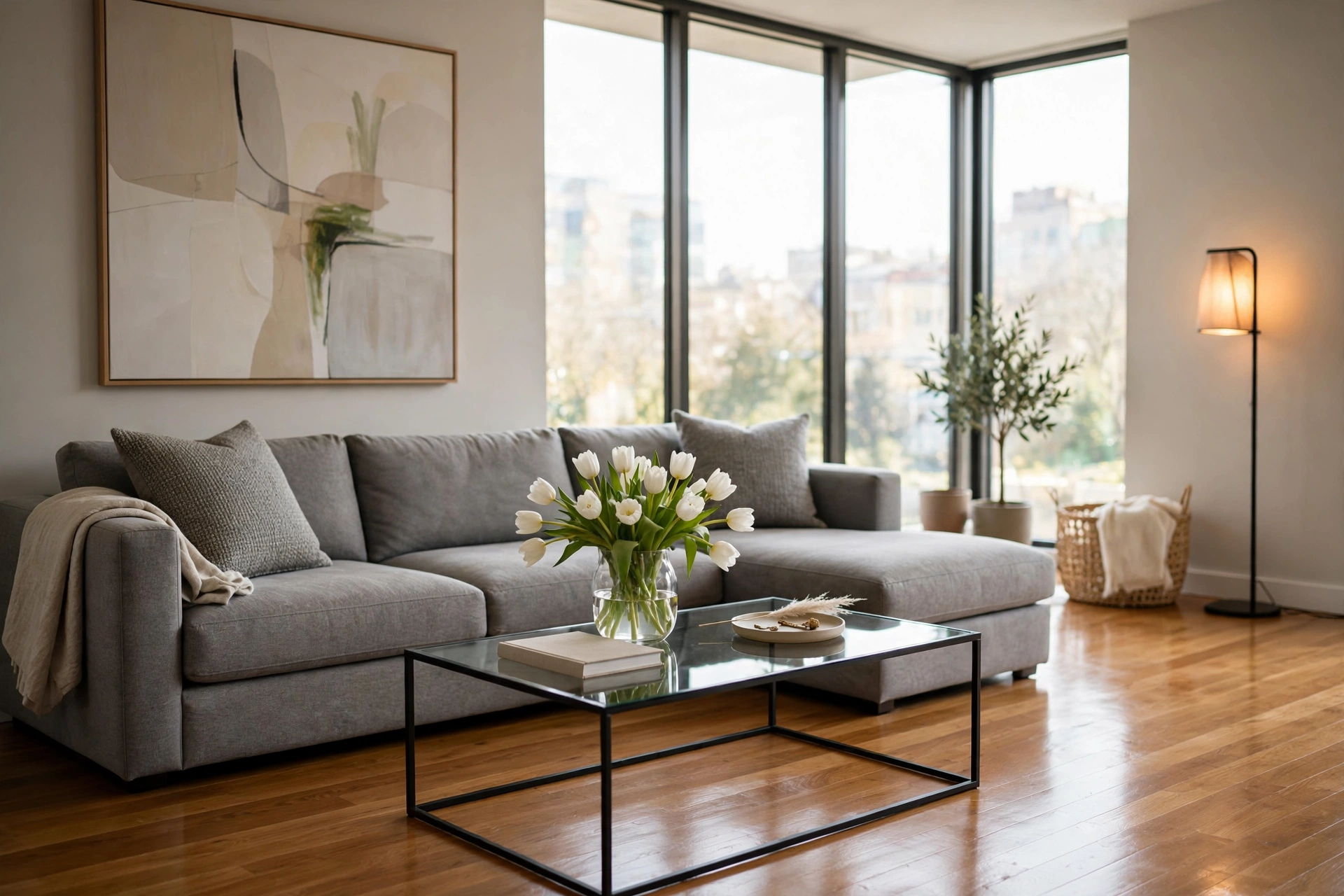


Which Type of Residential Virtual Staging Should You Choose for Your Listings?
Vacant homes often feel cold and impersonal, which directly translates to longer days on the market and lower offer prices. When deciding which approach to take, residential virtual staging offers the most scalable solution by allowing agents to digitally furnish a space without the logistical nightmare of moving physical furniture. For most professionals in 2026, the choice comes down to whether you need full-room transformations, strategic accent staging, or AI-driven rapid iterations.
The best option depends on the property's current state: completely empty homes require full virtual staging to define room functions, while lived-in homes with dated decor benefit more from virtual decluttering and style refreshing. By aligning the staging type with the target buyer persona, agents can increase a property's perceived value by an average of 1% to 5% of the total listing price.
For a deeper look at how these tools integrate into a broader strategy, explore our Real Estate Visual Marketing: The 2026 Guide to AI-Driven Sales.
What Exactly is Residential Virtual Staging and How Does it Differ?
To understand the various types, we first need to establish a baseline for what the technology actually does. Unlike traditional staging, which requires renting furniture and paying a crew for installation, digital versions use computer vision and high-end rendering to place 3D models into a 2D photograph.
📚
Definition
Residential virtual staging is the process of using computer-generated imagery (CGI) and artificial intelligence to add furniture, decor, and architectural elements to photos of empty or cluttered residential properties.
In my experience working with high-volume brokerage firms, the biggest mistake I see constantly is treating all virtual staging as a "one size fits all" service. There is a fundamental difference between "filling a room" and "creating a lifestyle." The former simply puts a couch in a living room; the latter uses specific design psychology—such as "Modern Minimalist" for urban condos or "Traditional Warmth" for suburban family homes—to evoke an emotional response from the buyer.
According to a report by the National Association of Realtors (NAR), properties with high-quality visuals are significantly more likely to generate immediate interest. This isn't just about aesthetics; it's about spatial cognition. Most buyers cannot visualize how a king-sized bed fits into an empty room. By providing a digital blueprint of the space's potential, agents remove the mental friction that prevents a buyer from making an offer.

Now, here is where it gets interesting: the industry has shifted from manual 3D rendering toward AI-powered generative filling. While a human designer might take 48 hours to render a room, modern systems can now achieve photorealistic results in seconds, allowing agents to test multiple design styles for the same room to see which resonates best with their specific target demographic.
Why Does the Choice of Staging Type Impact Your Bottom Line?
The decision of which residential virtual staging method to use isn't just a design choice; it's a financial one. Using the wrong style can actually alienate your target buyer. For instance, placing ultra-modern, industrial furniture in a cozy cottage can make the home feel "wrong" or mismatched, potentially creating a subconscious barrier for the buyer.
According to research from Deloitte on the digital transformation of real estate, the integration of AI-driven visuals has reduced the "time-to-market" for luxury listings by nearly 20%. When a property looks "move-in ready" in the photos, it triggers a higher psychological urgency in the buyer.
The business impact manifests in three specific areas:
- Increased Click-Through Rates (CTR): On platforms like Zillow or Redfin, the "hero image" (the first photo) determines whether a user scrolls or skips. A virtually staged, sun-drenched living room outperforms a grey, empty room by a massive margin.
- Higher Perceived Value: When a buyer sees a functional home office in a spare bedroom, they stop seeing a "small room" and start seeing a "productive workspace." This shifts the value proposition from square footage to utility.
- Reduced Carrying Costs: Every day a home sits vacant, the seller pays for utilities, insurance, and mortgage. Reducing the days on market (DOM) by even one week can save a seller thousands of dollars.
If you are unsure if the investment is worth it for a specific property, you might want to check our analysis on Is AI Property Enhancement Worth ItC?.
The consequence of avoiding professional staging is often "listing fatigue." When a property has been on the market for 30+ days with empty rooms, buyers assume there is something wrong with the house itself, rather than the presentation. This leads to "low-ball" offers because the property is perceived as stagnant.
Practical Application: How to Implement Residential Virtual Staging Effectively
Implementing residential virtual staging requires a strategic approach rather than a random application of furniture. The goal is to guide the buyer through the home's "story."
Step 1: Define the Buyer Persona
Before uploading photos to RealVisionAI Blog - AI Real Estate Photography & Virtual Staging, identify who is buying. Is it a first-time millennial buyer? A retiring couple? A corporate executive? Use this to choose the design style. A "Scandi-Boho" look works for the former, while a "Classic Transitional" look appeals to the latter.
Step 2: Select the High-Impact Rooms
You don't need to stage every single closet. Focus on the "Big Three": the Living Room, the Primary Bedroom, and the Kitchen/Dining area. These are the emotional centers of the home.
Step 3: Execute the Transformation
Using a professional tool like RealVisionAI Blog - AI Real Estate Photography & Virtual Staging, you can upload your raw photos and apply specific themes. The AI handles the perspective, lighting, and shadows automatically, ensuring the furniture doesn't look like it's "floating" on the floor.
Step 4: Compare and A/B Test
In my experience, the most successful agents create two versions of the same room—one modern and one traditional. They can then use these in different marketing channels (e.g., Instagram vs. LinkedIn) to see which style attracts more leads.
💡
Key Takeaway
Effective staging is not about adding furniture; it is about defining the room's purpose. A room without a purpose is just a box of air; a room with a purpose is a lifestyle choice.
If you are new to this process, we recommend starting with the AI Property Enhancement for Beginners guide to avoid common pitfalls.

Which Option is Right for You? Comparing Staging Types
Depending on the property's condition, you will choose between different "levels" of staging. It is a mistake to think that "Full Staging" is always the best option. Sometimes, less is more.
| Staging Type | Pros | Cons | Best For |
|---|---|---|---|
| Full Virtual Staging | Maximize spatial potential; fills "dead" space completely. | Can feel "too perfect" or artificial if overdone. | Completely vacant new builds or gut renovations. |
| Partial / Accent Staging | Maintains a sense of airiness; feels more natural. | Doesn't solve the "how does a bed fit here?" problem. | Large rooms with some existing architectural character. |
| Virtual Decluttering | Removes "noise"; makes a home feel cleaner and larger. | Requires precise masking to avoid removing structural elements. | Lived-in homes with too much personal clutter or old furniture. |
| Virtual Renovation | Shows potential for flooring/paint changes. | Can be seen as misleading if not clearly labeled as "concept." | Properties in poor condition that need a "vision" to sell. |
When deciding between these, consider the Types of AI Property Enhancement for Real Estate to see how these styles overlap with other visual improvements.
Now, here's where it gets interesting: the "Hybrid" approach is becoming the gold standard in 2026. This involves using virtual decluttering to remove an ugly old sofa and then replacing it with a virtually staged modern sectional. This creates a realistic transition that doesn't shock the buyer when they walk through the door.
Common Questions and Misconceptions About Virtual Staging
Most guides get this wrong: they tell you that virtual staging is a "trick" to hide flaws. In reality, it's a tool for communication. Here are the most common myths.
Myth 1: Virtual staging is misleading to the buyer.
Contrary to this belief, virtual staging is a transparent marketing tool. As long as the photos are labeled as "Virtually Staged," it is no different from a physical stager bringing in rented furniture. It doesn't change the walls or the square footage; it simply suggests a layout.
Myth 2: It only works for luxury properties.
This is a fallacy. In fact, mid-market and entry-level homes benefit the most because these buyers often have less imagination regarding interior design. Showing a "starter home" as a stylish, modern space can trigger an emotional purchase that a bleak, empty room never would.
Myth 3: AI staging looks "fake" and "plastic."
This was true in 2021, but the 2026 landscape is different. With the advent of advanced computer vision and neural rendering, AI can now simulate "global illumination," meaning the light from a window actually hits the virtual fabric of a sofa in a way that is indistinguishable from a real photo.
If you are still wondering about the cost-to-benefit ratio, check out our AI Property Enhancement: Pricing and Value Guide.
Frequently Asked Questions
Which style of residential virtual staging is most popular in 2026?
The "Modern Organic" and " Japandi" (Japanese and Scandinavian) styles are currently dominating the market. These styles emphasize neutral tones, natural textures, and a sense of calm. Because they are minimalist, they make rooms appear larger and cleaner, which is the primary goal of most sellers. According to industry trends, minimalist staging leads to a higher volume of inquiries because it allows buyers to project their own personalities onto the space without feeling overwhelmed by a specific, heavy design choice.
How do I prevent virtual staging from looking unrealistic?
The secret lies in "shadow grounding" and "perspective matching." If the furniture doesn't have a soft shadow where it touches the floor, it looks like it's floating. Professional tools like RealVisionAI Blog - AI Real Estate Photography & Virtual Staging automate this by analyzing the light source in the original photo and applying a matching shadow to the 3D model. Another tip is to avoid over-furnishing; leaving some "breathing room" in the image makes the scale feel more authentic to the human eye.
Should I use virtual staging for a home that already has some furniture?
Yes, but you should use "Virtual Decluttering" first. In my experience, a home with a few pieces of old, mismatched furniture is harder to sell than a completely empty home. The old furniture creates a "dated" feeling that is hard to shake. By virtually removing the old pieces and replacing them with modern, cohesive items, you transform the property from "someone else's old house" into a "fresh opportunity." This process is often referred to as a visual reset.
Does virtual staging actually help sell a home faster?
The data suggests a resounding yes. By removing the cognitive load of imagining furniture placement, you shorten the buyer's decision-making cycle. When a buyer can instantly "see" themselves living in the space, they are more likely to book a viewing. This increases the lead velocity, which often leads to multiple offers in the first weekend. For those managing a large portfolio, this efficiency is why Digital Staging Services: Scaling Real Estate Listings in 2026 have become an essential part of the operations.
Is there a risk of buyers feeling deceived when they see the home in person?
This risk is minimal if you manage expectations. The best practice is to include a small disclaimer on the listing: "Images are virtually staged to show potential layout." Most buyers appreciate the vision. The key is to stage the home realistically; don't put a giant sectional in a room where it physically wouldn't fit. Use accurate scaling so that the "promise" made by the photo is kept by the physical reality of the space.
Final Thoughts on Residential Virtual Staging
Choosing the right type of residential virtual staging is the difference between a listing that "sits" and a listing that "sells." Whether you opt for a full transformation to define a vacant space or a strategic declutter to refresh a dated interior, the goal remains the same: to remove the friction between the buyer and their dream home.
In the competitive market of 2026, visual excellence is no longer a luxury; it is a baseline requirement. By leveraging AI-driven tools, you can experiment with different styles and layouts in seconds, ensuring that every property you represent is presented in its absolute best light.
If you are ready to stop losing leads to "empty room syndrome," experience the power of market-ready visuals in 12 seconds with RealVisionAI Blog - AI Real Estate Photography & Virtual Staging. Visit realvisionaire.com to transform your listings today. For further optimization, see our guide on Property Listing Optimization: The 2026 Guide to Higher Conversion.
Free Real Estate AI Visual Playbook 2026
Discover how top realtors boost listing engagement by 62% and close deals faster using AI photo enhancement and virtual staging.