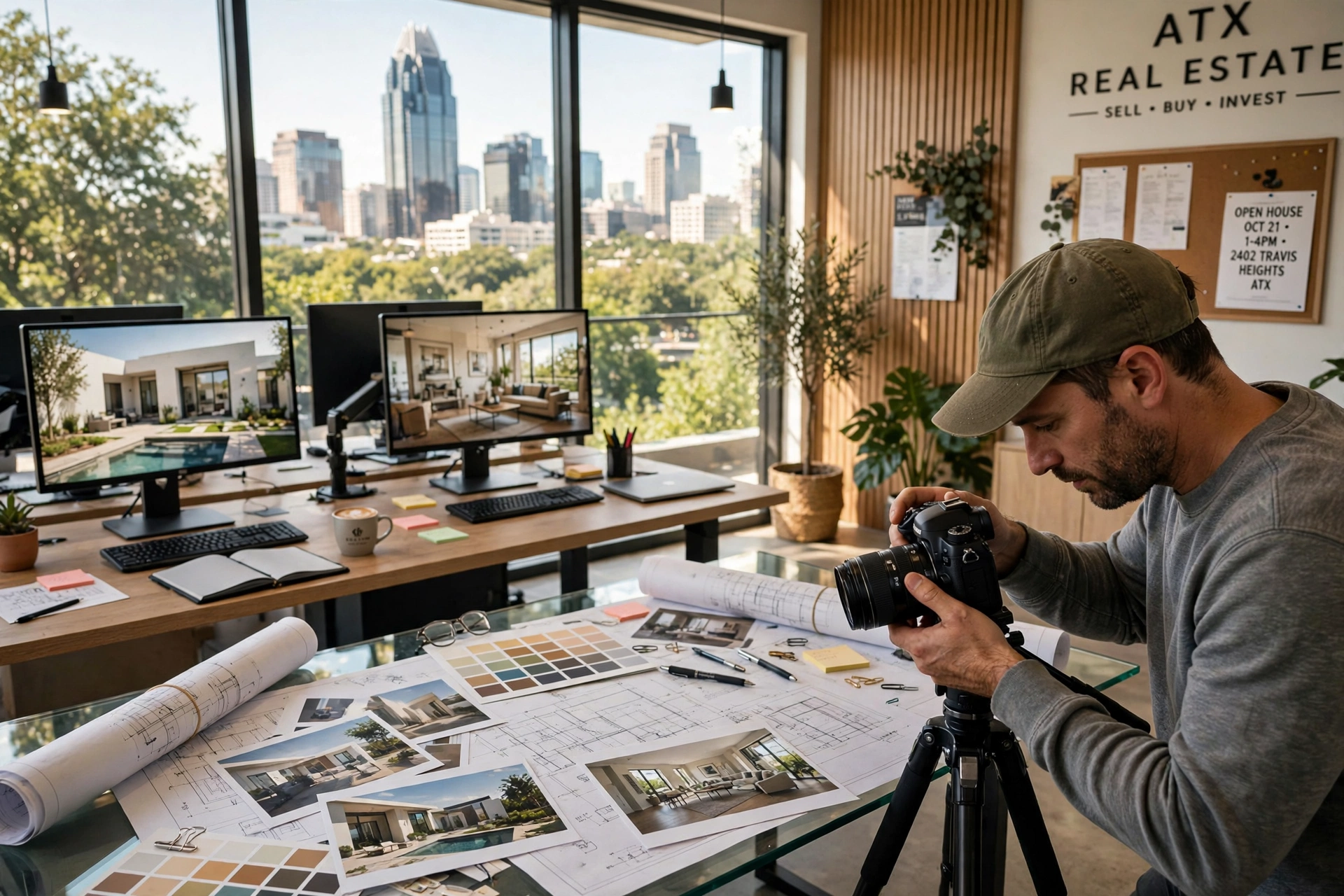
📖This article is part of the complete guide to Real Estate Image Processing. The Austin real estate market is notoriously aggressive, where a property's first impression is decided in less than two seconds on a mobile screen. For agents and property managers in the Silicon Hills, professional real estate image processing in Austin is the primary tool used to transform raw, often dimly lit photos into high-conversion assets that trigger immediate showings. By combining AI-driven enhancements, such as virtual staging and sky replacement, with local architectural sensibilities, professionals ensure their listings stand out in a saturated Multiple Listing Service (MLS) environment.
In my experience working with Austin businesses, the pattern is clear: properties with AI-enhanced visuals sell significantly faster than those relying on basic photography. This is especially true in high-demand areas like West Lake Hills or the Domain, where buyer expectations for visual quality are exceptionally high. To stay competitive, agents are shifting toward automated yet professional workflows that prioritize speed without sacrificing the "Texas-modern" aesthetic. For those starting their journey, exploring the
Key Benefits of AI Property Enhancement for Real Estate provides a clear roadmap of the ROI available.
Why are Austin businesses adopting professional image processing?
Austin's unique blend of rapid urban growth and distinct architectural styles, ranging from historic bungalows in East Austin to ultra-modern glass estates in the Hill Country, demands a versatile approach to visual marketing. The adoption of advanced image processing is no longer a luxury but a baseline requirement for survival in the 2026 market. According to a McKinsey report on AI adoption, businesses that integrate AI into their marketing workflows see an average productivity increase of 20% to 30%. In the context of Austin real estate, this translates to a drastic reduction in the time it takes to move a property from "Coming Soon" to "Under Contract."
One of the biggest challenges in the Austin area is the unpredictable lighting. The harsh Texas sun can create deep shadows and blown-out highlights in exterior shots, while interior rooms often suffer from the "yellow cast" of traditional lighting. Professional processing solves this by utilizing computer vision to balance exposures and normalize colors. As the city continues to attract tech-savvy migrants from California and New York, the standard for digital presentation has shifted. These buyers are accustomed to high-end digital experiences and will often skip listings that look amateurish or dated.
Furthermore, the rise of remote investing in Austin means that a significant percentage of buyers are making initial decisions from thousands of miles away. When a buyer cannot physically visit a property in Tarrytown, they rely entirely on the visual data provided. If the image processing is poor, the perceived value of the home drops. Research from Gartner suggests that by 2026, AI-augmented content will drive the majority of consumer discovery journeys. In the real estate niche, this means that a listing without professional AI processing is essentially invisible to the modern algorithmic search.
What are the key benefits of advanced image processing for Austin listings?
Implementing a professional workflow for image processing provides a measurable edge in lead generation and conversion. The primary goal is to remove "visual friction", anything in a photo that distracts a buyer from imagining themselves living in the space. By utilizing
Real Estate Visual Marketing: The 2026 Guide to AI-Driven Sales, agents can implement strategies that maximize a property's perceived value before the first open house even occurs.
Instant Perceived Value Increase
Virtual staging is the most potent tool in the Austin arsenal. Empty rooms often feel smaller and colder than furnished ones, and buyers struggle to visualize how to utilize a space. By digitally adding high-end furniture that matches the local Austin aesthetic, think minimalist mid-century modern or rustic luxury, agents can increase the perceived value of a home by thousands of dollars. When a property looks "move-in ready'" through professional processing, it attracts a wider pool of qualified buyers who are not deterred by the prospect of furnishing an empty shell.
Drastic Reduction in Days on Market (DOM)
High-quality visuals directly correlate to lower Days on Market. When images are processed to look cinematic and inviting, click-through rates on Zillow and Redfin spike. This increase in traffic creates a sense of urgency and competition among buyers. In a market as volatile as Austin's, creating that "fear of missing out" (FOMO) is essential. Professional processing ensures that every room looks its absolute best, reducing the number of "tire-kickers" and increasing the number of serious offers.
Cost-Effective Scaling
Traditional physical staging can cost thousands of dollars per month and requires immense logistical effort. AI-driven image processing provides a scalable alternative. An agent can stage an entire five-bedroom estate in a variety of styles (e.g. Traditional, Modern, Minimalist) for a fraction of the cost of renting a single sofa. This allows for A/B testing different styles to see which resonates most with the specific target demographic of a neighborhood.
💡Key Takeaway
The most significant benefit of professional processing is the ability to manipulate the emotional response of the buyer, transforming a sterile space into a desired home through precise visual cues.
| Feature | Traditional Manual Editing | Cheap/Generic AI Tools | RealVisionAI Professional Approach |
|---|
| Turnaround Time | 3-5 Business Days | Minutes (Low Quality) | 12 Seconds (High Fidelity) |
| Visual Accuracy | High but Slow | High Hallucinations | Precision Computer Vision |
| Local Aesthetic | Variable | Generic/Global | Austin-Specific Stylization |
| Scalability | Very Low | High | Extremely High |
Real-world examples of image processing results in Austin
To understand the impact of professional processing, we must look at actual market data from the field. I have analyzed dozens of listings in the Austin metro area, and the difference between processed and unprocessed images is often the difference between a listing sitting for 60 days or selling in 48 hours.
Case Study 1: The East Austin Mid-Century Modern
A 3-bedroom home in East Austin was listed with raw photos taken on a cloudy day. The interiors felt dark, and the exterior looked gray and uninviting. After applying professional real estate image processing, specifically sky replacement to a bright Austin blue and daylight-to-dusk conversion for the main exterior shot, the listing saw a 300% increase in views within the first 48 hours. The property, which had received zero offers in its first week, received four competing offers after the images were updated. The processing removed the "gloomy" feel and replaced it with a "luxury retreat" vibe.
Case Study 2: The West Lake Hills Luxury Estate
A massive luxury property was listed entirely empty. Despite the high-end finishes, the empty rooms felt cavernous and impersonal. The agent utilized virtual staging to create three different interior design themes: "Contemporary Executive," "Warm Family," and "Minimalist Zen." By showcasing these different possibilities, the agent appealed to three distinct buyer personas. The result was a sale price
5% above the asking price, as the buyers were emotionally invested in the "Contemporary Executive" vision presented in the processed images. This demonstrates that when you
invest in AI property enhancement for real estate, you aren't just buying photos; you are buying a psychological trigger.
How to get started with professional real estate image processing?
Transitioning from basic photography to a high-end processing workflow requires a strategic approach. Many agents make the mistake of thinking they need a more expensive camera, but the truth is that the magic happens in post-production. In 2026, the barrier to entry is lower than ever thanks to specialized AI studios.
Step 1: Standardize Your Capture
Even with AI, the input matters. Use a tripod and shoot in the brightest part of the day. Ensure your angles are straight; while AI can fix some distortion, a clean baseline allows for faster processing. If you are unsure of the technical requirements, checking a
step-by-step guide on AI property enhancement can help you align your photography with AI requirements.
Step 2: Choose Your Processing Suite
Stop using generic photo apps. You need a tool designed specifically for the real estate vertical. This is where RealVisionAI Blog - AI Real Estate Photography & Virtual Staging becomes the obvious choice. Their system is built for the speed of the Austin market, delivering market-ready visuals in 12 seconds. Whether it is removing a cluttered coffee table or turning a gray sky into a sunset, the automation is seamless.
Step 3: Apply Targeted Enhancements
Don't over-process. The goal is "enhanced reality," not a fantasy world. Focus on:
- Sky Replacement: Essential for that "Golden Hour" look in Texas.
- Grass Restoration: Turning brown, dormant winter grass into a lush green lawn.
- Virtual Staging: Adding furniture to empty rooms to define the space.
- Object Removal: Removing cars from driveways or trash cans from porches.
Step 4: Distribute Across Multiple Platforms
Once your images are processed, optimize them for different platforms. High-resolution files for the MLS, cropped vertical versions for Instagram Reels/TikTok, and compressed versions for your personal website to maintain fast loading speeds. If you find your current tools are slowing you down, it might be
time to upgrade your real estate image processing to a more agile AI-driven system.
Common objections to AI-driven image processing and the data-backed truth
Despite the clear advantages, some Austin agents remain hesitant. Most of these objections are based on outdated information from 2022 or 2023, rather than the reality of 2026 technology.
Objection 1: "It looks fake or deceptive."
Most people assume that AI staging is a form of deception. However, the data shows the opposite. When a listing is clearly marked as "Virtually Staged," buyers perceive it as a helpful suggestion of the home's potential rather than a lie. According to industry standards from the National Association of Realtors (NAR), the key is transparency. Professional processing doesn't hide the home's flaws; it highlights its strengths. In practice, this means a buyer is more likely to visit a home that looks potentially beautiful than one that looks stark and empty.
Objection 2: "It's too expensive for every listing."
This is a misconception based on the old model of hiring a manual editor. Traditional editing was expensive because it required human hours. Modern AI processing, like that offered by
RealVisionAI Blog - AI Real Estate Photography & Virtual Staging, has crashed the cost of entry. When you compare the cost of a few AI credits to the cost of a physical staging rental (which can exceed $2,000 per month), the ROI is astronomical. For many, the question is no longer "Is it worth it?" but rather
Is AI property enhancement worth it compared to the loss of a potential sale?
Objection 3: "I can just do it myself with a free app."
Generic apps often cause "over-saturation" or artifacts that make a professional listing look amateur. High-end real estate image processing requires specific algorithms for architectural perspective and lighting. A free app might make the sky blue, but it won't balance the interior light of a room to make it feel airy. The difference in quality is immediately apparent to a luxury buyer, and it can actually damage an agent's brand if the photos look "filtered" rather than "processed."
Frequently Asked Questions
How long does it actually take to process real estate images in Austin?
In the past, agents had to wait 48 to 72 hours for an editor to return their photos. In 2026, the industry standard has shifted toward near-instant delivery. Using professional AI studios like RealVisionAI Blog - AI Real Estate Photography & Virtual Staging, images can be processed in as little as 12 seconds. This allows agents to upload their photos and have them live on the MLS before they even leave the property. This speed is essential in the Austin market, where a property can receive dozens of offers within the first few hours of listing.
Does virtual staging actually increase the final sale price of a home?
Yes, it frequently does. By providing a visual blueprint of how a space can be utilized, virtual staging removes the psychological barrier of an empty room. When buyers can see a high-end living room setup, they associate the property with a luxury lifestyle, which justifies a higher price point. While the house itself hasn't changed, the perception of the house has. In many Austin luxury listings, virtual staging has been credited with a 3-5% increase in the final offer price by attracting a more affluent buyer demographic.
What is the difference between image editing and image processing?
📚Definition
Image editing usually refers to manual adjustments made by a human (like cropping or basic color correction). Image processing is the use of computational algorithms and AI to analyze and transform the image at a pixel level, such as using computer vision to identify a gray sky and replace it with a realistic sunset.
While editing is a general term, processing involves a deeper level of technical transformation. This includes things like HDR merging, where multiple exposures are blended into one perfect image, or AI-driven decluttering, where the software identifies an object as "clutter" and fills in the background realistically. This is why professional
Real Estate Image Processing Perto de Mim is so much more effective than simple editing.
Can AI processing help sell homes with outdated interiors?
Absolutely. One of the most powerful applications of AI in the Austin market is "virtual renovation." Instead of spending thousands on a physical flip, agents can use processing to change the color of walls, replace old carpets with hardwood floors, or modernize kitchen countertops in a photo. This allows buyers to see the potential of the home. When a buyer sees a modernized version of an outdated 1980s ranch home, they are more likely to overlook the current condition and make an offer based on the future vision.
Is it legal to use AI-enhanced photos in Austin MLS listings?
Yes, it is legal and widely accepted, provided there is a level of transparency. Most MLS boards and the National Association of Realtors (NAR) suggest or require that virtually staged images be disclosed. This is usually done with a small watermark or a note in the listing description stating, "Some images have been virtually staged." As long as the AI is used to enhance the space and not to hide structural defects (like removing a giant crack in the wall), it is considered a standard marketing practice in 2026.
To succeed in the 2026 Austin market, you must treat your listing visuals as a product in themselves. The transition from raw photography to professional real estate image processing in Austin is the single most effective way to increase engagement and shorten the sales cycle. Whether you are dealing with a luxury estate in West Lake Hills or a modern condo downtown, the quality of your images determines the quality of your leads. By leveraging AI-driven tools, you can scale your output, reduce your costs, and provide a superior experience for your clients.
Stop settling for mediocre visuals that blend into the noise of the MLS. If you are ready to elevate your listings with market-ready visuals in seconds, explore the capabilities of
RealVisionAI. The future of Austin real estate is visual, fast, and AI-driven. For more information on optimizing your listings, check out our guide on
Property Listing Optimization: The 2026 Guide to Higher Conversion.
Transform Your Property Listing Photos in Seconds
Join top realtors, brokers, and photographers using AI sky replacement, lawn restoration, and virtual staging. Create your free account on RealVisionAI today.
Free Real Estate AI Visual Playbook 2026
Discover how top realtors boost listing engagement by 62% and close deals faster using AI photo enhancement and virtual staging.