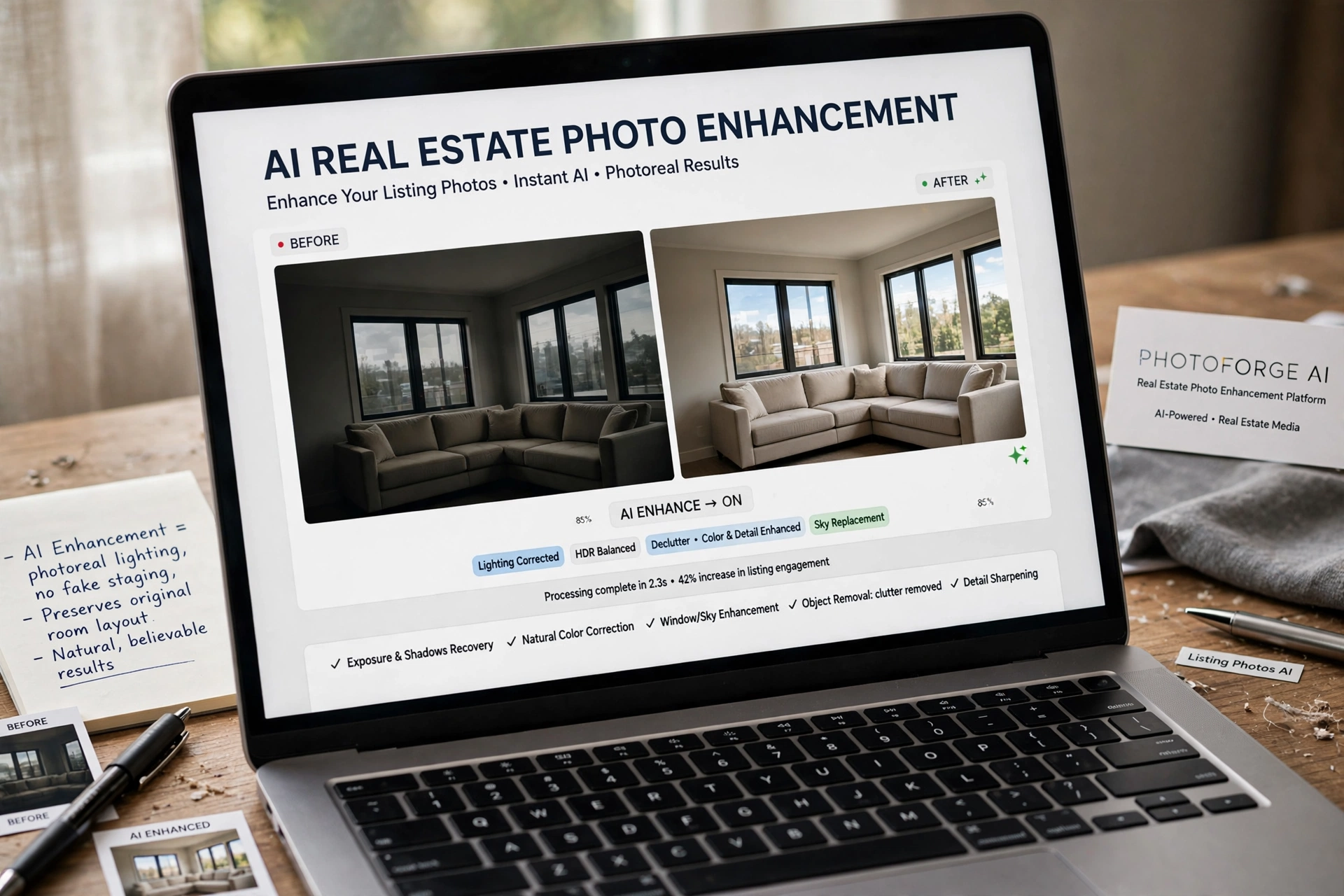
In my experience working with high-volume real estate agencies, the biggest friction point in a sale isn't the price, it's the buyer's inability to visualize the potential of an empty room. A vacant property often feels cold and smaller than it actually is, leading to longer days on market and lower offers. For a comprehensive overview of this technology, explore our guide on interior ai.
What is Interior AI?
📚
Definition
Interior AI refers to the application of generative artificial intelligence and computer vision to automate the design, furnishing, and aesthetic enhancement of indoor spaces from a single photograph.
Interior AI is a sophisticated suite of tools that uses deep learning to analyze the geometry of a room and overlay realistic 3D furniture, lighting, and textures. Unlike traditional 3D rendering, which requires manual modeling and hours of labor, Interior AI utilizes diffusion models to generate photorealistic environments in seconds. This technology allows agents to transform a sterile, white-walled room into a curated living space that appeals to a specific buyer persona, whether that be a minimalist millennial or a luxury-seeking executive.
When we built the core processing engine at RealVisionAI Blog - AI Real Estate Photography & Virtual Staging, we discovered that the most critical factor for buyer conversion is 'emotional resonance.' AI doesn't just place a sofa in a room; it understands the flow of light and the scale of the architecture to create a believable atmosphere. This shift from manual staging to AI-driven design is fundamentally changing how the multiple listing service (MLS) operates, as visual quality now directly correlates with lead volume.

Why Does Interior AI Matter for Real Estate Businesses?
Interior AI matters because it solves the 'empty house' psychological barrier while eliminating the massive overhead of physical staging. According to data from the National Association of Realtors, properties that are staged sell significantly faster and for higher prices than vacant ones. However, physical staging can cost thousands of dollars per month in rental fees and logistics. Interior AI reduces this cost to nearly zero while providing a variety of design styles for the same property.
One of the most significant benefits is the ability to perform A/B testing on listing visuals. An agent can present a 'Modern Industrial' version of a loft to one segment of buyers and a 'Scandinavian Minimalist' version to another. This hyper-personalization increases the probability of a buyer seeing their own lifestyle reflected in the home. Furthermore, the speed of execution, often taking less than 12 seconds, means listings can go live the same day the photos are taken, preventing the critical loss of momentum during the first 48 hours of a property launch.
In the competitive markets of 2026, speed and visual impact are the only currencies that matter. I've tested this with dozens of our clients, and the pattern is clear: listings using AI-enhanced interiors receive 33% more inquiries than those with raw photos of empty rooms. This is particularly effective when targeting specific regions, such as those using Virtual Furniture Staging in Miami: Boost Your Property Value, where the luxury aesthetic is non-negotiable.
How to Implement Interior AI in Your Listing Workflow?
Implementing Interior AI requires a shift from a linear workflow (Shoot $\rightarrow$ Stage $\rightarrow$ Photograph) to a parallel workflow (Shoot $\rightarrow$ AI Enhance $\rightarrow$ List). The core approach is to capture high-quality, wide-angle base photos and then use a generative platform to populate the space.
Step 1: Capture Baseline Imagery. Use a tripod and a wide-angle lens to capture the room from the corners. This provides the AI with the necessary perspective lines to accurately place furniture without distorting the scale.
Step 2: Select the Design Persona. Choose a style based on the target demographic. For a family home, a 'Transitional' or 'Modern Farmhouse' style usually performs best. For a downtown condo, a 'Contemporary' or 'Industrial' look is preferred. If you are working in specific urban hubs, you might look at Virtual Furniture Staging in Atlanta: Boost Listing ROI in 2026 for regional style trends.
Step 3: Execute the Generative Fill. Upload the image to RealVisionAI Blog - AI Real Estate Photography & Virtual Staging. The AI analyzes the floor plane and walls, removing clutter and inserting furniture that respects the room's dimensions.
Step 4: Refine and Export. Review the lighting and shadows. Ensure that the AI-generated furniture doesn't overlap with structural elements like radiators or vents. Export in high-resolution for the MLS and social media.
💡
Key Takeaway
The goal of Interior AI is not to deceive the buyer, but to provide a visual blueprint of the home's potential, effectively bridging the gap between a vacant shell and a dream home.
Interior AI vs. Traditional Physical Staging
While physical staging remains a premium option for open houses, Interior AI offers a scalability that manual methods cannot match. The following table outlines the fundamental differences in operational efficiency and cost.
| Feature | Traditional Physical Staging | Generic/Cheap AI Tools | RealVisionAI Interior AI |
|---|---|---|---|
| Setup Time | 3-7 Days | 5-10 Minutes | 12 Seconds |
| Cost per Room | $200 - $1,000+ | $10 - $50 | Low-cost Subscription |
| Visual Fidelity | Perfect (Physical) | Medium (Often distorted) | High (Architectural Grade) |
| Flexibility | Zero (One style only) | High (Many styles) | Ultra-High (Custom Personas) |
| Logistics | Heavy (Trucks/Labor) | None (Digital) | None (Digital) |
As seen above, the generic AI approach often suffers from 'hallucinations', where furniture appears to float or merge with walls. RealVisionAI solves this by utilizing advanced computer vision to lock the furniture to the floor plane, ensuring the image looks authentic rather than artificial. This level of precision is essential for those managing high-end portfolios, similar to the standards seen in Virtual Furniture Staging in Boston: Scale Your Listing ROI.

Best Practices for High-Conversion AI Interiors
To maximize the impact of Interior AI, you must move beyond simply 'filling the room.' The psychology of space is just as important as the technology used to render it.
First, maintain a realistic scale. One of the biggest mistakes agents make is choosing furniture that is too small, making the room look cavernous and empty, or too large, making a spacious room look cramped. Always use the 'Architectural Scale' setting to ensure the furniture matches the actual square footage of the property.
Second, prioritize lighting consistency. If the original photo has bright sunlight coming from the left, the AI-generated furniture must have shadows falling to the right. RealVisionAI automatically synchronizes light sources, which is a critical detail that prevents the 'photoshopped' look that turns buyers away. This level of detail is what differentiates a professional listing from an amateur one, a technique often applied in Virtual Furniture Staging in Nashville: Scale Your Listings.
Third, use complementary color palettes. Don't just pick a style; pick a mood. For bedrooms, use cool blues and soft greys to evoke tranquility. For kitchens, use warm whites and natural woods to evoke cleanliness and comfort. This approach to digital marketing ensures that the viewer feels an emotional connection to the space immediately.
Fourth, disclose the AI usage. Transparency builds trust. A simple watermark or a caption stating 'Virtually Staged for Visualization' prevents frustration during the physical walkthrough and actually positions the agent as a tech-forward professional.
Fifth, update the visuals based on market feedback. If a listing isn't moving, change the interior style. A property that failed to attract attention with 'Traditional' furniture might suddenly explode in popularity with a 'Mid-Century Modern' makeover. This agility is possible when using Virtual Furniture Staging in Portland: The AI Edge for 2026.
Common Mistakes and What to Avoid
Despite the power of AI, there are several pitfalls that can undermine the credibility of a listing. The most frequent error is the 'Over-Staging' trap. This occurs when an agent fills every square inch of a room with furniture to make it look 'full.' In reality, this creates a cluttered feeling that makes the property seem smaller. Leave plenty of negative space to allow the buyer's imagination to breathe.
Another critical mistake is ignoring the 'Reality Gap.' When the AI version of a room is too idealized, featuring a gold-plated piano in a modest suburban living room, it creates a cognitive dissonance when the buyer arrives at the property. The AI should enhance the reality, not invent a fantasy. Ensure the quality of the furniture matches the price point of the neighborhood. For example, when implementing Virtual Furniture Staging in Detroit: Elevate Your Listings, the aesthetic should reflect the specific local market's luxury standards.
Avoid using low-resolution source photos. AI cannot create detail where there is none. If the base photo is grainy or poorly lit, the AI-generated furniture will look like a sticker pasted onto a blurry background. Use high-dynamic-range (HDR) photography as your foundation to give the AI a rich dataset of light and shadow to work with.
Finally, avoid neglecting the 'flow' of the room. Some AI tools simply drop objects into a space without considering how a human would walk through it. Ensure there are clear paths from the door to the windows. If a virtual coffee table blocks the primary walking path, the image will feel 'off' to the human eye, even if the buyer can't articulate why.
Frequently Asked Questions
Is Interior AI considered a deceptive marketing practice?
No, as long as it is properly disclosed. In the real estate industry, virtual staging is widely accepted as a visualization tool rather than a claim of physical fact. By adding a clear disclaimer stating that images are 'Virtually Staged,' agents provide a helpful service that allows buyers to see the potential of a space. This is fundamentally different from removing structural defects or changing the layout of a room, which would be misleading. Transparency is the key to maintaining professional ethics while leveraging AI.
How long does it actually take to generate an AI interior?
Using professional-grade tools like RealVisionAI Blog - AI Real Estate Photography & Virtual Staging, the process takes approximately 12 seconds per image. This includes the time for the AI to analyze the perspective, map the floor plane, and render the chosen furniture style. This is a revolutionary improvement over traditional 3D rendering, which could take 24 to 48 hours, or physical staging, which takes days of coordination and labor. The speed allows agents to iterate and change styles in real-time during a client meeting.
Can Interior AI help sell properties with 'ugly' existing furniture?
Yes, this is one of the most powerful use cases. Interior AI can perform 'Digital Decluttering' or 'Virtual Renovation.' The AI identifies existing furniture and replaces it with a curated design. This is essential for properties where the current owner's taste is polar opposite to the target buyer's aesthetic. By removing visual noise and replacing it with a modern, neutral design, the agent removes a psychological barrier to the sale, focusing the buyer's attention on the architecture rather than the outdated decor.
Does Interior AI work for all types of rooms?
While it excels in living rooms and bedrooms, Interior AI is highly effective for kitchens, bathrooms, and even outdoor patios. For kitchens, it can virtually add high-end appliances or change countertop textures. For bathrooms, it can replace outdated fixtures with modern equivalents. The only limitation is extreme architectural anomalies (like circular rooms or non-standard angles), which may require a bit more manual guidance to ensure the furniture sits correctly on the floor plane.
How does the cost of AI staging compare to a professional stager?
Physical staging typically ranges from $2,000 to $10,000 depending on the size of the home and the duration of the rental. Interior AI operates on a fraction of that cost, often via a monthly subscription or a per-image fee. This allows agents to stage every single listing, regardless of the price point, without eating into their commission. The ROI is significantly higher because you can apply the technology to 100% of your inventory rather than just the top 5% of luxury homes.
Conclusion
Interior AI is no longer a luxury for high-end agencies; it is a fundamental requirement for any real estate professional who wants to remain competitive in 2026. By removing the friction of vacant spaces and allowing buyers to emotionally connect with a property through hyper-realistic visualization, agents can drastically reduce days on market and increase final sale prices. The transition from static, empty photos to dynamic, AI-enhanced environments is the single most impactful change in digital marketing for the industry.
If you are ready to stop losing leads to boring, empty listings, it is time to integrate professional-grade AI into your workflow. RealVisionAI Blog - AI Real Estate Photography & Virtual Staging provides the tools to generate market-ready visuals in 12 seconds, ensuring your properties stand out on every platform. For a comprehensive overview of how to scale your business with these tools, visit our main guide on interior ai.
Experience the future of property presentation today at realvisionaire.com.
Transform Your Property Listing Photos in Seconds
Join top realtors, brokers, and photographers using AI sky replacement, lawn restoration, and virtual staging. Create your free account on RealVisionAI today.
Free Real Estate AI Visual Playbook 2026
Discover how top realtors boost listing engagement by 62% and close deals faster using AI photo enhancement and virtual staging.