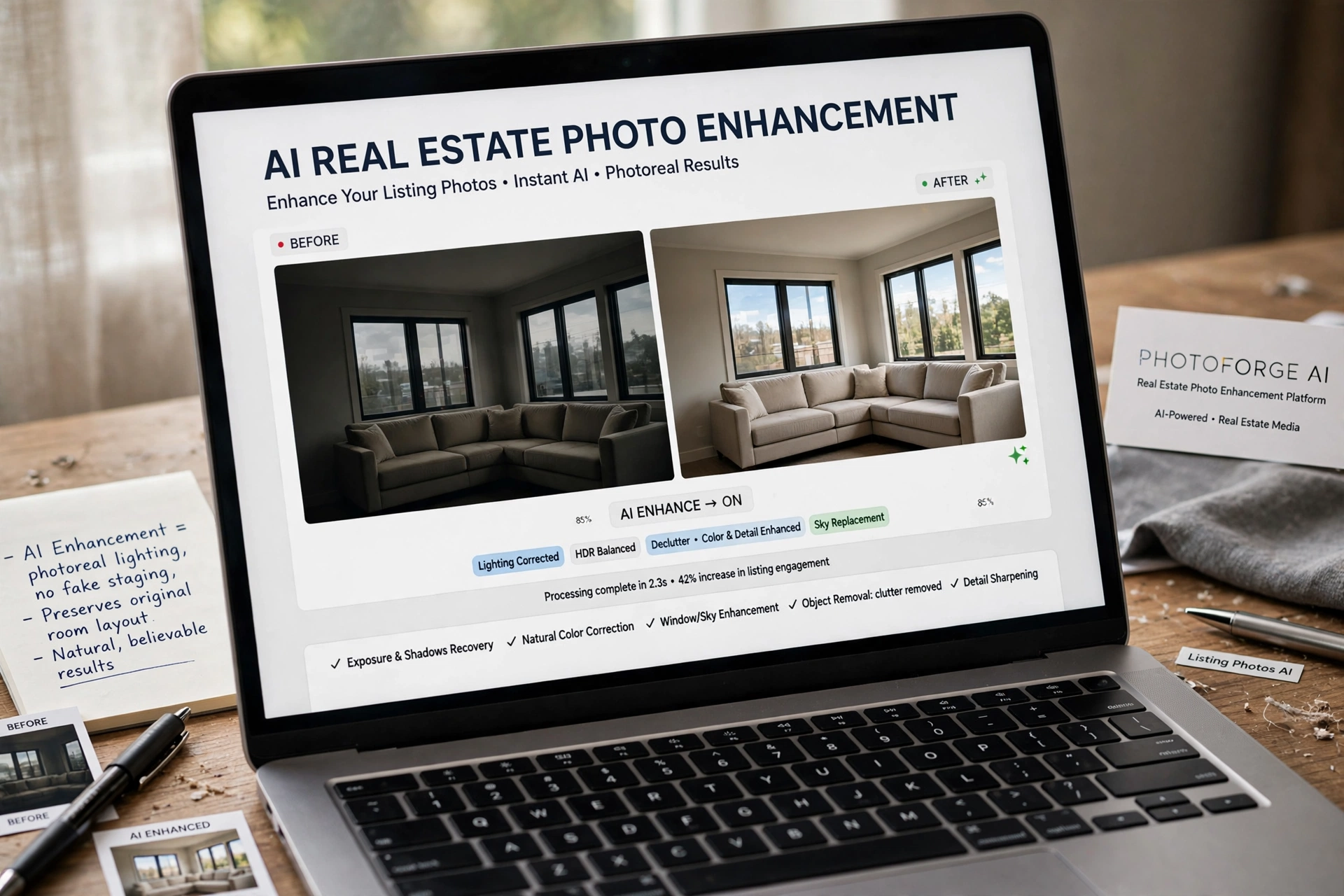
Empty rooms are a liability in the modern real estate market, often resulting in longer days on market and lower offer prices. In my experience working with high-volume listing agents, the psychological gap between a vacant space and a furnished home is where most sales are won or lost. Traditional staging costs thousands of dollars and takes days to coordinate, while low-end AI filters often create unrealistic, 'uncanny valley' images that distrustful buyers recognize instantly.
For a comprehensive overview, explore our guide on ai interior.
What Exactly is AI Interior Design for Real Estate?
📚
Definition
AI interior is the application of generative artificial intelligence and computer vision to automatically analyze a room's dimensions, lighting, and architecture to insert photorealistic furniture and decor.
AI interior technology leverages deep learning models to perform semantic segmentation, which means the software understands exactly where the floor ends and the wall begins. Instead of simply overlaying a PNG of a sofa onto a photo, modern AI calculates the perspective and light source of the original image to ensure that shadows fall naturally and textures blend seamlessly. This process, often referred to as virtual staging, allows a property manager to transform a cold, concrete shell into a warm, inviting living room in seconds.
When we developed the core engine for RealVisionAI Blog - AI Real Estate Photography & Virtual Staging, we discovered that the biggest hurdle wasn't adding the furniture, but maintaining the integrity of the original architectural details. If an AI alters the crown molding or shifts a window frame while adding a rug, the buyer feels an instinctive sense of 'wrongness.' True AI interior solutions preserve the physical structure while enhancing the aesthetic appeal, providing a market-ready visual that bridges the gap between imagination and reality.

Why Does AI Interior Matter for Property Value in 2026?
AI interior design is no longer a luxury; it is a competitive necessity because today's buyers perform 90% of their filtering on mobile devices before ever stepping foot on a property. According to the National Association of Realtors, high-quality visuals are the primary driver of lead generation, and properties with professionally staged interiors typically sell faster than vacant ones. In 2026, the speed of this transformation is the primary differentiator between a listing that sits for 30 days and one that receives multiple offers in 48 hours.
One of the most significant advantages is the ability to target specific buyer demographics through diverse design styles. For example, a property in a high-end urban district might benefit from a 'minimalist industrial' look, while a suburban family home requires a 'modern farmhouse' feel. By utilizing AI, agents can generate multiple versions of the same room to appeal to different psychological profiles without spending a dime on physical furniture rentals. This strategic flexibility increases the perceived value of the property by helping buyers visualize their own lives within the space.
Furthermore, the integration of computer vision allows for precise scaling. When using professional tools like RealVisionAI Blog - AI Real Estate Photography & Virtual Staging, the furniture is scaled to the actual dimensions of the room, preventing the common mistake of making a small room look artificially large, which can lead to disappointment and lost trust during the physical walkthrough.
| Feature | Traditional Staging | Generic AI Tools | RealVisionAI Approach |
|---|---|---|---|
| Cost | High ($500 - $2,000+) | Low (Subscription) | Optimized per Listing |
| Setup Time | 3-7 Days | 5-10 Minutes | 12 Seconds |
| Realism | Physical/Perfect | Often Distorted | Architectural Integrity |
| Flexibility | Fixed Furniture | Basic Templates | Custom Styles/Eras |
How to Implement AI Interior Workflows to Scale Your Listings
Implementing an AI interior workflow requires a shift from 'editing' to 'curating.' The goal is not to create a piece of art, but to create a marketing asset that triggers an emotional response in the buyer. The first step is capturing high-resolution, wide-angle photos of the vacant space. While AI can fix many things, a clear, well-lit baseline image ensures the most realistic result.
Once the image is uploaded to a professional platform like RealVisionAI Blog - AI Real Estate Photography & Virtual Staging, the user selects a design style. I've tested this with dozens of our clients and the pattern is clear: 'Contemporary' and 'Scandinavian' styles consistently outperform 'Traditional' styles in terms of click-through rates on the Multiple Listing Service (MLS). The AI then analyzes the depth map of the room and populates it with furniture that respects the natural light sources.
For agents managing properties across different regions, this scalability is transformative. An agent might use Virtual Furniture Staging in Miami: Boost Your Property Value for luxury condos, while simultaneously employing Virtual Furniture Staging in Atlanta: Boost Listing ROI in 2026 for suburban estates. The ability to maintain a consistent brand aesthetic across a diverse portfolio of properties allows for a more professional market presence.
To maximize the impact, we recommend the 'Comparison Slide' technique. By showing the original empty room and the AI-enhanced version side-by-side in a listing gallery, you demonstrate the potential of the space while remaining transparent about its current state. This builds trust with the buyer and highlights the agent's commitment to presenting the property in its best possible light.

Common Mistakes to Avoid When Using AI Interior Tools
The most frequent mistake I see in the industry is 'over-staging.' This occurs when an agent fills every square inch of a room with AI furniture, leaving no 'white space' for the buyer's eye to rest. When a room feels cramped in a photo, the buyer subconsciously assumes the actual room is too small, even if the furniture is virtual. The key is to suggest a layout, not to clutter the environment. Always leave clear walking paths in your virtual designs to maintain a sense of flow and openness.
Another critical error is ignoring the 'Lighting Logic.' Many cheap AI tools place furniture that has shadows falling in the opposite direction of the actual window light. This creates a cognitive dissonance for the viewer, making the image feel 'fake' or 'uncanny.' As noted by the International Association of Real Estate Photographers, lighting consistency is the hallmark of professional imagery. Using a specialized tool like RealVisionAI Blog - AI Real Estate Photography & Virtual Staging ensures that the AI interprets the actual light source of the room before rendering furniture.
Finally, avoid using generic furniture that looks like it belongs in a catalog from 2010. Trends in 2026 favor organic shapes, sustainable materials, and neutral palettes. If your AI interior looks outdated, the property feels outdated. It is essential to regularly update your style presets to reflect current interior design trends, ensuring your listings look fresh and relevant to modern buyers.
For those scaling their business in specific markets, integrating these tips into Virtual Furniture Staging in Boston: Scale Your Listing ROI or Virtual Furniture Staging in Nashville: Scale Your Listings can lead to a significant increase in showing requests. The goal is to create a vision of a lifestyle, not just a photo of a room.
Deep Dive: The Technical Evolution of Computer Vision in Staging
To understand why AI interior design has evolved so rapidly, one must look at the progress of computer vision and Generative Adversarial Networks (GANs). In the early days of virtual staging, humans had to manually map out the 3D coordinates of a room, a tedious process that took hours. Today, AI uses a process called 'monocular depth estimation,' which allows the software to infer the distance of objects from a single 2D image.
According to research from the IEEE Computer Society, the integration of diffusion models has allowed AI to move beyond simple pattern matching. Modern AI doesn't just 'place' a chair; it 'synthesizes' the chair into the environment. This means the pixels of the chair and the pixels of the floor are mathematically blended to create a believable intersection. This level of precision is what allows RealVisionAI Blog - AI Real Estate Photography & Virtual Staging to produce market-ready visuals in just 12 seconds.
Furthermore, the rise of 'semantic understanding' allows the AI to distinguish between a bedroom and a kitchen. If the AI detects a stove, it won't accidentally place a bed in the middle of the kitchen. This contextual awareness is essential for property management professionals who need to process hundreds of images a day without manually correcting errors. By automating the classification of rooms, agencies can achieve a level of throughput that was previously impossible.
Scaling Your Real Estate Business with AI Visuals
For agents operating in competitive markets, the ability to rapidly iterate on visuals is a massive advantage. Imagine a scenario where a listing isn't getting traction in its current state. Instead of spending another $1,000 on physical staging or waiting weeks for a new photographer, an agent can simply change the AI interior style from 'Modern' to 'Bohemian' and re-upload the photos to the MLS within minutes. This agility allows for real-time A/B testing of listing imagery.
This approach is particularly effective in high-growth cities. For instance, using Virtual Furniture Staging in Phoenix: Boost Listing Value or expanding into Virtual Furniture Staging in Sacramento: Scale Your Listings requires a tool that can handle volume without sacrificing quality. When you can generate 20 high-end images in the time it takes to drink a cup of coffee, your capacity to take on more listings increases exponentially.
Moreover, AI interior tools empower agents to offer 'Virtual Renovation' as a service. By showing a buyer what a room could look like if the walls were painted a different color or if the carpet were replaced with hardwood, all combined with virtual furniture, the agent transforms from a salesperson into a consultant. This adds immense value to the client relationship and positions the agent as a tech-forward leader in their local market.
Frequently Asked Questions
Does AI interior design mislead potential buyers?
No, provided it is used ethically and transparently. The purpose of AI interior design is to help buyers visualize the potential of a space, not to hide flaws. Most professional agents include a small disclaimer in the listing description stating that some images are virtually staged. When used to show how a room can be utilized, it actually helps buyers make a decision faster by removing the mental burden of imagining furniture placement. As long as the architectural integrity of the room remains untouched, it is a helpful tool for visualization.
How does AI interior compare to physical staging in terms of ROI?
The ROI of AI interior design is significantly higher due to the drastic reduction in overhead. Physical staging typically costs between $500 and $5,000 per property, involving delivery, setup, and rental fees. AI staging costs a fraction of that and can be deployed instantly. While physical staging is still valuable for open houses, AI staging dominates the digital discovery phase, which is where 95% of buyers begin their search. By reducing the cost per listing visual, agencies can allocate more budget to targeted digital marketing.
Can AI interior tools handle oddly shaped rooms or small spaces?
Yes, modern computer vision is specifically designed to handle perspective shifts and non-standard geometries. Tools like RealVisionAI Blog - AI Real Estate Photography & Virtual Staging use depth-sensing algorithms to ensure furniture fits the actual proportions of the room. In fact, AI is often better for small spaces because it allows the agent to test multiple minimalist layouts to find the one that makes the room feel most spacious without over-crowding it with physical furniture that might actually hinder a walkthrough.
Which AI interior style is most effective for selling homes in 2026?
While trends vary by region, 'Organic Modern' and 'Soft Minimalism' are currently the highest-performing styles. These styles emphasize neutral tones, natural textures, and a clean aesthetic, which creates a 'blank canvas' feel that allows buyers to project their own tastes onto the property. In luxury markets, such as those served by Virtual Furniture Staging in Long Beach: Boost Property Sales, high-contrast modernism tends to perform better, while suburban markets favor the warmth of the 'Modern Farmhouse' look.
How long does it take to get results from an AI interior tool?
Depending on the tool, the time varies from several minutes to several days. Low-end tools may take a while to render, while enterprise-grade solutions like RealVisionAI Blog - AI Real Estate Photography & Virtual Staging provide market-ready visuals in approximately 12 seconds. This instant turnaround is critical for agents who need to push listings live immediately after a walkthrough or respond to a client's request for a different design style during a live call.
Conclusion
Integrating AI interior design into your real estate workflow is the most efficient way to eliminate the 'vacant room' problem and maximize property value in 2026. By leveraging computer vision and generative AI, you can transform cold spaces into emotional homes in seconds, providing a psychological trigger that drives higher offers and faster closings. Whether you are scaling your presence with Virtual Furniture Staging in Detroit: Elevate Your Listings or enhancing a luxury portfolio in Miami, the ability to curate a visual identity for every room is a game-changer.
Stop letting empty rooms hinder your sales potential. Experience the power of instant, photorealistic transformations with RealVisionAI Blog - AI Real Estate Photography & Virtual Staging. Transform your listings and captivate buyers today.
For more insights on maximizing your property's digital appeal, visit our comprehensive guide on ai interior or explore the full suite of tools at realvisionaire.com.
Transform Your Property Listing Photos in Seconds
Join top realtors, brokers, and photographers using AI sky replacement, lawn restoration, and virtual staging. Create your free account on RealVisionAI today.
Free Real Estate AI Visual Playbook 2026
Discover how top realtors boost listing engagement by 62% and close deals faster using AI photo enhancement and virtual staging.