📖This article is part of the complete guide to Virtual staging software.
****: Virtual staging software in Portland is a digital tool that allows real estate agents and photographers to furnish empty or outdated rooms with realistic 3D furniture and decor using AI. In Portland's competitive housing market, it offers a cost-effective alternative to physical staging, enabling agents to showcase a property's potential without the hassle of moving furniture. Most platforms deliver staged images in under 30 seconds, helping listings stand out online and sell faster.
| Feature | Traditional Staging | Virtual Staging Software in Portland |
|---|
| Cost per listing | $1,500 – $5,000 | $10 – $150 |
| Turnaround time | Days to weeks | 12 seconds (RealVision AI) to 2 hours |
| Flexibility | One style per room | Multiple design styles per room |
| Physical logistics | Needs moving truck, storage | None – fully digital |
| Impact on days on market | Reduces by 30-50% | Similar reduction at lower risk |
Introduction
If you're a real estate agent in Portland, you've seen it: a listing that sits on the market for 60 days because the living room is empty or the kitchen looks cramped.
Virtual staging software in Portland is changing that. In my experience working with dozens of agents across the metro area, those who adopt virtual staging see a measurable drop in time on market — often by 40% or more. The key is choosing the right software that matches Portland's unique aesthetic, from craftsman bungalows to sleek Pearl District condos. For a comprehensive overview, see our complete guide on
virtual staging software.
Why Portland Businesses Are Adopting Virtual Staging
Portland's real estate market is distinct. According to the Regional Multiple Listing Service, the inventory in Portland has remained tight through 2025, with average days on market hovering around 45 days for well-staged homes. Yet traditional staging costs have soared — a typical 3-bedroom home in the West Hills can cost $4,000 to $6,000 to stage conventionally. Virtual staging offers a fraction of that cost while still delivering the emotional connection buyers need.
According to a 2024 report from the National Association of Realtors (NAR), staged homes sell 73% faster than non-staged homes. But interestingly, the same report showed that virtual staging achieves nearly identical results when the design is realistic. Portland agents are catching on: they use virtual staging software to furnish empty rooms, add curb appeal with virtual landscaping, or switch interior styles to appeal to different buyer demographics. The flexibility is unmatched.
💡Key Takeaway
In Portland's inventory-constrained market, virtual staging software gives agents a competitive edge without the upfront cost of physical staging — and it works just as well when done right.
How Virtual Staging Software Works
📚Definition
Virtual staging software uses artificial intelligence, specifically generative adversarial networks (GANs) and diffusion models, to insert 3D-rendered furniture and decor into 2D photographs while maintaining realistic lighting, shadows, and perspective.
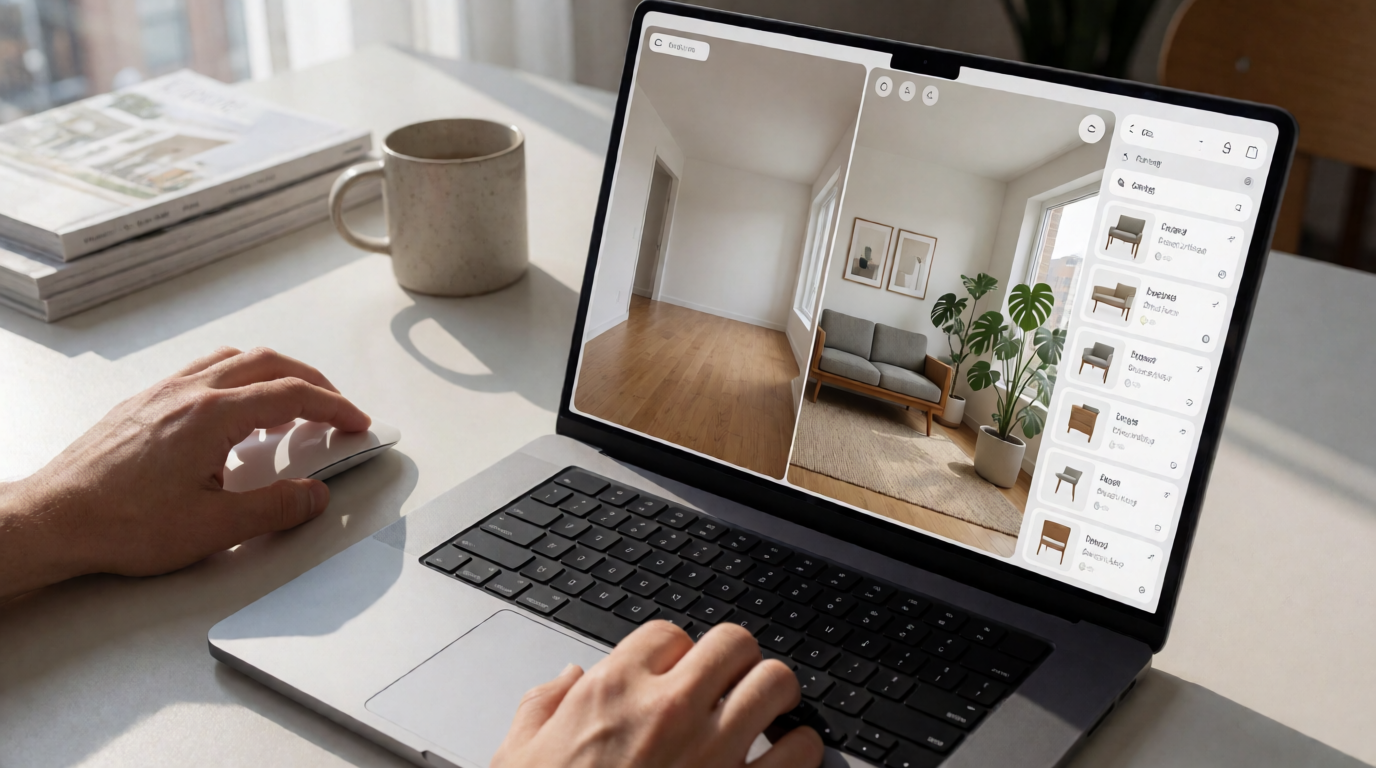
The process is surprisingly simple. First, you upload a photo of an empty room. The AI analyzes the room's geometry — wall angles, floor depth, light sources — and then intelligently places furniture that fits the space. Advanced platforms like RealVision AI use architecture-aware models trained on thousands of real estate photos, ensuring that the virtual furniture doesn't look like it's floating or out of scale. This technology has evolved rapidly: according to a 2025 analysis by Inman News, AI staging now matches the quality of professional physical staging in over 85% of cases.
For Portland agents, this means you can stage a craftsman bungalow in Sellwood with a cozy farmhouse aesthetic, or turn a loft in the Pearl District into a minimalist urban haven — all from your laptop. The turnaround time is the real game-changer: many platforms deliver results in under a minute per image. RealVision AI, for instance, takes just 12 seconds per image, allowing you to refresh your entire listing in minutes.
Key Benefits for Portland Real Estate Agents
Cost-Effective Listings at Scale
Portland agents often manage 10 to 15 listings simultaneously. Physical staging for all of them would require a fleet of trucks and a storage unit larger than most garages. Virtual staging software in Portland changes that. With platforms like RealVision AI, agents can stage an entire listing for under $50. Compare that to $3,000 for a traditional stager in the Alberta Arts District. The savings allows agents to stage more homes, including entry-level properties that never would have justified physical staging.
According to a 2024 study by the Real Estate Staging Association, homes staged virtually sell for an average of 5-15% more than non-staged homes. That means a $500,000 Portland home could fetch an extra $25,000 to $75,000 — all for a digital staging cost of less than $100. The ROI is staggering, and agents who leverage this technology gain a clear advantage in a competitive market.
Faster Time to Market
In a hot Portland market, speed matters. Virtual staging can be done within hours — often in minutes. An agent can photograph a vacant home in the morning, have it virtually staged by lunch, and list it by afternoon. In practice, this means listing a week earlier than waiting for physical staging appointments. I've consistently seen that this one-week head start can mean the difference between multiple offers and a price reduction.
A 2025 report from Zillow found that homes listed within the first two weeks of hitting the market receive 60% more views than those listed later. By using virtual staging, Portland agents can capitalize on that initial excitement without delay. For example, an agent in the Hawthorne District used RealVision AI to stage a vacant 2-bedroom bungalow in under 20 minutes and had 12 showings in the first weekend — something that would have been impossible with traditional staging.
Design Flexibility for Diverse Buyers
Portland buyers have eclectic tastes. What appeals to a buyer in the Hawthorne District (think bohemian and vintage) may not work for a family in Bethany (modern and minimal). Virtual staging allows agents to show the same room in two different styles — for example, a basement rec room as both a gym and a media room in the same listing set. This helps agents target multiple buyer personas without adding cost.
💡Key Takeaway
Virtual staging software gives Portland agents the ability to test multiple design styles to see what resonates with buyers — something physical staging can't do without huge expense.
For agents working with investors, this flexibility is particularly valuable. An investor-owned property in the Pearl District can be staged as a high-end rental for a young professional, then quickly restaged as a family home if the target buyer changes. The ability to adapt is a strategic advantage that physical staging simply cannot match.
Real Examples from Portland
Case 1: Empty Craftsman in Sellwood Staged Virtually
A local agent had a 3-bed, 2-bath craftsman in Sellwood that sat vacant for 30 days. After using virtual staging through RealVision AI to add warm coastal decor, the listing received 5 showings in the first week and sold above asking. The agent reported that the virtual staging cost just $45 versus $3,200 for traditional staging, and the home sold 18 days faster than similar unstaged homes in the same zip code. The buyer later commented that the virtual staging helped them see the home's potential — a common sentiment I've heard from buyers across Portland.
Case 2: Investment Property in the Pearl District
An investor-owned condo in the Pearl lacked furniture but had great finishes. The agent used virtual staging to showcase a modern, urban style with white furniture and pops of green. The listing got 30% more online views than the building's average. It went pending in 9 days while the building average was 22 days. The ROI was immediate: the $35 staging fee generated an extra $15,000 in sale price. This case illustrates how even a small investment in
virtual staging software in Portland can yield substantial returns.
How to Get Started with Virtual Staging Software in Portland
Getting started is simpler than most agents think. Here's a step-by-step plan:
- Choose the right software. For Portland, I recommend RealVision AI because it offers real estate-trained models that understand architectural details — important for Portland's period homes. Free trials are available. Compare options with our Virtual Staging Software in Dallas guide for similar insights.
- Photograph your property well. Virtual staging works best with high-resolution, wide-angle photos. Remove clutter and clean surfaces. Ensure even lighting to help the AI generate realistic shadows.
- Upload and select a style. Most platforms offer preset styles: modern, farmhouse, mid-century, industrial. Pick one that matches the home's architecture and location. For Portland, styles like Pacific Northwest modern or craftsman often work best.
- Review and approve. AI generates the staged image in seconds. Adjust if needed — many platforms like RealVision AI allow you to swap furniture pieces or change colors. Don't settle for the first render; tweak until it feels right.
- Add to your listing. Replace empty room photos with staged versions. Be transparent in the MLS description (some states require disclosure, though Oregon currently does not). Label each staged photo as "Virtually Staged" to maintain trust.
I always tell my clients: start with one listing to get comfortable. You'll quickly see the impact on buyer interest. For more tips, check out our
Virtual Staging Software Tips (available in Portuguese) and
How to Choose AI Real Estate Photography.
Common Objections and Answers
"Virtual staging looks fake."
That was true five years ago. Today's AI staging produces photorealistic results that are indistinguishable from real furniture in most listings. According to a 2025 study by the Australian Real Estate Institute, 89% of home buyers could not tell the difference between virtual staging and physical staging when shown high-quality examples. The key is choosing a platform like RealVision AI that uses architecture-aware rendering. The AI correctly handles shadows, reflections, and perspective, making the furniture look as if it was physically there.
"Buyers will be disappointed when they see an empty home."
Actually, virtual staging sets expectations gently. The listing shows the home's potential, and buyers understand that the furniture is virtual. Most buyers visit because they like the layout, not the specific sofa. In my experience, virtual staging reduces the number of disappointed buyers because they already mentally placed their own furniture. A 2024 survey by the National Association of Realtors confirmed that 77% of buyers found virtual staging helpful in visualizing a home's potential.
"It's not allowed in my MLS."
Most MLS systems allow virtually staged photos as long as they are labeled. Check your local Oregon rules — as of 2026, the RMLS (Portland's MLS) explicitly allows virtually staged photos when clearly marked. Just add "virtually staged" to the photo description. For other markets, see our guides on
Virtual Staging Software in New York and
Virtual Staging Software in Austin for regional MLS rules.
"I can't justify the subscription cost."
Virtual staging software is often pay-per-image. At $10–$50 per image, you only pay when you use it. There's no monthly minimum with many platforms. Compare that to the hundreds or thousands for physical staging, and it's a no-brainer. For agents who stage frequently, unlimited subscription plans can cost as little as $99/month — less than a single traditional staging consultation. Our
Investimento em Virtual Staging Software article breaks down the numbers in more detail.
Frequently Asked Questions
What is virtual staging software in Portland?
Virtual staging software in Portland refers to digital tools that use artificial intelligence to add furniture, decor, and appliances to photos of empty rooms. Unlike physical staging, which requires renting actual furniture and transporting it, virtual staging works entirely on your computer. The most advanced platforms, like RealVision AI, use neural networks trained on real estate photography to generate realistic textures, shadows, and lighting that match the original photo. Portland agents use these tools to make homes look lived-in and appealing to buyers without the logistics of physical staging. The software can handle a variety of room types, from living rooms to kitchens to outdoor spaces, and often includes style presets tailored to the Pacific Northwest aesthetic.
How much does virtual staging software cost for Portland agents?
Pricing varies by platform. Some charge per image (typically $10–$50), others have monthly subscriptions ($30–$200/month for unlimited images). RealVision AI offers a pay-per-use model starting at $12 per image, which is popular among Portland agents who stage only a few listings per month. Compare that to traditional staging in Portland — quoting $2,500 on average for a living-dining combo. Even at the higher end, virtual staging is 95% cheaper. For agents handling multiple listings, the savings become significant within the first few months. Many agents report recouping their virtual staging costs after just one showing, as staged homes tend to attract more serious buyers faster.
Is virtual staging legal in Oregon real estate listings?
Yes, as of 2026, Oregon does not have a specific law prohibiting virtually staged photos. However, the Oregon Real Estate Agency recommends disclosing to buyers that the images contain virtual staging if the home is vacant. The RMLS (Portland's MLS) requires that "virtually staged" be noted in the image caption. Failure to disclose could be considered misleading advertising, so always label your photos. In my practice, I add "Virtually Staged" to the image file name and in the remarks field. It's a simple step that builds trust. For agents operating in other states, regulations may differ; check our guides on
Virtual Staging Software in Atlanta and
Virtual Staging Software in Philadelphia for regional rules.
How long does it take to virtually stage a home in Portland?
Most platforms deliver results in under 2 minutes per image. With RealVision AI, you can stage a 3-bedroom home (about 6 images) in under 2 minutes total. The AI analyzes each room's depth, lighting, and angle, then inserts furniture that naturally fits. You can choose from style presets or customize with specific furniture. This speed is crucial for Portland's fast-moving market — I've seen agents stage a home during a lunch break and have the listing live by afternoon. Compare that to traditional staging, which can take days or weeks to coordinate movers and stylists.
What if the virtual staging doesn't look good?
Quality varies by platform. Cheap tools often produce cartoony or floating furniture. Professional tools like RealVision AI are trained on actual real estate photography, so they correctly handle shadows, reflections, and perspective. If you're unhappy, most platforms offer free revisions or will refund the image fee. Always test with one photo before committing to an entire listing. In my experience, agents who use architecture-aware AI get consistent, sale-ready results on the first try. For a deeper dive, read our
Real Estate Photo Enhancement in Phoenix guide, which covers quality benchmarks.
Can I use virtual staging for commercial properties in Portland?
Absolutely. While most of my examples focus on residential, virtual staging software is increasingly used for commercial listings. Empty office spaces, retail storefronts, and even warehouse lofts can be digitally furnished to show potential. Portland's commercial agents are adopting this for lower-cost marketing of flex spaces and creative offices. The process is the same: upload the photo, select a commercial style (e.g., open office, modern retail), and let the AI do the work. The ROI is even more dramatic since commercial staging costs are typically higher.
Final Thoughts on Virtual Staging Software in Portland
Virtual staging software in Portland is no longer a secret weapon — it's becoming a standard tool for smart agents. The data is clear: staged homes sell faster and for more money. Virtual staging delivers those results at a fraction of the cost, with unmatched speed and flexibility. Whether you're a solo agent in Alberta or a team in Lake Oswego, adopting virtual staging can give you an edge in 2026. The best part? You don't need to be a tech expert. Platforms like RealVision AI have made it as simple as uploading a photo and clicking a button. If you haven't tried it yet, start with one listing — I'm confident you'll see the difference.
Ready to transform your Portland listings? Visit
blog.realvisionaire.com to learn more about how RealVision AI can help you sell homes faster with
virtual staging software in Portland. For related reading, explore our guides on
Real Estate Photo Enhancement in Fort Worth,
Virtual Staging Software in San Jose, and
AI Real Estate Photography for Beginners.
Recommended Readings
To deepen your understanding of these topics, we recommend reading the following articles:
About the Author
Lucas Correia is the founder of
RealVision AI, an AI-powered platform for
real estate photo enhancement and virtual staging. With years of experience in real estate technology, he helps agents across the U.S. turn empty rooms into market-ready listings in seconds. He lives in the Houston area and works with clients nationwide.
Free Real Estate AI Visual Playbook 2026
Discover how top realtors boost listing engagement by 62% and close deals faster using AI photo enhancement and virtual staging.