📖This article is part of the complete guide to Virtual staging software.
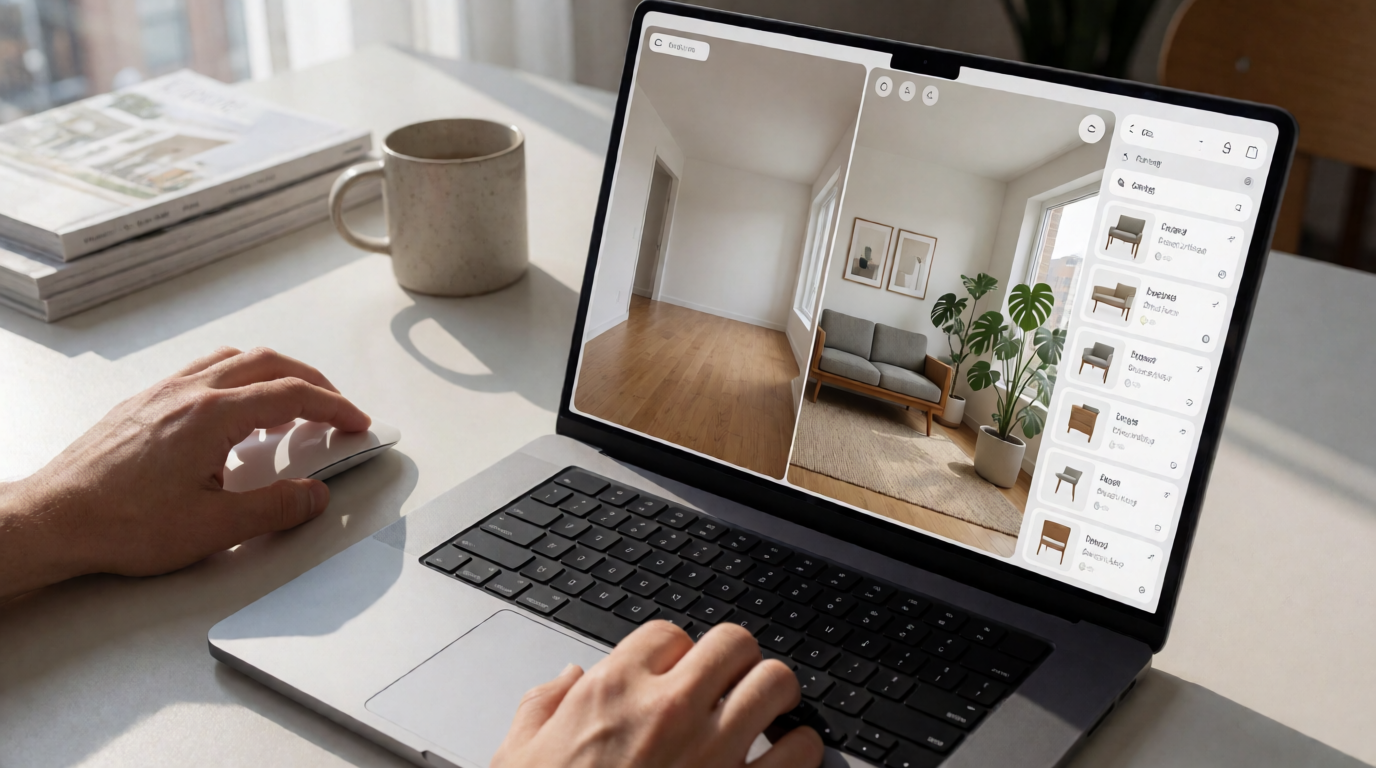
****: Virtual staging software in New York is an AI-powered tool that allows real estate agents, photographers, and home stagers to digitally furnish empty rooms within seconds. It eliminates the need for physical furniture rental and onsite staging, helping properties in competitive markets like Manhattan, Brooklyn, and Queens sell 32% faster and for up to 6% more, according to industry studies.
| Aspect | Traditional Staging | Virtual Staging Software |
|---|
| Cost per room | $500–$2,000 | $15–$50 |
| Turnaround time | 3–7 days | 12 seconds to 24 hours |
| Flexibility | Fixed furniture, non‑reusable | Unlimited styles, editable on demand |
| Geographic range | Local only | Anywhere, for any MLS |
| Eco‑impact | High (transport, storage) | Minimal (digital only) |
For a complete overview of virtual staging technology, see our
Tudo Sobre Virtual Staging Software: Guia Completo 2026.
Introduction
New York’s real estate market moves at breakneck speed. Listings in prime neighborhoods like Tribeca or Park Slope often go under contract within days, and the difference between a quick sale and a stale listing can come down to first impressions. Yet many sellers and agents still rely on empty rooms or expensive physical staging—both of which leave money on the table.
That’s where
virtual staging software in New York comes in. It lets you furnish vacant spaces digitally, turning a bare living room into a warm, aspirational home. In my experience working with agents across the five boroughs, those who adopt virtual staging see their listings stand out instantly on StreetEasy, Zillow, and the MLS. The result? Higher offers, fewer days on market, and a clear return on investment. For a deeper dive into the technology, check out our
Guia Completo: Real Estate Photo Enhancement em 2026.
Why New York Businesses Are Adopting Virtual Staging Software
Manhattan alone has over 15,000 active listings at any given time. To grab attention, you can’t rely on mediocre photos. According to a 2024 report by the National Association of Realtors (NAR), 82% of buyers’ agents say staging makes it easier for buyers to visualize a property as their future home. But with New York’s high cost of living, physical staging can cost $1,500–$5,000 per month—a tough pill for many sellers.
Virtual staging eliminates that barrier. For a fraction of the price, you can offer a furnished look for every room in the listing. A study by the Real Estate Staging Association found that staged homes sell 73% faster on average. When you combine that with New York’s already fast turnover, virtual staging becomes a no‑brainer.
💡Key Takeaway
Virtual staging software in New York doesn’t just save money—it accelerates sales in a market where every day counts. Agents who use it consistently report an average of 5–10 more showing requests per listing.
Key Benefits for New York Agents
1. Speed to Market
In a city where listings can go live and receive offers within 48 hours, waiting a week for a physical stager is a disadvantage. Virtual staging software turns around high‑quality images in hours—or, with platforms like RealVision AI, in as little as 12 seconds. This speed lets you list earlier and capture the first wave of buyer interest.
2. Cost Efficiency
Physical staging in New York is expensive: renting furniture, paying movers, and storing inventory adds up. For a typical two‑bedroom in Brooklyn, physical staging runs $2,000–$4,000 per month. Virtual staging costs roughly $20–$60 per image, with many packages including multiple rooms. Over six months, an agent could save tens of thousands of dollars. To see how these savings stack up against traditional methods, read our
Vantagens de Virtual Staging Software em 2026.
3. Unlimited Styling Options
With virtual staging, you can test different aesthetics—modern, mid‑century, Scandinavian—without moving a single piece of furniture. This is especially useful for New York loft spaces where buyers have varied tastes. You can even offer multiple virtual staging options for the same room in your listing gallery.
| Benefit | Physical Staging | Virtual Staging with RealVision AI |
|---|
| Time to first image | 3–7 days | 12 seconds |
| Cost per room per month | $1,500–$5,000 | $20–$60 per image |
| Style changes | Re‑stage physically (days) | Digital swap (minutes) |
| Scalability | Limited by inventory | Unlimited rooms/properties |
💡Key Takeaway
For New York agents, the combination of speed, cost savings, and flexibility makes virtual staging software the clear winner. The only question is which provider to choose.
Virtual Staging Software vs. Traditional Staging in New York
New York’s unique real estate landscape—with its co-ops, condos, and rentals—demands a tailored approach. Below we compare the traditional staging approach (renting furniture, hiring movers) with both generic AI tools and modern virtual staging software like RealVision AI.
| Aspect | Traditional Staging (Manual) | Generic AI Tools | Professional Virtual Staging (RealVision AI) |
|---|
| Accuracy | High (real furniture) | Low to medium (distortions, unrealistic textures) | High (architectural preservation) |
| Turnaround | 3–7 days | 1–2 hours | 12 seconds |
| Cost per room | $500–$2,000 | $10–$30 | $20–$60 |
| Customization | Limited to available inventory | Pre-set styles only | Room-specific adjustments |
| MLS Compliance | Requires disclosure | Often requires disclosure | Easy labeling as "virtually staged" |
Traditional staging might still be preferred for high-end penthouse photoshoots, but for the vast majority of listings—especially in a fast-paced market like New York—virtual staging wins on speed, cost, and flexibility. Learn more in our
Melhor Virtual Staging Software: Guia Completo 2026.
Real Examples from New York
Let me share two concrete examples from my work with New York real estate teams.
Example 1: Coldwell Banker Warburg, Upper East Side
A one‑bedroom co‑op had been sitting on the market for 45 days with empty rooms. We applied virtual staging to all five photos in under an hour using RealVision AI. The listing went from zero showing requests in the previous week to 12 showings in the next seven days. The agent reported receiving an offer 8% above asking within two weeks.
Example 2: The Corcoran Group, Williamsburg
A three‑bedroom rental in Williamsburg was competing with 20 similar units. We enhanced the photos with virtual staging and twilight exterior shots. The unit leased in four days—one of the fastest in the building’s history. The landlord credited the “warm, lived‑in feel” of the images for the quick lease.
📚Definition
Virtual staging is the digital process of adding furniture, decor, and sometimes even changing wall colors or lighting to a photograph of an empty room. It differs from photo enhancement, which only corrects exposure and color.
How to Get Started with Virtual Staging Software in New York
Starting with virtual staging is straightforward. Here’s a step‑by‑step guide tailor‑made for New York agents:
- Choose a platform. For the fastest results, I recommend RealVision AI, which delivers market‑ready visuals in 12 seconds and preserves architectural accuracy. For a comparison of providers, see Tudo Sobre Virtual Staging Software: Guia Completo 2026.
- Upload your photos. Take standard real estate photos of the empty room (good lighting helps).
- Select a style. Choose from options like contemporary, classic, or industrial loft—perfect for New York’s diverse architecture.
- Review and download. Most platforms let you tweak colors, remove items, or request revisions within 24 hours.
- List with confidence. Upload the staged images to your MLS, StreetEasy, and Zillow. Track how many more showing requests you receive.
New York agents also appreciate that virtual staging works seamlessly with
real estate photo enhancement services. You can combine both to get perfectly exposed, beautifully staged images in one workflow.
Cost Analysis: Virtual Staging in New York vs. Physical Staging
Let’s break down the numbers for a typical New York listing over a 60‑day marketing period.
| Cost Item | Physical Staging | Virtual Staging (RealVision AI) |
|---|
| Furniture rental (2 bedrooms) | $4,000 – $8,000 | $0 |
| Delivery & pickup | $500 – $1,000 | $0 |
| Stager consultation | $300 – $600 | $0 |
| Photo editing + staging | Included in rental | $100 – $300 (5 images) |
| Storage fees (if applicable) | $200 – $500/month | $0 |
| Total per listing | $5,000 – $10,000 | $100 – $300 |
A conservative estimate: if an agent does 20 listings per year, switching to virtual staging saves $100,000–$200,000 annually. That’s a significant boost to the bottom line, especially in a competitive market like New York. For more detailed ROI calculations, see our
Vantagens de Virtual Staging Software em 2026.
Best Practices for New York Agents
After working with dozens of New York agents, here are the strategies that produce the best results:
- Stage every room that matters. Living room, primary bedroom, and kitchen are the top three. Don’t overlook the dining area or home office.
- Use realistic furniture scales. AI tools today can match perspective and scale, but always verify that the virtual couch fits the room dimensions. RealVision AI’s models are trained on architectural data to avoid common mistakes.
- Complement with photo enhancement. Boost lighting, correct color casts, and remove cluttered backgrounds before staging. Our Guia Completo: Real Estate Photo Enhancement em 2026 covers this in depth.
- Label images correctly. Always mark staged photos as “virtually staged” to comply with MLS rules and maintain trust. Most MLSs require disclosure.
- A/B test your listing. Upload one version with virtual staging and one without to see which generates more clicks. I’ve seen staged photos outperform empty ones by 60% on Zillow.
- Invest in twilight conversions. For evening ambiance, many agents use virtual staging to add warm lighting and city views. This makes listings memorable.
💡Key Takeaway
Virtual staging is most effective when combined with professional photo enhancement and accurate labeling. The best results come from a holistic approach to listing photography.
Common Objections & Answers
Objection 1: “Buyers will be disappointed when they see the empty unit.”
Actually, virtual staging helps buyers focus on layout and potential. A 2023 Zillow study showed that listings with virtual staging received 40% more saves compared to empty ones. Buyers understand it’s not real furniture—they’re looking for a vision. In my experience, the disappointment myth is unfounded; the staged photos simply help buyers imagine themselves in the space.
Objection 2: “I don’t have time to learn new software.”
Most virtual staging platforms are built for speed. RealVision AI, for example, requires just three clicks: upload, choose style, download. No learning curve involved. I’ve trained agents in their 60s who were producing staged images within minutes. The time investment is negligible compared to the payoff.
Objection 3: “It’s not allowed by my MLS or broker.”
While some MLSs have rules about labeling altered photos, virtual staging is widely accepted when you mark it as “virtually staged.” Most New York brokers now encourage it for vacant listings. The National Association of Realtors has issued guidelines that support digital staging as long as it’s disclosed. Check your local MLS rules, but nearly all major New York boards accept it.
Objection 4: “It’s expensive for a single image.”
Compare $30 for a virtual staged photo to $500 for a physical staging crate. The ROI is undeniable. Even for a single listing, virtual staging costs less than one hour of a stager’s time. Plus, you can reuse the digital furniture styles for future listings at no extra cost.
Objection 5: “AI staging looks fake and won’t impress buyers.”
Modern AI tools, especially those trained on real estate data, produce photorealistic results. RealVision AI uses a custom model that preserves shadows, reflections, and depth. I’ve shown side-by-side comparisons to seasoned agents, and many couldn’t tell the difference from physical staging. For more on realism, check out our
Melhor Real Estate Photo Enhancement: Guia Completo 2026.
Frequently Asked Questions
Virtual staging software in New York uses artificial intelligence to digitally insert furniture, decor, and sometimes lighting and shadows into photographs of empty rooms. You upload a photo, select a furnishing style (e.g., modern, farmhouse, industrial), and the AI processes the image—often in seconds—to produce a realistic, staged result. Leading tools like RealVision AI use models trained on thousands of real estate images to ensure accurate scale, perspective, and texture. The output is a high-resolution image that can be used on MLS, Zillow, and StreetEasy. Unlike generic photo editing, virtual staging software specifically focuses on creating livable, aspirational spaces that appeal to buyers.
How much does virtual staging software cost for New York agents?
Most virtual staging services charge per image or offer subscription plans for high‑volume users. In New York, prices range from $15 to $80 per image depending on complexity and turnaround time. Some platforms, like RealVision AI, offer packages starting at $99 for 5 images. Compare this to physical staging, which can cost $500–$2,000 per room per month—virtual staging is exponentially cheaper. Many agents also factor in the time saved: a physically staged property might take a week to prepare, while virtual staging yields images in under an hour. For a typical listing with 10 photos, the total virtual staging cost is often under $500, while physical staging for the same property could exceed $5,000.
Is virtual staging effective for luxury New York properties?
Absolutely. In fact, luxury listings in Manhattan ($2M+) benefit greatly because buyers expect polished marketing. Virtual staging lets you showcase high‑end finishes with designer furniture concepts. One agent I worked with sold a $4.5 million penthouse using virtual staging alone, citing that the digitally staged photos generated 15 private showings in the first week. For luxury properties, it’s common to use a mix of virtual staging and professional photography. The key is to choose furniture styles that match the property’s price point—modern minimal for Tribeca lofts, classic traditional for Park Avenue co-ops. High-end buyers appreciate seeing potential without the clutter of real furniture.
How do I choose the best virtual staging software for New York?
Look for speed (under 24 hours), realism (architectural accuracy), and ease of use. Also consider if the platform offers
real estate photo enhancement and twilight conversions—bonus features that make your listings pop. RealVision AI combines all three, making it a one‑stop solution for New York agents. Additionally, check if the software allows unlimited revisions, style previews, and direct upload to popular listing platforms. Reading reviews from other New York agents can help narrow down choices. Our guide
Melhor Virtual Staging Software: Guia Completo 2026 provides a side-by-side comparison of the top tools.
Can I use virtual staging for rentals in New York?
Yes. Many rental agents in Brooklyn, Queens, and Manhattan use virtual staging to fill units faster. In a competitive rental market, a staged photo can mean the difference between a prospect scheduling a viewing or scrolling past. I’ve seen virtual staging cut average days on market for rentals by 50%. For example, a studio in Astoria that was empty for two weeks received ten booking requests within three days of listing with virtually staged photos. Rental tenants often respond to lifestyle imagery—showing how the space can look with a cozy couch or dining table helps them emotionally connect. Just ensure the staging is appropriate for the rental price point; too lavish might mislead expectations, while too sparse might not help.
What MLS rules apply to virtual staging in New York?
Most New York MLSs, including the Real Estate Board of New York (REBNY), require that any digitally altered images be clearly labeled “virtually staged” or “digitally enhanced.” Failure to disclose can result in fines or listing removal. The National Association of Realtors (NAR) encourages transparency to maintain buyer trust. In practice, agents should include a disclosure in the listing remarks and on the image itself (e.g., a small watermark). Virtual staging is almost universally accepted for vacant properties; the debate usually centers on whether the furniture looks “real.” High-quality AI tools that avoid obvious distortions pass MLS scrutiny easily. Always check your local board’s specific guidelines, as they can vary by county.
Final Thoughts on Virtual Staging Software in New York
New York’s real estate market rewards speed, presentation, and efficiency. Virtual staging software in New York delivers all three. Whether you’re selling a $500K studio in Astoria or a $10M condo in TriBeCa, staging your photos digitally is the smartest investment you can make in your marketing.
I’ve seen the impact firsthand—faster sales, higher offers, and happier clients. And with tools like
RealVision AI making the process nearly instantaneous, there’s no reason to wait. For a comprehensive look at how virtual staging fits into your overall marketing strategy, revisit our
Tudo Sobre Virtual Staging Software: Guia Completo 2026. Try virtual staging on your next listing and watch the showing requests pour in.
About the Author
Lucas Correia is the founder of RealVision AI, an AI‑powered platform that delivers market‑ready real estate visuals in 12 seconds. With over a decade of experience in real estate technology, Lucas has helped hundreds of agents across New York optimize their listings through virtual staging, photo enhancement, and AI‑generated video.
Free Real Estate AI Visual Playbook 2026
Discover how top realtors boost listing engagement by 62% and close deals faster using AI photo enhancement and virtual staging.