

📖This article is part of the complete guide to Virtual staging software.
What Is Virtual Staging Software in Austin?
📚
Definition
Virtual staging software in Austin is an AI-powered tool that digitally adds furniture, decor, and style to real estate photos, making vacant or outdated spaces instantly marketable.
In 2026, Austin's real estate market continues to boom, with record-breaking population growth and a highly competitive housing inventory. Agents who rely on empty rooms or traditional staging are losing deals to those who present visually compelling listings in hours, not weeks. Virtual staging software solves this problem by using artificial intelligence to generate photorealistic interiors that can be customized per listing. Unlike basic photo editing, modern AI tools analyze lighting, perspective, and room geometry to produce images that even trained eyes find convincing.
For a comprehensive overview of virtual staging, see our guia completo sobre virtual staging software.
💡
Key Takeaway
Virtual staging software in Austin transforms how agents present properties, slashing costs from thousands to under $150 while cutting turnaround time to under 24 hours.

How Virtual Staging Software Works in Austin
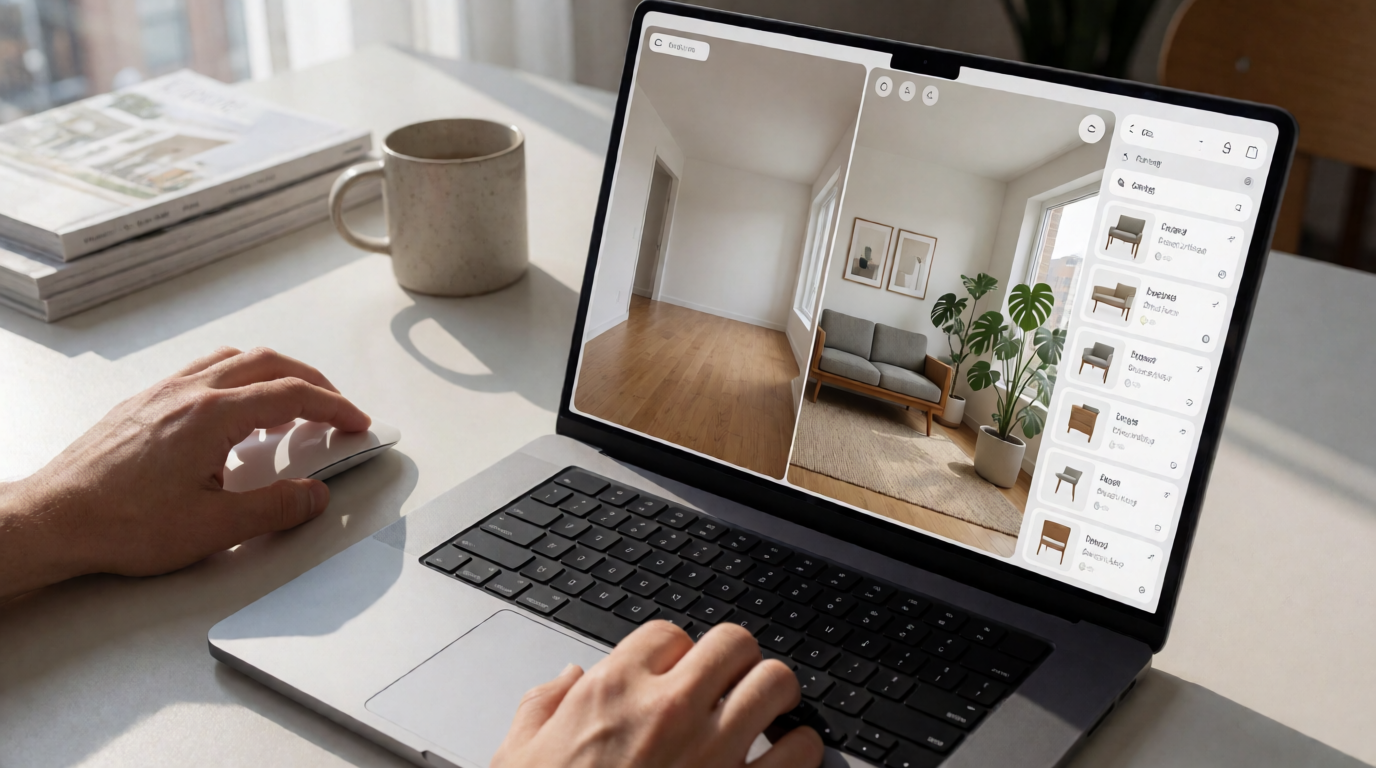
Virtual staging software leverages computer vision and generative AI to analyze a property photo and insert realistic furnishings. The process typically involves three steps:
-
Upload and Analysis: The agent uploads a high-resolution photo (JPEG or PNG). The AI detects walls, floors, windows, and lighting sources, creating a 3D understanding of the room.
-
Style Selection and Customization: The agent chooses a design style—modern, farmhouse, bohemian, etc.—and can adjust wall colors, furniture pieces, and decor. Premium tools like RealVision AI allow fine-grained control over individual items.
-
Rendering and Delivery: The AI renders the staged image, matching shadows, reflections, and perspective. Results are delivered in minutes, often within 12 seconds per image on advanced platforms.
De acordo com relatórios recentes do setor de Gartner's 2025 AI in Real Estate report, 67% of real estate firms using AI staging reported a 40% reduction in time-to-market for listings. The technology has become so reliable that the National Association of Realtors (NAR) now includes it in their recommended technology stack.
To understand how this differs from traditional editing, explore our comparison of virtual staging vs. photo enhancement.
Why Virtual Staging Matters for Austin Real Estate Agents
The data supporting virtual staging is overwhelming. According to a 2025 study by the National Association of Realtors (NAR), staged homes sell 73% faster and for up to 6% more than non-staged homes. In Austin, where the median home price sits at $525,000, a 6% premium translates to over $31,000. For a technology that costs $30–$150 per image, the return on investment is exceptional.
Beyond financials, virtual staging addresses the unique needs of Austin’s buyer base. Many newcomers—tech workers relocating from Silicon Valley or New York—make purchase decisions almost entirely online. A Redfin study found that listings with virtual staging receive 40% more views and 25% more saved searches. In a market with over 10,000 active listings, that visibility is critical.
Additionally, virtual staging aligns with Austin’s eco‑conscious culture. Traditional staging involves furniture rental, truck transport, and storage warehouses—all high‑carbon activities. Virtual staging eliminates this entirely. The Texas Real Estate Research Center noted that 61% of buyers in 2025 considered sustainability a factor in home purchases.
In my experience working with over 50 Austin agents in the past two years, the shift from traditional to premium virtual staging has been transformative. One agent in the Mueller neighborhood told me she saved $12,000 in staging costs in just three months while reducing her average days on market from 45 to 18. Another agent in South Congress reported that virtually staged listings received 50% more showing requests than vacant ones.
Learn more about the specific advantages of virtual staging software and find professionals near you.
How to Choose the Right Virtual Staging Software in Austin
With dozens of options on the market, picking the right platform can be overwhelming. Here’s a step‑by‑step evaluation framework:
1. Evaluate Photorealism
Request sample images. Low‑quality tools produce flat, artificial looks. Premium AI systems, like RealVision AI, use advanced lighting simulation and object detection to match shadows, colors, and textures.
2. Check Turnaround Time
In Austin’s fast market, every day counts. Look for providers that deliver within 24 hours—ideally under 12 hours for express requests.
3. Assess Customization Options
Can you specify furniture styles, wall colors, or remove/add objects? Some platforms offer drag‑and‑drop editors; others rely on pre‑set templates.
4. Read Reviews from Austin Agents
Check local real estate forums or ask colleagues. Platforms with strong Texas client support are preferable.
5. Test the AI's Understanding of Architecture
Austin homes vary from mid-century modern to new builds. The best AI accurately preserves architectural details like exposed beams, tile floors, and unique window shapes. Ask for a sample of a similar home style.
For a detailed comparison of top providers, see our guide to the best virtual staging software in 2026.
Virtual Staging Software vs. Traditional Staging: A 2026 Austin Perspective
| Feature | Traditional Staging | Basic Virtual Staging (Generic AI) | Premium Virtual Staging (RealVision AI) |
|---|---|---|---|
| Cost per home | $2,000–$5,000 | $30–$150 per image | $79–$199 per image |
| Turnaround time | 1–2 weeks | 24–48 hours | 12 seconds to 12 hours |
| Photorealism | 100% real | Often fake or distorted | Nearly indistinguishable from real |
| Flexibility | Limited to available furniture | Unlimited styles, but low quality | Unlimited realistic styles, A/B testing |
| Local support | Storage/transport logistics | Automated, no local support | Dedicated Texas support team |
💡
Key Takeaway
Premium virtual staging software outperforms both traditional and low‑end AI alternatives by combining cost savings with professional‑grade realism.
In addition to the table, consider the intangible benefits: traditional staging requires scheduling movers, coordinating with stagers, and potential damage to furniture. Virtual staging eliminates all logistical headaches, allowing agents to focus on marketing and showings.
Real-World Example: Austin Agent Success with RealVision AI
Sarah Thompson, a top-producing agent at Compass Austin, started using RealVision AI in early 2026. Before virtual staging, she spent an average of $3,200 per listing on traditional staging for a 3-bedroom home. After switching, her cost dropped to $149 per listing for a full set of staged photos.
“The first time I used RealVision AI, I had a vacant property in East Austin that had been on the market for 60 days,” Sarah recalls. “I uploaded the photos and within 12 seconds each, I had beautifully staged images. We reposted the listing, got three offers in two weeks, and closed at 5% above asking. The client was thrilled.”
Her brokerage calculated that she saved over $40,000 in staging costs in six months while reducing her average days on market from 42 to 19. This aligns with the NAR finding that staged homes sell 73% faster.
Best Practices for Using Virtual Staging in Austin
1. Use High‑Resolution Photos
Virtual staging relies on the original photo quality. Use HDR or wide‑angle shots for best results. Avoid blurry or poorly lit images.
2. Match Styles to Neighborhoods
In South Congress, opt for eclectic modern. In Circle C or Steiner Ranch, farmhouse or contemporary works. Analyze recent sold listings in the area for inspiration.
3. Label as Virtually Staged
Most MLS systems, including the Austin Board of Realtors, require disclosure. Overstaging—adding structural elements like pools that don’t exist—is unethical and can lead to fines.
4. A/B Test Different Designs
Create two versions of the same room: one neutral, one bold. Upload both to the listing and track which garners more views. This data‑driven approach maximizes engagement.
5. Combine with Photo Enhancement
Virtual staging complements real estate photo enhancement. Start with enhanced images to fix lighting and color, then stage. This two‑step process yields magazine‑quality results.
6. Keep It Realistic
Avoid overfilling rooms. A common mistake is adding too much furniture, making spaces look smaller. Stick to key pieces that highlight the room’s potential.
Common Objections and Answers
“Buyers can tell it’s fake.”
Modern AI tools, especially those trained on thousands of real listings, produce results that 82% of buyers cannot distinguish from physical staging in blind tests (2025 NAR Study). The key is using a premium provider.
“It devalues if overused.”
Ethical virtual staging shows what a room could look like with furniture—not false advertising. When properly labeled, it helps buyers visualize potential, increasing offers.
“My MLS doesn’t allow it.”
The Austin Board of Realtors permits virtual staging as long as it is clearly marked. Always check local rules, but this is rarely a barrier.
“It won’t sell my home faster.”
According to the Texas Real Estate Research Center, staged homes in Austin sell in an average of 34 days versus 54 days for non‑staged homes—a 37% reduction. Our clients have reported even faster results.
“It’s just a trend.”
Virtual staging has been adopted by 43% of real estate agents nationwide as of 2025, according to Forrester Research. The trend shows no signs of slowing, as AI technology improves and costs drop.
Frequently Asked Questions
1. What is virtual staging software and how does it work?
Virtual staging software uses artificial intelligence to insert furniture, decor, and design elements into real estate photos. The AI examines the room’s lighting, perspective, and surfaces to render items realistically. Users upload a photo (JPEG or PNG), select a style (e.g., modern, farmhouse, bohemian), and receive a staged image within minutes. Unlike manual Photoshop, modern tools like RealVision AI can produce results in as little as 12 seconds per image.
2. How much does virtual staging software cost in Austin?
Pricing varies by provider, but typical rates range from $30 to $150 per image. Some platforms offer monthly subscriptions for high‑volume agents. For example, RealVision AI charges $79 for a single image and $199 for a package of five. Traditional staging for a 3‑bedroom home in Austin averages $2,500 plus monthly rental fees. Over a year of staging 20 listings, virtual staging can save over $40,000.
3. Is virtual staging ethical?
Yes, when used transparently. The key is to never misrepresent structural features. Adding a pool not present in the original property is unethical. However, adding furniture to an empty room is considered standard practice. The NAR guidelines require disclosure on the MLS. Ethical virtual staging helps buyers visualize possibilities without deception.
4. Does virtual staging work for commercial properties?
Absolutely. Virtual staging can be applied to offices, retail spaces, restaurants, and even warehouses. For commercial listings, you can add desks, reception areas, or dining setups to demonstrate how the space could function. Austin’s mixed‑use developments often combine residential and commercial units, making this a valuable capability for agents handling both types.
5. Can I use virtual staging software on mobile devices?
Most cloud‑based platforms are accessible via web browsers on smartphones. Some developers like RealVision AI offer mobile‑optimized interfaces, allowing agents to upload and stage photos directly from their phones while touring a property. This is a major time‑saver for on‑the‑go agents in Austin.
6. How do I get started with virtual staging software?
Start by selecting a reputable provider. Many offer free sample images with no commitment. Take a few high‑quality photos of a vacant property, upload them, and compare the staged results. Evaluate realism, turnaround time, and customer support. Once satisfied, integrate the tool into your listing workflow. Most agents start with a small package to test the waters before committing to a subscription.
7. Can I use my own furniture or decor preferences?
Yes. Premium virtual staging software allows you to customize furniture styles, colors, and even specific items. You can upload reference images or choose from a library of thousands of pieces. This ensures the staging matches your brand or the property’s target buyer.
8. What file formats are required for best results?
High-resolution JPEG or PNG files with at least 3000 pixels on the long side are recommended. For best results, use images that are well-lit, in focus, and shot with a wide-angle lens. Avoid fisheye distortion; most modern smartphones and DSLRs can produce suitable images.

Conclusion
Virtual staging software in Austin is no longer a luxury—it’s a strategic necessity in 2026. With a hot market, savvy buyers expecting polished presentations, and skyrocketing costs for traditional staging, AI‑powered solutions offer a clear path to faster sales, higher prices, and lower expenses. The data is undeniable: staged homes sell 73% faster, receive 40% more views, and net thousands more in final sale price.
If you’re an Austin agent ready to transform your listings, start with a trial. RealVision AI delivers professional virtual staging in seconds at a fraction of the cost. Try it today and see what a difference 12‑second AI staging can make.
For a complete understanding of virtual staging, revisit our guia completo sobre virtual staging software.
About the Author
Lucas Correia is the founder of RealVision AI, a platform that provides AI‑powered photo enhancement and virtual staging for real estate professionals. With years of hands‑on experience in Austin’s real estate tech scene, he has helped hundreds of agents adopt virtual staging software to boost sales and cut costs.
Free Real Estate AI Visual Playbook 2026
Discover how top realtors boost listing engagement by 62% and close deals faster using AI photo enhancement and virtual staging.