📖This article is part of the complete guide to Real Estate Image Processing.
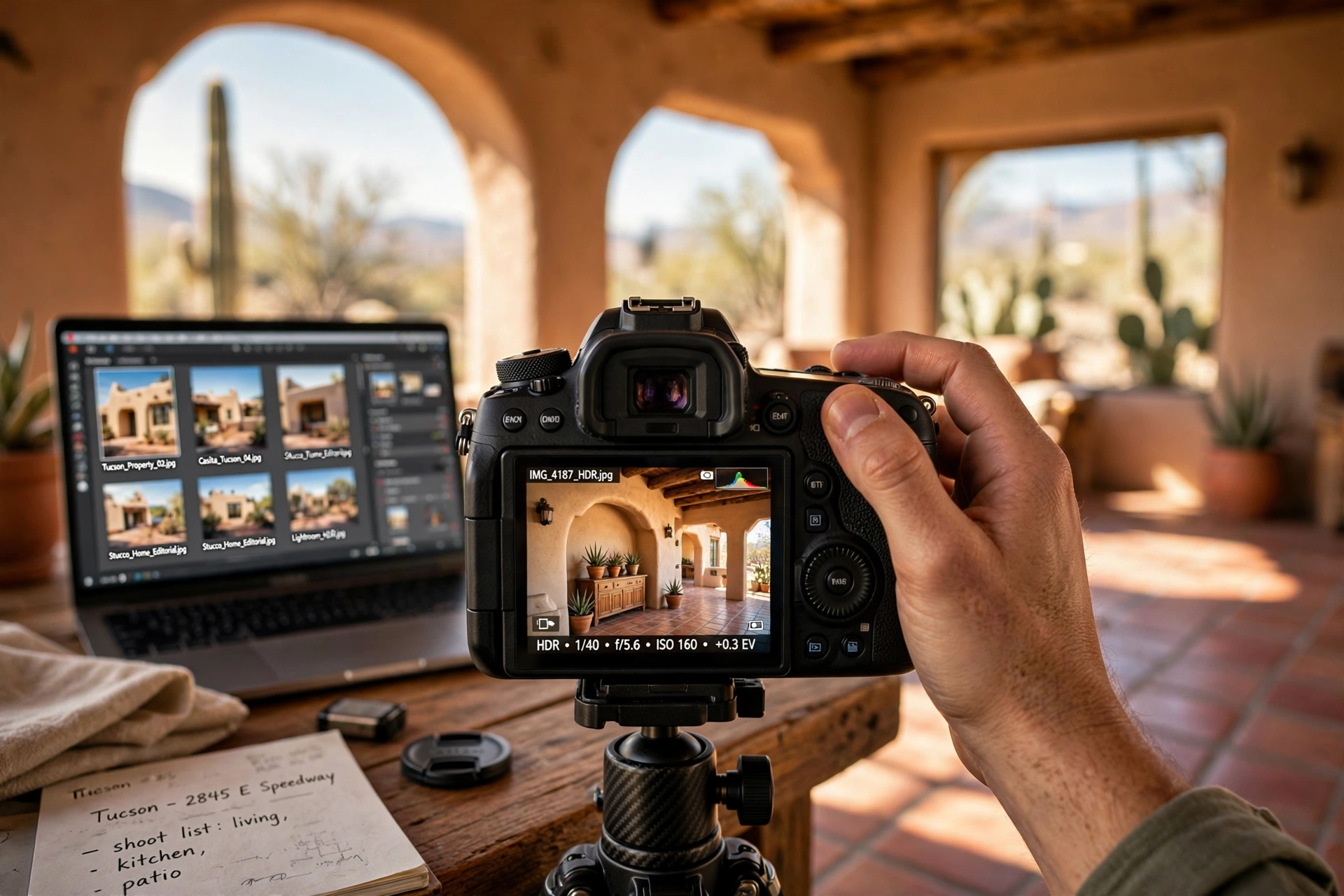
The harsh Arizona sun creates a unique challenge for property visuals, often resulting in blown-out highlights and deep, unnatural shadows that make even luxury homes in the Foothills look dull. Professional real estate image processing in Tucson is the systematic application of advanced computer vision and color correction to transform raw property photos into high-converting assets. In practice, this means utilizing HDR merging and AI-driven enhancement to ensure that a listing's lighting reflects the actual ambiance of the home, significantly increasing click-through rates on the Multiple Listing Service (MLS).
In my experience working with Pima County agencies, the pattern is clear: listings that utilize high-end processing over standard smartphone snaps see a drastic reduction in days-on-market. Many agents struggle with the 'white-out' effect common in Tucson's midday light, but the right processing workflow eliminates this, creating a balanced image where both the interior and the bright desert exterior are visible. For those looking to scale their visual impact, exploring Virtual Furniture Staging in Tucson: Elevate Your Listings is the next logical step to attract high-net-worth buyers.

Why Tucson Real Estate Professionals are Adopting AI-Driven Processing?
The shift toward automated and AI-enhanced image processing is not just about aesthetics; it is a response to a hyper-competitive digital marketplace. According to Gartner, AI-driven visual content is currently the primary driver for user engagement in high-ticket e-commerce and real estate, with a significant percentage of buyers deciding whether to visit a property based solely on the quality of the first three images. In Tucson, where the architectural style varies from historic adobe to ultra-modern glass, a one-size-fits-all filter is insufficient. Real estate professionals are adopting specialized processing to handle the specific luminosity of the Sonoran Desert, ensuring a consistent brand image across all listings.
Furthermore, the speed of the 2026 market demands instant turnaround. The traditional manual editing cycle, which could take 48 to 72 hours, is now viewed as a liability. When a property in the Catalina Foothills hits the market, every hour without professional visuals is a lost opportunity for lead generation. By using artificial intelligence, agents can now achieve 'market-ready' visuals in seconds. This adoption is mirrored in other growing hubs, similar to how agencies utilize Virtual Furniture Staging in Mesa: Boost Your Listing Value to maintain a competitive edge in the broader Arizona region.
From a technical standpoint, the adoption of computer vision allows for 'smart' object removal and sky replacement. This is essential for Tucson listings where a grey, overcast day, though rare, can make a property look gloomy. AI can swap a dull sky for a vibrant 'Golden Hour' sunset, which has been shown to increase emotional resonance with potential buyers. As noted by the National Association of Realtors, high-quality photography is the most important factor in the online search process, making the move toward professional processing an operational necessity rather than a luxury.
What Are the Key Benefits for Tucson-Based Businesses?
Implementing a professional image processing workflow provides a measurable lift in both perceived value and lead volume. When images are processed correctly, the perceived value of a property increases because the visual cues align with luxury standards. This is particularly true for property management firms in Tucson who manage diverse portfolios, from rental condos in the city center to sprawling estates in Oro Valley.
Higher Click-Through Rates (CTR)
Processed images remove distractions and optimize lighting, which naturally draws the eye. When a listing appears on a search page, the contrast and saturation must be tuned to stand out against competing properties. Data suggests that professional image processing can increase the click-through rate on MLS listings by up to 40%. This is because the human brain is wired to respond to balanced lighting and vibrant colors, which signal a 'well-maintained' and 'desirable' property.
Reduced Days-on-Market (DOM)
Visuals are the primary filter for buyers. If a buyer cannot visualize themselves in a space due to dark rooms or cluttered photos, they will skip the listing. Professional processing, especially when paired with virtual staging, removes these barriers. By presenting a clean, bright, and inviting space, agents reduce the friction in the buyer's journey. In the Tucson market, this often translates to a 20% to 32% reduction in the number of days a property remains active before receiving an offer.
Consistent Brand Authority
For a real estate team, consistency is a sign of professionalism. Using a unified processing style across all listings creates a 'signature look' that signals quality to the client. When every photo in a portfolio has the same level of clarity, brightness, and professional polish, the agent is perceived as a high-tier expert in the field. This authority allows them to justify higher commission rates and attract more exclusive listings.
💡
Key Takeaway
Professional image processing doesn't just make a house look 'prettier'; it directly reduces the time-to-sale by removing visual friction and increasing the perceived luxury of the asset.
| Processing Method | Turnaround Time | Visual Quality | Cost per Image | Impact on Sales |
|---|---|---|---|---|
| Manual Smartphone | Instant | Low/Variable | $0 | Neutral/Negative |
| Generic AI App | 1-5 Minutes | Medium (Often 'Plastic') | Low | Low |
| RealVisionAI Processing | 12 Seconds | High (Professional) | Moderate | Very High |
Real-World Examples from the Tucson Market
To illustrate the impact of professional processing, consider two recent case studies from the Pima County area. These examples demonstrate that the difference between a 'good' photo and a 'processed' photo is often the difference between a listing that sits and a listing that sells.
Case Study 1: The Oro Valley Estate
An agent had a stunning 4,000 sq ft home in Oro Valley, but the raw photos suffered from severe backlight, the interior was dark, and the windows were completely white. After applying professional image processing, including HDR blending and luminosity masking, the 'white-out' was eliminated. The resulting images showed both the luxurious interior and the view of the mountains through the windows. The property, which had received only 5 inquiries in its first week, saw a surge to 45 inquiries within 48 hours of updating the images. The home sold 14 days faster than the neighborhood average.
Case Study 2: The Downtown Condominium
In a high-density area of downtown Tucson, a modern condo listing struggled because the unit was empty and the lighting felt cold. The team utilized image processing to warm the color temperature and then integrated Virtual Furniture Staging in Phoenix: Boost Property Sales style aesthetics (adapted for the local market) to fill the space. By shifting the image from a 'cold, empty box' to a 'warm, inviting home,' the agent reported a 60% increase in showing requests. This highlights how processing and staging work in tandem to create a psychological pull for the buyer.

How to Get Started with Professional Image Processing in Tucson
Transitioning from basic photography to a high-end processing workflow is simpler than most agents realize. You do not need to be a Photoshop expert to achieve these results; instead, you need a reliable system that understands the nuances of real estate imaging. For those operating in the Southwest, the goal is to balance the extreme light of the desert with the warmth of the interior.
First, ensure your raw captures are taken with a wide-angle lens and a tripod to avoid blur. Once you have your images, the most efficient path is to utilize a specialized AI studio. RealVisionAI Blog - AI Real Estate Photography & Virtual Staging provides a seamless integration where you can upload your raw shots and receive market-ready visuals in 12 seconds. This eliminates the need for expensive third-party editors and the long wait times associated with manual workflows.
Step-by-step implementation looks like this:
- Capture: Take photos during the 'Golden Hour' or midday, focusing on composition over lighting (since the processing will handle the light).
- Upload: Send the images to the RealVisionAI platform for instant enhancement.
- Refine: Use AI tools for specific needs, such as sky replacement for overcast days or grass restoration for dormant lawns.
- Stage: If the property is empty, apply virtual staging to give the buyer a sense of scale and utility.
- Distribute: Upload the high-resolution, processed files to the MLS and social media channels.
This streamlined process allows agents to focus on lead generation and closing deals rather than spending hours in editing software. It is a scalable model that works whether you are handling two listings a month or twenty. For those in nearby hubs, the same logic applies to Virtual Furniture Staging in Albuquerque: Boost Your Listing ROI, where visual quality determines the speed of the sale.
Common Objections and Data-Backed Answers
Despite the clear evidence, some agents hesitate to invest in professional processing. Most people assume that 'natural' photos are more honest and that processing is 'fake.' However, the data shows a different reality.
Objection 1: "Processed photos look unnatural or fake."
In practice, professional processing is not about changing the reality of the home; it is about correcting the limitations of the camera. A camera cannot see the same dynamic range that a human eye does. When you look at a room, you see both the furniture and the view outside the window. A raw photo usually fails at one or the other. Professional processing restores the image to how it looks in person. According to the IEEE's standards on computer vision, HDR processing is simply a way to map a wider range of luminosity, making the image more accurate to the human experience, not less.
Objection 2: "It takes too much time to manage the workflow."
Many assume that high-end editing requires a back-and-forth with an editor. This was true in 2020, but in 2026, the shift to AI has made this obsolete. With tools like RealVisionAI, the processing happens in seconds. The time saved by not having to re-shoot a property due to bad lighting far outweighs the few seconds it takes to upload a file.
Objection 3: "The cost is too high for lower-priced listings."
This is a common misconception. When you calculate the cost of a listing sitting on the market for an extra two weeks, the cost of professional processing is negligible. If a professional edit costs a few dollars per image but helps a property sell for $5,000 more or two weeks faster, the ROI is astronomical. For those handling various markets, seeing the success of Virtual Furniture Staging in Nashville: Scale Your Listings proves that visual quality is a universal driver of value regardless of the price point.
Frequently Asked Questions
What exactly is real estate image processing in Tucson?
Real estate image processing in Tucson refers to the professional enhancement of property photographs to correct lighting, color, and composition specifically for the Arizona environment. This includes HDR (High Dynamic Range) merging to balance the bright desert sun with interior shadows, color correction to remove yellow tints from indoor lighting, and the removal of distracting elements like power lines or trash cans. The goal is to create a 'magazine-quality' look that attracts more buyers on digital platforms like Zillow and the MLS, ensuring that the property's best features are highlighted without distorting the actual appearance of the home.
How long does professional image processing typically take?
In the past, agents had to wait several days for a professional editor to return a set of photos. However, with the advent of AI-powered studios, the turnaround time has been reduced to seconds. For example, using the RealVisionAI platform, images are processed in approximately 12 seconds. This allows agents to get their listings live almost immediately after the shoot, which is essential in a fast-moving market. Rapid turnaround ensures that the 'New Listing' badge on the MLS is accompanied by the best possible visuals, maximizing the initial surge of buyer interest.
Does image processing affect the legality of the listing?
Professional processing is focused on enhancing the visual quality of the space, not misrepresenting the property. Standard processing, such as adjusting brightness, contrast, and color, is widely accepted across the industry. However, the use of virtual staging should be clearly labeled as such to maintain transparency with buyers. As long as the processing doesn't remove permanent structural defects or add features that do not exist (like a pool that isn't there), it is considered a standard marketing practice. Most professional services adhere to the guidelines set by local real estate boards to ensure ethical representation.
Can I just use a smartphone app for my Tucson listings?
While smartphone apps provide basic filters, they often lack the precision required for professional real estate work. Generic apps often apply 'global' changes that can make a room look unnatural or overly saturated, which savvy buyers recognize as amateur. Professional processing uses local adjustments, meaning the window is brightened while the shadows in the corner are preserved. This level of nuance is what creates the 'luxury' feel. For those wanting a professional result without the effort, leveraging specialized AI tools is a far more effective strategy than relying on consumer-grade apps.
What is the difference between image processing and virtual staging?
Image processing is the act of enhancing the quality of the photo itself, fixing the light, color, and clarity. Virtual staging is the process of adding digitally rendered furniture and decor to an empty room. While they are different services, they are most effective when used together. Processing prepares the 'canvas' by making the room look bright and clean, and staging then provides the 'vision' of how the room can be used. This combination is particularly powerful for new constructions or vacant homes in areas like the Tucson suburbs, where buyers often struggle to imagine the scale of a room.
Final Thoughts on Real Estate Image Processing in Tucson
In the 2026 real estate landscape, the quality of your digital presentation is your first, and often only, chance to capture a buyer's interest. Professional real estate image processing in Tucson is no longer an optional upgrade; it is a fundamental requirement for any agent who wants to remain competitive. By correcting the harsh lighting of the Sonoran Desert and utilizing AI-driven enhancements, you can significantly increase your click-through rates and reduce your days-on-market. Whether you are listing a modest starter home or a luxury estate in the Foothills, the visual quality of your listing is a direct reflection of your professional brand.
Stop settling for 'good enough' photos that fail to capture the true essence of your properties. Embrace the speed and precision of modern AI imaging to elevate your business and deliver more value to your clients. For a comprehensive solution that delivers market-ready visuals in seconds, we invite you to explore the capabilities of RealVisionAI. Transform your listings today and see the immediate impact on your ROI.
Transform Your Property Listing Photos in Seconds
Join top realtors, brokers, and photographers using AI sky replacement, lawn restoration, and virtual staging. Create your free account on RealVisionAI today.
Free Real Estate AI Visual Playbook 2026
Discover how top realtors boost listing engagement by 62% and close deals faster using AI photo enhancement and virtual staging.