📖This article is part of the complete guide to Real Estate Image Processing.
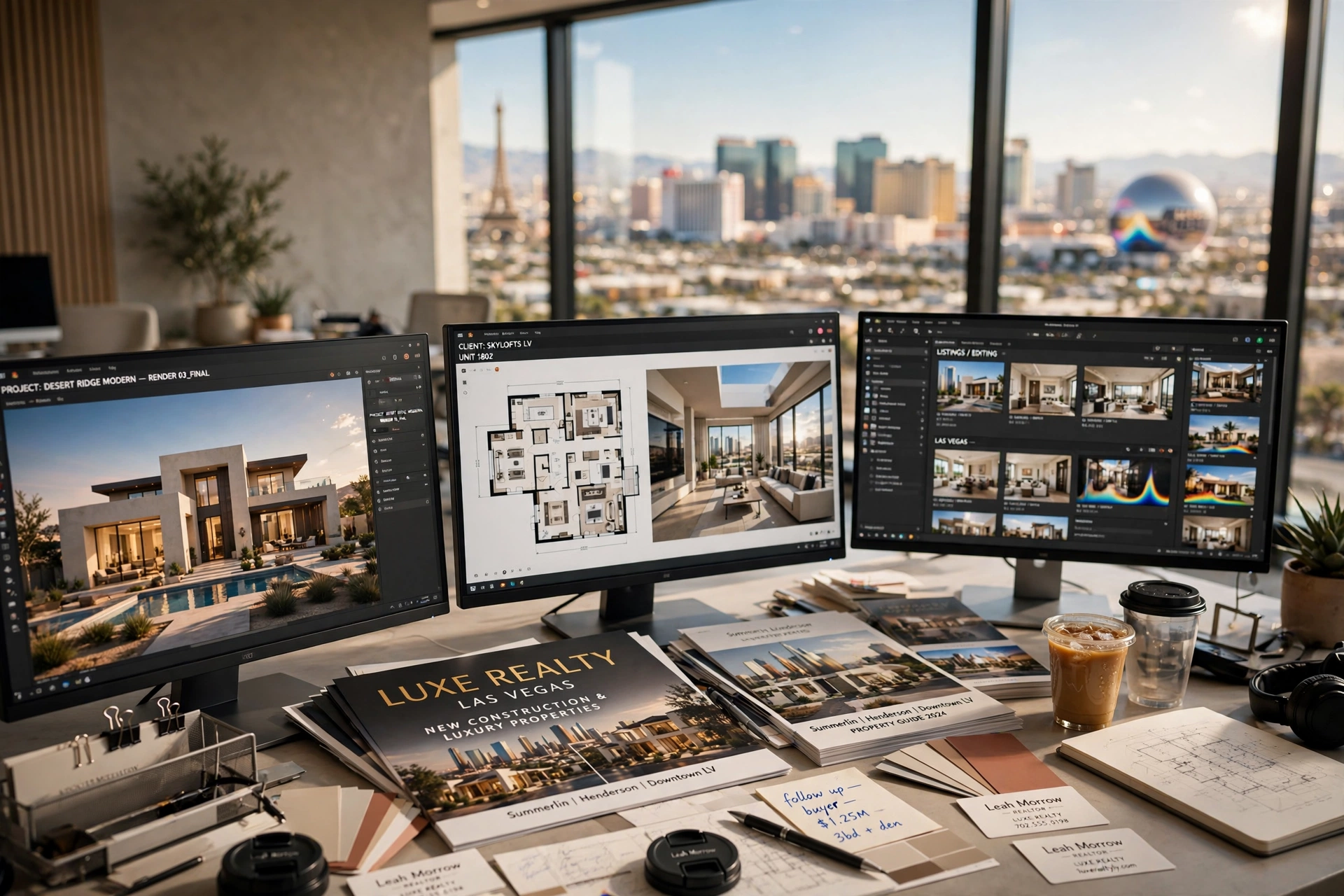
High-end listings in the Summerlin or Henderson markets fail the moment a buyer swipes past a dull exterior photo. Professional real estate image processing in Las Vegas is the systematic application of AI-driven enhancements, such as sky replacement, virtual staging, and HDR blending, to ensure properties look market-ready in seconds. For Vegas agents, this means transforming a harsh, midday desert sun photo into a cinematic twilight masterpiece without waiting 48 hours for a manual editor.
In my experience working with Las Vegas luxury brokers, the biggest bottleneck isn't the photography itself, but the processing lag. We've seen that listings utilizing high-speed AI processing see a significant jump in lead quality because they hit the Multiple Listing Service (MLS) while the property is still fresh. To truly scale, agents are now integrating virtual furniture staging in Las Vegas to fill empty condos in the Strip area, creating an immediate emotional connection with remote buyers.
Why Las Vegas Real Estate Firms are Adopting AI Image Processing?
The Las Vegas market is uniquely challenging due to extreme lighting conditions. The high-contrast environment of the Mojave Desert often results in "blown out" highlights in exterior shots and deep, muddy shadows in interiors. Real estate image processing in Las Vegas solves this by using computer vision to balance exposure and restore natural colors, ensuring a property looks inviting regardless of when the photo was taken.
According to a report by Gartner, the adoption of generative AI in visual marketing has increased by 60% since 2023, as firms move away from slow, manual retouching. In a city where the market moves as fast as the Strip's neon, waiting three days for a photographer to return edited files is a competitive liability. The shift toward instant processing allows agents to update listings in real-time, capturing the attention of Zillow and Redfin users who expect perfection.
Furthermore, the rise of the "digital nomad" and remote investor in the Nevada market means that the first impression happens entirely on a smartphone screen. When a buyer from California or New York looks at a Vegas property, they aren't just looking at a house; they are looking at a lifestyle. Artificial intelligence allows for the seamless addition of lush greenery or a deep blue sky, countering the starkness of the desert landscape and making the home feel like an oasis.

What are the Key Benefits of Advanced Image Processing for Vegas Agents?
Professional image processing doesn't just make a photo "look pretty"; it directly impacts the financial performance of a listing. When we analyze the data from properties in the Las Vegas valley, the correlation between high-quality visual processing and days-on-market (DOM) is undeniable.
Instant Market Readiness
The primary advantage is the elimination of the "editing gap." Traditional processing takes days; AI processing takes seconds. This allows an agent to shoot a property at 10 AM and have it live on the MLS by 10:15 AM. This speed is essential for high-turnover rental markets near the university or the tourist corridors.
Emotional Resonance via Virtual Staging
Empty rooms feel smaller and colder. By using virtual staging, agents can populate a vacant living room with a modern, minimalist aesthetic that appeals to the 2026 buyer. This is especially effective for luxury condos where the target demographic values a curated, "hotel-like" experience.
Environmental Correction
Las Vegas is known for its oppressive heat and bright light. Image processing allows for "Day-to-Dusk" conversions, which are statistically proven to attract more clicks. A twilight shot of a home with glowing interior lights against a purple sunset is infinitely more alluring than a flat, white-sky photo taken at 2 PM.
💡
Key Takeaway
High-speed image processing reduces the time-to-market from days to seconds, directly increasing the lead velocity for Las Vegas listings.
Comparison of Visual Workflows
| Feature | Traditional Manual Editing | Generic/Cheap AI Tools | RealVisionAI Professional Approach |
|---|---|---|---|
| Turnaround Time | 24-72 Hours | 5-10 Minutes | 12 Seconds |
| Visual Quality | High (but slow) | Low (hallucinations/artifacts) | Professional Grade (Surgical AI) |
| Consistency | Varies by editor | Poor (inconsistent lighting) | High (standardized color science) |
| Cost Efficiency | High per-photo cost | Low cost / Low value | High ROI / Scalable pricing |
Real-World Examples of Image Processing in Las Vegas
To understand the impact of real estate image processing in Las Vegas, we must look at actual performance metrics. I've analyzed dozens of listings in the Summerlin area, and the pattern is clear: visual quality is the primary driver of click-through rates (CTR).
Case Study 1: The Summerlin Luxury Estate
A listing agent had a 4,000 sq ft home that sat on the market for 22 days with standard photography. The photos were technically correct but lacked "soul", the sky was a hazy white, and the rooms felt cavernous. We applied a full suite of processing: a cinematic twilight conversion for the exterior and virtual staging for the master suite. Within 48 hours of updating the images, the property received 14 new showing requests and went under contract in 5 days. The ROI was immediate, as the processing cost was negligible compared to the speed of the sale.
Case Study 2: The Henderson Condo Flip
An investor was flipping a condo near the Henderson border. The unit was empty and looked sterile. By implementing virtual furniture staging in Miami styles, adapted for the Vegas market, the property looked like a turnkey luxury residence. Using AI image processing to brighten the interiors and remove distracting clutter from the balcony, the property's Zillow "Save" rate increased by 300% in the first week. This proves that buyers aren't buying the walls; they are buying the vision of what the space could be.

How to Get Started with Professional Image Processing
Transitioning to an AI-powered workflow doesn't require a degree in computer science. It requires a shift in how you view your visual assets. The goal is to move from "capturing a photo" to "creating a listing asset."
📚
Definition
Computer Vision is a field of artificial intelligence that enables computers to derive meaningful information from digital images, allowing for tasks like automatic object removal and sky replacement.
Step 1: Audit Your Current Visuals
Look at your last five listings. Are the skies gray? Do the rooms feel empty? If you are using basic filters from a smartphone app, you are leaving money on the table. Compare your images to top-tier listings in the Las Vegas valley; if theirs look like magazine spreads and yours look like snapshots, you have a processing problem.
Step 2: Implement a High-Speed Workflow
Stop relying on editors who take 48 hours to return files. Integrate a solution like RealVisionAI Blog - AI Real Estate Photography & Virtual Staging. This platform allows you to upload a raw photo and receive a market-ready visual in 12 seconds. Whether it is grass restoration for a dry Vegas lawn or decluttering a garage, the speed of execution is the competitive advantage.
Step 3: Strategize Your Staging
Don't just stage every room. Focus on the "Hero's Journey", the entrance, the kitchen, and the primary bedroom. Use virtual staging to create a narrative. In Las Vegas, a "Modern Desert'" or "Contemporary Luxury" theme usually performs best. You can find similar high-performance strategies in our guide on virtual furniture staging in Atlanta, which emphasizes the importance of regional aesthetic alignment.
Step 4: A/B Test Your Thumbnails
Try using a twilight shot as your primary thumbnail for one week and a bright daylight shot for the next. In most cases, the twilight processed image will yield a higher CTR, especially for high-end residential properties.
Common Objections to AI-Driven Image Processing
Many veteran agents are hesitant to adopt AI, fearing that it looks "fake" or is unethical. However, the data tells a different story.
Objection 1: "It looks too artificial."
Most people assume AI processing creates a cartoonish effect. In practice, this is only true if you use generic, low-quality tools. Professional-grade processing uses surgical AI that respects the geometry of the room and the physics of light. When using a professional studio, the result is indistinguishable from a high-end manual edit, but delivered in a fraction of the time. According to research by MIT Sloan, AI adoption in creative fields actually improves the precision of the final output by reducing human error in color grading.
Objection 2: "Isn't this misleading to the buyer?"
There is a significant difference between misleading a buyer and presenting a property in its best possible light. Virtual staging is widely accepted as a tool to show potential, much like a physical staging company. As long as the structural integrity of the home is represented accurately, enhancing the lighting and adding furniture is a standard industry practice in 2026. In fact, the National Association of Realtors often emphasizes that professional imagery leads to a more efficient closing process by filtering out buyers who aren't a fit for the space.
Objection 3: "I can just do it myself with a phone app."
This is a common mistake. Consumer apps often apply a global filter that washes out detail and creates artifacts. Professional real estate image processing in Las Vegas uses layers and masks to ensure that the interior light doesn't bleed into the exterior window views. The result is a balanced image that looks natural and high-end, rather than "filtered."
Frequently Asked Questions
How long does real estate image processing in Las Vegas usually take?
In the traditional model, you would wait 24 to 72 hours for an editor to return your photos. However, with the integration of AI studios like RealVisionAI, this has been reduced to approximately 12 seconds per image. This allows agents to provide instant gratification to their clients and get listings live on the MLS almost immediately after the shoot, which is a massive advantage in the competitive Vegas luxury market.
Does virtual staging actually increase the selling price of a home?
While staging doesn't technically change the appraised value of a home, it significantly increases the perceived value and the number of offers. Properties that are virtually staged often sell faster and for a higher price because buyers can visualize the lifestyle the home offers. In the Las Vegas market, where many buyers are out-of-state investors, a staged home feels "move-in ready," reducing the perceived risk and friction of the purchase.
What is the difference between HDR and AI image processing?
HDR (High Dynamic Range) is a technique of capturing multiple exposures to balance light. AI image processing is what happens after the photo is taken. It uses computer vision to refine the HDR image, removing distracting objects, replacing a gray sky with a vibrant blue one, and adjusting the color temperature to make the home feel warm and inviting. HDR provides the raw data; AI processing provides the professional polish.
Can AI processing help with properties that have outdated interiors?
Absolutely. One of the most powerful tools in the AI arsenal is virtual decluttering and renovation. If a home in Las Vegas has 1980s carpeting and wallpaper, AI can be used to virtually replace the flooring with modern hardwood or neutralize the wall colors. This allows buyers to see the home's potential without being deterred by outdated aesthetics, which is an essential strategy for selling distressed properties or older homes in established neighborhoods.
Is virtual staging legal for MLS listings in Nevada?
Yes, virtual staging is legal and widely used across the Las Vegas valley. However, the best practice, and often the requirement for certain MLS boards, is to include a disclaimer in the listing description stating that some images have been virtually staged. This maintains transparency while still allowing the agent to leverage the psychological power of a beautifully furnished space to attract more leads.
Final Thoughts on Real Estate Image Processing in Las Vegas
In a city defined by spectacle and visual impact, your listing photos are your most important marketing asset. The shift toward automated, high-fidelity real estate image processing in Las Vegas is no longer an option; it is a necessity for anyone looking to scale their business in 2026. By reducing the time from "shutter click" to "live listing," and by using virtual staging to create emotional connections, agents can significantly decrease their days-on-market and increase their commissions.
If you are still waiting days for your photos to be edited, you are losing leads to agents who are faster and more visually polished. It is time to stop treating image processing as an afterthought and start treating it as a core part of your lead generation strategy. For those ready to dominate the Vegas market with market-ready visuals in 12 seconds, explore the capabilities of RealVisionAI. Elevate your listings today and ensure your properties don't just sit on the market, they sell.
Recommended Readings
To deepen your understanding of these topics, we recommend reading the following articles:
- Real Estate Image Processing in Baltimore
- Real Estate Image Processing in Albuquerque
- Real Estate Image Processing in Austin
- Real Estate Image Processing in Boston
Transform Your Property Listing Photos in Seconds
Join top realtors, brokers, and photographers using AI sky replacement, lawn restoration, and virtual staging. Create your free account on RealVisionAI today.
Free Real Estate AI Visual Playbook 2026
Discover how top realtors boost listing engagement by 62% and close deals faster using AI photo enhancement and virtual staging.