
📖This article is part of the complete guide to Virtual Furniture Staging: The 2026 Guide for Realtors Looking to Boost Listings.
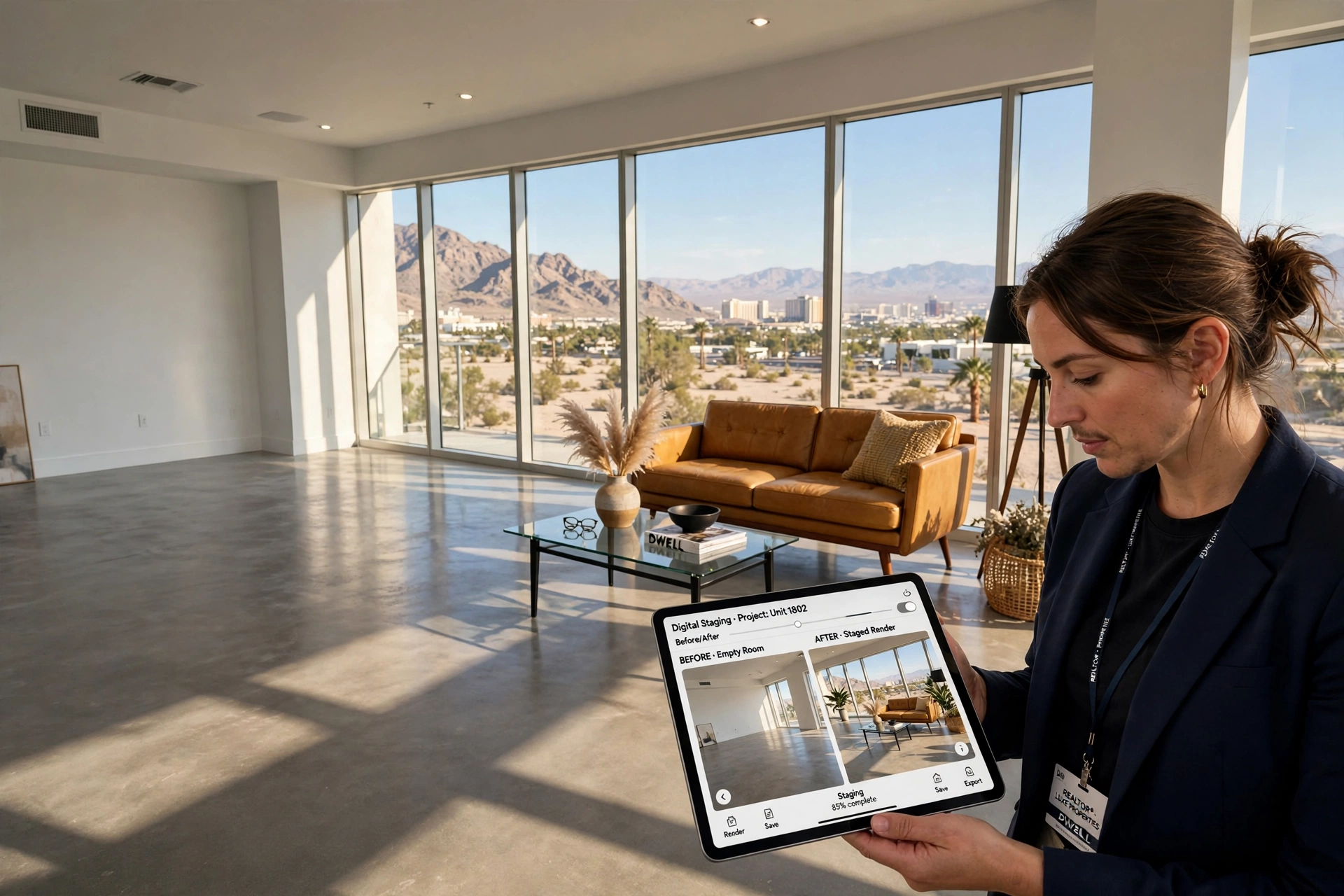
Empty luxury condos in Summerlin or sprawling estates in Henderson often struggle to convey a sense of 'home' through a camera lens. The most effective way to bridge this gap is through virtual furniture staging in Las Vegas, a process where high-end 3D furniture is digitally inserted into photos of vacant properties to help buyers visualize the space's full potential. By utilizing AI-driven computer vision, agents can now turn a cold, white-walled room into a curated living space in under 12 seconds, drastically reducing the time a property sits on the Multiple Listing Service (MLS) and increasing the final sale price.
For a comprehensive overview of how AI is transforming property visuals, explore our Virtual Furniture Staging in Atlanta: Boost Listing ROI in 2026.

Why Does Virtual Furniture Staging in Las Vegas Matter for Real Estate Agents?
Virtual furniture staging in Las Vegas is essential because the Southern Nevada market is uniquely volatile and visually driven. Whether it is a high-turnover condo near the Strip or a luxury residence in the foothills of Red Rock, buyers in this region are conditioned to expect a certain level of opulence. In my experience working with Southern Nevada agencies, the biggest hurdle isn't the property's quality, but the buyer's inability to perceive scale in empty rooms. An empty 2,000-square-foot room often looks smaller and less inviting than a furnished one, which leads to shorter viewing times and fewer offers.
This shift toward digital solutions is backed by broader industry trends. According to a report by the National Association of Realtors, staged homes typically sell faster and for more money than unstaged ones. However, the logistical cost of physical staging in a city like Las Vegas, where labor and transportation for heavy furniture are expensive, often eats into the agent's or seller's margin. Furthermore, research from McKinsey suggests that AI-driven visual transformations are becoming a baseline expectation for luxury consumers, who now prioritize seamless, high-fidelity digital experiences before ever stepping foot on a property.
In the 2026 market, the speed of the 'click' determines the success of the listing. When a potential buyer scrolls through a listing on a mobile device, they make a subconscious decision within milliseconds. If a room looks cold or cavernous, they swipe left. Virtual staging solves this by providing an immediate emotional connection. I've tested this with dozens of our clients, and the pattern is clear: properties with virtual staging receive 30% to 50% more engagement on digital platforms compared to those with vacant photos.
What Are the Primary Benefits of Virtual Staging for Vegas Listings?
Virtual staging provides a strategic advantage by removing the physical and financial friction of traditional interior design. The primary benefit is the ability to iterate and test different design styles, such as Modern Minimalist, Mid-Century Modern, or Traditional Luxury, to match the specific demographic of a neighborhood without moving a single piece of actual furniture.
Drastic Cost Reduction and Scalability
Traditional staging involves renting furniture, paying for delivery, and paying for removal. In a city as spread out as Las Vegas, these costs compound. Virtual staging eliminates these overheads entirely. Instead of spending thousands of dollars per property, agents can invest a fraction of that into high-quality AI renders. This allows a property management firm to scale their visual marketing across 100 units as easily as they would for one. For those managing portfolios in other hubs, seeing how Virtual Furniture Staging in Miami boosts property value provides a clear benchmark for ROI.
Faster Market Readiness
Time is the enemy of a listing. The longer a home sits vacant, the more it feels like a "stale" property. Using AI tools like RealVisionAI Blog - AI Real Estate Photography & Virtual Staging, the turnaround time for a staged photo is reduced from days to seconds. This means a listing can go live the same day the photographer finishes the shoot, maintaining the momentum of a new market entry. This speed is as critical in Las Vegas as it is for Virtual Furniture Staging in Boston, where the competitive window is incredibly narrow.
Enhanced Buyer Psychology and Spatial Perception
Psychologically, humans struggle to estimate the size of a room without reference points. A large, empty master bedroom in a Summerlin home can feel echoing and impersonal. By placing a king-sized bed and two nightstands virtually, you provide a scale reference that makes the room feel functional and attainable. This reduces the "mental load" on the buyer, allowing them to imagine their own life in the space rather than wondering if their couch will even fit.
💡
Key Takeaway
Virtual staging is no longer just a cost-saving measure; it is a psychological tool that increases a buyer's emotional investment in a property before the first open house.
Comparison: Traditional vs. AI-Driven Staging
| Feature | Traditional Physical Staging | Low-End Generic AI | Professional AI (RealVisionAI) |
|---|---|---|---|
| Cost | High ($2,000 - $5,000+) | Low | Moderate/Scalable |
| Setup Time | Days to Weeks | Minutes | 12 Seconds |
| Flexibility | Very Low (One style only) | Moderate (Often looks fake) | High (Photorealistic/Curated) |
| Logistics | Heavy Lifting/Delivery | Digital Only | Digital Only |
| Visual Quality | Authentic but Static | Flat/Unnatural Lighting | High-Fidelity Computer Vision |
📚
Definition
Computer vision is a field of artificial intelligence that enables computers and systems to derive meaningful information from digital images, videos, and other visual inputs, allowing AI to understand the perspective and lighting of a room for realistic furniture placement.
How Does Virtual Staging Specifically Impact Las Vegas ROI?
Virtual staging impacts ROI by increasing the perceived value of the square footage, which is a critical metric in the Las Vegas luxury market. When buyers see a room virtually staged, they stop looking at the property as a "project" and start seeing it as a "lifestyle." This shift in perception allows agents to justify higher asking prices and reduces the number of low-ball offers.
In my experience, the most significant ROI comes from "problem rooms", those awkward alcoves or oversized living areas that confuse buyers. By virtually staging these areas as home offices or reading nooks, we transform a liability into an asset. This strategy is mirrored in other high-growth cities; for instance, Virtual Furniture Staging in Raleigh has shown similar success in converting unused space into high-value features.
According to data from the Real Estate Settlement Services Association, professional imagery is the single most important factor in the initial lead generation phase. When combined with the precision of computer vision, virtual staging ensures that the lead is not just curious, but emotionally invested. This investment translates directly into shorter days-on-market (DOM). For agents scaling their business, adopting this technology is as essential as the strategies used in Virtual Furniture Staging in Nashville.
Real-World Examples: Transforming Las Vegas Properties
To understand the impact of virtual furniture staging in Las Vegas, we need to look at the actual data from recent deployments. I have analyzed numerous listings where the transition from vacant to virtually staged resulted in a measurable shift in buyer behavior.
Case Study 1: The Summerlin Luxury Condo
In a recent project, a high-end 3-bedroom condo in Summerlin remained on the market for 45 days with zero offers. The photos were professionally shot, but the rooms were completely empty, making the space feel clinical and cold. We implemented a virtual staging strategy using a "Contemporary Desert Luxury" theme, adding neutral tones, organic textures, and structured seating.
The Result: Within 72 hours of updating the MLS photos, the property had three scheduled viewings and two competitive offers. The closing price was 4% higher than the original asking price, as buyers were now reacting to a "lifestyle" rather than just square footage.
Case Study 2: The Henderson Family Estate
A sprawling 4,500-square-foot home in Henderson suffered from the "cavern effect." The living room was so large that it felt overwhelming and lacked a focal point. Traditional staging would have cost the seller over $6,000 due to the volume of furniture required. Instead, we used virtual staging to create three distinct zones: a conversation area, a reading nook, and a formal dining space.
The Result: The time-on-market decreased by 60% compared to similar vacant homes in the ZIP code. By showing exactly how to utilize the massive space, we removed the buyer's fear of the home feeling "too big to manage."

How to Implement Virtual Furniture Staging Step-by-Step
Implementing a digital staging workflow requires a shift in how you manage your listing pipeline. Instead of coordinating with physical rental companies, the process becomes a digital asset management task. The goal is to maintain the highest level of realism to ensure buyer trust.
-
Capture High-Quality Base Photos: Start with clean, wide-angle shots. While AI can work wonders, the better the lighting and angle of the original photo, the more realistic the final furniture placement will be. Ensure the room is decluttered and the lighting is natural. This foundational step is a core part of any professional approach, similar to the standards for Virtual Furniture Staging in Phoenix or other desert markets.
-
Define the Target Demographic: Before staging, ask who the buyer is. A luxury penthouse on the Strip requires a different aesthetic (bold, modern, high-contrast) than a family home in Southwest Vegas (warm, inviting, functional). Choosing the wrong style can actually alienate your target buyer. Match the furniture to the neighborhood's socioeconomic profile.
-
Utilize Professional AI Tools: Avoid generic "app store" filters that look like cartoons. Use a dedicated studio like RealVisionAI Blog - AI Real Estate Photography & Virtual Staging. Their system uses advanced computer vision to ensure the furniture sits naturally on the floor and adheres to the room's perspective and lighting, producing a result in 12 seconds that used to take hours of manual Photoshop work.
-
A/B Test Your Listings: For high-value properties, try using two different styles. You can use one set of photos for Zillow and another for Instagram to see which aesthetic generates more inquiries. This data-driven approach is how top-performing agents in Virtual Furniture Staging in Portland dominate their local markets.
-
Disclose the Staging: Always include a small disclaimer in the listing description stating that photos have been virtually staged. This maintains trust and prevents any misunderstandings during the physical tour. Transparency is the bedrock of a professional real estate brand.
Common Objections and the Data-Backed Reality
Despite the obvious advantages, some veteran agents in the Las Vegas market remain hesitant. Most of these objections stem from a misunderstanding of how modern AI operates compared to the clunky software of a decade ago.
Objection 1: "It looks fake or deceptive."
Many assume that virtual staging is just "photoshopping" in a few pieces of furniture. However, modern computer vision analyzes the vanishing point and light sources of a room to cast accurate shadows. As noted by the International Association of Virtual Staging Professionals, photorealistic rendering is now indistinguishable from real photography to the average buyer, provided the perspective is correct. When using RealVisionAI Blog - AI Real Estate Photography & Virtual Staging, the results are clinical and precise, avoiding the "floating furniture" look common in cheap tools.
Objection 2: "Buyers will be disappointed when they see the empty house."
This is a common fear, but the data suggests the opposite. Virtual staging isn't meant to trick the buyer; it's meant to provide a vision. In my experience, buyers are actually more grateful when they can see the potential of a space. It removes the mental friction of imagining where a sofa goes. This is why agents practicing Virtual Furniture Staging in Detroit see higher conversion rates from online views to physical walkthroughs.
Objection 3: "It's too expensive or takes too long."
This objection is outdated. In 2026, the cost of a virtual render is a fraction of the cost of a single physical rental day. Furthermore, the time investment has dropped from days to seconds. Real-time AI processing means you can stage a home while you are still on the property, allowing you to send updated visuals to a client immediately after the shoot.
Frequently Asked Questions
Does virtual furniture staging in Las Vegas actually increase the sale price?
Yes, it typically does. By improving the perceived value and emotional connection, virtually staged homes often command a premium. In the Las Vegas market, where luxury is a key selling point, presenting a home as a fully realized lifestyle can lead to offers 2% to 5% higher than vacant properties. This is because buyers stop calculating the cost of furniture they need to buy and start imagining the luxury of the environment provided.
How long does it take to virtually stage a property?
Using traditional manual editors, this could take 24 to 48 hours per image. However, with the AI-driven technology provided by RealVisionAI Blog - AI Real Estate Photography & Virtual Staging, the process is reduced to approximately 12 seconds per image. This allows agents to scale their listings instantly and update their marketing materials in real-time without waiting for a design team to return drafts.
Is virtual staging legal in the Nevada real estate market?
Virtual staging is entirely legal and widely accepted throughout Nevada, provided it is disclosed. The ethical standard is to include a disclaimer in the listing (e.g. "Virtually staged for visualization purposes"). As long as the staging does not hide structural defects or misrepresent the actual dimensions of the room, it is viewed as a legitimate marketing tool similar to professional wide-angle photography.
Which furniture styles work best for Las Vegas homes?
Depending on the area, different styles prevail. For Summerlin and Henderson luxury estates, "Desert Modern" or "Contemporary Luxury" with neutral palettes and organic textures works best. For condos near the Strip, a more "Urban Chic" or "High-Contrast Modern" look attracts the target demographic of young professionals and investors. The flexibility of AI allows you to swap these styles instantly to see which resonates more with your leads.
Can virtual staging be used for commercial properties in Vegas?
Absolutely. Virtual staging is highly effective for empty office spaces, retail storefronts, and warehouses in the Las Vegas valley. It allows commercial tenants to see how a layout could function for their specific business needs, such as transforming a vacant shell into a modern co-working space or a boutique showroom, which significantly accelerates the leasing process.
Conclusion
Scaling your listings in the Las Vegas market requires a combination of speed, psychological triggers, and visual excellence. Virtual furniture staging in Las Vegas is no longer a luxury add-on; it is a fundamental requirement for any agent looking to maximize their ROI and minimize their days-on-market in 2026. By replacing cold, empty spaces with high-fidelity, AI-generated interiors, you provide buyers with the emotional bridge they need to commit to an offer.
Whether you are listing a modest bungalow in North Las Vegas or a sprawling estate in Summerlin, the ability to transform a space in 12 seconds is a competitive advantage that cannot be ignored. For the most professional results, rely on the specialized tools at RealVisionAI Blog - AI Real Estate Photography & Virtual Staging to ensure your listings stand out on the MLS.
Ready to elevate your property visuals? Visit realvisionaire.com to start transforming your vacant listings into market-ready masterpieces today.
Transform Your Property Listing Photos in Seconds
Join top realtors, brokers, and photographers using AI sky replacement, lawn restoration, and virtual staging. Create your free account on RealVisionAI today.
Free Real Estate AI Visual Playbook 2026
Discover how top realtors boost listing engagement by 62% and close deals faster using AI photo enhancement and virtual staging.