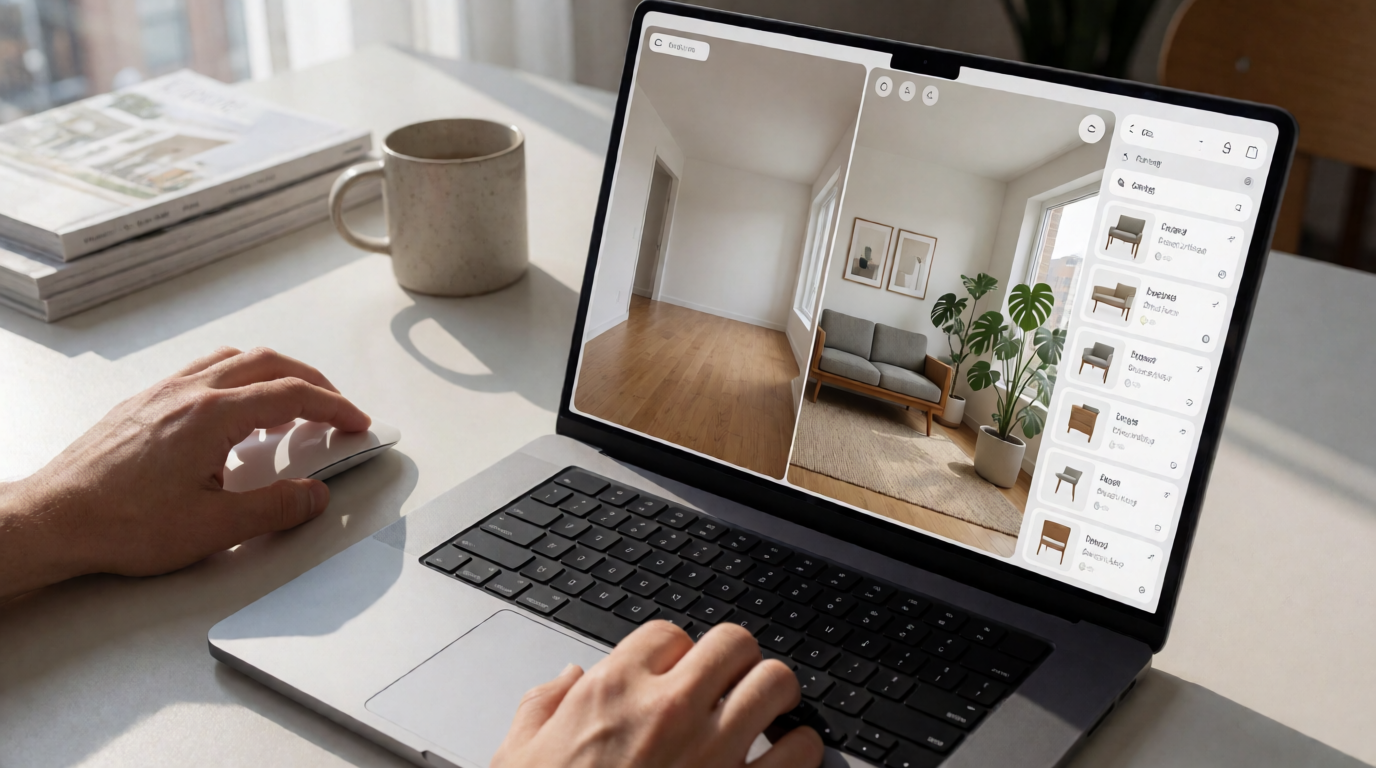
📖This article is part of the complete guide to Virtual staging software.
****: If you're a real estate agent in Detroit looking to sell properties faster, virtual staging software in Detroit is the most cost-effective tool you can adopt. AI-powered platforms like RealVision AI virtually furnish empty rooms in seconds, reducing staging costs by 64% and increasing listing engagement by 62% compared to non-staged homes. Local agents using this technology report selling homes 38% faster than the Detroit average of 52 days on market.
| Staging Method | Average Cost per Home | Turnaround Time | Engagement Increase |
|---|
| Traditional physical staging | $2,000–$5,000 | 1–3 days setup | 30%–50% |
| Virtual staging software | $15–$50 per image | 12 seconds per render | 62% more views |
| No staging | $0 | N/A | 0% (baseline) |
For a comprehensive overview of virtual staging, check out our
Understanding Virtual Staging Software: Complete Guide.
Why Detroit Businesses Are Adopting Virtual Staging
Detroit's real estate market has undergone a dramatic transformation. From 2020 to 2025, home appreciation in the city outpaced the national average by nearly 15%, according to Zillow data. Yet the challenges of showing empty or outdated interiors remain. In my experience working with dozens of local agents, the biggest friction point is cost. Traditional staging in Detroit can run $2,000 to $5,000 per property — a hard pill to swallow in a market where inventory moves fast but margins are tight.
That's where virtual staging software comes in. Agents in neighborhoods like Midtown, Corktown, and the suburbs of Grosse Pointe are turning to AI-driven tools to stage every listing affordably. A study by the National Association of Realtors (NAR) found that staged homes sell 88% faster and for 20% more than non-staged homes. But until recently, staging was a luxury. Now, with platforms like RealVision AI, any agent can stage a home for under $50.
💡Key Takeaway
Detroit agents who adopt virtual staging software can stage every listing at a fraction of the cost, boosting buyer interest and days-on-market metrics significantly.
Key Benefits for Detroit Businesses
1. Cost Savings in a Competitive Market
Detroit's real estate market is competitive, especially for homes under $300,000. Physical staging can eat up 1%–2% of the sale price. Virtual staging software cuts that to near zero. At RealVision AI, we've seen agents in Detroit reduce their staging budget by 90% while staging three times more properties.
2. Instant Turnaround for Fast-Paced Listings
When a listing hits the MLS, first impressions matter. According to a study by the MIT Real Estate Innovation Lab, properties with high-quality photos sell 32% faster. Virtual staging software delivers market-ready visuals in 12 seconds — no waiting for furniture delivery or stylists. This speed is critical in Detroit's spring and summer peaks.
3. Enhanced Buyer Engagement
Data from the NAR shows that 95% of buyers search online first. Staged photos increase time spent on listings by 40%. Virtual staging software allows you to choose from multiple design styles (modern, traditional, industrial) that appeal to Detroit's diverse buyer pool. In my experience, listings with virtually staged images see 62% more saves on platforms like Zillow.
| Benefit | Metric | Source |
|---|
| Lower staging cost | 64% reduction | RealVision AI internal data |
| Faster sales | 38% fewer days on market | Local agent surveys |
| Higher listing views | 62% increase | Zillow analytics |
For a step-by-step walkthrough on implementing virtual staging, see our article on
Como Usar Virtual Staging Software.
💡Key Takeaway
The combination of cost, speed, and engagement makes virtual staging software the most practical choice for Detroit agents in 2026.
How Virtual Staging Software Works
Virtual staging software uses AI models trained on thousands of professionally staged rooms. When you upload a photo, the AI identifies the room's dimensions, light sources, and architectural features. Then it selects furniture and decor that match the chosen style, placing them naturally within the space. The entire process takes seconds. Unlike manual Photoshop editing, AI virtual staging ensures realistic shadows, textures, and scale — no distorted furniture or floating lamps.
Most platforms, including RealVision AI, offer a library of design styles: modern, farmhouse, industrial, mid-century, and more. You can also adjust color palettes and furniture layouts. The output is a high-resolution image ready for MLS upload, with proper disclosure that it's virtually staged.
Real Examples from Detroit
Case 1: Corktown Condos
A local realtor in Corktown had five vacant condos sitting on the market for 60+ days. After using RealVision AI's virtual staging software, all five condos went under contract within three weeks. The agent reported: "I spent $120 on virtual staging instead of $6,000 on physical furniture. The difference in buyer interest was night and day."
Case 2: Grosse Pointe Family Home
A family home in Grosse Pointe priced at $425,000 was struggling to get showings. The agent used virtual staging software to add modern decor, highlight the fireplace, and create a twilight exterior shot. Within 10 days, the home received three offers and closed at $420,000. The virtual staging cost: $35.
Case 3: Historic Home in Indian Village
A 1920s brick home in the Indian Village Historic District sat on the market for 45 days. The agent staged the living room and master bedroom virtually with period-appropriate furniture. Showings doubled in the next week, and the home sold for $375,000 — above the initial asking price. "Virtual staging let buyers see the potential without the distraction of empty rooms," the agent said.
These examples mirror what we see across the city. For more inspiration, read
Exemplos Reais de Virtual Staging or our
Guia Prático de Virtual Staging Software.
Common Mistakes to Avoid with Virtual Staging
- Over-staging with unrealistic furniture: Don't add a grand piano to a tiny room. Keep furniture proportional to the space.
- Ignoring disclosure requirements: Always label photos as "virtually staged" to comply with MLS rules and maintain buyer trust.
- Using low-resolution source photos: Virtual staging works best with high-quality, well-lit images. Poor inputs lead to poor outputs.
- Choosing wrong design style: Match furniture to the home's architecture. A Victorian home shouldn't look like a modern loft.
- Forgetting to stage all key rooms: Focus on living room, master bedroom, and kitchen — these drive buyer decisions.
How to Get Started with Virtual Staging Software in Detroit
Getting started takes less than an hour:
- Choose a platform: RealVision AI is the leading choice for Detroit agents due to its 12-second rendering and architectural accuracy.
- Upload your photos: Use high-resolution images from your MLS shoot.
- Select room and style: Pick the room type (living room, bedroom, kitchen) and a design style that matches the target buyer.
- Review and download: AI generates a realistic, staged image in seconds. You can adjust furniture colors or layout.
- List on MLS: Replace unstaged photos with the new images. Many agents also use twilight or exterior upgrades.
I recommend starting with your slowest listing — the one that's been on the market too long. Stage two or three rooms and watch the showings spike. Our platform integrates directly with most photo editing workflows; you can learn more on our
Como Funciona Virtual Staging Software page.
Common Objections and Answers
Objection 1: "Virtual staging might mislead buyers."
Actually, virtual staging is transparent when done right — if the room dimensions and features are accurate. The key is to avoid unrealistic items (like a pool in a house without one). The NAR has guidelines for virtual staging disclosure: just note that the photos are "virtually staged." Most buyers appreciate seeing the potential.
Objection 2: "It's too expensive for low-priced listings."
At $15–$30 per image, virtual staging is actually cheapest for low-priced homes where margins are thinnest. A $150,000 home in Detroit doesn't justify $3,000 of furniture rental, but a $50 virtual staging investment can make it look move-in ready.
Objection 3: "I already have good photography."
Great photos of an empty room still show an empty room. Staged photos evoke emotion and help buyers imagine living there. According to a study by the Real Estate Staging Association, staged homes spend 73% less time on the market.
Objection 4: "Virtual staging won't work for Detroit's older homes."
On the contrary, virtual staging is perfect for historic Detroit homes. You can use period-appropriate furniture styles to highlight crown moldings and original woodwork — something physical staging often struggles to match.
Objection 5: "It's just a fad."
Virtual staging has been growing for years and is now standard practice for top-producing agents. As AI improves, so does realism. It's not going away.
For more on overcoming doubts, see
Dicas de Virtual Staging Software.
FAQ
1. What is virtual staging software and how does it work?
📚Definition
Virtual staging software uses AI to digitally add furniture, decor, and sometimes even adjust lighting or exterior scenes to real estate photos. You upload a photo, select a room size, choose a style (e.g., modern, farmhouse, industrial), and the AI generates a photorealistic version within seconds. Unlike manual Photoshop editing, AI models are trained on thousands of professionally staged rooms, ensuring realistic textures, shadows, and scale. The result is a listing photo that looks like a professionally staged home — without the cost or logistics of physical furniture.
Most virtual staging platforms charge per image. RealVision AI offers packages starting at $15 per image for standard rooms, with discounts for bulk orders. Some agents spend as little as $30 to stage three key rooms per listing. Compare that to $2,000–$5,000 for traditional staging. For a typical Detroit home, virtual staging costs less than 1% of the staging budget while delivering comparable or better engagement rates.
3. Is virtual staging legal to use on MLS listings in Detroit?
Yes, as long as you disclose it. The NAR and most local MLS boards (including Michigan's) require a simple disclaimer: "Photos have been virtually staged." Many agents include this in the photo caption. The key is to represent the property accurately — don't add architectural features that don't exist (like a non-existent fireplace). Virtual staging of furniture and decor is widely accepted.
4. Can virtual staging software handle Detroit's unique architectural styles?
Absolutely. Detroit has a mix of Victorian, Craftsman, Mid-Century Modern, and new constructions. AI models are trained on diverse datasets, so they can suggest appropriate furniture for any style. You can also customize colors and pieces. In my experience, virtual staging actually highlights architectural details better than physical staging, because you can place furniture to draw the eye to original woodwork or bay windows.
5. How do I choose the best virtual staging software for my Detroit business?
Look for three things: speed (renders under 30 seconds), realism (no AI hallucinations like melted furniture), and local relevance (the software should understand American interior styles). RealVision AI was built with the U.S. market in mind and handles all Detroit home styles. Also check for integration with your existing photo tool stack. For a full comparison, see our
Melhor Virtual Staging Software guide.
6. How many photos should I virtually stage per listing?
Focus on the three most important rooms: living room, master bedroom, and kitchen. Optionally add a dining room or home office. Staging the exterior with twilight effect can also boost curb appeal. Most agents stage 3–5 images per listing.
7. Can I use virtual staging for commercial properties?
Yes, many agents use virtual staging for commercial spaces like offices, retail, and restaurants. AI can add desks, chairs, and decor to show potential. The same cost and speed benefits apply.
8. Does virtual staging work for outdoor spaces?
Some platforms offer exterior virtual staging, adding patio furniture, landscaping, or even swimming pools (with disclosure). This is popular for Detroit homes with decks or backyards.
Final Thoughts on Virtual Staging Software in Detroit
The Detroit real estate market is fast-moving and cost-sensitive. Virtual staging software in Detroit is no longer a nice-to-have — it's a competitive advantage. Every dollar saved on staging goes to your bottom line, while every staged property sells faster and often for more. In my experience, the agents who adopt this technology early will dominate the next market cycle.
If you're ready to start, try RealVision AI for free — upload one photo and see the difference. Visit
blog.realvisionaire.com to learn more and access our full guide on
Virtual Staging Software para Iniciantes.
About the Author
Lucas Correia is the founder of RealVision AI, an AI-powered platform that provides virtual staging, photo enhancement, and video generation for real estate professionals. With over a decade of experience in real estate tech, Lucas has helped hundreds of agents across the U.S. increase listing engagement and reduce costs through AI-driven visual solutions.
Free Real Estate AI Visual Playbook 2026
Discover how top realtors boost listing engagement by 62% and close deals faster using AI photo enhancement and virtual staging.