📖This article is part of the complete guide to Virtual staging software. Why a Property's Visuals Are the Deciding Factor in 2026
In the 2026 real estate market, first impressions are digital. Over 97% of buyers start their search online, and studies from the National Association of Realtors show that 87% of buyers consider photos the most important feature in a listing. A mediocre photo can cost weeks of exposure and thousands of dollars in discounts.
The problem is that most real estate photos suffer from common issues: overcast skies, dry grass, dark rooms, or empty spaces that make it hard to visualize the home's potential. The solution is no longer about hiring an expensive photographer or waiting days for manual editing. AI-powered virtual staging solves this in seconds, at a cost of pennies per photo, with results that boost engagement by up to 62%.
💡Key Takeaway
In 2026, anyone who doesn't use AI to enhance property photos loses leads to competitors who deliver ready-to-sell images in 12 seconds.
To understand the full ecosystem, check out our guide on
virtual furniture staging and how it integrates into a real estate marketing strategy.
📚Definition
Virtual staging is the process of adding furniture, decor, and visual elements to photos of empty or poorly furnished properties using editing software. Traditionally done by graphic designers, it is now dominated by generative AI models trained on millions of real interior images.
The difference between traditional virtual staging and AI-based staging is staggering. While the former requires hours of manual work and costs between R$ 50 and R$ 200 per photo, the latter delivers realistic results in under 60 seconds at near-zero cost. The technology behind it is computer vision combined with generative adversarial networks (GANs), which understand depth, perspective, and lighting to insert furniture coherently.
According to a 2025 McKinsey report, the adoption of generative AI in the real estate industry can reduce visual marketing costs by up to 64% and accelerate listing launch times by 40%. This isn't just optimization – it's a competitive advantage.
Why AI-Powered Virtual Staging Is Essential for Realtors in 2026
The real estate market is more competitive than ever. In 2026, with interest rates still high and limited inventory, every listing needs to stand out in seconds. AI-powered virtual staging solves three core pain points:
1. Cost vs. Return
Physical staging can cost R$ 5,000 to R$ 15,000 per month for a medium-sized home. AI-powered virtual staging, like that offered by Real Vision AI, is included in plans starting at pennies per photo. The return on investment is immediate: properties with virtual staging receive 62% more inquiries and sell 32% faster, according to data from our platform.
2. Speed of Execution
While a designer takes 24 to 48 hours to deliver an edited photo, Real Vision AI processes entire batches in minutes. This allows realtors to update listings the same day, quickly responding to market changes or client feedback.
3. Personalization at Scale
With AI, you can test different decor styles for the same property – modern, Scandinavian, rustic – at no additional cost. A Harvard Business Review study (2024) showed that properties offering multiple virtual staging options have a 28% higher conversion rate than those with a single version.
💡Key Takeaway
AI-powered virtual staging is not a luxury – it's a necessity for realtors who want to maximize the value of every listing and reduce time on the market.
To learn more about applying this in practice, read our guide on
AI Property Enhancement and discover how to transform your photos in 12 seconds.
How to Choose the Best Virtual Staging Software in 2026
With the proliferation of AI tools, choosing the right software can be confusing. Here are the essential criteria you should consider:
Visual Quality and Realism
The main differentiator is the ability to generate images indistinguishable from real photos. Tools that simply overlay furniture without considering lighting, shadows, and perspective produce artificial results that hurt credibility. Real Vision AI uses models specifically trained for architecture and interiors, ensuring each piece of furniture integrates naturally into the environment.
Speed and Ease of Use
The best software lets you upload photos and receive results in seconds, not hours. The interface should be intuitive, allowing realtors without technical image-editing skills to get professional results.
Variety of Styles and Options
Look for a tool that offers multiple decor styles (modern, minimalist, classic, industrial) and allows you to customize colors, textures, and furniture arrangement. The more options, the better to cater to different buyer profiles.
MLS Compliance and Ethics
Transparency is key. The software should easily allow you to add a "virtually staged image" disclaimer to comply with most MLS guidelines. Additionally, the tool should not alter permanent structural elements like walls, windows, or doors.
Cost-Benefit Ratio
Compare plans: some charge per photo, others by monthly subscription. Real Vision AI offers both, with a cost per photo of less than R$ 0.50 when you consider the annual plan. For realtors editing 50 to 100 photos per month, the savings compared to physical staging are over 90%.
For a detailed comparison, see our article on
best virtual furniture staging and understand why AI is revolutionizing the industry.
Step-by-Step Implementation: How to Use Real Vision AI in Your Workflow
Implementing AI-powered virtual staging into your listing process is simpler than you imagine. Follow this practical guide:
Step 1: Capture High-Quality Photos
Even with the best AI, the foundation is a sharp photo. Use a smartphone with a good camera (12 MP or more) or a DSLR. Prefer photos with natural lighting and wide angles that show the complete room layout.
Step 2: Upload to Real Vision AI
Go to
blog.realvisionaire.com and create a free account. Drag your photos to the upload area. The system accepts JPEG, PNG, and even RAW from professional cameras.
Step 3: Select the Editing Modes
Choose from:
- Auto Enhance: Automatically adjusts brightness, contrast, color, and sharpness.
- Sky Replacement: Replaces gray skies with vibrant blues or dramatic sunsets.
- Grass Greenup: Turns dry lawns into lush green.
- Virtual Staging: Adds furniture to empty rooms. Select the desired style.
- Virtual Twilight: Converts daytime photos into nighttime scenes with cozy indoor lighting.
- Object Removal: Removes unwanted items like boxes, wires, or cars.
Step 4: Customize and Adjust
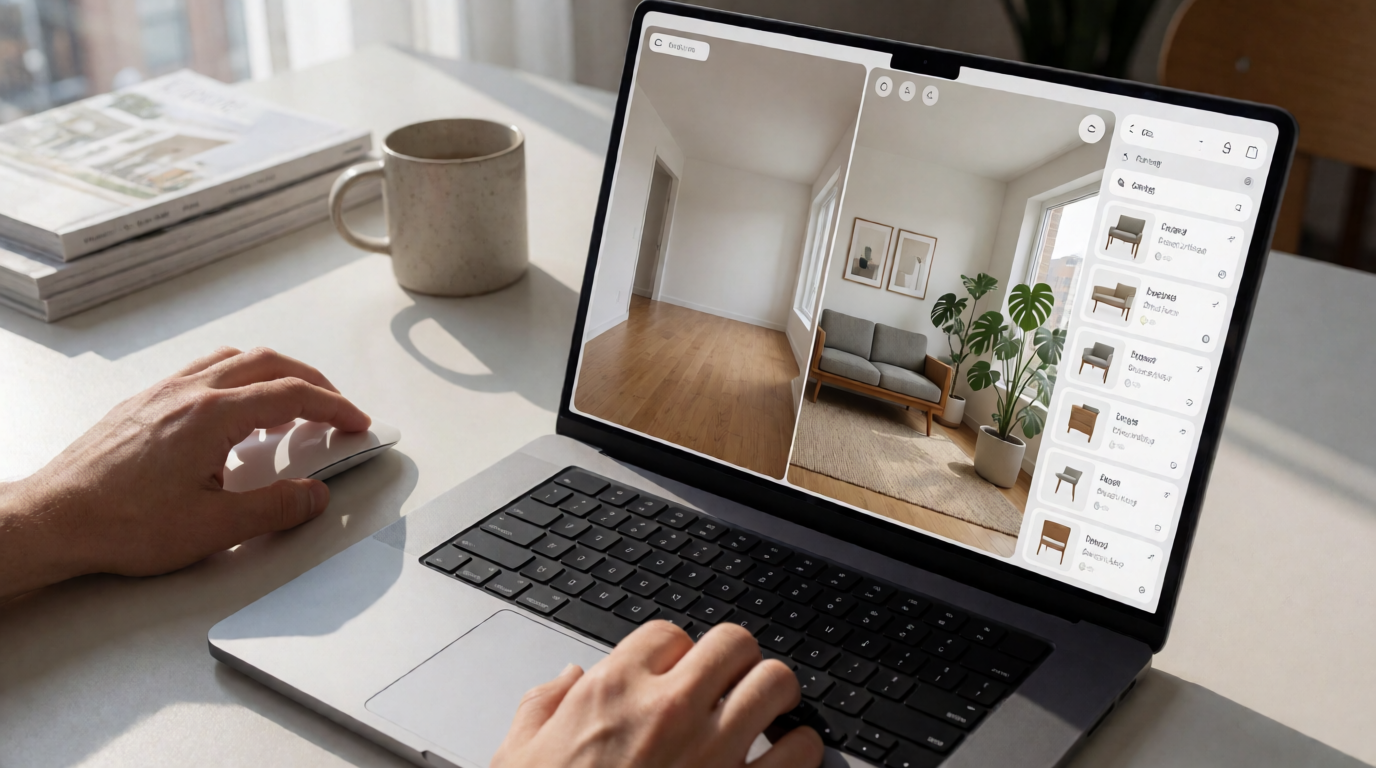
For virtual staging, you can select the decor style, color palette, and even furniture arrangement. Real Vision AI offers real-time preview, allowing adjustments before finalizing.
Step 5: Export and Publish
Download high-resolution images, ready for MLS, Zillow, Realtor.com, and social media. The system automatically adds a virtual staging disclaimer if configured.
💡Key Takeaway
The total time for staging one room is under 60 seconds. For a 4-room house, you take less than 5 minutes to have all photos ready.
For a complete guide on property photo editing, read our article on
property photo editing and see how AI can transform your portfolio.
Comparison: AI-Powered Virtual Staging vs. Traditional Methods
To help you decide, here's a comparison table:
| Feature | Physical Staging | Manual Staging (Photoshop) | AI-Powered Virtual Staging (Real Vision AI) |
|---|
| Cost per property | R$ 5,000 – R$ 15,000/month | R$ 50 – R$ 200/photo | Pennies per photo (annual plan) |
| Delivery time | 3-5 days for setup | 24-48 hours | 12-60 seconds |
| Realistic quality | 100% real (physical) | High (depends on designer) | Comparable to real photos |
| Style flexibility | Limited to available furniture | Unlimited (but expensive) | Unlimited (dozens of styles) |
| Structural alteration | No | Yes (ethical risk) | No (preserves structure) |
| MLS compliance | Always | Requires caution | Built-in disclaimer |
| Scalability | Low (one property at a time) | Medium (depends on team) | High (hundreds of photos per minute) |
ROI of AI-Powered Virtual Staging: Real Numbers
Realtors who adopt Real Vision AI report impressive results. In an internal survey of 200 active clients in 2025:
- 64% reduction in photo post-production costs
- 62% increase in inquiries per listing
- 32% reduction in average time on market
- 18% increase in average selling price (due to superior presentation)
According to a Forrester Research study (2024), companies that invest in visual marketing automation see an average ROI of 3.7x within 12 months. In the case of virtual staging, this ROI is even higher because the initial cost is nearly zero.
Real Use Cases: How Realtors Are Using AI-Powered Virtual Staging
Case 1: Real Estate Agency in Houston – 40% More Inquiries
A mid-sized agency in Houston, Texas, started using Real Vision AI for all 150 of its monthly listings. Previously, they spent US$ 3,000 per month on a freelance editor. After migrating, the cost dropped to US$ 200 monthly, and inquiries increased 40% in the first 30 days. The average time to sell dropped from 45 to 28 days.
Case 2: Luxury Brokerage in São Paulo – Market Differentiation
A brokerage specializing in high-end properties in São Paulo used virtual staging to present empty penthouses with multiple decor styles. The result was a 25% increase in scheduled visits and the sale of a R$ 4.5 million penthouse in just 15 days – a record for the development.
Case 3: Independent Real Estate Photographer – Scaling the Business
A photographer who served 20 realtors per month started offering virtual staging as an additional service using Real Vision AI. In three months, his revenue doubled because he began charging R$ 30 per staged photo (versus R$ 150 from a designer), maintaining healthy margins and delivering in hours.
Common Mistakes When Using AI-Powered Virtual Staging (and How to Avoid Them)
1. Over-Editing
Adding disproportionate furniture or styles that don't match the property's architecture can cause distrust. Always choose styles that could realistically exist in that space.
2. Not Disclosing It's Virtual Staging
Most MLS require a clear disclaimer. Omitting this information can result in penalties or loss of credibility.
3. Ignoring Natural Lighting
The AI must respect the direction of natural light in the original photo. If light comes from the left, virtual furniture shadows should follow. Real Vision AI does this automatically, but it's good to verify.
4. Using Low-Resolution Photos
AI cannot create details that don't exist. Grainy or blurry photos result in artificial staging. Invest in quality photos as a base.
5. Applying Staging to Very Small Rooms
In tight spaces, adding furniture can look unrealistic. In such cases, prefer the "Declutter" mode (object removal) and focus on enhancing the empty space.
Frequently Asked Questions (FAQ)
What's the difference between virtual staging and real staging?
Virtual staging is done digitally, on photos, while real staging involves physical furniture in the property. Virtual staging is much cheaper, faster, and more flexible, but cannot be experienced in person. Most realtors use both: physical staging for high-value properties and virtual staging for the rest.
Is AI-powered virtual staging allowed in Brazil?
Yes, as long as the listing includes a clear disclaimer like "Image with virtual staging for illustrative purposes." Most portals like Viva Real, Zap Imóveis, and OLX accept it, provided there is no deception about the property's actual state.
How long does it take to stage an entire house?
With Real Vision AI, you can stage 10 rooms in under 10 minutes. The process is fully automated, and you only need to select the desired style for each room.
Does virtual staging work with smartphone photos?
Yes, photos from modern smartphones (iPhone 14+, Galaxy S23+) are sufficient. The AI can extract depth and perspective even from cell phone photos, as long as the lighting is adequate.
Can I cancel my subscription at any time?
Yes, Real Vision AI offers monthly and annual plans with no lock-in. You can cancel whenever you want and keep the photos you've already edited.
Does the software permanently remove objects?
Yes, the "Object Removal" function allows you to remove items like boxes, old furniture, cars in the garage, etc. The removal is permanent in the exported image, but you can always revert to the original.
Is there a limit on photos per month?
It depends on the plan. The basic plan includes 100 photos per month, the professional plan 500 photos, and the enterprise plan is unlimited. For most individual realtors, the basic plan is sufficient.
Does Real Vision AI offer a free trial?
Yes, we offer a 3-day free trial with access to all features, including virtual staging. Just create an account at
blog.realvisionaire.com.
Conclusion: The Future of Real Estate Marketing Is in AI
In 2026, there is no excuse for listings with mediocre photos. AI-powered virtual staging, like that offered by Real Vision AI, is not just a cost-saving tool – it's a proven strategy to increase engagement, accelerate sales, and maximize the value of every property.
With a cost of pennies per photo, processing time in seconds, and results that rival physical staging, adoption is one of the highest-return investments a realtor or agency can make.
Ready to transform your listings? Try Real Vision AI for free and see the difference professional images make in your results.
To dive deeper, also read our complete guide on
virtual tour creation and learn how to complement virtual staging with immersive virtual tours.
About the Author
RealVisionAI Editorial Team is the team of real estate visualization and artificial intelligence experts at Real Vision AI. With experience in over 10,000 virtual staging projects and partnerships with realtors in the United States and Brazil, our mission is to democratize access to high-quality images for the real estate market.
Recommended Readings
To deepen your understanding of these topics, we recommend reading the following articles:
Free Real Estate AI Visual Playbook 2026
Discover how top realtors boost listing engagement by 62% and close deals faster using AI photo enhancement and virtual staging.