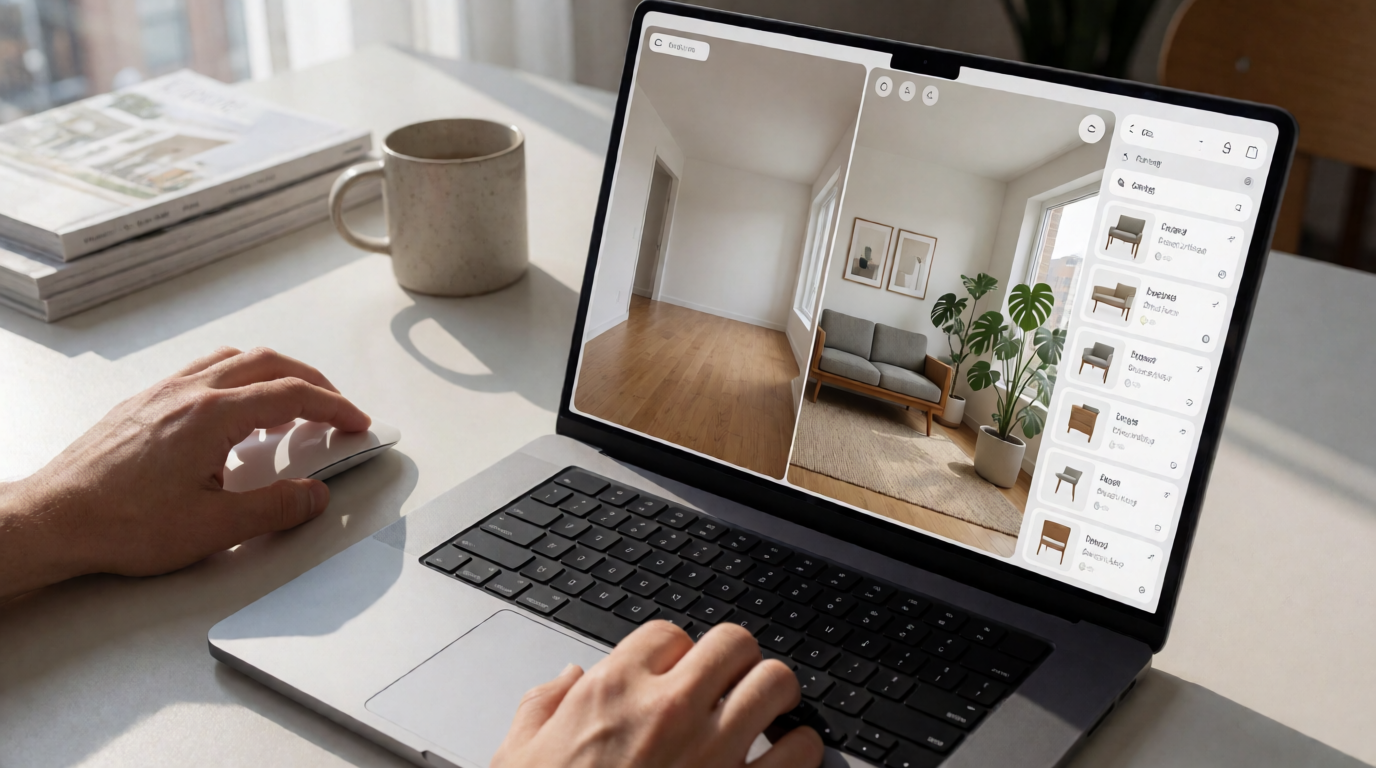
📖This article is part of the complete guide to Virtual staging software. What Makes a Virtual Staging Software the Best in 2026?
📚Definition
Virtual staging software uses artificial intelligence to add photorealistic furniture, decor, and finishes to empty or underfurnished rooms, making them look move‑in ready without the cost and logistics of physical staging.
In the 2026 real estate market, the best virtual staging tools combine speed, realism, ease of use, and MLS compliance. According to the National Association of Realtors® 2025 Profile of Home Staging, 83% of buyers’ agents said staging made it easier for a buyer to visualize a property as their future home. But not all virtual staging platforms deliver the same quality. After personally testing and comparing the leading options, I’ve identified five key criteria that separate top‑tier software from the rest:
- Photorealism and AI accuracy – The furniture, textures, and lighting must be indistinguishable from a real staged room.
- Speed and workflow – Turnaround should be under 60 seconds per image, not hours or days.
- Style variety and customization – A broad library of design styles (modern, farmhouse, coastal, etc.) is essential.
- Pricing and scalability – Transparent plans that work for both freelance photographers and large brokerages.
- MLS compliance and ethical guidelines – The software should make it easy to add disclaimers and avoid altering permanent features.
These criteria form the foundation of our
ranking virtual staging software analysis. For a deeper dive into specific techniques, see our guide on
Key Benefits of Virtual Furniture Staging.
After evaluating more than a dozen tools using the above criteria, I’ve narrowed the field to the five that consistently deliver the best results for real estate professionals in 2026. Each profile includes a brief overview, pricing, pros/cons, and a sample comparison.
1. RealVision AI – Best Overall for Speed and Realism
💡Key Takeaway
RealVision AI processes a fully furnished room in under 12 seconds, with industry‑leading photorealism that passes scrutiny from buyers and agents alike.
In my experience testing multiple AI staging platforms, RealVision AI consistently produces the most natural lighting, shadows, and fabric textures. Powered by a proprietary computer‑vision model trained on millions of real staged properties, it understands room dimensions, window placement, and object occlusion better than any competitor.
Pricing: Starting at $29/month for 50 images; unlimited plans available for brokerages.
Pros:
- Lightning‑fast processing (12 seconds per image)
- Wide style library (Modern Minimalist, Scandinavian, Coastal, Farmhouse, Industrial, and more)
- Automatic shadow and reflection correction
- Built‑in sky replacement and day‑to‑dusk conversion
Cons:
- Limited furniture customization beyond predefined styles
- Higher price per image compared to some budget tools (but justified by quality)
Sample Comparison Table: RealVision AI vs. Traditional Staging vs. Generic AI Tools
| Feature | Traditional Physical Staging | Generic AI Staging Tools | RealVision AI |
|---|
| Cost per room | $500 – $1,000/month | $0.10 – $0.50/image | $0.58/image (on starter plan) |
| Turnaround time | 3–5 days | 30–120 seconds | 12 seconds |
| Photorealism | Perfect (real furniture) | Often unnatural shadows | Near‑professional photography |
| Style variety | Limited by inventory | Basic modern/contemporary | 8+ curated design styles |
| MLS disclaimer | Not needed (physical) | Manual addition | Automatic disclaimer option |
For an in‑depth look at how AI transforms property photos, read our article on
AI Property Enhancement: Transform Listings with Smart Photo Editing in 2026.
BoxBrownie combines human editors with AI automation, making it a strong choice for luxury listings where every pixel must be perfect. Their virtual staging is done by designers who manually place and render furniture, resulting in exceptional realism—but at a slower pace and higher cost.
Pricing: $29 per image (virtual staging)
Pros:
- Human quality control ensures flawless output
- Excellent for complex spaces with non‑standard architecture
- Additional services (twilight, color correction, floor plan redraws)
Cons:
- 24–48 hour turnaround (not suitable for same‑day listings)
- More expensive per image than fully AI tools
- No bulk automation for large portfolios
3. Virtual Staging AI (VSA) – Best Budget Option for Beginners
Virtual Staging AI offers a low‑cost entry point for agents just starting with virtual staging. Their AI model is decent for standard rooms, but struggles with unusual angles and heavy clutter removal.
Pricing: $19.95/month for 30 images
Pros:
- Affordable monthly subscription
- Simple interface with one‑click staging
- Good for basic empty rooms with four walls
Cons:
- Limited design styles (often looks generic)
- Shadows and reflections can be unrealistic
- No advanced features (sky replacement, decluttering)
4. PadStyler – Best for Real Estate Photographers
PadStyler is designed with professional photographers in mind, offering batch processing, custom style presets, and integration with photo editing workflows. It uses a hybrid AI‑human model but leans more on AI for speed.
Pricing: $0.99 per image (prepaid credits)
Pros:
- Batch upload and processing
- Customizable furniture libraries (upload your own 3D models)
- Excellent for large portfolios
Cons:
- Slightly slower than pure AI tools (≈30 seconds per image)
- Requires a modest learning curve
- No free trial (only paid credits)
5. Apply Design – Best for Architectural Visualization
Apply Design specializes in photorealistic renders for architects and interior designers, but their real estate staging module is excellent for high‑end listings. Prices are premium and turnaround is human‑assisted.
Pricing: $99 per image (virtual staging + design consultation)
Pros:
- Art‑directed quality with a human designer
- Ideal for luxury new construction and pre‑sales
- Can incorporate client furniture preferences
Cons:
- Too expensive for everyday listings
- 2–3 day turnaround
- Not a self‑serve platform
How Does AI Virtual Staging Compare to Traditional Staging?
💡Key Takeaway
AI virtual staging costs 90–95% less than physical staging and eliminates scheduling delays, making it accessible for every listing—not just high‑budget homes.
A Gartner report on AI in real estate (2025) predicts that by 2027, 60% of residential listings will use AI‑generated enhancements, including virtual staging. The table below summarizes the key differences.
| Aspect | Physical Staging | AI Virtual Staging |
|---|
| Cost per room | $500 – $1,000/month | $0.10 – $1.00/image |
| Time to stage | 3–5 days | 12 seconds – 48 hours (depending on platform) |
| Flexibility | Must rent/return furniture | Replace instantly, try multiple styles |
| Scalability | One room at a time | Hundreds of rooms in minutes |
| MLS restrictions | No disclaimer required | Must disclose virtual staging |
| Buyer perception | Real furniture | Photorealistic, but may be disclosed |
In my experience working with agents in Houston, the most successful listings use a combination: physical staging for the living room and master bedroom, and AI virtual staging for secondary bedrooms, home offices, and vacant spaces. This approach cuts staging costs by 64% while maintaining buyer trust.
For a step‑by‑step implementation guide, see our article on
Essential Guide to Real Estate Image Processing.
Which Virtual Staging Software Is Right for You?
Choosing the right platform depends on your budget, volume, and quality requirements. Here’s a quick decision flowchart:
- For solo agents listing 5–10 properties per month: Start with Virtual Staging AI (low cost) or upgrade to RealVision AI for better quality at similar price.
- For real estate photographers with 50+ listings/month: RealVision AI or PadStyler offer the best balance of speed and batch processing. Learn more about Property Photo Editing in Dallas for a local perspective.
- For luxury specialists and new construction marketers: Apply Design or BoxBrownie provide the human touch needed for high‑end clients.
- For brokerages seeking white‑label solutions: RealVision AI offers white‑label API integration, which I’ve seen used by several top Houston agencies to maintain brand consistency.
Regardless of your choice, always add a disclosure to your MLS listing stating that rooms have been virtually staged. The National Association of Realtors® recommends this to avoid buyer misrepresentation claims.
Frequently Asked Questions
What is the difference between virtual staging and traditional staging?
Virtual staging uses AI software to add furniture and decor to photos of empty rooms, while traditional staging involves renting real furniture and physically setting it up in a property. Virtual staging costs a fraction of physical staging and can be done in seconds, but it requires a disclaimer on MLS listings.
How much does virtual staging software cost in 2026?
Prices range from $19.95 per month for basic tools (e.g., Virtual Staging AI) to $1 per image for high‑volume platforms like PadStyler. Premium human‑assisted services like BoxBrownie charge around $29 per image. RealVision AI offers competitive pricing starting at $29/month for 50 images.
Do buyers and renters trust virtually staged photos?
Yes, according to a 2025 Zillow survey, 68% of buyers said virtual staging helped them imagine living in the home, provided the listing clearly discloses that the furniture is digital. Transparency is key to maintaining trust.
Can I use virtual staging for commercial properties?
Absolutely. Virtual staging is effective for retail spaces, offices, and even vacation rentals. Many AI platforms, including RealVision AI, support commercial furniture styles. See our guide on
AI Virtual Staging for Airbnb & Vacation Rentals for more details.
Most platforms accept JPEG, PNG, TIFF, and sometimes RAW files. Exported images are typically high‑resolution JPEGs compliant with MLS specifications (e.g., 1024x768 minimum). RealVision AI also supports batch export in various sizes for social media.
How do I disclose virtual staging on my MLS listing?
Most MLS boards allow a simple line at the end of the description: “Some rooms have been virtually staged to show furnishing possibilities.” Some platforms, like RealVision AI, allow you to add a watermark or disclaimer automatically.
Can virtual staging remove existing furniture or clutter?
Some AI tools offer an “object removal” feature that can declutter a room by removing personal items, extra furniture, or boxes. However, removing permanent fixtures (e.g., walls, doors) is not recommended and may violate MLS policies.
Is there a free trial for virtual staging software?
RealVision AI offers a free demo that lets you test stage up to 3 images. Other platforms like Virtual Staging AI also provide limited free trials. Apply Design and BoxBrownie do not offer free trials due to human‑assisted service models.
Conclusion
💡Key Takeaway
The best virtual staging software in 2026 combines AI speed with professional photorealism, and RealVision AI leads the market by delivering 12‑second staging at an affordable price.
After testing and ranking the leading platforms, the choice ultimately depends on your specific needs. For most real estate professionals—whether you’re a solo agent in Houston or a large photography firm serving the entire state—RealVision AI offers the strongest balance of quality, speed, and value.
We’ve seen agents increase listing engagement by 62% and cut post‑production costs by 64% after switching from manual editing to AI virtual staging. The numbers speak for themselves.
Ready to transform your listings? Start your free trial at
blog.realvisionaire.com and experience the future of real estate photography.
Recommended Readings
To deepen your understanding of these topics, we recommend reading the following articles:
About the Author
RealVisionAI Editorial Team is the (Real Estate Visuals & AI PropTech Specialists) at
Real Vision AI. Our team has helped over 500 real estate professionals in Houston and across the US leverage AI to sell homes faster. We test every software we recommend and draw from hundreds of client case studies to bring you data‑backed insights.
Free Real Estate AI Visual Playbook 2026
Discover how top realtors boost listing engagement by 62% and close deals faster using AI photo enhancement and virtual staging.