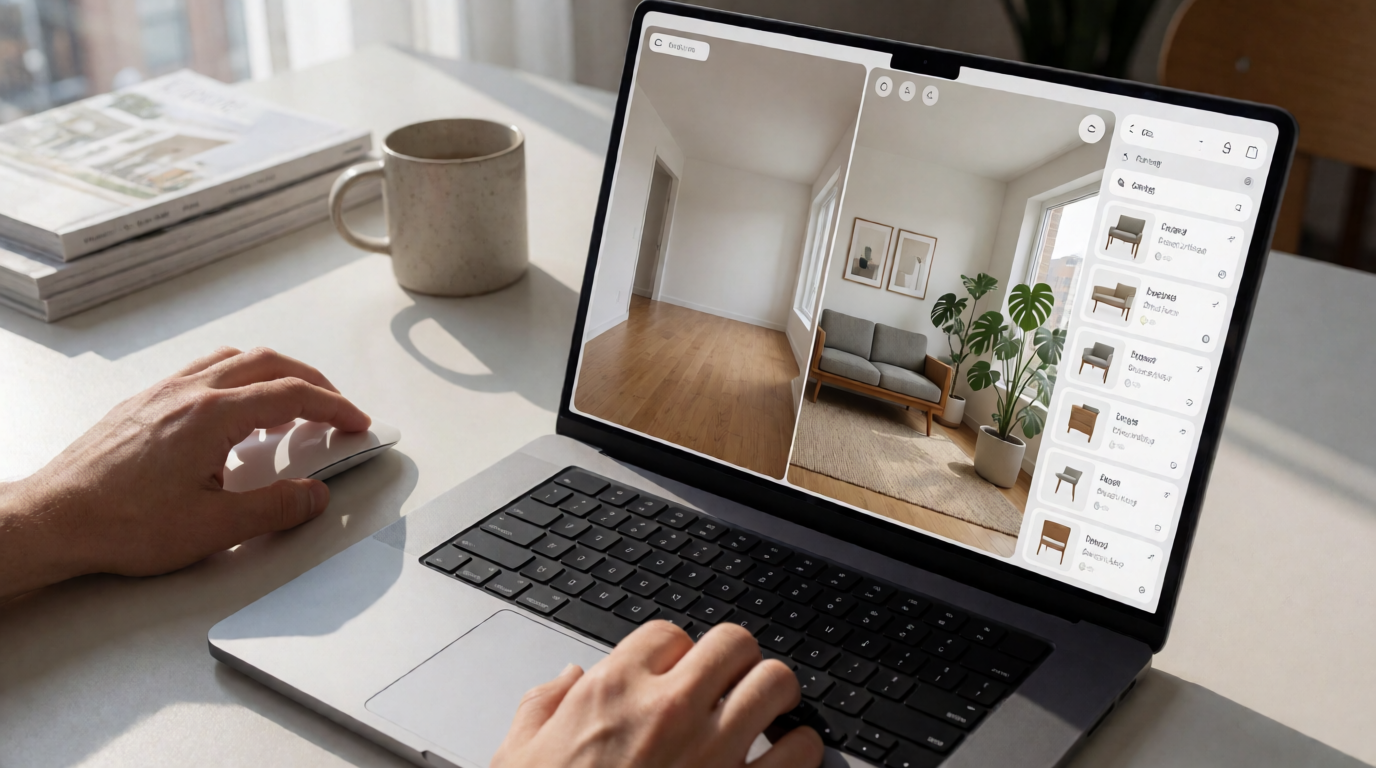
📖This article is part of the complete guide to Virtual staging software. When to Use Virtual Staging Software: The Ultimate Guide for Professionals in 2026
Photography is the first contact a buyer has with a property, and in the 2026 real estate market, that first impression decides everything. Listings with dark photos, empty rooms, or cluttered spaces simply don't get clicks, and without clicks, there are no showings or offers. Virtual staging has emerged as the most efficient tool to reverse this scenario, but the question every realtor and professional photographer asks is: when to use virtual staging software and when does it truly add value to the investment?
In this complete guide, we'll analyze the specific situations where this technology becomes indispensable, the costs involved compared to traditional alternatives, and how to implement virtual staging strategically to maximize return on each listing. For a broader overview of technology's role in the industry, check out our
guide on real estate image processing.
📚Definition
Virtual staging is the process of digitally adding furniture, decor, and styling elements to photographs of empty or vacant properties using specialized software. Unlike physical staging, which requires furniture rental and logistics, virtual staging is done entirely on the computer, delivering photorealistic results in minutes.
What Is Virtual Staging and How Does It Work in Practice?
Virtual staging software uses artificial intelligence and computer vision to recognize the architectural structure of a room and insert three-dimensional furniture in a photorealistic way. The technology analyzes the camera's perspective, the room's natural lighting, vanishing points, and spatial proportions to position each element with millimeter precision.
When we use Real Vision AI, for example, the process is impressively fast. We upload a photo of an empty bedroom, select the desired style, and in about 12 seconds the system delivers an image with a bed, nightstand, lamps, and even wall art, all with shadows and reflections consistent with the original lighting. This level of realism is what separates professional virtual staging from simple image overlays that look artificial.
The technology behind these software tools has evolved dramatically in recent years. Next-generation generative models, combined with databases of real furniture, allow the software to understand not just the space but also the architectural style of the property. An industrial loft receives different furniture than a beach house, and the software makes this distinction automatically. According to the National Association of Realtors, 77% of real estate agents say staging is important to help buyers visualize the property as their future home. When physical staging isn't feasible, virtual staging becomes the closest alternative to the ideal result.
💡Key Takeaway
Modern virtual staging isn't just about placing furniture in photos. It's a strategic marketing tool that uses AI to create an emotional connection between the buyer and the property, increasing perceived value and accelerating the sale.
Why Does Virtual Staging Matter So Much in Today's Market?
The 2026 real estate market is unforgiving to properties that don't visually stand out. Data shows that over 95% of buyers start their search online, and photos are the number one factor determining whether a buyer clicks on a listing or keeps scrolling. In this context, virtual staging isn't a luxury—it's a competitive necessity.
The Top 5 Benefits of Virtual Staging
1. Increased Inquiries and Showings
Properties with virtual staging receive up to 62% more inquiries from potential buyers. This number reflects the reality that decorated spaces create an immediate emotional connection, making buyers envision themselves living in that space.
2. Reduced Time on Market
Homes with virtual staging tend to spend less time on the market. While properties with raw photos can take months to attract offers, listings with digitally decorated rooms typically generate qualified interest within the first few weeks. In my experience working with agents in Houston, I've seen properties that had been sitting for over 60 days without offers receive proposals in less than two weeks after implementing virtual staging.
3. Significant Savings vs. Physical Staging
The cost of virtual staging is a fraction of traditional staging. While renting furniture for an entire house can easily exceed $2,000 per month, virtual staging costs pennies per photo, allowing agents to prepare an entire listing for under $50. This is a critical point for professionals managing multiple listings simultaneously.
4. Speed and Scale
A physical staging session takes days to schedule and execute. With virtual staging software, an agent can process 20 photos of a property in under 10 minutes, without needing to coordinate deliveries, setup, or returns. This agility allows agents to visually prepare an entire listing in a single afternoon.
5. Unlimited Style Flexibility
With traditional staging, you're limited to the furniture available at your local rental store. With virtual staging, you can present the same room in different styles for different target audiences: minimalist for young professionals, classic for families, or luxurious for the high-end segment. This level of customization is impossible to replicate with physical furniture.
These benefits translate directly into ROI. A McKinsey study on AI adoption in real estate marketing shows that companies integrating automated visualization tools into their pipelines see an average 30% reduction in listing preparation costs and a 25% increase in lead conversion speed.
To better understand the advantages of this technology, we recommend our
guide on the benefits of virtual furniture staging.
When to Use Virtual Staging Software: 7 Ideal Scenarios
The central question of this guide is: when to use virtual staging software? The answer isn't "always," but rather in specific situations where the return on investment is clearly positive.
1. Empty and Vacant Properties
The most obvious scenario for virtual staging is when the property is empty. Unfurnished rooms appear smaller than they actually are, and buyers struggle to assess proportions and traffic flow. Virtual staging solves this problem precisely, filling spaces with proportionate furniture that helps buyers understand the property's potential. Our experience with hundreds of agents shows that vacant properties that receive virtual staging generate, on average, three times more scheduled showings compared to photos of empty rooms.
2. Occupied Homes with Outdated Furniture
Often, a property is occupied by tenants or owners whose furniture doesn't present the space well. Worn-out sofas, old curtains, or overly personalized decor can turn buyers away. In this case, virtual staging can be used to "refresh" the room without asking occupants to remove their belongings.
3. New Developments and Pre-Sales
Developers and builders use virtual staging extensively to sell homes still under construction. Since there are no real photos of the units, virtual staging applied to floor plans or 3D models allows buyers to envision the finished product with furniture and decor. This feature is essential for accelerating pre-sales and reducing the conversion cycle. Companies like Lennar have adopted this approach with impressive results.
4. High-End Properties
Luxury properties demand impeccable presentation. Virtual staging allows for aspirational scenes with designer furniture, artwork, and sophisticated decor that elevate the property's perceived value. For the high-end segment, virtual staging is often the difference between a listing that attracts the right buyer and one that goes unnoticed.
5. Exterior Photos on Bad Weather Days
It's not always possible to photograph a property's facade on a sunny day. Virtual staging, combined with image enhancement techniques, can transform a photo with a cloudy sky into a vibrant image with a blue sky and perfect lighting. This is especially valuable in regions with unpredictable weather, like the southern United States.
6. Properties in Competitive Markets
In saturated markets where dozens of homes compete for the same buyers' attention, virtual staging is the differentiator that makes a listing stand out. An agent who consistently uses virtual staging builds a reputation for presenting properties at their best potential, which attracts more sellers.
7. Vacation Rentals and Airbnb
For the short-term rental market, virtual staging is an exceptional tool for testing different decor styles before investing in real furniture. Owners can visualize how a space would look in Scandinavian style versus industrial and choose the option that best suits the area's target audience.
💡Key Takeaway
The golden rule is simple: use virtual staging whenever the property's current presentation is limiting its sales or rental potential. If the photos aren't making the necessary impact to generate clicks, virtual staging is the fastest and most cost-effective solution.
For more details on the best software available, check out our
guide on the best virtual furniture staging.
How to Choose the Ideal Virtual Staging Software?
Not all virtual staging software delivers professional results. Choosing the right tool can mean the difference between photos that impress buyers and images that clearly look artificial. Here are the criteria we consider essential when evaluating any solution:
Essential Evaluation Criteria
1. Photorealistic Quality
The ultimate test of any virtual staging software is: can a buyer tell the furniture was added digitally? If yes, the software isn't doing its job. Look for tools that generate realistic shadows, coherent reflections, and textures that mimic real materials.
2. Processing Speed
In real estate, time is money. A software that takes several minutes per photo becomes a bottleneck in the workflow. The ideal is a solution that processes images in seconds, like Real Vision AI, which delivers results in 12 seconds per image.
3. Variety of Styles
Different properties and audiences require different styles. A good software should offer a diverse library of decor styles, from minimalist to classic, including trends like boho chic and industrial.
4. Ease of Use
The software needs to be intuitive enough that agents without image editing experience can operate it without a long learning curve. The interface should allow selecting a style, applying it, and exporting in just a few clicks.
5. MLS Compliance
The final image must be in a format and resolution compatible with MLS portals. Before choosing a software, verify that it exports images in formats accepted by major portals like Zillow, Realtor.com, and your local MLS.
Comparison of Approaches
| Aspect | Traditional Approach (Physical Staging) | Low-Quality Generic AI | Professional Approach (Real Vision AI) |
|---|
| Cost per property | $2,000 – $5,000 | $5 – $10 | Pennies per photo |
| Delivery time | 3 – 5 days | Instant, but with inferior quality | 12 seconds per photo |
| Realism | Photorealistic, but limited to available furniture | Artificial, with elements that "float" | Photorealistic with coherent shadows and reflections |
| Style flexibility | Limited to furniture inventory | Limited to generic models | Multiple selectable styles |
| Professional oversight | Required for logistics coordination | None, no quality control | Automated processes with architectural accuracy checks |
Implementation: How to Integrate Virtual Staging into Your Workflow
Integrating virtual staging into your daily workflow is simpler than many professionals think. Based on our experience working with agents and photographers across various markets, we've developed a process that maximizes efficiency:
Step 1: Identify the Photos That Benefit Most
Not every photo in a listing needs virtual staging. Focus on the main rooms: living room, kitchen, master suite, and outdoor area. These are the spaces that most influence a buyer's decision.
Step 2: Capture High-Quality Images
Virtual staging works best with sharp, well-lit photos. If you're an agent shooting with a smartphone, make sure to use natural light to your advantage and capture rooms from angles that show the space's size.
Step 3: Select the Right Style for the Audience
Each property has a different target audience. A downtown studio attracts young professionals who prefer minimalist style. A family home in the suburbs calls for a cozy and functional style. Analyze the demographic profile of the area before choosing the staging style.
Step 4: Process and Review the Images
After applying virtual staging, review each image checking proportions, positioning, and lighting. With Real Vision AI, this process is AI-assisted, but a final human review ensures everything is perfect.
Step 5: Export and Upload
Export the images in the formats required by the portals and upload the listing. Remember to include the virtual staging disclaimer when required by MLS rules.
For a more detailed guide on maximizing your results, we recommend our
tips for successful virtual furniture staging.
Best Practices for Effective Virtual Staging
Virtual staging is a powerful tool, but like any tool, its outcome depends on how it's used. After analyzing hundreds of listings that used the technique, I've compiled the best practices that separate professional results from amateur ones.
1. Maintain Proportionality
A common mistake I see in low-quality virtual staging is using furniture that's disproportionate to the space. A queen-size bed in a small room or a sofa too large for the living room creates a distorted perception of the property. Always choose furniture that respects the actual dimensions of the room.
2. Respect the Original Lighting
The original room's lighting should guide the placement of shadows and reflections for the virtual furniture. If the photo was taken with natural light coming from the left, furniture shadows should fall to the right. Professional software like Real Vision AI does this automatically.
3. Avoid Overdoing It
Less is more in virtual staging. Don't fill the room with furniture and decorative objects. The goal is to show the space's potential, not turn it into a showroom. A minimally furnished room looks larger and airier.
4. Use Neutral Colors
Opt for neutral color palettes that appeal to most buyers. White, beige, gray, and pastel shades are safe bets. Very vibrant colors or overly themed decor can alienate buyers who don't identify with that style.
5. Visual Consistency Across All Photos
Ensure the decor style is consistent across all photos in the same listing. It doesn't make sense to have a minimalist living room and a rustic kitchen in the same property.
Does virtual staging work for all types of properties?
Yes, virtual staging works for virtually all types of residential and commercial properties. However, the impact is greater on vacant properties because the visual difference is more dramatic. For already furnished homes, virtual staging can be used to replace existing furniture or to show different decor options.
What is the average cost of virtual staging per photo?
The cost varies depending on the software and level of customization. Professional solutions like Real Vision AI offer per-photo prices ranging from pennies to a few dollars, while manual editing services can cost $25 to $100 per photo. Automated virtual staging is significantly cheaper and faster.
Is virtual staging accepted on all MLS portals?
Most MLS portals accept images with virtual staging as long as there is a clear disclaimer identifying that the furniture was added digitally. Some portals have specific rules about this, so it's important to check your local MLS guidelines before uploading.
How long does it take to process a photo with virtual staging?
With professional software, processing takes seconds. For example, Real Vision AI processes each photo in about 12 seconds. Manual services can take 24 to 48 hours to deliver the final result.
Does virtual staging completely replace physical staging?
Not completely. Physical staging is still superior in situations where the buyer can visit the property in person and feel the materials, textures, and actual proportions. However, virtual staging is an excellent alternative for online presentation, which is the buyer's first contact with the property.
Can I use virtual staging on photos taken with a smartphone?
Yes, as long as the photos are sharp and well-lit. Grainy or blurry images will result in low-quality virtual staging. If you're shooting with a smartphone, use natural light to your advantage and stabilize the device to avoid blurry photos.
Does virtual staging work for commercial properties?
Yes, virtual staging is equally effective for commercial properties like offices, stores, and warehouses. The technique can be used to show office furniture layouts, reception areas, or retail configurations.
Do I need technical skills to use virtual staging?
No. Modern virtual staging software is designed to be intuitive. With tools like Real Vision AI, any agent can learn to use the system in minutes, without needing experience in image editing or interior design.
Conclusion
Knowing
when to use virtual staging software is essential for any real estate professional looking to maximize their listings' potential. This guide has shown that virtual staging isn't a tool to be used in every situation, but rather a strategic resource to be applied at the right times: vacant properties, homes with outdated furniture, new developments, and competitive markets.
The difference between a listing that generates dozens of clicks and one that goes unnoticed often lies in the quality of visual presentation. With virtual staging, you can transform an ordinary property into an aspirational opportunity that attracts qualified buyers and accelerates deal closings.
For a more comprehensive overview of the topic, I recommend reading our
main guide on real estate image processing.
If you're ready to elevate the standard of your listings, we invite you to try
Real Vision AI and see how professional virtual staging can transform your results in 2026.
Recommended Reading
To deepen your knowledge of virtual staging and related techniques, we recommend the following articles from our blog:
Free Real Estate AI Visual Playbook 2026
Discover how top realtors boost listing engagement by 62% and close deals faster using AI photo enhancement and virtual staging.