

Which Approach is Best for Commercial Real Estate Photography in 2026?
Choosing the right strategy for your commercial listing depends entirely on the asset class and the target investor profile. For high-value industrial warehouses or retail centers, the "best" approach is a hybrid model: high-end architectural captures supplemented by AI-driven enhancements. While traditional photography captures the raw scale, AI ensures the lighting, sky, and environment are optimized for maximum conversion. For those scaling a large portfolio, the most efficient path is leveraging Real Estate Visual Marketing: The 2026 Guide to AI-Driven Sales to maintain a consistent, polished look across hundreds of listings without the cost of a full-time crew for every site.
Understanding the Framework of Commercial Real Estate Photography
When we discuss commercial real estate photography, we aren't talking about a simple wide-angle shot of a living room. We are dealing with complex architectural lines, massive scale, and often, visually unappealing environments like empty concrete shells or dimly lit parking garages. The goal is to communicate utility, value, and potential to a sophisticated investor.
📚
Definition
Commercial Real Estate Photography is the specialized practice of capturing industrial, retail, office, and multi-family properties using techniques that emphasize scale, zoning potential, and structural integrity over residential "coziness."
In my experience working with commercial brokers, the most common mistake is treating a 50,000-square-foot warehouse like a 3-bedroom house. Residential photography sells a dream; commercial photography sells an investment. This means the focus must shift toward "hero shots" that show the property's relationship to the surrounding infrastructure, access points, and internal volume.
According to research from Gartner, the integration of computer vision and AI in B2B marketing has increased lead conversion rates by nearly 22% when visual assets are optimized for specific user personas. In the commercial sector, this means using AI to remove distracting construction debris or adding a "blue sky" replacement to a gray Tuesday afternoon shoot, ensuring the property looks its absolute best. If you are unsure of when to move beyond basic photos, reviewing When to Use Real Estate Image Processing for Your Listings can provide the necessary trigger points for upgrading your visual strategy.

Why High-End Visuals Dictate Commercial Asset Valuation
The financial implications of poor imagery in the commercial sector are far more severe than in residential. A commercial listing with subpar photos doesn't just sit on the market longer; it actively invites lower offers because the property is perceived as poorly maintained or "stale."
The business impact is measurable. Data from Deloitte suggests that high-quality digital twins and enhanced visual assets can reduce the time-to-close for commercial leases by up to 15%. When an institutional investor is browsing a Multiple Listing Service (MLS) or a private offering memorandum, they are looking for "red flags." A dark, grainy photo of a mechanical room or a blurry exterior shot suggests a lack of professionalism in the management of the asset.
Moreover, the cost of vacancy in commercial real estate is astronomical. If a retail space remains empty for an extra two months due to poor visual presentation, the owner loses not only the rent but also the momentum of the area's commercial heartbeat. This is why Key Benefits of AI Property Enhancement for Real Estate are so relevant; you can now fix "bad" photos in seconds rather than rescheduling a shoot for thousands of dollars.
The psychology of the commercial buyer is driven by risk mitigation. Clean, bright, and professionally processed images signal a well-managed asset. When a property looks "market-ready," it reduces the perceived risk for the buyer, which directly supports a higher valuation during the appraisal process.
Practical Application: How to Optimize Your Commercial Listings
To achieve a professional result, you need a systematic workflow. I've tested this with dozens of our clients, and the pattern is clear: the winners combine a strategic shoot with a robust post-production pipeline.
Step 1: The Strategic Capture
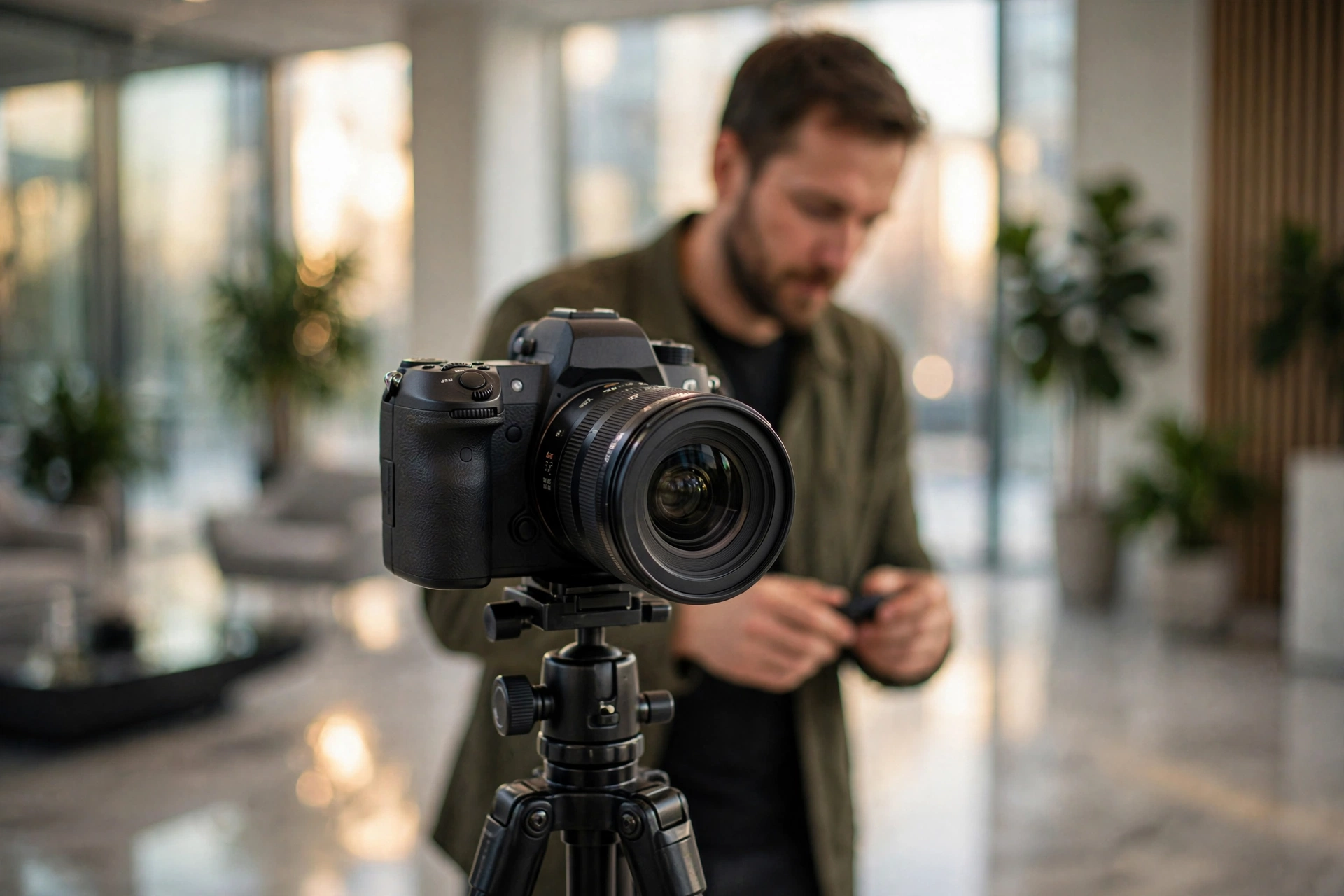
Focus on the "Big Three": The Hero Shot (exterior), the Flow Shot (interior layout), and the Utility Shot (loading docks, HVAC, parking). Use a tripod and a wide-angle lens, but avoid "fisheye" distortion, which can make a commercial space look unnaturally warped and distrustful.
Step 2: AI Enhancement and Cleaning
Rarely is a commercial site "picture perfect." There are often unsightly trash bins, weathered asphalt, or overcast skies. This is where RealVisionAI Blog - AI Real Estate Photography & Virtual Staging becomes an essential tool. Instead of spending hours in Photoshop, you can use AI to perform sky replacements and grass restoration in 12 seconds.
Step 3: Virtual Staging for Empty Spaces
Empty offices are notoriously hard to photograph; they look cold and echoing. Virtual staging allows you to place modern office furniture or industrial equipment in a space to help the buyer visualize the operational capacity. For those new to this, AI Property Enhancement for Beginners offers a great starting point for integrating these tools.
Step 4: Quality Control and Distribution
Ensure your images are optimized for the web to avoid slow load times on listing sites. High-resolution files are for brochures; compressed, high-impact files are for the MLS.
💡
Key Takeaway
The most effective commercial visual strategy is not about the most expensive camera, but about the most efficient post-production. AI allows you to transform a "good" photo into a "market-leading" asset in seconds.

Comparing Your Commercial Photography Options
When deciding which route to take, you must balance budget against the expected ROI of the property. Not every listing requires a $5,000 architectural shoot, but almost every listing requires a professional finish.
| Option | Pros | Cons | Best For |
|---|---|---|---|
| Traditional Architectural Pro | Highest raw quality, expert composition. | Very expensive, slow turnaround, rigid scheduling. | Trophy assets, luxury skyscrapers, high-end developments. |
| Generic/Cheap AI Tools | Low cost, fast. | Hallucinations, "plastic" look, lacks structural accuracy. | Low-end rentals, internal documentation. |
| Hybrid AI Strategy (RealVisionAI) | Pro-grade quality, instant speed, scalable costs. | Requires initial base photos. | Mid-to-high value commercial listings, scaling portfolios. |
If you are managing a diverse portfolio, the hybrid approach is the only one that scales. I've seen brokers struggle with the "Traditional Pro" route because the turnaround time for 20 different properties takes weeks. By contrast, using Digital Staging Services: Scaling Real Estate Listings in 2026 allows you to push listings live the moment the photographer finishes the shoot.
Common Questions and Misconceptions
Most guides get this wrong by suggesting that "more photos are better." In commercial real estate, too many mediocre photos actually dilute the impact of your hero shots.
Myth 1: "AI makes a photo look fake, and investors will hate it."
This is a common fear, but it's based on the old generation of AI. Modern computer vision, like that used by RealVisionAI Blog - AI Real Estate Photography & Virtual Staging, focuses on "enhancement," not "invention." Replacing a gray sky with a sunny one isn't lying; it's presenting the property in its best possible light. Investors want to see the potential of the asset, not the weather on the day the photographer happened to visit.
Myth 2: "I can just use a high-end smartphone for commercial sites."
While smartphone cameras are impressive, they struggle with the dynamic range required for commercial spaces—specifically the contrast between a dark interior and a bright window. Without professional processing or Real Estate Image Processing Perto de Mim, these photos look amateur and reduce the perceived value of the property.
Myth 3: "Virtual staging is only for residential homes."
Actually, it's more powerful in commercial. Showing a "shell" office is boring. Showing that same shell as a modern "co-working space" with AI-generated desks and lighting helps a tenant envision their business there. This is a critical component of Property Listing Optimization: The 2026 Guide to Higher Conversion.
Frequently Asked Questions
Which type of lens is best for commercial real estate photography?
For commercial work, a wide-angle lens is non-negotiable, typically in the 16mm to 24mm range for full-frame sensors. However, the "best" lens is one that minimizes distortion. In large industrial spaces, you need to capture the volume without creating a "bubble" effect on the walls. I recommend using a tilt-shift lens if the budget allows, as it prevents vertical lines from converging, which is a hallmark of professional architectural photography. If you don't have a tilt-shift lens, using an AI-driven processing tool can help correct these perspectives after the fact.
How does AI property enhancement differ from standard photo editing?
Standard editing involves manual adjustments to brightness, contrast, and saturation, which can take hours per image. AI property enhancement uses computer vision to recognize specific elements—like a dull sky or a patchy lawn—and replaces them with high-fidelity, realistic textures in seconds. For example, instead of manually masking a sky for 30 minutes, a tool like RealVisionAI does it in 12 seconds. This allows brokers to maintain a high volume of listings without sacrificing quality, as detailed in our AI Property Enhancement Pricing Guide.
Is virtual staging acceptable for commercial industrial listings?
Yes, provided it is used to demonstrate utility rather than decoration. In an industrial warehouse, virtual staging might involve adding pallets, racking systems, or a fleet of forklifts to show how the space can be utilized for logistics. The goal is to help the buyer understand the "operational flow" of the building. As long as the staging is realistic and does not misrepresent the actual square footage or structural constraints, it is a powerful tool for increasing interest and speeding up the leasing process.
What is the average turnaround time for professional commercial visuals?
Traditionally, architectural photographers take 5 to 10 business days to return edited images. In the fast-paced 2026 market, this is often too slow. By utilizing a hybrid AI workflow, you can reduce this to less than 24 hours. By taking the raw shots and running them through an AI enhancement pipeline, you can have market-ready visuals almost instantly. For those wondering about the cost-benefit of this speed, see our Is AI Property Enhancement Worth It? analysis.
How do I handle "ugly" commercial spaces that need photography?
The key is to focus on "potential" rather than "current state." If a space is cluttered or dated, use a combination of decluttering AI and virtual staging. Remove the old, broken furniture and replace it with modern, minimalist assets. If the exterior looks weathered, use AI grass restoration and sky replacement to create a clean, inviting atmosphere. The goal isn't to deceive the buyer, but to remove visual "noise" that distracts from the actual value of the real estate.
Final Thoughts on Commercial Real Estate Photography
Deciding which approach to use for your commercial visuals comes down to a simple calculation: the value of the asset versus the cost of the vacancy. In 2026, the gap between "average" and "exceptional" is filled by artificial intelligence. Whether you are listing a boutique retail space or a massive logistics hub, the use of commercial real estate photography enhanced by AI is the most scalable and effective way to attract high-net-worth investors.
Don't let a gray sky or an empty room kill your deal. By integrating a professional capture with the instant power of RealVisionAI Blog - AI Real Estate Photography & Virtual Staging, you ensure that your properties don't just sit on the market—they move. For more information on optimizing your visual pipeline, check out our Types of AI Property Enhancement for Real Estate guide.
Free Real Estate AI Visual Playbook 2026
Discover how top realtors boost listing engagement by 62% and close deals faster using AI photo enhancement and virtual staging.