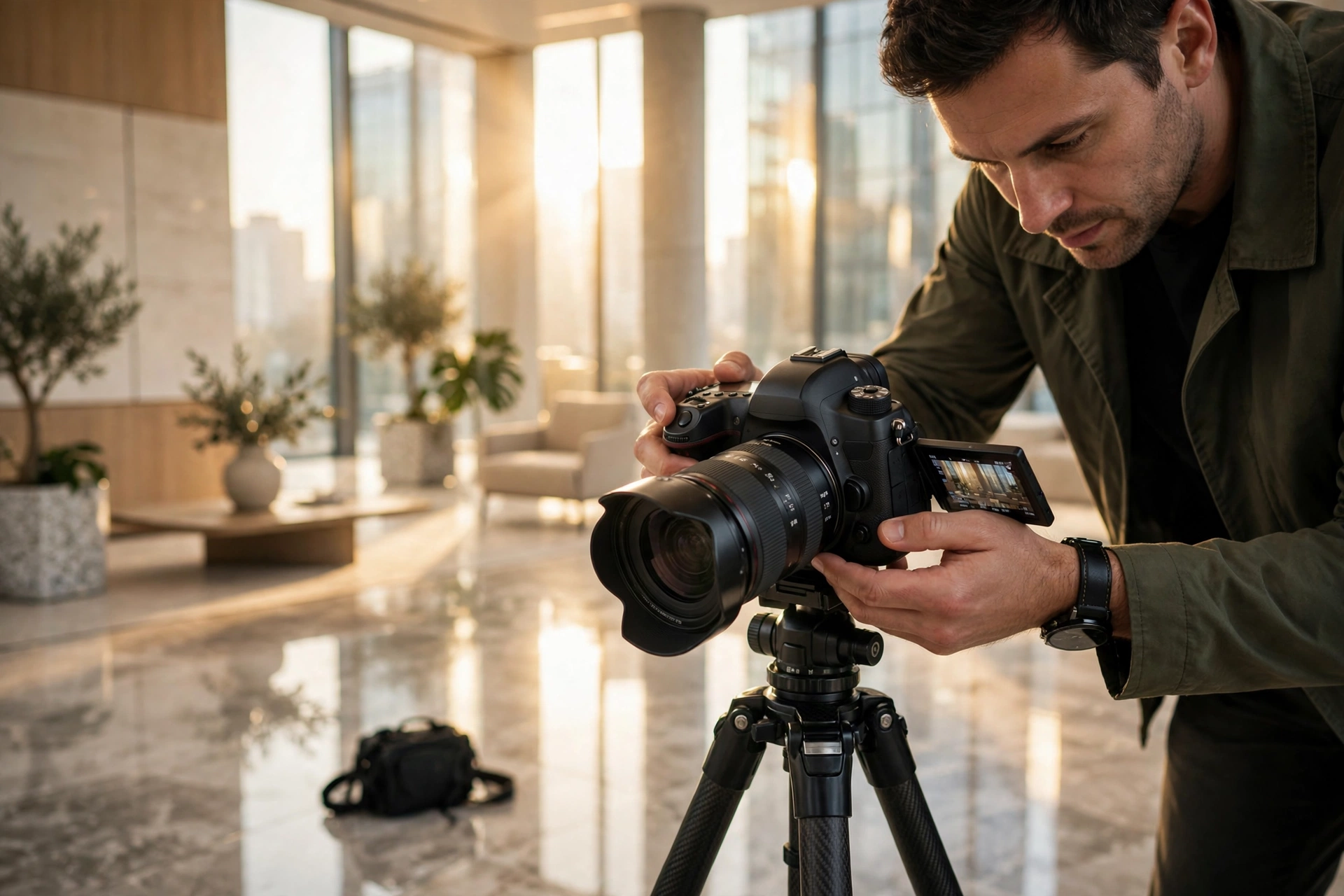


Why High-End Visuals Dictate the Value of Asset Listings?
A commercial property with mediocre photos doesn't just look "unprofessional"; it actively loses money every hour it remains unleased. In the high-stakes world of industrial warehouses, retail spaces, and Class A office buildings, the first interaction is almost always digital. When high-quality commercial real estate photography is absent, potential tenants and investors subconsciously perceive the property as poorly managed or undervalued, leading to a drastic drop in qualified inquiries. The "Why" is simple: professional imagery creates an immediate perception of prestige and operational excellence, which justifies higher rental rates and compresses the time-to-lease.
In my experience working with property managers and commercial brokers, the most common mistake I see is treating commercial assets like residential homes. A residential buyer looks for "coziness"; a commercial investor looks for efficiency, scale, and ROI. If your visuals don't communicate the structural integrity and potential of a 50,000 sq. ft. facility, you are essentially leaving a percentage of your cap rate on the table. To maximize these returns, many professionals are now integrating Real Estate Visual Marketing: The 2026 Guide to AI-Driven Sales to ensure their assets stand out in a saturated digital marketplace.

Understanding the Mechanics of Commercial Real Estate Photography
To truly grasp why professional imagery is non-negotiable, we must first define what separates "good photos" from architectural-grade commercial assets. Unlike residential photography, commercial work focuses on the intersection of utility and aesthetics. It requires an understanding of linear perspective, wide-angle precision without distortion, and the ability to capture the scale of a space while maintaining its detail.
📚
Definition
Commercial real estate photography is the specialized practice of capturing industrial, retail, and office properties to highlight their functional capacity, architectural merit, and economic potential to a professional B2B audience.
Now, here is where it gets interesting: the psychology of the commercial viewer is different. According to a report by Gartner, B2B buyers now conduct nearly 70% of their research independently before ever contacting a sales representative. In the context of a commercial lease, this means the photography is doing the "selling" long before the broker enters the conversation. If the images fail to showcase the ceiling height of a warehouse or the natural light in a corporate suite, the buyer simply moves to the next listing.
This is why integrating Types of AI Property Enhancement for Real Estate has become such a powerful trend. By combining traditional professional photography with AI-driven enhancements—such as sky replacement or daylight-to-dusk conversion—brokers can present a property in its absolute best light, regardless of when the actual shoot took place. This ensures that the "digital twin" of the property is an optimized version of reality, designed to trigger a psychological response of trust and stability.
Why Professional Imagery Directly Impacts the Bottom Line
The financial implications of poor imagery in the commercial sector are quantifiable. When a property is listed with low-quality photos, it suffers from "listing fatigue," where the market perceives the asset as stagnant. This often leads to a downward pressure on pricing, as tenants assume the lack of interest is due to a fundamental flaw in the property itself.
According to research from McKinsey, companies that prioritize high-quality digital experiences see a measurable increase in customer acquisition and a reduction in the cost of sale. In real estate, this translates to a shorter vacancy period. A property that attracts 20% more qualified leads due to superior visuals can reduce vacancy time by weeks, which, for a large-scale commercial asset, can represent tens of thousands of dollars in saved carrying costs.
Furthermore, the consequences of not acting are severe. In 2026, the barrier to entry for digital visibility is higher than ever. A property that lacks a cohesive visual strategy is effectively invisible to the modern institutional investor. When we analyze the data, the pattern is clear: assets with professional architectural photography and virtual staging command a premium because they allow the viewer to visualize the future use of the space. This is why understanding Why Use AI Property Enhancement for Real Estate? is essential for any broker wanting to maintain a competitive edge.
The risk is not just about "not getting a lead"; it is about attracting the wrong lead. Low-quality photos attract "bottom-feeders"—tenants looking for the cheapest possible space. High-end imagery attracts credit-worthy, institutional tenants who are willing to pay a premium for a space that reflects their own brand identity.
Practical Application: Implementing a Visual Strategy for Assets
Implementing a professional visual strategy requires a shift from "taking pictures" to "creating a visual narrative." The goal is to prove the property's value proposition through a sequence of images that guide the viewer from the exterior scale to the interior functionality.
- The Hero Shot: This is the primary exterior image. It must be captured during the "golden hour" or enhanced via AI to show a perfect sky. This image establishes the property's prestige.
- The Flow Analysis: Capture the primary corridors and open spaces. For commercial assets, this means emphasizing the "clear span" of warehouses or the "open concept" of offices.
- The Detail Close-ups: Focus on the high-value features—HVAC systems, loading docks, high-end finishes in the lobby, or LEED-certified installations.
- The Contextual View: Use drone photography to show the proximity to major highways, ports, or transit hubs.
For those who cannot afford a full production crew for every listing, the RealVisionAI Blog - AI Real Estate Photography & Virtual Staging platform offers a streamlined way to achieve these results. By utilizing their "Market-Ready Listing Visuals in 12 Seconds," brokers can take raw images and instantly apply professional-grade enhancements, such as room decluttering and daylight-to-dusk conversion. This allows a lean team to maintain the visual quality of a global firm without the associated overhead.
💡
Key Takeaway
The most effective commercial listings don't just show the space; they use professional imagery to prove the asset's operational efficiency and economic potential.
If you are managing a portfolio of multiple properties, the most efficient way to scale this is by looking into Digital Staging Services: Scaling Real Estate Listings in 2026, which allows you to show "potential" without spending thousands on physical furniture in an empty warehouse.

Choosing the Right Approach: Manual vs. AI-Enhanced
Brokers often struggle to decide between traditional high-end architectural photography and the newer wave of AI-driven enhancements. The truth is that the best results come from a hybrid approach. While a human photographer understands the "soul" of a building, AI can fix the "flaws" of the day—such as a gray sky or an empty, cold-looking room.
| Approach | Pros | Cons | Best For |
|---|---|---|---|
| Traditional Manual | Absolute precision, artistic control, high prestige. | Very slow, expensive, dependent on weather. | Iconic landmarks, ultra-luxury HQ. |
| Generic/Cheap AI | Low cost, instant delivery. | Hallucinations, "uncanny" look, low resolution. | Low-end rental flips, quick listings. |
| Professional AI Hybrid | High speed, consistent quality, optimized for ROI. | Requires a baseline of decent raw images. | Scale portfolios, Mid-to-High end CRE. |
Most guides get this wrong by suggesting you pick one or the other. In reality, if you use a professional photographer but don't apply AI Property Enhancement: Pricing and Value Guide techniques to the final delivery, you are leaving the final product to chance. The hybrid model allows for the consistency that institutional clients demand.
Common Questions and Misconceptions
There is a pervasive myth in the commercial world that "the right buyer doesn't care about the photos; they care about the numbers." This is a dangerous fallacy. While the numbers (Cap Rate, NOI, Square Footage) close the deal, the photos are what get the buyer to the table. If the visual presentation is poor, the buyer's perception of the "numbers" is negatively skewed before they even see the spreadsheet.
Another common misconception is that "AI looks fake." Most people who say this are using consumer-grade AI generators. Professional-grade tools, like those found at RealVisionAI Blog - AI Real Estate Photography & Virtual Staging, focus on enhancement rather than generation. There is a massive difference between creating a fake room and using AI to remove a distracting trash can or brighten a dark corner. This is why Is AI Property Enhancement Worth It? is a question that is answered with a resounding "yes" when looking at the conversion data.
Finally, many believe that drone shots are "extra." In the commercial world, the exterior context is often more important than the interior. A warehouse located 2 minutes from a highway exit is worth significantly more than one located 10 minutes away. If your photography doesn't visualize that proximity, you are failing to market the asset's primary value driver.
Frequently Asked Questions
Does commercial real estate photography actually increase the rental price?
Yes, it does. Professional imagery creates a "halo effect" where the perceived quality of the photography is transferred to the perceived quality of the asset. When a property is presented with a cohesive, high-end visual narrative, tenants perceive it as a "premium" space. This psychological positioning allows brokers to maintain higher asking prices and resist aggressive low-ball offers. According to industry standards, well-documented assets can command a premium because they reduce the perceived risk for the tenant, making the space feel like a safe, professional investment for their business.
How is commercial photography different from residential photography?
The primary difference lies in the objective. Residential photography focuses on emotion, warmth, and "lifestyle." Commercial photography focuses on utility, scale, and potential. In a commercial shoot, the priority is showing the structural capabilities—such as ceiling heights, loading dock accessibility, and HVAC zoning—rather than the color of the curtains. It requires a more clinical approach to composition, emphasizing linear perspectives and wide-angle views that accurately represent the square footage without distorting the reality of the space.
Can AI-enhanced photos be considered "misleading" in a legal sense?
As long as the AI is used for enhancement (lighting, sky replacement, decluttering) rather than altering the structure of the building, it is generally accepted as a standard marketing practice. Removing a piece of old furniture through virtual staging or brightening a dark room is equivalent to professional photo editing. However, adding a window where there isn't one or changing the footprint of the building would be misleading. The key is to use tools like RealVisionAI Blog - AI Real Estate Photography & Virtual Staging to optimize the current reality, not to invent a new one.
What is the ideal number of photos for a commercial listing?
For a standard commercial asset, a range of 15 to 25 high-quality images is typically ideal. This should include 3-5 hero exterior shots, 5-8 interior wide shots of the main spaces, 5-8 detailed shots of key amenities/infrastructure, and 2-3 drone perspectives showing the surrounding area. Overloading a listing with 100 mediocre photos actually hurts the conversion rate by creating "visual noise." The goal is a curated gallery that tells a story of efficiency and value, ensuring the viewer remains engaged without feeling overwhelmed.
How often should I update the photography for a long-term vacant asset?
If a property has been on the market for more than six months, the visual strategy must be refreshed. Market trends change, and "stale" photos are a red flag to investors. I recommend a seasonal refresh or a complete pivot in the visual narrative. For example, if the property didn't lease in the winter, using When to Use Real Estate Image Processing for Your Listings to create a "summer" feel with bright, sunny exteriors can breathe new life into the listing and attract a fresh wave of inquiries.
Final Thoughts on Commercial Real Estate Photography
The decision to invest in high-end commercial real estate photography is not an aesthetic choice; it is a financial strategy. In an era where the first "showing" happens on a smartphone screen, the quality of your imagery is the primary filter for your asset's value. By combining the precision of architectural photography with the speed and optimization of AI enhancements, you effectively eliminate the friction between the listing and the lease.
If you are tired of stagnant listings and want to accelerate your time-to-lease, it is time to move beyond basic snapshots. Leverage the power of RealVisionAI Blog - AI Real Estate Photography & Virtual Staging to transform your raw assets into market-ready visuals in seconds. Whether you need day-to-dusk conversions or professional virtual staging, the tools are available to ensure your properties are seen as the premium assets they are. Visit realvisionaire.com today to start optimizing your portfolio. For more on scaling your visual strategy, check out our Vantagens de Real Estate Image Processing.
Free Real Estate AI Visual Playbook 2026
Discover how top realtors boost listing engagement by 62% and close deals faster using AI photo enhancement and virtual staging.