

Which AI Real Estate Photo Enhancement Tool Should You Choose?
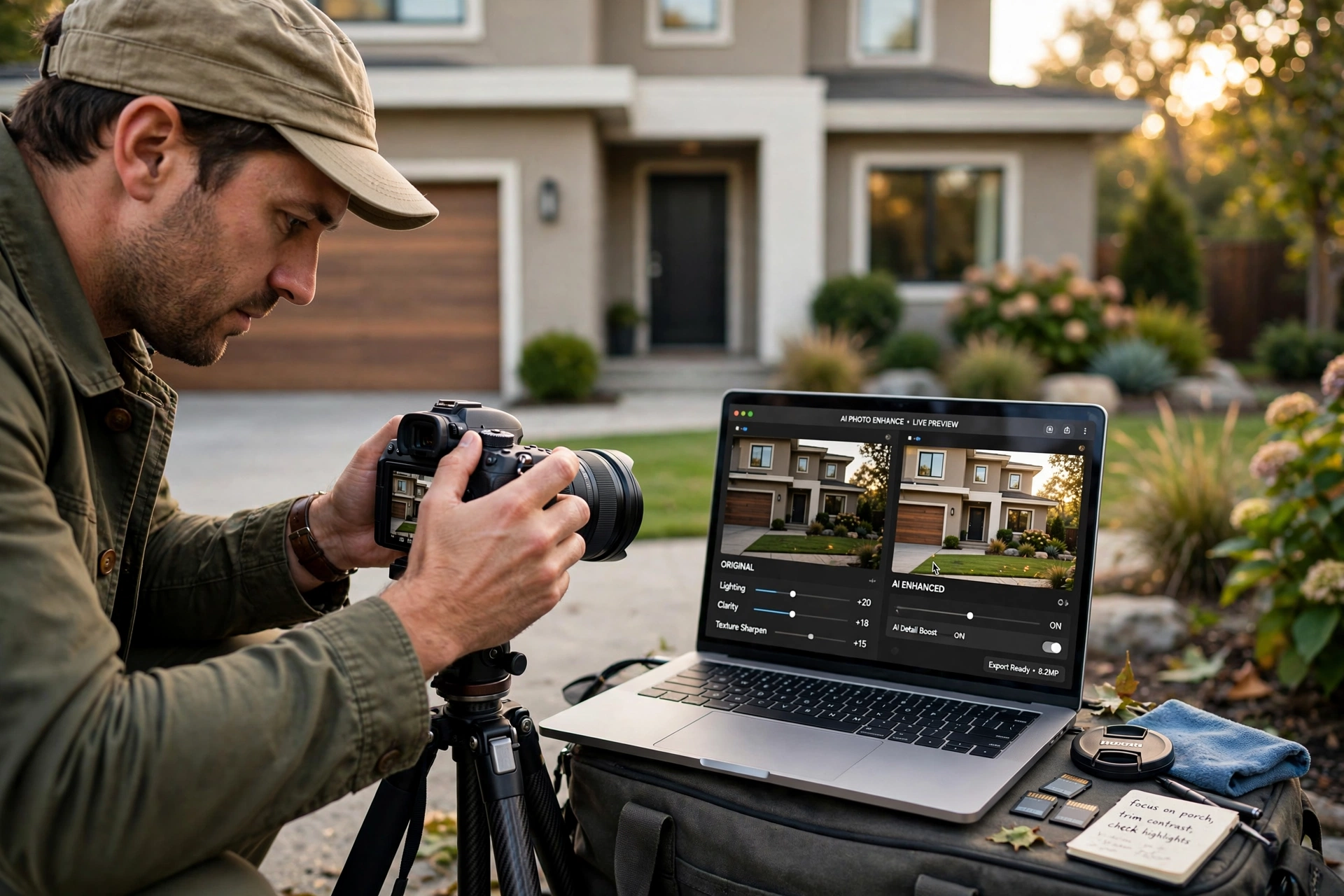
The difference between a property that sits on the market for 60 days and one that sells in 72 hours often comes down to a single click. In my experience working with high-volume agencies, the biggest mistake I see is agents choosing an ai real estate photo enhancement tool based on price rather than output quality. To answer the "which" question immediately: if you need raw speed and high-end architectural accuracy for professional listings, specialized AI studios like RealVisionAI Blog - AI Real Estate Photography & Virtual Staging are the only viable choice; for casual social media posts, generic filters suffice, but they will actively harm your brand's perceived value in a competitive 2026 market.
For those managing luxury portfolios, the decision framework depends on whether you prioritize "instant automation" or "creative control." While generic AI tools can brighten a room, they often fail at perspective correction and realistic lighting integration, which are the hallmarks of professional real estate photography. If you are scaling your business, exploring Virtual Furniture Staging in Atlanta: Boost Listing ROI in 2026 can show you how integrated enhancement and staging work together to drive higher offers.
Understanding the Mechanics of AI Real Estate Photo Enhancement
To choose the right tool, you must first understand what is actually happening under the hood. Most basic tools perform simple "global adjustments"—they raise the exposure and saturation across the entire image. Professional-grade AI, however, utilizes computer vision to perform "semantic segmentation."
📚
Definition
Semantic Segmentation is a computer vision process where an AI identifies and labels every pixel in an image, allowing it to distinguish between a "sky," a "wall," "grass," and "furniture" to apply different editing rules to each.
When a professional system processes an image, it doesn't just make the photo "brighter." It identifies the blown-out windows and applies a virtual HDR (High Dynamic Range) effect, blending the exterior view with the interior lighting. This prevents the common "white box" effect where windows look like glowing rectangles. According to research by Gartner, the integration of specialized computer vision in vertical industries has led to a 40% increase in production efficiency for visual content by 2026, as AI can now replicate human artistic judgment in milliseconds.
In the real world, this means the AI can recognize that a lawn is brown due to a drought and specifically target those pixels for "grass restoration" without affecting the color of the house's siding. This level of precision is what separates a "filter" from an "enhancement." When we developed the workflows at RealVisionAI Blog - AI Real Estate Photography & Virtual Staging, we discovered that the most critical factor for agents isn't just the final look, but the consistency across a 30-photo gallery. If the living room looks like a sunny afternoon and the kitchen looks like a cloudy morning, the buyer's subconscious flags the listing as "untrustworthy."
Why High-End Enhancement Directly Impacts Your Bottom Line
The psychological impact of visual quality on a buyer's perceived property value is measurable. When a listing features professional ai real estate photo enhancement, it signals to the buyer that the property is well-maintained and high-value. Conversely, dark, grainy, or distorted photos create "friction" in the buyer's journey, making them question the actual condition of the home.
According to a report by McKinsey, digital-first buyers are 70% more likely to book a viewing for a property that uses advanced visual staging and enhancement over those using basic smartphone photography. This is because high-quality visuals reduce the cognitive load on the buyer, allowing them to visualize themselves living in the space rather than focusing on the "flaws" of the photography.
The business impact manifests in three specific areas:
- Click-Through Rate (CTR): Listings with enhanced "hero shots" (the first 3 photos) see a significant spike in views on the Multiple Listing Service (MLS).
- Time on Market: Properties that "look" the part attract more immediate offers, reducing the holding cost for the seller.
- Final Sale Price: There is a direct correlation between the perceived luxury of the imagery and the final bid price. In many markets, a professional visual presentation can add 1% to 5% to the final sale price by attracting a wider pool of high-net-worth buyers.
Now, here's where it gets interesting: the cost of not using high-end AI is the "invisible loss." When you use a low-quality tool that creates "hallucinations" (like adding a window where there isn't one or distorting a wall), you risk losing a buyer's trust before they even step foot in the door. For those operating in high-competition areas, utilizing Virtual Furniture Staging in Miami: Boost Your Property Value ensures that the enhancement and staging remain cohesive and realistic.
How to Implement an AI Enhancement Workflow
Implementing a professional workflow isn't just about uploading a photo; it's about the sequence of operations. If you apply virtual staging before photo enhancement, the furniture often looks "pasted on" because the lighting doesn't match.
The professional sequence should follow this order:
- Perspective Correction: Ensure vertical lines (walls, door frames) are perfectly straight. AI does this by analyzing the vanishing points of the room.
- Lighting & Color Correction: Use ai real estate photo enhancement to balance the exposure. This includes "Day-to-Dusk" conversion if the exterior shot was taken at noon but needs that golden-hour glow.
- Object Removal/Decluttering: Remove distracting elements like trash cans, power cables, or old magazines using AI inpainting.
- Virtual Staging: Once the room is clean and the lighting is perfect, add furniture.
RealVisionAI Blog - AI Real Estate Photography & Virtual Staging streamlines this entire process into a 12-second window. Instead of jumping between four different software tools, the system applies these layers of logic simultaneously. This is especially useful for agents in fast-moving markets who need to get a listing live while the homeowner is still at the property. If you are scaling across different cities, you might find that Virtual Furniture Staging in Boston: Scale Your Listing ROI requires a slightly different aesthetic approach than a Texas property, but the technical workflow remains the same.
💡
Key Takeaway
Always perform lighting and perspective correction before adding virtual furniture. Lighting the furniture to match a bad photo is impossible; it is far easier to add furniture to a perfectly lit, enhanced photo.
Comparison: Which Option Fits Your Business Model?
Not every agent needs a full-scale AI studio, but every agent needs to know the trade-offs. The "which" depends on your volume and your target demographic.
| Feature | Traditional Manual Editing | Generic AI Apps | RealVisionAI Professional Studio |
|---|---|---|---|
| Turnaround Time | 24–72 Hours | Instant | 12 Seconds |
| Accuracy | High (Human Eye) | Low (Frequent Artifacts) | High (Trained Models) |
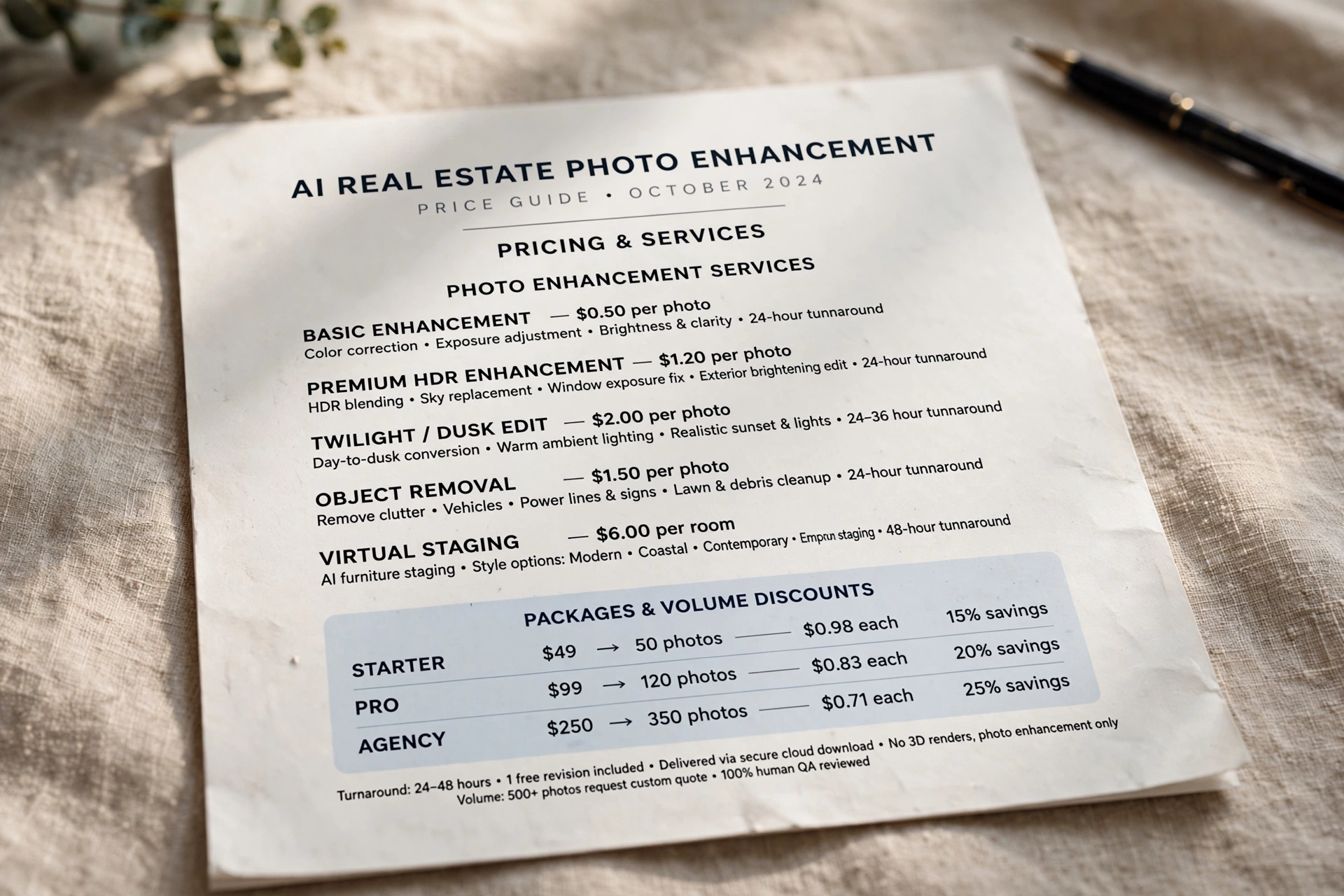
| Cost per Image | Expensive ($5–$15) | Cheap/Subscription | Scalable Professional Pricing |
| Consistency | Variable by Editor | High (but often "fake") | High (Architectural Standards) |
| Best For | Ultra-Luxury (1-of-1) | Casual Social Media | High-Volume Pro Agents |
That said, the "Generic AI" approach often fails in the "uncanny valley." You've likely seen photos where the grass is an neon-green that doesn't exist in nature or where the sky looks like a painting. This happens because those tools lack the specialized training sets required for architectural photography.
For agents who need a middle ground, we suggest starting with specific regional optimizations. For example, Virtual Furniture Staging in Dallas: Boost Your Listing ROI—or similarly, the strategies used for Virtual Furniture Staging in Nashville: Scale Your Listings—demonstrate that the AI must understand the local architectural style to be effective.
Common Misconceptions About AI Enhancement
Most guides get this wrong by suggesting that AI is a replacement for a good photographer. It is not. AI is a replacement for the post-production phase.
Myth 1: "AI can fix any photo, even a blurry one."
This is false. While AI can upscale a low-resolution image, it cannot "invent" a sharp focus where there was none without creating "plastic" looking textures. The "garbage in, garbage out" rule still applies. You need a stable shot to begin with.
Myth 2: "AI enhancement is misleading or 'fake'."
There is a fine line between enhancement and deception. Using ai real estate photo enhancement to remove a stray power cord or brighten a dark room is standard industry practice. However, removing a permanent structural pillar or changing the actual layout of a room is a legal risk. As the National Association of Realtors (NAR) suggests in their ethics guidelines, visuals should accurately represent the property's essence.
Myth 3: "You need to be a tech expert to use these tools."
This is the most common barrier I encounter. In the early days, you needed to understand "masks" and "layers." In 2026, the interface has shifted to "intent-based editing." You don't tell the AI how to change the pixels; you tell it what the goal is (e.g., "Make this room look like a modern Scandinavian living room").
The mistake I made early on—and that I see constantly—is trying to use a tool that does "everything" (like a general-purpose image editor) rather than a tool designed specifically for the real estate vertical. General tools don't understand the difference between a kitchen counter and a bathroom vanity, which leads to lighting errors.
Frequently Asked Questions
Does AI real estate photo enhancement violate MLS rules?
Generally, no, as long as the enhancement does not fundamentally alter the reality of the property. Using AI for color correction, sky replacement, or removing temporary clutter (like a trash can) is widely accepted. However, using AI to remove a permanent fixture or a large crack in a wall could be considered misleading. The key is to use AI to present the home in its "best light" without creating a false representation. Always check your local MLS guidelines, as some boards have specific rules about "virtual" vs "actual" imagery.
How does the "12-second" turnaround actually work?
Professional studios like RealVisionAI Blog - AI Real Estate Photography & Virtual Staging use pre-trained neural networks that have analyzed millions of professional architectural photos. Instead of processing the image from scratch, the AI identifies the "scene type" (e.g., master bedroom) and applies a set of optimized parameters for that specific space. This allows it to handle perspective, lighting, and color balance in parallel rather than in a linear sequence, reducing the time from hours to seconds.
Can AI enhancement help sell an unfurnished home?
Yes, but enhancement is only half the battle. To sell an unfurnished home, you need a combination of photo enhancement (to fix the "cold" feeling of empty rooms) and virtual staging. An empty room often looks smaller than it actually is because the human eye has no scale reference. By enhancing the lighting and adding virtual furniture, you provide that scale and an emotional "hook" for the buyer. This is a primary reason why Virtual Furniture Staging in Phoenix: Elevate Your Listings is so effective in the desert market.
Which is better: AI enhancement or traditional HDR photography?
It is not a matter of "which is better," but how they are used together. Traditional HDR photography captures multiple exposures to get the most detail. AI enhancement then takes those HDR files and "polishes" them, removing the "gray" cast that often plagues traditional HDR and adding the "pop" that buyers love. The most successful 2026 listings use HDR for the capture and AI for the final polish to ensure the images look natural yet aspirational.
Will using AI photo tools make my listings look "too perfect" or fake?
This depends entirely on the tool's training data. Cheap AI tools use "over-saturation," which leads to that fake, neon look. Professional tools use "architectural weighting," meaning they prioritize the natural physics of light. If the AI knows where the window is located, it ensures the shadows fall in the correct direction. This maintains the "believability" of the image while still making it look professional.
Final Thoughts on AI Real Estate Photo Enhancement
Choosing the right ai real estate photo enhancement strategy is no longer about whether to use AI, but which level of AI sophistication your brand requires. If you are competing for luxury listings, the "cheap" options are a liability. You need a system that understands the nuances of architectural light, the importance of vertical perspective, and the psychological impact of a perfectly staged room.
The transition to AI-driven visuals in 2026 is about efficiency and conversion. By reducing the time it takes to get a listing market-ready from three days to twelve seconds, you gain a massive competitive advantage in lead response time. Whether you are scaling your presence through Virtual Furniture Staging in Detroit: Elevate Your Listings or maximizing your ROI with Virtual Furniture Staging in San Diego: Scale Your Listings, the goal remains the same: eliminate friction between the buyer and the property.
Stop settling for "good enough" photos that leave buyers guessing. Elevate your entire portfolio and capture more high-value leads by switching to a professional AI workflow. Experience the difference in speed and quality today at RealVisionAI Blog - AI Real Estate Photography & Virtual Staging.
Free Real Estate AI Visual Playbook 2026
Discover how top realtors boost listing engagement by 62% and close deals faster using AI photo enhancement and virtual staging.