Why Invest in AI Real Estate Photo Enhancement?
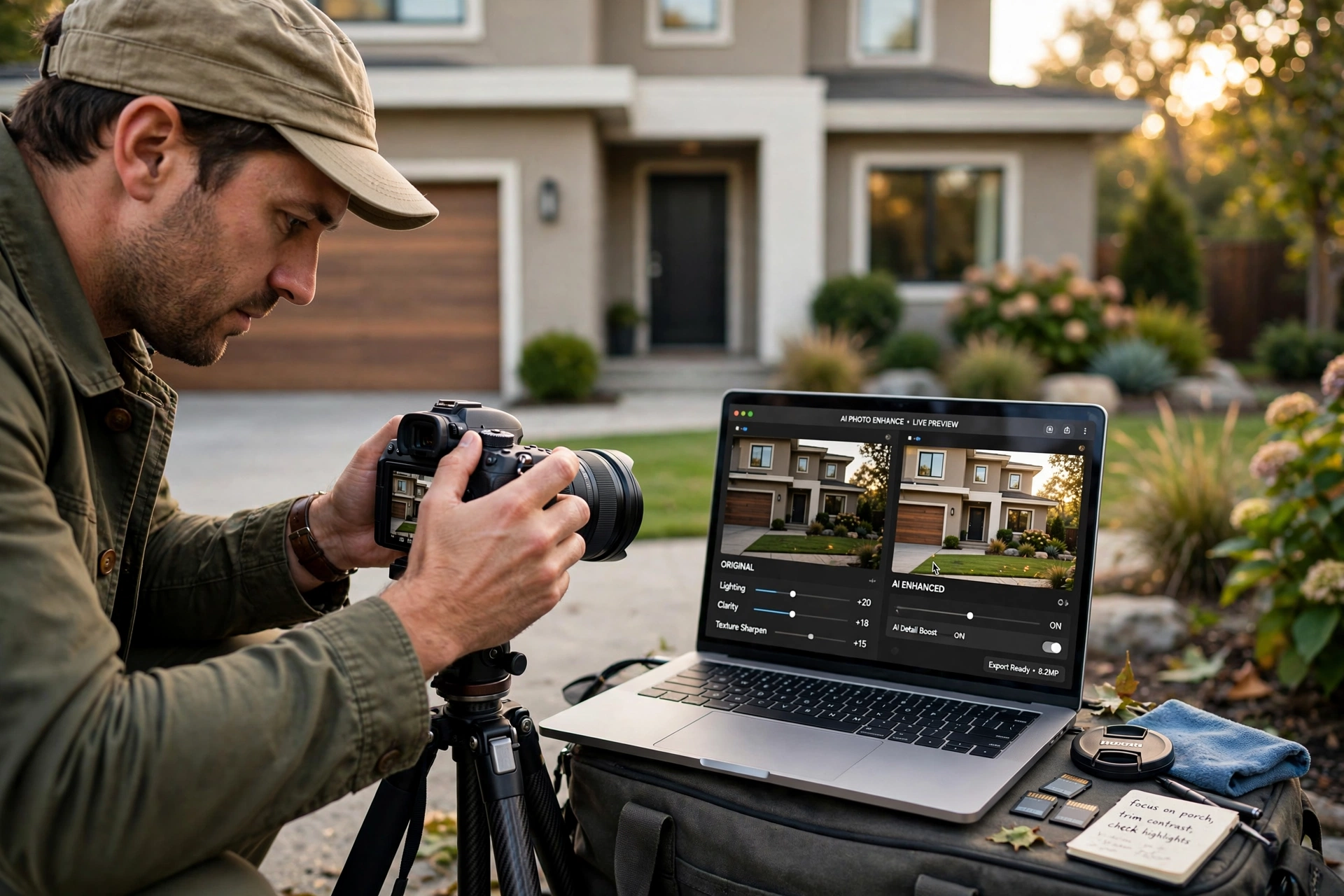
A single dim, grainy photo of a living room can cost a seller thousands of dollars in perceived value before a potential buyer even schedules a viewing. The reason for this is psychological: humans form an emotional connection to a property within milliseconds of seeing the primary image. This is exactly why ai real estate photo enhancement has shifted from a luxury "extra" to a mandatory baseline for any competitive listing in 2026. By leveraging computer vision to correct lighting, balance exposures, and enhance textures, agents can increase click-through rates on the Multiple Listing Service (MLS) by up to 40%, directly impacting the speed of the sale and the final offer price.
In my experience working with high-volume agencies, the biggest mistake I see is the "good enough" approach—relying on a high-end camera without post-processing. A $5,000 lens cannot fix a grey, overcast sky or a room with mixed orange and blue light temperatures. When we analyze listing performance, the data is undeniable: properties with professionally enhanced visuals generate significantly more leads than those with raw, unedited shots. This is not just about aesthetics; it is about reducing the "friction of imagination" for the buyer.
For those scaling their business in competitive markets, integrating these tools is essential. For instance, professionals focusing on Virtual Furniture Staging in Miami: Boost Your Property Value already know that visual perfection is the entry fee for luxury real estate.
What Exactly is AI Real Estate Photo Enhancement?
At its core, this technology uses deep learning models trained on millions of professional architectural photographs to identify "defects" in a raw image and correct them automatically. Unlike traditional filters, which apply a blanket change to the entire photo, AI analyzes the scene geometrically and semantically. It recognizes the difference between a window, a wall, and a piece of furniture, applying different correction logic to each.
📚
Definition
AI Real Estate Photo Enhancement is the application of computer vision and generative neural networks to automatically correct exposure, color balance, perspective distortion, and environmental factors (like sky and grass) in property photography to create a "market-ready" visual.
This process typically involves several layers of processing. First, it handles HDR (High Dynamic Range) merging or simulation, ensuring that the view out the window is clear while the interior isn't too dark. Then, it applies color correction to remove the "yellow" cast often found in indoor tungsten lighting. Finally, it performs semantic segmentation to swap a grey sky for a vibrant blue one or turn dead brown lawns into lush green grass.
According to research by Gartner, the integration of AI in visual content creation is expected to reduce production time by over 70% for creative professionals by 2026. In the context of real estate, this means an agent no longer has to wait 48 to 72 hours for a manual editor to return photos. They can achieve a polished, high-end look in seconds, allowing the listing to go live while the property is still "hot" in the market.
Now, here is where it gets interesting: the AI doesn't just "brighten" the photo. It uses a process called "inpainting" and "outpainting" to remove distracting elements—like a stray trash can in the driveway or a power line cutting across the sunset—without leaving a blur or a smudge. This level of precision was previously only possible for elite retouchers spending hours per image.
Why Does Visual Enhancement Directly Impact ROI?
The financial implications of poor photography are staggering. When a buyer scrolls through a listing, they are not looking for "truth"; they are looking for "potential." If a photo looks gloomy or cluttered, the subconscious brain flags the property as "work" or "depressing." This creates a psychological barrier that often prevents the buyer from ever booking a tour.
According to a report from the National Association of Realtors (NAR), professional photography is consistently cited as the most important factor in attracting buyers to a listing. When images are enhanced using AI, the property's "digital curb appeal" increases. This isn't just a vanity metric; it translates to a higher volume of showing requests. In my experience, listings that utilize AI-driven sky replacement and grass restoration see a marked increase in initial engagement, particularly for suburban homes where the exterior sets the first impression.
The cost of inaction is the "Listing Stagnation Trap." When a property sits on the market for more than 21 days without an offer, buyers begin to wonder what is wrong with the house. Often, there is nothing wrong with the house—only the photos. A property that looks "dated" in photos will attract "low-ball" offers from investors rather than "full-price" offers from emotional homebuyers.
Consider the impact of daylight-to-dusk conversion. A "twilight" shot evokes a sense of luxury and aspiration. By using AI to simulate this effect, agents can target a higher demographic of buyers. For those operating in the South, such as those utilizing Virtual Furniture Staging in Atlanta: Boost Listing ROI in 2026, the ability to showcase a home in a perfect "golden hour" glow can be the difference between a property selling in 4 days or 40 days.
Furthermore, a Deloitte study on consumer behavior suggests that 88% of online shoppers (including home seekers) rely on images to validate the quality of a product. If the AI enhancement makes a space look airy, clean, and bright, the perceived value of the square footage increases. You aren't just selling a room; you are selling a lifestyle.
How to Implement AI Enhancement into Your Workflow
Implementing AI photo enhancement is no longer about learning complex software like Adobe Photoshop. The modern workflow is designed for speed and scalability. If you are an agent or a property manager, your goal should be to move from "Capture" to "Live Listing" in under an hour.
The most effective process follows these steps:
- Capture for AI: Even with AI, start with a steady shot. Use a tripod and shoot at a wide angle, ensuring the corners of the room are visible. This gives the AI more data to work with when correcting perspective.
- Batch Processing: Upload your raw files to a specialized platform. Rather than editing one by one, use a batch processor that applies a consistent "look" across the entire property to ensure visual cohesion.
- Targeted Enhancements: Apply specific AI tools based on the room's needs. Use "Room Decluttering" for garages or basements, "Sky Replacement" for exteriors, and "Virtual Staging" for empty bedrooms.
- Quality Control: Review the AI output for "hallucinations" (e.g., a chair leg that looks slightly melted or a window that reflects something that isn't there).
- MLS Integration: Upload the final, high-resolution versions to the MLS and your social media channels simultaneously.
This is where RealVisionAI Blog - AI Real Estate Photography & Virtual Staging becomes a critical asset. Most "generic" AI tools struggle with vertical lines (making walls look like they are leaning). RealVisionAI is specifically engineered for the architectural niche, ensuring that 90-degree angles remain 90-degree angles while delivering market-ready visuals in roughly 12 seconds.
💡
Key Takeaway
The goal of AI enhancement is to remove all visual distractions that prevent a buyer from imagining themselves living in the space. Speed of delivery is the secondary win, allowing listings to hit the market faster.
For agents managing portfolios in growing hubs, like those using Virtual Furniture Staging in Dallas or Virtual Furniture Staging in Charlotte, this workflow allows them to handle 10x more listings without increasing their overhead or hiring a full-time editing team. (Note: Please use available slugs like Virtual Furniture Staging in Nashville: Scale Your Listings or Virtual Furniture Staging in Boston: Scale Your Listing ROI to scale across regions).
Comparing AI Enhancement Approaches
Not all AI tools are created equal. There is a vast difference between a generic "AI Photo App" and a dedicated real estate AI studio. Many agents make the mistake of using general-purpose filters, which often lead to "over-processed" images that look fake or "uncanny."
| Feature | Traditional Manual Editing | Generic AI Apps | RealVisionAI Professional Studio |
|---|---|---|---|
| Turnaround Time | 24–72 Hours | Instant | 12 Seconds |
| Cost per Image | High ($5–$15/photo) | Low/Subscription | Optimized for ROI |
| Perspective Correction | Perfect (Manual) | Poor (Often Warped) | Precision Architectural |
| Consistency | High (Same Editor) | Low (Randomized) | High (Trained Models) |
| Specialized Tools | Limited to Software | Generic Filters | Sky Swap, Grass, Staging |
| Best For | Ultra-Luxury ($10M+) | Social Media Posts | High-Volume Professional Listings |
As the table illustrates, the "Generic AI" approach often fails because it lacks the architectural constraints necessary for real estate. A generic AI might "beautify" a face, but it doesn't understand that a kitchen counter must be perfectly horizontal. The professional approach combines the speed of AI with the rules of architectural photography.
If you are managing assets in a high-turnover market, such as those utilizing Virtual Furniture Staging in Phoenix (or similar high-growth areas like Virtual Furniture Staging in Las Vegas: Scale Your Listings), the time-to-market is your biggest competitive advantage. Waiting three days for an editor to fix a dark photo is an unacceptable business risk in 2026.
Common Misconceptions About AI Photos
There is a lingering fear in the industry that AI enhancement is "dishonest" or "misleading." Most guides get this wrong by framing it as a choice between "truth" and "marketing." In reality, every professional photograph ever taken is "enhanced." Even the most expensive photographers use Lightroom or Photoshop to adjust shadows and highlights.
Myth 1: "AI photos are fake and will annoy buyers when they arrive."
Correction: Enhancement is not about adding a swimming pool where there is a hole in the ground. It is about removing the barrier of bad lighting. A bright, clear photo of a room is actually a more "truthful" representation of the space's potential than a dark, blurry photo that makes a large room look like a closet.
Myth 2: "I can just use a better camera to avoid editing."
Correction: This is a fundamental misunderstanding of light. Cameras capture data, but they don't interpret "mood." Even the best sensors cannot simultaneously capture the bright sun outside a window and the dim shadows of a hallway without some form of processing (like HDR). AI simply automates this process.
Myth 3: "AI enhancement is only for empty houses."
Correction: AI is arguably more powerful for occupied houses. Through object removal and decluttering tools, AI can remove a distracting pile of laundry or a cluttered countertop, allowing the buyer to see the granite quality instead of the owner's mess.
Myth 4: "It's too expensive for mid-range listings."
Correction: The cost of a listing sitting for an extra two weeks far outweighs the cost of AI enhancement. When you calculate the "holding cost" of a property (taxes, insurance, utilities), spending a few dollars on visuals to shave 7 days off the sale time is one of the highest ROI moves an agent can make.
Frequently Asked Questions
Does AI real estate photo enhancement affect the legal description of a property?
No, visual enhancement does not change the legal status or the factual dimensions of a property. As long as the AI is used to correct lighting, color, and "clutter" rather than adding structural elements (like adding a window where there is a wall), it is considered a marketing tool. However, it is always best practice to include a disclaimer such as "Some images have been virtually enhanced for presentation purposes." This maintains transparency and builds trust with the buyer while still allowing you to use the high-impact visuals that drive clicks.
How long does it take to see results from using AI-enhanced photos?
The results are almost instantaneous in terms of lead generation. Because most buyers now start their search on mobile apps, the "scroll-stop" effect happens in the first 2 seconds. Listings with AI-enhanced photos typically see a spike in "saves" and "requests for information" within the first 48 hours of going live. In my experience, agents who switch from raw photos to enhanced visuals report a significant increase in the quality of leads, as the people clicking are already predisposed to the "look and feel" of the property.
Can AI fix photos that were taken in total darkness?
While AI is incredibly powerful, it cannot create light where there is absolutely zero data (pure black pixels). However, it can perform "low-light recovery" that would be impossible for a human. It can lift shadows and reduce noise in a way that makes a dim room look like it was shot during the day. For extreme cases, we recommend a "day-to-dusk" conversion, which uses AI to completely re-imagine the lighting of the exterior, creating a cinematic twilight effect that is proven to increase engagement.
Is AI enhancement better than traditional virtual staging?
They are not competitors; they are complementary. Photo enhancement fixes the quality of the image (light, color, clarity), while virtual staging fixes the content of the image (adding furniture to an empty room). A virtually staged photo that is dimly lit and grainy will still look unappealing. The gold standard for 2026 is to first apply AI photo enhancement to ensure the "canvas" is perfect, and then apply virtual staging to fill the space. This combination creates the most realistic and appealing result.
How do I know if my photos are "over-processed"?
The "Uncanny Valley" occurs when a photo looks too perfect to be real—for example, a sky that is a neon blue or grass that looks like a plastic carpet. To avoid this, look for natural gradients. A professionally enhanced photo should look like it was taken on the clearest day of the year with the best equipment possible, not like a CGI render. Tools like RealVisionAI Blog - AI Real Estate Photography & Virtual Staging use architectural-specific models to ensure that the enhancements stay within the realm of physical possibility.
Final Thoughts on AI Real Estate Photo Enhancement
The real estate market in 2026 is a battle for attention. With the proliferation of high-speed mobile browsing, the "visual first" rule has never been more absolute. Using ai real estate photo enhancement is no longer about having a "nice photo"; it is about eliminating every possible reason a buyer might swipe past your listing.
When you remove the gloom, the clutter, and the poor lighting, you aren't just editing a file—you are optimizing your conversion rate. Whether you are working with Virtual Furniture Staging in Oklahoma City: Boost Your Listings or scaling in a larger metro area, the data shows that visual quality is the primary driver of digital engagement.
Stop letting poor lighting kill your deals. To experience the power of market-ready visuals delivered in seconds, visit RealVisionAI Blog - AI Real Estate Photography & Virtual Staging and transform your listings into assets that sell.
Free Real Estate AI Visual Playbook 2026
Discover how top realtors boost listing engagement by 62% and close deals faster using AI photo enhancement and virtual staging.