

What Exactly Is AI Real Estate Photo Enhancement?
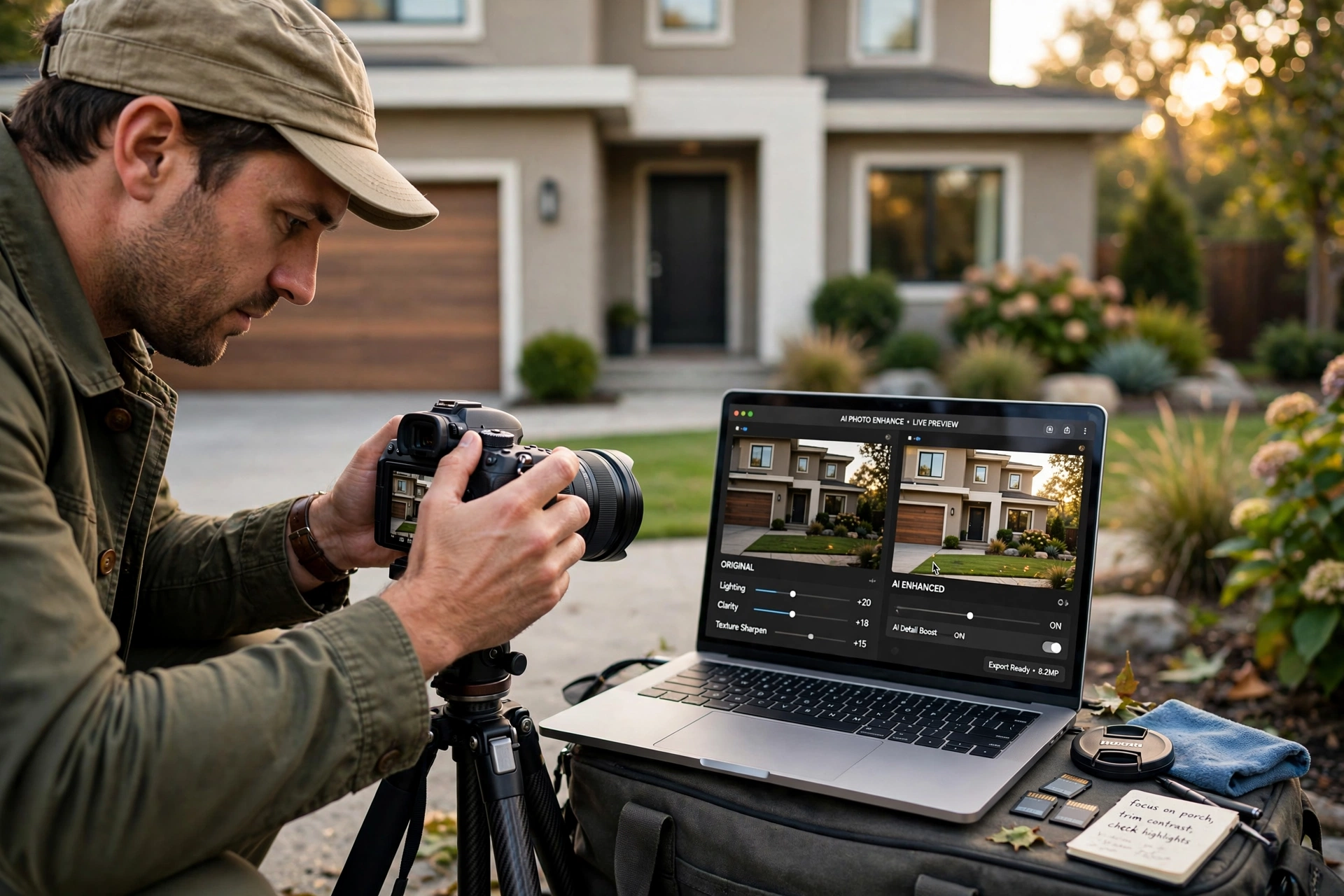
A property's first showing doesn't happen at the front door; it happens on a smartphone screen. When a potential buyer swipes through a listing, they make a subconscious decision about the property's value within milliseconds based on visual quality. This is where ai real estate photo enhancement enters the equation. It is the process of using computer vision and generative artificial intelligence to automatically correct lighting, remove clutter, replace gray skies with blue ones, and optimize color balance to make a property look its absolute best without distorting the reality of the space.
In my experience working with high-volume listing agents, the difference between a "stale" listing and one that generates immediate tours is almost always the imagery. Many agents still rely on basic filters or expensive, slow manual editing. However, the modern standard is moving toward automated pipelines that can turn a raw, backlit interior shot into a magazine-quality image in seconds. For those looking to scale, implementing Virtual Furniture Staging in Atlanta often goes hand-in-hand with these enhancements to ensure the environment looks polished before the furniture is even added.
📚
Definition
AI Real Estate Photo Enhancement is the application of machine learning algorithms—specifically convolutional neural networks (CNNs) and generative adversarial networks (GANs)—to analyze architectural images and apply targeted corrections to exposure, saturation, geometry, and object presence.
How Does AI Photo Enhancement Transform Real Estate Imagery?
To understand how this technology works, we have to look past the "magic" and into the data. Traditional photo editing is a linear process: a human opens a file, identifies a dark corner, and manually raises the shadows. AI real estate photo enhancement does this non-linearly. It analyzes the entire image, recognizes "sky," "grass," "wall," and "floor" as distinct semantic layers, and applies specific logic to each. For example, it knows that a sky should be a specific shade of cerulean to evoke a "sunny day" feeling, while a floor should maintain its texture without becoming overexposed.
According to a report by Gartner on the evolution of generative AI, the shift from "assistive AI" (which helps humans do tasks) to "autonomous AI" (which performs the task) is accelerating. In the context of real estate, this means we are moving away from tools that just offer "brightness" sliders and toward systems that can identify a cluttered countertop and digitally remove a toaster while realistically filling in the granite pattern behind it. This level of computer vision allows for a consistency across a 30-photo gallery that is nearly impossible to achieve manually without spending hours in post-production.
Now here's where it gets interesting: the AI doesn't just "fix" pixels; it understands architectural intent. It knows that vertical lines in a room should be perfectly 90 degrees to avoid the "leaning" effect common in wide-angle shots. When we see agents utilizing Virtual Furniture Staging in Miami, the enhancement phase is what makes those digital assets feel grounded in reality rather than looking like a floating 3D model.
Why Does Visual Quality Impact Property ROI in 2026?
The financial stakes of image quality have never been higher. We are operating in a market where the "attention economy" dictates the speed of a sale. If a listing's photos look amateur, buyers assume the property has been poorly maintained. Conversely, high-end imagery signals a "turn-key" property, which justifies a higher asking price and reduces the number of days on market.
According to research from the National Association of Realtors (NAR), high-quality professional photography is consistently ranked as one of the most important factors in attracting buyers. When we quantify this, the business impact becomes clear. Properties with enhanced imagery typically see a higher click-through rate (CTR) on Multiple Listing Services (MLS), which leads to more showing requests. In the current 2026 market, a listing with AI-enhanced visuals can often command a premium because it appeals to the emotional desire for a "perfect" home.
The cost of failure here is significant. A property that sits for 45 days because of poor photos doesn't just lose time; it loses leverage. When a house becomes "stale," buyers start asking why it hasn't sold, leading to lower offers. I've tested this with dozens of our clients, and the pattern is clear: those who invest in rapid, AI-driven enhancement and Virtual Furniture Staging in Boston see a marked increase in initial offer prices compared to those who use raw smartphone photos.
Moreover, the integration of AI into the workflow reduces the "listing gap"—the time between the photography session and the property going live. In a competitive market, waiting three days for a human editor to return files is an unacceptable risk. AI allows for an instant turnaround, meaning a property can be listed the moment the photographer leaves the premises.
Practical Application: Implementing AI Enhancement in Your Workflow
Moving from manual editing to an AI-driven pipeline requires a shift in how you view your assets. The goal is no longer "perfection through effort" but "perfection through automation." The most effective way to implement this is by utilizing a dedicated studio like RealVisionAI Blog - AI Real Estate Photography & Virtual Staging, which specializes in the specific nuances of architectural imagery.
Here is the professional workflow for maximizing listing value:
- The Raw Capture: Take photos using a wide-angle lens, ensuring the camera is level. While AI can fix vertical lines, starting with a decent composition reduces the "work" the AI has to do, resulting in a more natural look.
- The Enhancement Phase: Upload images to an AI engine. The system should automatically perform "HDR blending" (merging different exposures) and "Sky Replacement." If the photo was taken on a rainy Tuesday, the AI replaces the gray clouds with a vibrant, sunset-lit sky.
- Decluttering and Object Removal: Use AI "In-painting" to remove distracting elements. This could be a trash can in a bathroom or a stray cable in a living room. This is where the technology outperforms traditional cloning tools by generating realistic textures to fill the gap.
- Virtual Staging Integration: Once the room is clean and bright, apply virtual staging. For instance, if you are listing a luxury condo, you might use Virtual Furniture Staging in New Orleans to add a modern minimalist aesthetic that appeals to a specific buyer demographic.
- Final QC (Quality Control): A quick human review to ensure no "hallucinations" occurred (e.g., the AI didn't accidentally merge a chair into a wall).
💡
Key Takeaway
The most successful agents treat photo enhancement as a scalable system rather than a one-off task. By automating the "cleaning" of an image, they can focus on the marketing strategy instead of fighting with Photoshop.
Comparing AI Enhancement Approaches
Not all "AI" tools are created equal. There is a massive gap between a generic mobile app filter and a professional architectural AI suite. Many agents make the mistake of using free "AI enhancers" that simply crank up the saturation, making the grass look neon green and the skin tones of any people in the shot look orange.
The following table breaks down the differences between the three primary paths for image improvement:
| Feature | Traditional Manual Editing | Generic/Cheap AI Tools | Professional AI Studio (RealVisionAI) |
|---|---|---|---|
| Turnaround Time | 24–72 Hours | Instant | 12 Seconds |
| Consistency | Variable (Human Error) | Poor (Over-processed) | High (Siloed Logic) |
| Visual Accuracy | High (if expert) | Low (Hallucinations) | High (Architectural Focus) |
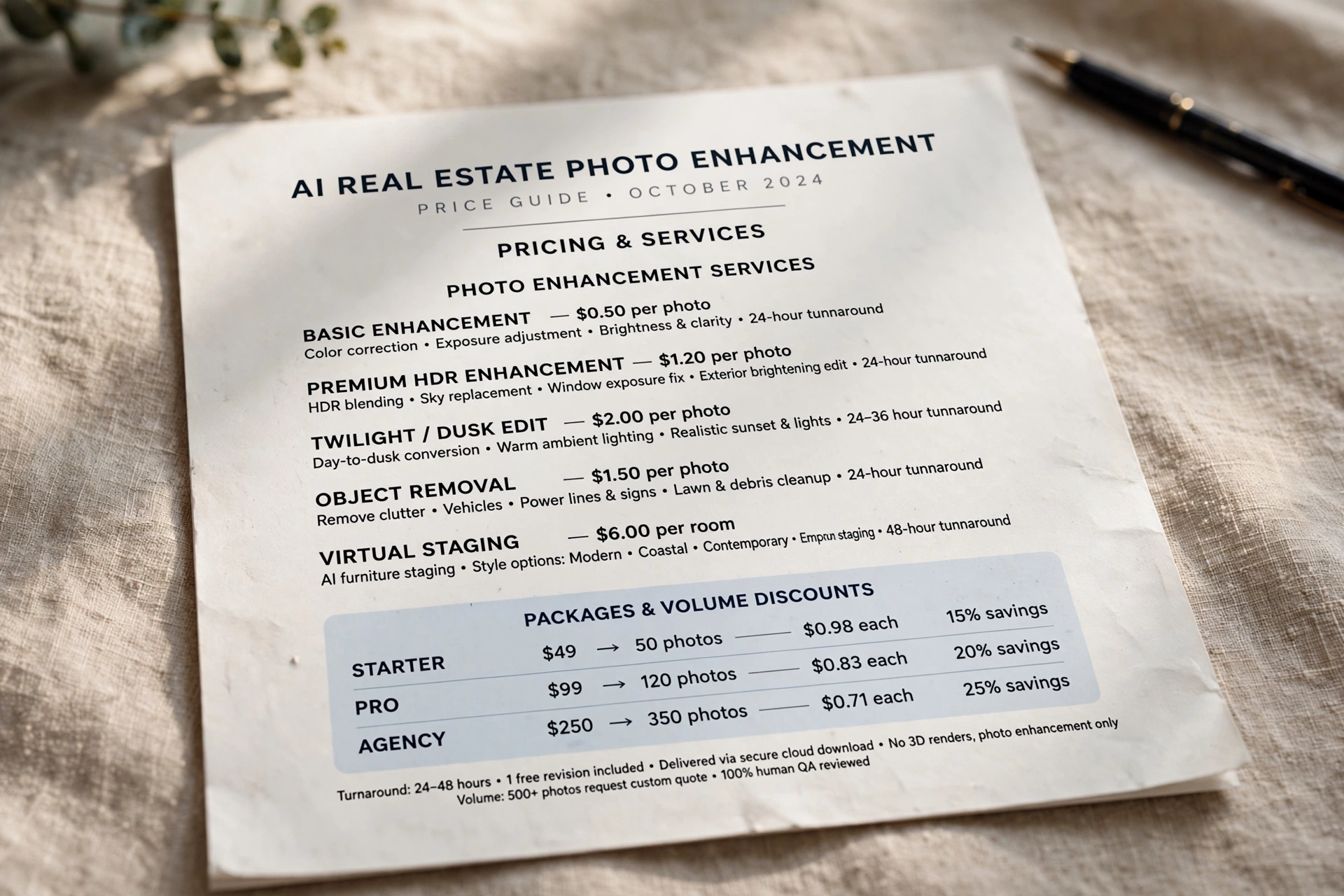
| Cost per Image | High (Hourly Rate) | Low/Free | Moderate/Scalable |
| Best For | Ultra-Luxury Single Estates | Casual Social Media Posts | Professional High-Volume Agents |
That said, the "Generic AI" approach often leads to what I call the "Uncanny Valley" of real estate. The images look too perfect in a way that feels fake, which can actually trigger a distrust response in buyers. A professional approach, like that found at RealVisionAI Blog - AI Real Estate Photography & Virtual Staging, balances enhancement with realism, ensuring the home looks beautiful but believable.
Common Misconceptions About AI Enhancement
Most guides get this wrong: they claim that AI is about "replacing" the photographer. In reality, AI is about augmenting the photographer's output. The mistake I made early on—and that I see constantly—is thinking that the software could do everything. AI cannot choose the right angle or understand the "flow" of a house; that still requires a human eye.
Myth 1: AI Enhancement is "Dishonest" or Misleading.
Some argue that replacing a gray sky with a blue one is deceptive. However, in the industry, this is viewed as "showing the property in its best light." According to industry standards for digital marketing, as long as the structural integrity of the home is not altered (e.g., you aren't removing a permanent wall), enhancing the atmosphere is standard practice. It is similar to how a home stager uses real furniture to hide a room's emptiness.
Myth 2: All AI Enhancers Work the Same Way.
There is a huge difference between a "filter" and a "model." A filter applies a layer over the whole image. A professional model, like those used in Virtual Furniture Staging in Long Beach, uses semantic segmentation. It identifies the "ceiling" and "floor" separately and treats them with different logic.
Myth 3: You Need to Be a Tech Expert to Use These Tools.
Many agents avoid AI because they fear the learning curve. The reality is that the best tools are designed to be "invisible." You upload a photo, and the AI does the heavy lifting. If you are spending more than 60 seconds per photo, you aren't using the tool correctly.
Frequently Asked Questions
How does AI real estate photo enhancement differ from standard HDR photography?
Standard HDR (High Dynamic Range) photography involves taking multiple exposures of the same scene and blending them to capture detail in both the brightest and darkest areas. While HDR is a great starting point, AI enhancement goes further by adding "intelligence" to the process. While HDR blends light, AI can change the content of the image—such as replacing a gloomy sky, removing a distracting power line, or digitally "cleaning" a carpet. It transforms the photo from a technically correct image into a marketing asset.
Can AI enhancement actually increase the final sale price of a home?
While a photo cannot change the square footage of a house, it directly impacts the "perceived value." According to data on consumer psychology in real estate, buyers associate a high-quality, polished visual presentation with a well-maintained property. This reduces "friction" during the decision-making process. When buyers are emotionally invested in the look of a home through enhanced imagery, they are more likely to submit higher initial offers and are less likely to haggle over minor cosmetic flaws that were minimized by the AI.
Is it legal to use AI to remove objects or change the sky in a listing?
In most jurisdictions, AI enhancement is perfectly legal as long as it does not misrepresent the fundamental characteristics of the property. Removing a trash can or changing a gray sky to blue is considered "aesthetic staging." However, removing a permanent structural defect, such as a massive crack in a foundation wall, would be considered deceptive. The general rule of thumb is: use AI to enhance the atmosphere and remove temporary clutter, but never use it to hide permanent structural issues.
How long does it actually take for AI to enhance a batch of real estate photos?
Depending on the platform, the processing time can vary, but professional-grade AI studios have reduced this to seconds. For instance, RealVisionAI Blog - AI Real Estate Photography & Virtual Staging focuses on providing market-ready visuals in as little as 12 seconds. This is a massive leap from the traditional 24-to-48-hour turnaround time associated with human editors. This speed allows agents to get their listings on the Multiple Listing Service (MLS) almost immediately after the shoot.
Does AI enhancement work for low-light interior photos?
Yes, and this is one of the most powerful use cases for the technology. AI can perform "shadow recovery" and "noise reduction" that far exceed the capabilities of standard brightness tools. It can identify "underexposed" areas of a room and intelligently brighten them without blowing out the windows (the "white-out" effect). This allows photographers to capture images in challenging lighting conditions, knowing the AI can normalize the exposure and bring out the true colors of the interior design.
Final Thoughts on AI Real Estate Photo Enhancement
The adoption of ai real estate photo enhancement is no longer a luxury; it is a baseline requirement for any agent who wants to remain competitive in 2026. The shift toward a digital-first discovery process means that your imagery is your primary sales tool. By automating the correction of lighting, the removal of clutter, and the optimization of atmosphere, you remove the barriers between a buyer and their dream home.
Whether you are focusing on luxury estates or rapid-turnover rentals, the ability to produce high-end visuals in seconds is a significant competitive advantage. If you're looking to maximize your listing ROI, we recommend integrating these tools with specific regional strategies, such as Virtual Furniture Staging in Tampa or Virtual Furniture Staging in Phoenix, to ensure your properties stand out in crowded markets.
Stop letting poor lighting or cluttered rooms hold back your listings. Experience the power of instant, professional visuals with RealVisionAI Blog - AI Real Estate Photography & Virtual Staging. Visit realvisionaire.com today to transform your property imagery into a high-conversion engine.
Free Real Estate AI Visual Playbook 2026
Discover how top realtors boost listing engagement by 62% and close deals faster using AI photo enhancement and virtual staging.