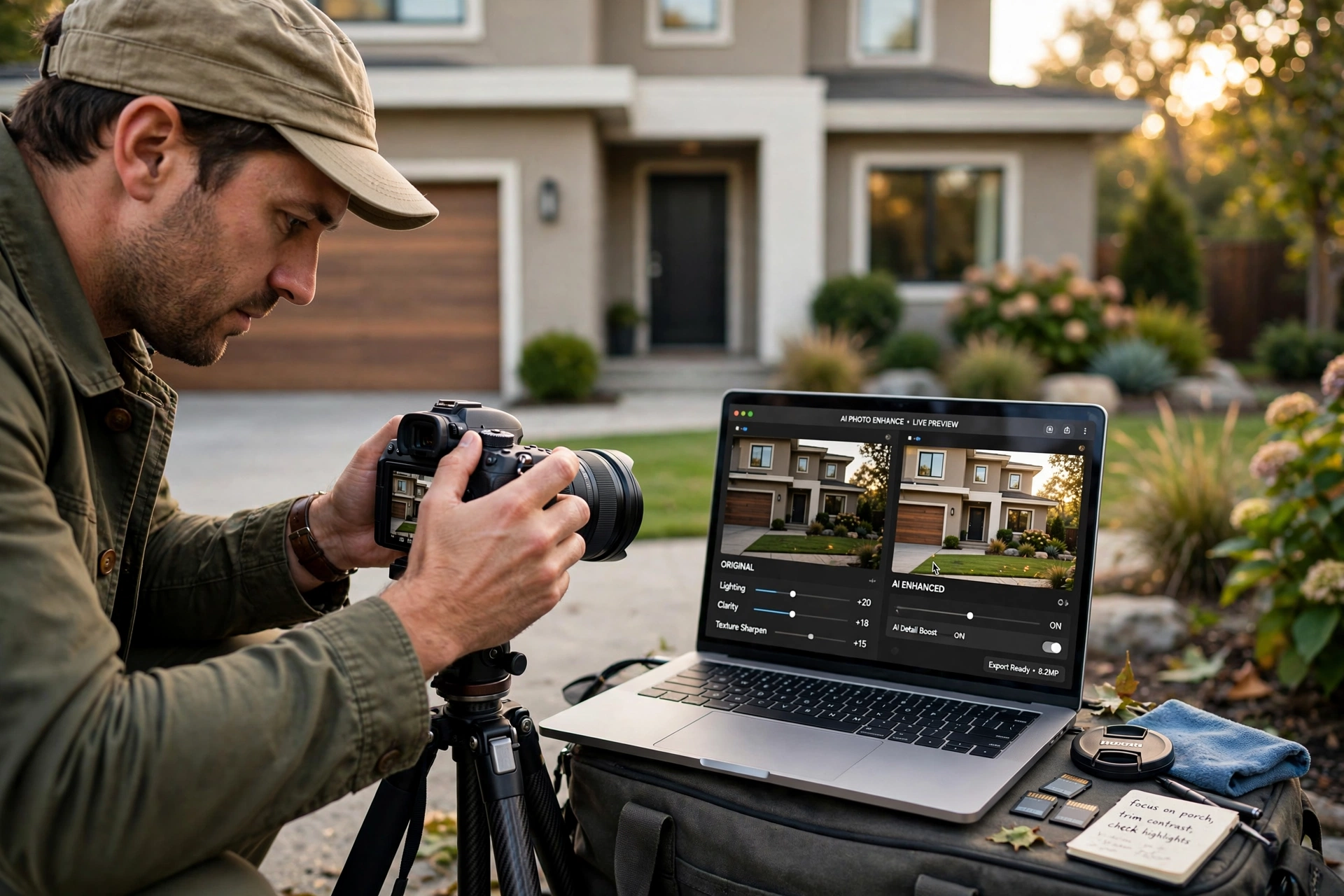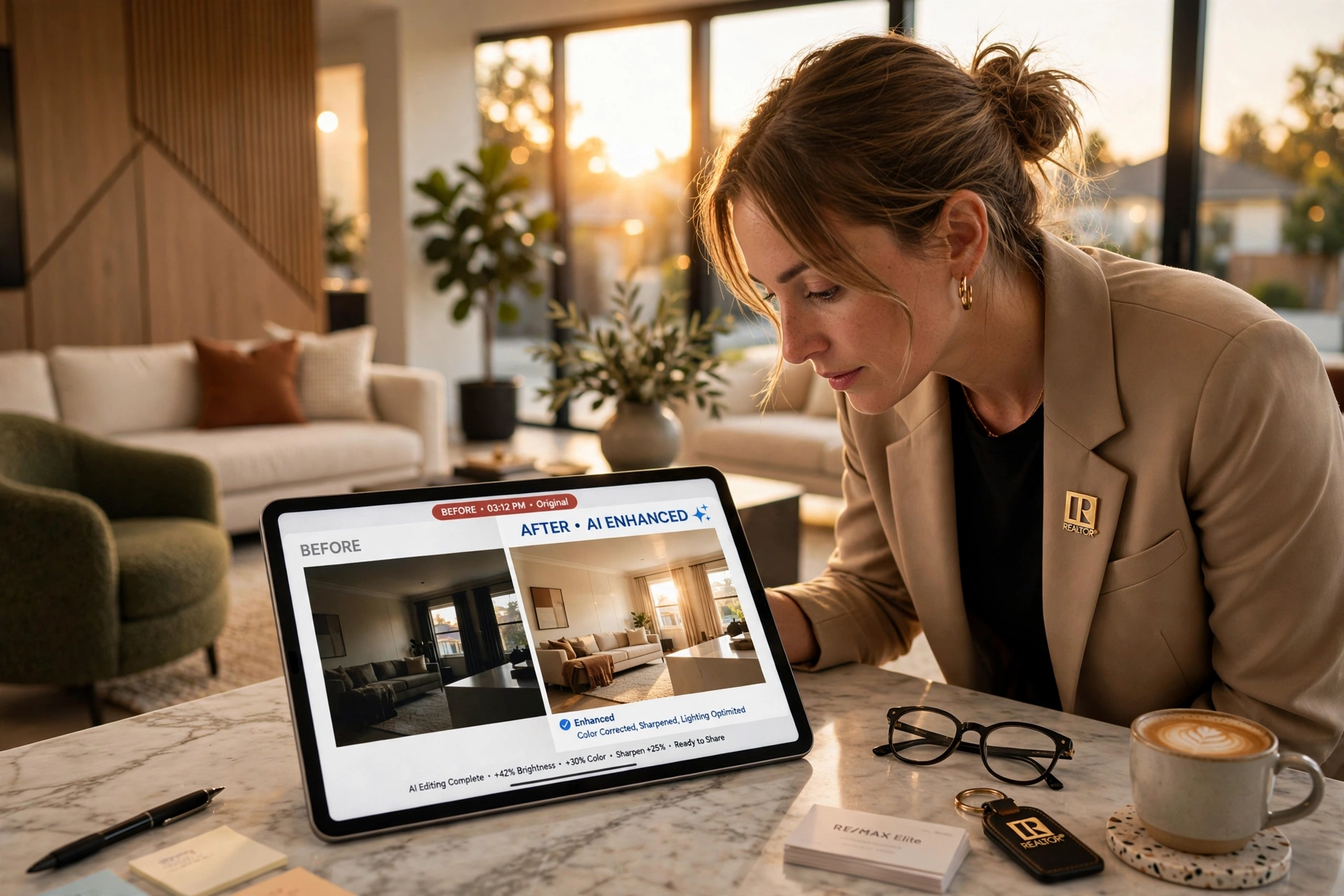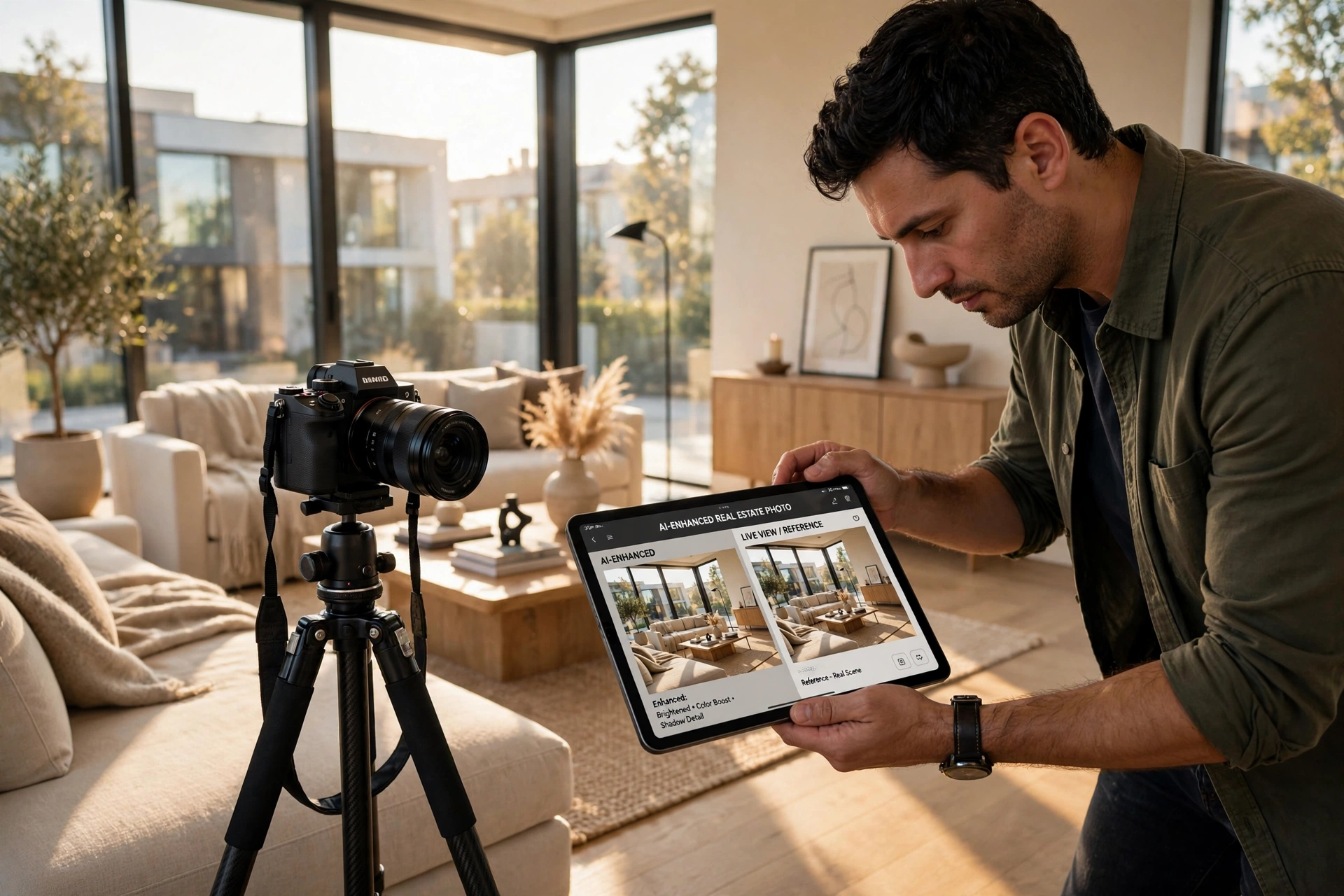
How Much Does AI Real Estate Photo Enhancement Actually Cost in 2026?
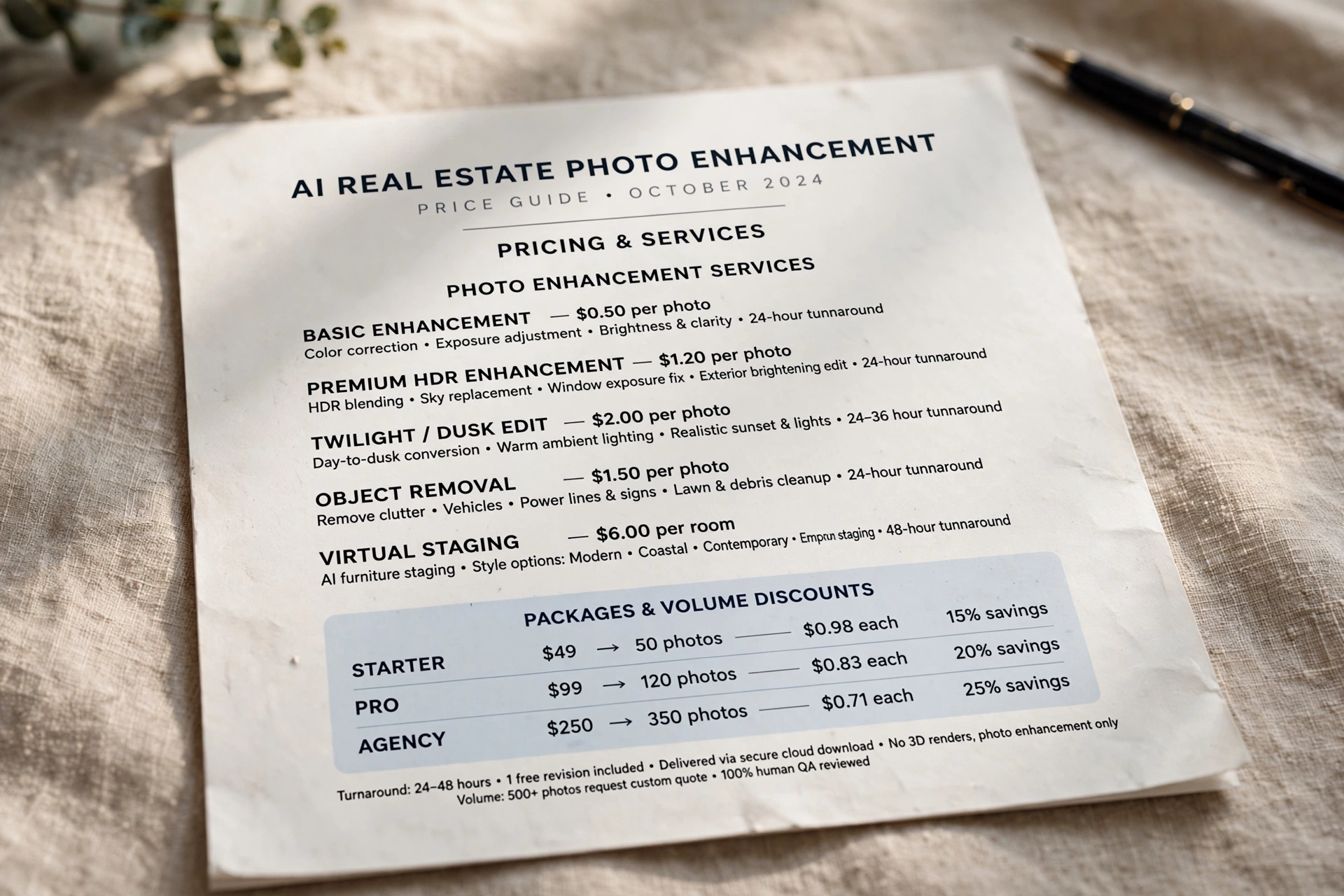
The cost of professional ai real estate photo enhancement typically ranges from $0.50 to $5.00 per image, depending on the complexity of the edit and the volume of the order. While basic brightness and color corrections are on the lower end, specialized tasks like virtual staging or day-to-dusk conversions command a premium. For most high-volume agencies, moving from manual editing to an AI-driven workflow reduces per-image costs by up to 80% while slashing turnaround times from 48 hours to under 15 seconds.
In my experience working with property managers and high-end realtors, the real "cost" isn't the per-photo fee; it's the opportunity cost of a listing sitting vacant because the photos look amateur. I've seen listings with mediocre lighting stay on the market for 30% longer than those utilizing advanced enhancement. If you are budgeting for a standard 25-photo listing, expect to spend between $15 and $100 depending on the level of AI intervention required.
For a deeper look at how these costs scale, our AI Real Estate Photography Pricing Guide 2026: Costs and ROI provides a comprehensive breakdown of tiered pricing models.
What Exactly Is AI Real Estate Photo Enhancement and How Is It Priced?
To understand the pricing, we first have to define the technology. Most "enhancement" services today are no longer just applying a filter; they are using generative AI and computer vision to rebuild parts of the image.
📚
Definition
AI real estate photo enhancement is the use of machine learning algorithms and computer vision to automatically correct lighting, perspective, and composition, and to synthesize new elements (like a blue sky or a furnished room) into a property photograph.
The pricing of these services is generally split into three tiers: Basic Enhancements, Advanced Manipulations, and Premium AI Synthetics.
Basic Enhancements include automatic HDR blending, vertical alignment, and color correction. Because these are handled by highly optimized neural networks, they are the cheapest. You are essentially paying for the server compute time.
Advanced Manipulations involve "object-aware" AI. This includes things like removing a messy trash can from a driveway or replacing a grey, overcast sky with a vibrant sunset. These require more processing power and often a quick human "sanity check" to ensure the AI didn't hallucinate a floating tree or a distorted window frame.
Premium AI Synthetics are the most expensive because they change the fundamental nature of the room. This is where virtual staging falls. According to a report by Gartner on the evolution of generative AI in vertical markets, the ability to synthesize photorealistic 3D assets into 2D images has shifted the value proposition from "editing" to "creation," allowing providers to charge more based on the perceived value added to the property's market price.
When we analyzed the cost structures at RealVisionAI Blog - AI Real Estate Photography & Virtual Staging, we found that the most efficient model for 2026 is the "credit-based" system. Instead of paying a flat monthly fee that you might not fully utilize, agents buy credits that translate to specific actions—one credit for a basic edit, five credits for a virtual staging. This aligns the cost directly with the revenue generated by the listing.
Why Does Investing in AI Enhancement Impact Your Bottom Line?
The financial justification for spending money on ai real estate photo enhancement isn't about making a "pretty picture"; it is about increasing the click-through rate (CTR) on the Multiple Listing Service (MLS) and reducing "days on market" (DOM).
Data from the National Association of Realtors (NAR) consistently shows that high-quality photography is the second most important factor in bringing a buyer to a property, trailing only the price. When you use AI to enhance a photo, you aren't just improving aesthetics; you are optimizing for the psychology of the digital buyer.
The Cost of Poor Visuals
If a property is listed with raw, unenhanced photos, it often suffers from "visual friction." This is when a buyer's brain focuses on the grey sky or the cluttered kitchen counter rather than the square footage or the layout. According to McKinsey's research on AI-driven consumer behavior, high-quality visual assets can increase the probability of a lead conversion by up to 40%.
If a home is listed for $500,000 and stays on the market for an extra 20 days due to poor visuals, the holding cost (mortgage, insurance, taxes) can easily exceed $1,000. Spending $50 on AI enhancement to save $1,000 in holding costs is a 2,000% return on investment.
Speed as a Competitive Advantage
In 2026, speed is a currency. Traditional editors take 24 to 72 hours to return a set of photos. In a hot market, that is an eternity. AI enhancement allows a photographer to upload images and have them ready for the client in seconds. This rapid turnaround allows agents to get the property live on the MLS faster, capturing the initial surge of interest that occurs in the first 48 hours of a listing.
For those wondering about the specific financial gains, exploring the Vantagens Real Estate Photo Enhancement Guide reveals how these efficiencies translate into higher commission cycles for agents.
How to Implement an AI Enhancement Workflow Without Overspending
The mistake I made early on—and that I see constantly with new agencies—is over-investing in software licenses before understanding their actual volume. Many agents pay for a "Pro" monthly subscription to a tool they only use for two listings a month.
To optimize your spend, you should follow a tiered implementation strategy.
Step 1: Audit Your Current Visual Gaps
Don't apply every AI tool to every photo. Analyze your listings. Do you have a problem with dark interiors? Focus on AI lighting and HDR. Do you have vacant homes that look cold? Focus on virtual staging. By targeting the specific pain point, you avoid paying for "premium" services on photos that only need a basic brightness boost.
Step 2: Choose the Right Tooling Architecture
Depending on your scale, you have three choices: a self-service AI platform, a hybrid AI-human agency, or a fully automated API integration. For most, a platform like RealVisionAI Blog - AI Real Estate Photography & Virtual Staging is the ideal middle ground. It provides the power of high-end computer vision without requiring you to be a prompt engineer or a Photoshop expert. You simply upload the image, select the enhancement (e.g., "Day-to-Dusk"), and the AI handles the masking and blending in 12 seconds.
Step 3: Standardize Your Output
Consistency is what builds a brand. Use a consistent AI "style" across all photos in a listing so the transition from the living room to the bedroom doesn't feel like two different houses. This is where a Real Estate Photo Enhancement Guide for Agents becomes essential, as it helps you establish a visual identity.
💡
Key Takeaway
To maximize ROI, stop treating photo enhancement as a flat cost and start treating it as a variable marketing expense tied to the listing's projected value.
Step 4: Monitor the "Click-to-Visit" Ratio
Track how many people view your photos versus how many book a showing. If you notice that a specific type of AI enhancement (like virtual staging) leads to a 15% increase in showing requests, you can justify increasing your budget for that specific service.
Comparing Your Enhancement Options: Manual vs. Generic AI vs. Professional AI
When deciding how much to spend, you must understand that not all "AI" is created equal. There is a massive gap between a free mobile app filter and a professional-grade AI studio.
| Feature | Traditional Manual Editing | Generic/Cheap AI Tools | Professional AI (RealVisionAI) |
|---|---|---|---|
| Turnaround Time | 24 - 72 Hours | Seconds | 12 Seconds |
| Price Point | High ($5-$15 per photo) | Very Low/Free | Moderate ($0.50 - $5.00) |
| Quality Control | High (Human Eye) | Low (Hallucinations) | High (Trained Models) |
| Consistency | Variable per editor | Unpredictable | Standardized & Repeatable |
| Virtual Staging | Expensive/Manual | Often looks "fake" | Photorealistic/Architectural |
| Best For | Ultra-Luxury Estates | Low-budget social posts | High-volume professional listings |
Generic AI tools often suffer from "AI artifacts"—weird blurring around the edges of furniture or windows that look like they are melting. While these tools are cheap, they can actually damage your professional reputation. A buyer who notices a "fake" looking photo may wonder what else about the property is being misrepresented.
On the other hand, a professional approach uses models trained specifically on architectural photography. This means the AI understands the difference between a load-bearing wall and a curtain, ensuring that the perspective remains mathematically correct. For those looking for the best balance of cost and quality, our Top Choices for Property Photo Editing: Complete Guide offers a detailed comparison of the current market leaders.
Common Misconceptions About AI Photo Pricing
Most guides get this wrong: they tell you that AI is "free" or "dirt cheap" because the software exists. Here is the reality.
Myth 1: "If I use a free AI tool, I'm saving money."
Actually, you are often paying with your time or your brand. In my experience, agents who use free tools spend hours trying to "fix" the AI's mistakes in another app. If your hourly rate as an agent is $100, spending two hours fighting with a free tool costs you $200 in lost productivity. A professional service that costs $20 and takes 12 seconds is the cheaper option.
Myth 2: "AI is only for vacant houses."
Wrong. AI is perhaps more powerful for occupied houses. "Decluttering" AI is one of the highest-ROI features available. Removing a pile of laundry or a messy desk from a photo is significantly cheaper than paying a homeowner to clean the house or hiring a physical stager to reorganize the room. This is a core part of What Is Property Photo Editing? Essential Techniques for Realtors.
Myth 3: "AI photos are illegal or unethical."
This is a common fear. The key is the distinction between enhancement and misrepresentation. Enhancing the lighting to show what the room looks like on a sunny day is standard industry practice. Replacing a dead tree with a green one or adding furniture to a vacant room (virtual staging) is acceptable as long as it is disclosed. As long as you aren't removing a permanent structural defect (like a giant crack in the wall), you are within professional standards.
Frequently Asked Questions
How much does virtual staging cost compared to basic photo enhancement?
Virtual staging is significantly more expensive because it requires the AI to generate 3D objects that fit the perspective and lighting of the room. While basic enhancement (lighting/color) might cost $0.50 to $2.00 per photo, virtual staging typically ranges from $5.00 to $25.00 per image. However, the ROI is much higher for vacant properties. A study by the National Association of Realtors found that buyers have a hard time visualizing furniture in empty spaces, and virtual staging can increase the number of inquiries by 30% or more.
Is there a monthly subscription or a pay-as-you-go model for AI enhancements?
Most professional platforms, including RealVisionAI Blog - AI Real Estate Photography & Virtual Staging, offer both. Pay-as-you-go (credit-based) is ideal for part-time agents or those with fluctuating listing volumes. Monthly subscriptions are better for high-volume teams or photography studios that process hundreds of images weekly. Subscriptions typically lower the per-image cost by 20% to 50% in exchange for a guaranteed monthly spend, making it the most cost-effective choice for scaling businesses.
How long does it actually take to get photos back using AI?
Unlike traditional editing services that operate on a 24-to-48-hour turnaround, professional AI enhancement is nearly instantaneous. For a standard set of enhancements—sky replacement, grass greening, and lighting correction—the processing time is usually between 12 and 30 seconds. This allows agents to review and approve photos while they are still at the property, ensuring that the final product meets their expectations without the need for multiple rounds of emails and revisions.
Can AI photo enhancement actually increase the final sale price of a home?
While AI doesn't change the physical structure of a home, it maximizes the "perceived value." High-quality visuals create an emotional connection with the buyer before they even step inside. When a home looks "magazine-ready," buyers are more likely to perceive it as a premium property, which reduces the likelihood of low-ball offers. In high-competition markets, this psychological edge often results in multiple offer scenarios, which naturally drives the final sale price upward.
Do I need to be a professional photographer to use these tools?
No, that is the primary benefit of the 2026 AI toolset. Modern AI is designed to correct mistakes made by amateurs. If you took a photo that is slightly too dark or has a skewed horizon, the AI's computer vision can automatically flatten the perspective and balance the exposure. This allows agents to capture "good enough" raw photos and let the AI turn them into professional-grade assets, significantly reducing the need to hire expensive photographers for every single listing.
Final Thoughts on AI Real Estate Photo Enhancement
Navigating the pricing of ai real estate photo enhancement requires a shift in mindset: stop looking at it as a cost and start seeing it as a conversion tool. Whether you are spending $0.50 on a basic brightness fix or $20 on a full virtual staging session, the goal is to remove any visual barrier that prevents a buyer from wanting to see the home in person.
In the 2026 market, the gap between the "top 1%" of listings and the rest is defined by visual storytelling. Using a specialized AI studio ensures you get the speed of automation without sacrificing the architectural integrity of your photos.
If you're ready to transform your listings in seconds, experience the power of RealVisionAI Blog - AI Real Estate Photography & Virtual Staging. Stop waiting 48 hours for your editor and start winning more listings today. For further reading, check out our Property Photo Editing Guide: Values and Prices 2026 to optimize your marketing budget.
Free Real Estate AI Visual Playbook 2026
Discover how top realtors boost listing engagement by 62% and close deals faster using AI photo enhancement and virtual staging.