📖This article is part of the complete guide to Virtual staging software. Is Virtual Staging Software Worth It? Complete Analysis for 2026
In the 2026 real estate market, a property's first impression is almost always digital. With over 95% of buyers starting their home search online, the visual quality of listing photos directly determines how many clicks, visits, and offers a property will receive. For professionals looking to stand out in an increasingly competitive environment, the central question is no longer whether they should use visual enhancement technology, but which tool offers the best value for money.
This guide provides an in-depth analysis of whether investing in virtual staging software like
Real Vision AI is truly worthwhile for agents, real estate photographers, and developers in 2026. We'll explore costs, results, and the direct impact on days on market and final sale price. For a complete overview of how photo editing boosts your listings, check out our main guide on
Property Photo Editing: Transform Your Real Estate Listings.
Why Property Visuals Matter More Than Ever
Before analyzing the software itself, it's crucial to understand the landscape. Modern buyer behavior is unforgiving toward low-quality photos. If the first image doesn't capture attention within half a second, the user simply scrolls to the next listing.
Key Industry Statistic: According to a National Association of Realtors (NAR) study, 87% of buyers consider property photos the most useful feature on a listing site. Even more importantly, properties with high-quality professional photos sell for up to 10% more than those with amateur photos, according to VHT Studios research.
The Modern Professional's Dilemma
Agents and photographers face a classic dilemma: quality versus speed and cost.
- Traditional Services: Professional photographers with manual post-production offer excellence, but at high costs ($150–$500 per session) and turnaround times of 24 to 48 hours.
- Amateur Photos (Smartphone): They are fast and free, but result in dark rooms, washed-out skies, and dead lawns, which drive buyers away and reduce the property's perceived value.
- Physical Staging: Renting furniture to decorate an empty home can cost $2,000 to $5,000 per month, an unfeasible investment for most listings.
It's in this gap that virtual staging software emerges as the ideal solution, offering professional-quality photos for pennies and in seconds.
What is Virtual Staging Software and How Does It Work?
📚Definition
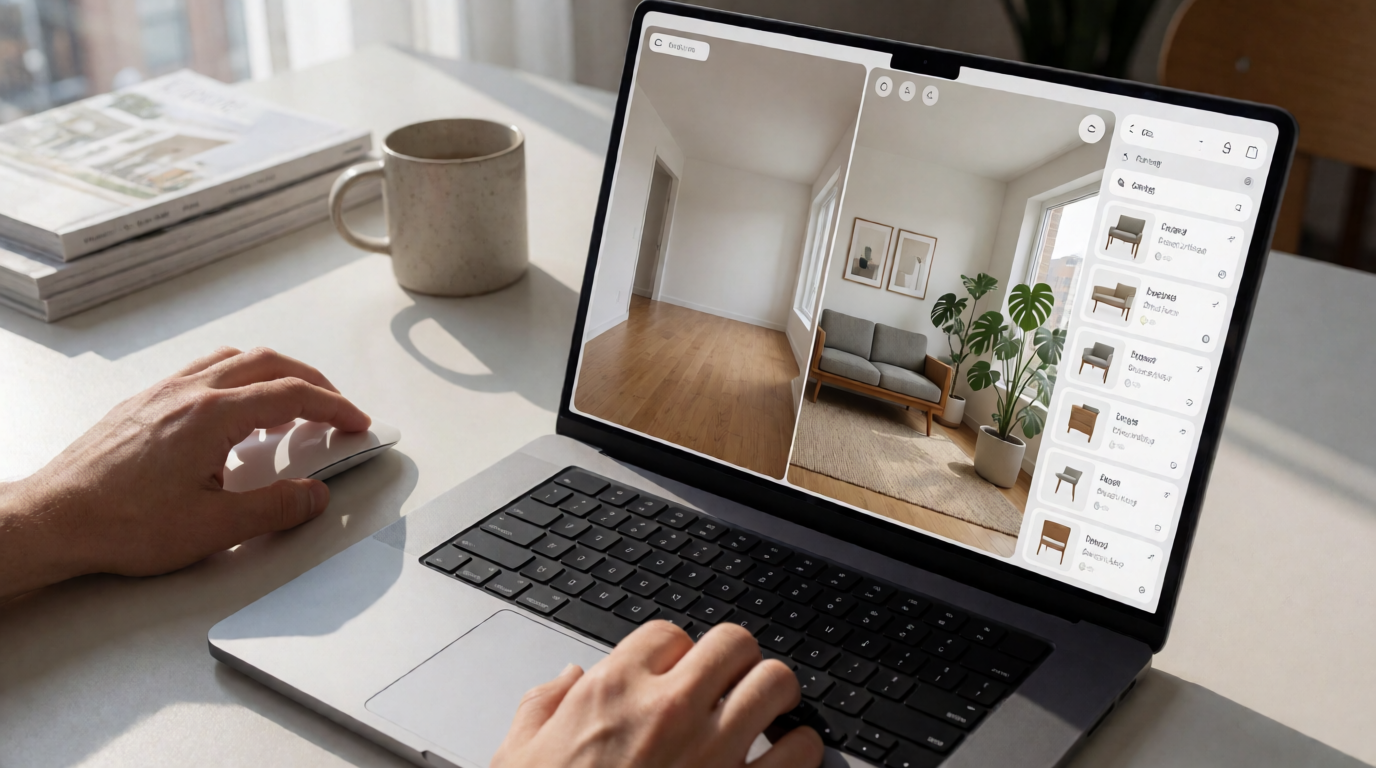
Virtual staging software is an artificial intelligence tool that uses computer vision and generative AI algorithms to digitally insert furniture, decor, and aesthetic elements into photos of empty or poorly furnished rooms. Unlike traditional photo editing, it understands room geometry, lighting, and perspective to generate photorealistic compositions.
Real Vision AI takes this concept further. It doesn't just insert furniture; it understands the room's context. For example, when virtually staging a living room, the system automatically adjusts shadows cast by the furniture to match the natural light from the window, creating an image that is practically indistinguishable from a real photo.
A Complete Enhancement Ecosystem
More than just staging, a complete platform offers a suite of essential tools:
- AI Property Enhancement: Automatic correction of lighting, contrast, and color for underexposed photos.
- Sky Replacement: Replacing cloudy skies with sunset or clear day scenes.
- Lawn Green-Up: Transforming yellowed lawns into lush, vibrant green carpets.
- Object Removal: Removing unwanted objects like visible wires, boxes, or cars in the garage.
Cost-Benefit Analysis: Is It Worth It?
The short answer is a resounding yes, but let's look at the numbers to support this conclusion. The ROI (Return on Investment) analysis for an agent using virtual staging is impressive.
Comparative Table: Traditional Staging vs. Virtual vs. No Staging
To illustrate, imagine a property valued at $400,000.
| Aspect | No Staging | Physical Staging | Virtual Staging (Real Vision AI) |
|---|
| Cost per Listing | $0 | $2,500 (monthly average) | ~$20 (monthly plan) |
| Preparation Time | Immediate | 3-5 days (scheduling + setup) | 12 seconds per photo |
| Days on Market | 60-90 days (average) | 30-45 days | 20-35 days |
| Final Price | Near asking price | 5-10% above asking price | 6-12% above asking price |
| Estimated ROI | - | Moderate (depends on time) | Extremely High (pennies per dollar invested) |
Data Analysis: A study by Realtor.com indicated that homes with staging (physical or virtual) sell 88% faster. For the seller, each month less on the market represents significant savings in mortgage costs, taxes, and maintenance. For the agent, selling faster means freeing up working capital and increasing the number of transactions per year.
💡Key Takeaway
For professionals handling multiple listings per month, virtual staging is not an expense; it's an investment with guaranteed returns. The savings compared to physical staging are 99%, and the time gain is 99.9%.
How to Implement Virtual Staging in Your 2026 Workflow
Implementation is surprisingly simple and requires no advanced technical knowledge.
Step-by-Step for Maximum Efficiency
- Photograph the Empty or Currently Furnished Property: Use a good camera or a latest-generation smartphone. Ensure the room is clean and well-lit. A good base photo yields a far superior final result.
- Upload to Real Vision AI: Access the platform and upload the photos. The system accepts JPEG, PNG, and RAW.
- Choose the Staging Mode:
- Auto-Staging (Recommended): The AI analyzes the room and automatically suggests the best furniture layout and decor style (Modern, Classic, Scandinavian, etc.).
- Manual: You select specific furniture from a catalog and position it in the room. Ideal for high-end projects or very specific needs, like AI Virtual Staging for Luxury Homes.
- Apply Additional Enhancements: Before finalizing, use enhancement tools to correct lighting, replace the sky, or perform AI Property Enhancement: Transform Listings with Smart Photo Editing in 2026. This step ensures the final photo has magazine-quality appeal.
- Download and List: In under 60 seconds, your photo is ready. Download in high resolution (MLS-compatible) and publish.
Why Speed is the New Competitive Differentiator
For real estate photographers, the ability to deliver staged and enhanced photos in minutes, rather than days, is a massive sales differentiator. It allows you to serve more clients, secure more profitable post-production contracts, and retain agents who need agility. Tools like
Real Estate Image Processing automate repetitive tasks, freeing the photographer to focus on creative capture.
💡Pro Tip
Offer a "Fast Track Listing" service where you deliver the complete photo + virtual staging package in under 2 hours. Charge a premium for this urgency and turn the speed of Real Vision AI into a new revenue stream.
The Biggest Mistakes When Using Virtual Staging (And How to Avoid Them)
Not all virtual staging is created equal. Using generic or low-quality tools can damage your reputation.
Mistake #1: Choosing Furniture That Doesn't Fit the Room
The most common mistake is inserting a sofa that's too large or a dining table that distorts the room's perspective.
Solution: Real Vision AI uses computer vision to map room depth and suggest furniture with realistic scale. Trust the AI's suggestions.
Mistake #2: Ignoring Lighting
A shadow cast to the left in a photo where light comes from the right completely breaks realism.
Solution: Real Vision AI's lighting engine replicates the original room's light physics (Global Illumination), projecting shadows and reflections accurately.
Mistake #3: Staging Rooms That Should Stay Empty
Children's rooms, very small offices, or storage areas often benefit from staging, but overdoing it can look fake.
Solution: Use common sense. For listings of
Virtual Staging for Empty Listings, focus on creating functional spaces. For
Virtual Staging for Already Furnished Rooms, change the style, not the function.
Mistake #4: Not Following MLS Rules
Transparency is key.
Solution: Always include a clear disclaimer: "This photo features virtual staging to demonstrate the room's potential." Real Vision AI can add a subtle, removable watermark to facilitate identification.
Real-World Use Cases in the 2026 Market
To understand the real impact, let's look at practical examples.
Case 1: The Expanding Solo Agent
Profile: John, an agent in Houston, listed 3 properties per month. He used cell phone photos and lost clients.
Solution: Subscribed to Real Vision AI. He started delivering high-quality photos with virtual staging for all his listings.
Result: Within 3 months, his number of views per listing increased by 70%. He sold a property that had been on the market for 4 months in just 2 weeks after applying virtual staging. His ROI was 50x in the first month.
Case 2: The Professional Real Estate Photographer
Profile: Maria, a photographer in San Francisco, charged $400 per photo session, but post-production took 2 days.
Solution: Integrated
Real Vision AI as a post-production tool.
Result: Reduced editing time from 2 hours per session to 15 minutes. She now offers a "Before and After" package with virtual staging and delivery in 4 hours for $500. She increased her revenue by 30% and drastically reduced deadline stress. For photographers working in the high-end market, see the guide on
Property Photo Editing in San Francisco: AI Guide 2026 to understand local nuances.
Frequently Asked Questions (FAQ)
Is virtual staging worth it for rental properties?
Yes. Rental properties also benefit immensely. One study showed that apartments with virtual stage rent 30% faster. Use more neutral and functional styles, like "Scandinavian" or "Industrial Chic."
Do Google and the MLS penalize the use of virtual staging?
No, as long as you follow the rules. Most US MLS systems require a disclaimer. Google does not penalize the use of enhanced images, as long as they faithfully represent the property (don't add a pool that doesn't exist, for example).
Is the Real Vision AI result better than an interior designer's?
The goal isn't to replace a designer, but to allow agents or photographers to offer a high-quality service at an affordable cost. For actual decor projects, a designer is indispensable. For sales marketing, Real Vision AI is unbeatable in cost and speed.
Can I use Real Vision AI for commercial properties?
Absolutely. Offices, stores, and warehouses can be virtually staged to show desk layouts, workstations, or machinery. It's a powerful tool for the B2B market.
How long does it take to learn the software?
About 10 minutes. The interface is intuitive, and the upload and staging process is almost fully automated. Most of the time will be spent choosing the ideal decor style.
Does Real Vision AI work with any type of camera?
Yes. From iPhone 15 Pro photos to full-frame cameras like the Canon R5. The AI optimizes the image regardless of the source, but the quality of the base photo (focus, lighting) impacts the final result.
Is there a limit to the number of furniture items I can place in a scene?
Real Vision AI automatically optimizes the number of furniture pieces to create a balanced composition. You can adjust manually, but adding too many items usually clutters the look. Less is more.
Does the software offer a satisfaction guarantee?
Real Vision AI offers a satisfaction guarantee. If the result doesn't meet your expectations, the support team can review the image or offer guidance on how to achieve better results.
Conclusion and Next Steps
After a deep analysis of costs, benefits, and use cases, the answer is clear:
yes, investing in virtual staging software like Real Vision AI in 2026 is absolutely worth it.It's not just a competitive advantage; for many markets, it's becoming the market standard. The ability to transform an empty, dull property into a desirable home in seconds, at a negligible cost, redefines what's possible in real estate marketing.
Whether you're an agent looking to increase sales and reduce listing time, or a photographer wanting to offer a premium service without increasing your workload, Real Vision AI is the tool you need.
Ready to transform your listings? Try Real Vision AI for free and see how artificial intelligence can elevate your results. Visit our blog at
blog.realvisionaire.com for more guides and comparisons.
About the Author
RealVisionAI Editorial Team is the specialized team in Real Estate Visuals & AI PropTech from
Real Vision AI. We combine expertise in real estate photography, interior design, and artificial intelligence to help industry professionals maximize the potential of their listings with cutting-edge technology.
Recommended Readings
To deepen your understanding of these topics, we recommend reading the following articles:
Free Real Estate AI Visual Playbook 2026
Discover how top realtors boost listing engagement by 62% and close deals faster using AI photo enhancement and virtual staging.