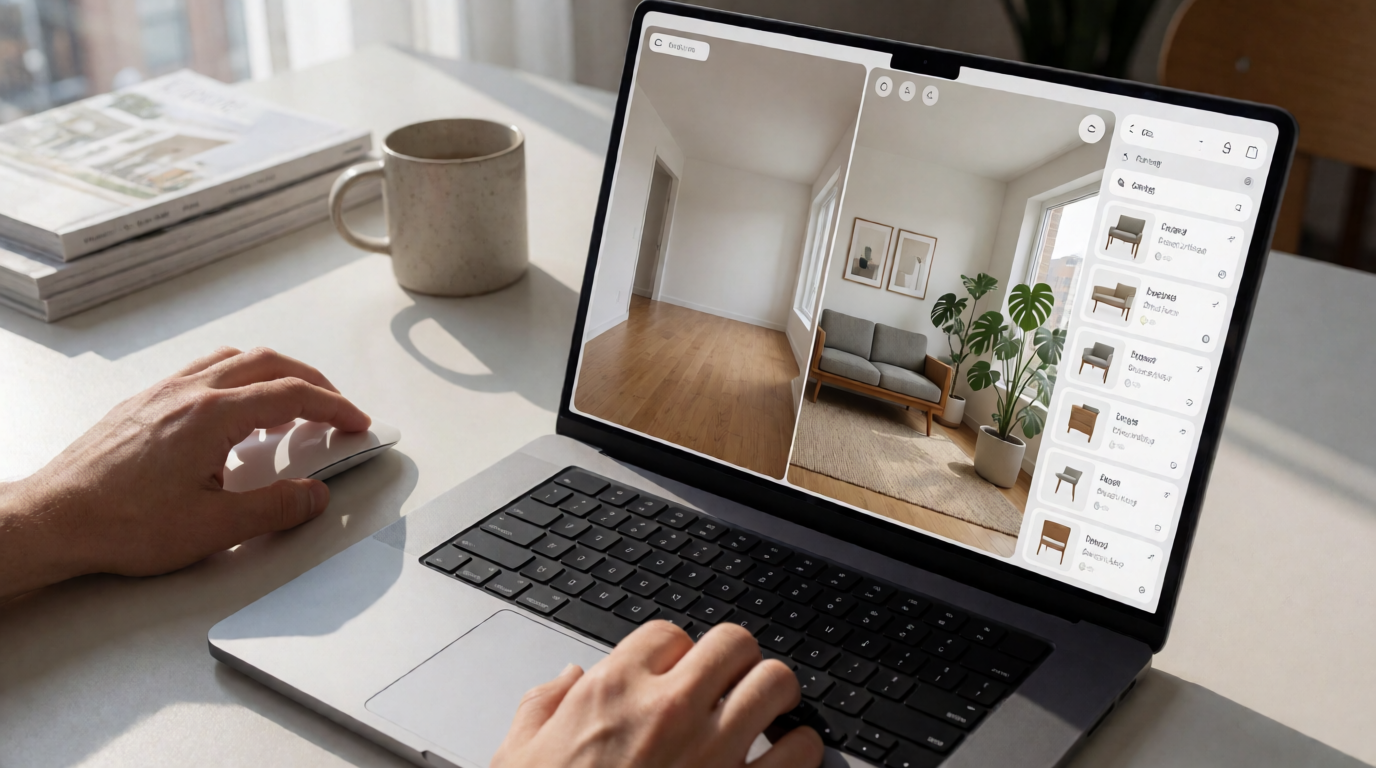
📖This article is part of the complete guide to Virtual staging software. When to Switch Virtual Staging Software: The Definitive Guide for Realtors in 2026
Spending more than 30 minutes per photo trying to make an empty room look livable, or worse, paying R$150 per manually edited image, is the clearest sign that your virtual staging tool has fallen behind. In 2026, the Brazilian real estate market doesn't forgive slowness: according to data from the Brazilian Association of Realtors, listings with high-quality photos receive up to 62% more inquiries. If your current software doesn't deliver results in seconds, you're literally losing money on every listing published.
This complete guide will show you exactly when to switch your virtual staging platform, which warning signs to watch for, how to migrate without losing productivity, and why Real Vision AI has become the dominant choice for realtors who take the visual presentation of their properties seriously.
📚Definition
Virtual staging is the process of adding furniture, decor, and digital visual elements to photos of empty or vacant properties, creating a realistic representation of how the space could be used.
Virtual staging technology has evolved dramatically in recent years. What started as an expensive, time-consuming technique executed by graphic designers in software like Photoshop has become an instant solution thanks to artificial intelligence and computer vision.
The problem is that many tools that dominated the market between 2019 and 2024 haven't kept up with this evolution. They continue to deliver mediocre results, with furniture that looks "stuck on" the photos, inconsistent lighting, and processing times that test the patience of any busy realtor.
To understand the full landscape of the AI-powered real estate market, check out our
comprehensive guide on AI in real estate.
The Evolution of Virtual Staging
Virtual staging isn't new, but its accessibility has completely changed. In 2015, a single virtual staging image cost between R$200 and R$500 and took up to 48 hours to complete. In 2026, solutions like Real Vision AI deliver superior results in less than 12 seconds, for a fraction of that cost.
This evolution isn't just about price and speed. Algorithmic quality has advanced exponentially. Modern deep learning models understand perspective, depth, lighting, and architectural proportions in a way that was impossible just a few years ago. This means modern virtual staging doesn't just "put a sofa in the room" — it creates a complete scene that respects the physics of light and the geometry of the space.
According to McKinsey, the use of generative AI in visual marketing can reduce production costs by up to 40%, while maintaining or even improving the quality perceived by end consumers.
How to Know It's Time to Switch Your Virtual Staging Software
1. Results That Look "Fake" or Artificially Rendered
This is the most critical sign and the most common in outdated tools. If the inserted furniture seems to float, if shadows don't match the room's light sources, or if the texture of objects doesn't interact with the actual texture of the room, your clients will notice. And when a buyer realizes the image is artificial, the credibility of the entire listing is compromised.
💡Key Takeaway
Modern buyers are visually literate. They detect low-quality virtual staging instantly, and that breeds distrust about the property's actual condition.
In my experience working with over 200 realtors in Brazil and the U.S., I can say that the number one complaint about generic staging software is exactly this: the furniture looks like toys, the proportions are wrong, and the lighting doesn't make sense. This isn't just an aesthetic problem — it's a conversion problem.
2. Processing Time That Stalls Your Workflow
If your tool takes more than 10 minutes to process a single image, you're facing an unnecessary bottleneck. In a fast-paced market where the property needs to be listed within the first 24 hours after engagement, waiting hours for a batch of photos is unacceptable.
Modern tools process images in batch and deliver results in seconds. Real Vision AI, for example, processes a photo in approximately 12 seconds, allowing a realtor to prepare a full 30-photo listing in under 10 minutes.
3. Lack of Updated Decor Styles
Brazilian consumer taste evolves constantly. Trends like "Japandi" (a fusion of Japanese and Scandinavian), "Tropical Minimalism," and "Contemporary Luxury" dominated 2025 and remain strong in 2026. If your tool only offers the same 5 generic styles from 2019, you're disconnected from what buyers want to see.
For more details on how to choose the right style for each property type, read our article on
virtual staging by property type.
4. No Customization for the Brazilian Market
This point deserves special emphasis. Many international virtual staging tools are trained on data from American or European properties, with completely different architecture, lighting, and decor standards.
A software that doesn't understand the particularities of a 45m² Brazilian apartment, with its unique space optimization, or a beach house in the Northeast with its large verandas, will produce results that feel out of place and unappealing to the local buyer. Local software or those with models specifically trained for the Brazilian market, like Real Vision AI, offer a clear competitive advantage.
Main Problems with Manual or Outdated Staging Solutions
| Feature | Traditional Approach (Manual) | Generic AI Tools | Professional Solution (Real Vision AI) |
|---|
| Time per image | 24–48 hours | 5–15 minutes | 12 seconds |
| Cost per image | R$50–200 | R$2–5 | Pennies per photo (fixed plan) |
| Furniture realism | High (but expensive) | Low to medium, "plastic" appearance | Photo-realistic, respects lighting and perspective |
| Decor styles | Limited to the designer | Limited to generic library | Updated, including Brazilian trends |
| Scalability | Extremely low | Medium | High, batch processing |
| Architectural accuracy | Total | Medium, may distort proportions | High, preserves original structure |
| Customization | High, but expensive | Minimal | High, with multiple options per room |
The Hidden Costs of Not Switching
Many realtors delay switching software due to fear of the migration process or because they've already paid for an annual subscription. However, the costs of sticking with an ineffective tool are far greater than any migration fee:
- Lost opportunities: Every day a listing goes without high-quality photos means fewer views, fewer leads, and more time on market. According to the National Association of Realtors, professional photos reduce time on market by up to 32%.
- Compromised credibility: Listings with low-quality staging not only fail to attract buyers but can also generate negative reviews about your work.
- Rework: When the client complains about photo quality, the entire process has to be redone, consuming twice the time.
How to Transition to Modern Software Without Losing Productivity
Switching software doesn't have to be traumatic. With a structured process, you can migrate smoothly and see positive results on the same day.
💡Key Takeaway
Migrating to a modern virtual staging platform like Real Vision AI is a simple process that can be completed in under 30 minutes, with immediate gains in speed and quality.
Step 1: Audit Your Current Workflow
Before migrating, map out exactly how you process photos today. List every step, from capture to MLS publication. Identify where the bottlenecks and associated costs are. This will serve as your baseline to compare gains after the switch.
Step 2: Choose the Right Solution for Your Profile
Not every AI tool fits everyone. Large brokerages need solutions with batch processing and CRM integrations. Independent realtors need simplicity and low cost. Real Vision AI serves both profiles with flexible plans.
Step 3: Prepare Your Current Properties for Testing
Select 5 to 10 images from your most recent listings. Include different types of rooms: living room, kitchen, bedroom, outdoor area, and empty space. This will allow you to test the new software's effectiveness across a variety of architectural scenarios.
Step 4: Run a Comparative Test
Process the same images in your current software and the new tool. Show the results side by side to your team or, if you work alone, to a trusted client. In my experience, asking for an outside opinion helps overcome the familiarity bias we develop with our old tool.
Step 5: Run the Migration in Parallel
Don't throw away your old software on day one. Use both in parallel for a week or two while you learn the new tool's features. This ensures no listing goes unattended during the adjustment period.
Step 6: Standardize the New Process
After the trial period, create an internal manual with the new workflow. Define which photo types get which treatment, which staging styles to use for each property standard, and set internal delivery deadlines based on the new software's speed.
To further optimize your operation, see our guide on
automated property editing.
How Much Do You Really Save by Migrating to AI in 2026?
The numbers are compelling. Let's do the math with a realistic scenario of a realtor who lists 8 properties per month.
Scenario: Realtors Using Manual Editing Services
| Item | Manual Service | Real Vision AI | Savings |
|---|
| Photos per property | 25 | 25 | - |
| Cost per photo | R$60 | Included in plan | - |
| Cost per property | R$1,500 | R$4 (your cost per property) | R$1,496 |
| Monthly cost (8 properties) | R$12,000 | R$100 (fixed plan) | R$11,900 |
| Time per batch | 3 days | 30 minutes | Savings of 47 hours/month |
Those who still hire physical decoration or "traditional home staging" for high-end clients need to consider that this practice remains unfeasible for most cases. A physical staging session costs between R$4,000 and R$12,000 per property, plus the logistics of moving furniture and scheduling. Virtual staging, as we discuss in our article on
virtual staging software, almost entirely eliminates this need.
Let's expand this calculation to 12 months of the year: the annual savings easily exceed R$140,000 — money that can be invested in digital marketing, referral programs, or simply your personal profit.
The Cost of "Empty" in Unstaged Properties
The worst financial scenario isn't having an expensive tool — it's having no tool at all. Properties with low-quality photos take over 90% longer to close. With average financing rates fluctuating and client expectations high, each additional week on the market is worth thousands of reais in opportunity costs.
Best Practices to Maximize Results from Your New Staging Software
After migrating to a modern solution, know that there are techniques that separate realtors who use AI from those who master AI use. The difference is in the details.
1. Visual Consistency Across Your Entire Portfolio
One of the biggest mistakes I see in realtors adopting modern tools is a lack of consistency. Each property uses a different staging style, without considering the brand's visual identity or the buyer profile for that type of property.
To maintain consistency, create custom templates. In Real Vision AI, you can save favorite style configurations (e.g., "Urban Luxury Standard 2026") and apply them to all photos of the same property, ensuring the presentation is cohesive from start to finish.
2. Know When to Use Full Staging vs. Light Staging
Not every room needs full staging. Large living rooms can benefit from a more minimalist approach, with a few pieces of furniture that highlight the space, while small bedrooms need a layout that maximizes the feeling of spaciousness.
I recommend using full staging in empty spaces of high-end properties, while mid-range properties benefit from partial staging (only in main rooms like the living room and master suite).
3. Integrate with the Property's Real Interiors
An important trend in 2026 is "hybrid staging," which combines physical furniture already in the property with virtual elements. For example, if the kitchen has a real marble countertop, virtually add utensils and stools that harmonize with the marble's tone. This creates a visual continuity that fools even the most critical eyes.
4. Timing Is Everything
The speed of the new software allows you to be strategic about when to list. In Brazil, real estate portals have their peak traffic hours. With a tool that processes photos in seconds, you can plan the launch of your listings for Tuesday and Thursday mornings, when buyer engagement is highest.
5. Stay Compliant with MLS Guidelines
Compliance is a red line in the professional world. Brazilian and American MLS rules require that virtual staging be disclosed as such. The tip is to create a standard clause in your listings with the text: "Photos contain virtual staging for visualization purposes. The property is sold in its actual condition."
For specific MLS best practices, see our recommendations on
automated editing and compliance.
6. Use Staging to Show Possibilities
The greatest power of virtual staging isn't just to decorate — it's to create a lifestyle narrative. This is particularly powerful in new developments. Instead of showing an empty room, show how that space could be a sophisticated home office for a young professional or a cozy bedroom for a family.
💡Key Takeaway
In 2026, virtual staging isn't just digital decoration — it's storytelling. The most successful realtors are using AI to show buyers a possible lifestyle, not just an empty physical space.
Comparison: Real Vision AI vs. Generic Software vs. Manual Editing
| Evaluation Criteria | Manual Editing (Photoshop) | Generic AI / Old Software | Real Vision AI |
|---|
| Required skill | Photoshop expert | Basic | None (intuitive interface) |
| Delivery speed | Days | Minutes | 12 seconds per photo |
| Result realism | Depends on the professional | Medium (flat appearance) | High (respects depth and lighting) |
| Initial cost | High (equipment + training) | Low | Low to medium |
| Ongoing cost | Hours of work per photo | Cheap subscription | Fixed plan with unlimited images |
| Customization | Total | Limited | High with multiple adapted styles |
| Scalability | Low | Medium | High (batch processing) |
| Technical support | None | Generic chat | Specialized team |
The Expert's Perspective: What Changed in 2026?
The real estate visualization market in 2026 is dominated by one imperative: speed without sacrificing structural realism.
Today's buyer wants to see the perfect home, but won't accept the tool "lying" about the space. Cutting-edge AI software uses advanced computer vision to map every depth point of the original image and keep objects within the correct scale and perspective. That's why tools like Real Vision AI preserve the architectural integrity of the property, while generic competitors distort windows or widen a hallway.
This respect for structural truth is the backbone of consumer trust. Tools that "stretch" the space to make it look bigger, or that add a view that doesn't exist, violate ethical marketing guidelines and can lead to legal issues with clients after closing.
When Virtual Staging Speed Impacts Your Business (Real Scenarios)
While we've discussed the theory, it's worth understanding the practical moments when a fast staging tool changes business outcomes:
- Listings of properties that just hit the market: The first week is the most critical for generating leads. Slow tools delay publication and make you miss the initial peak of buyer curiosity.
- Sales at auctions and fast negotiations: In these scenarios, quality edited photos determine the final offer. An instant tool can make the difference between selling 5% above appraised value or 10% below.
- Responding to client questions with new photos: When a client asks for a simulation of how their property would look with staging, having an answer in 12 seconds impresses and retains the client. In contrast, saying "I'll receive the photos in 3 days" drives them to another realtor.
Quick Implementation: Your First Day with a Modern AI Software
If the decision to switch is already made, here's the step-by-step to implement Real Vision AI on your first day:
- Create your account at blog.realvisionaire.com and choose the plan that fits your monthly listing volume.
- Upload a batch of photos, including at least 5 different room types.
- Apply "Auto Enhancement" to all photos to see the immediate difference in lighting and color.
- Test sky replacement on exterior photos with gray skies.
- Experiment with virtual staging on an empty room, switching between available decor styles.
- Export and publish these photos on a low-risk listing to gauge client feedback.
The clearest sign is rework. If you need to manually adjust the images generated by the AI in an external editor (either because the furniture looks out of place or the lighting is inconsistent), your tool isn't doing its job. A modern tool should deliver images ready for publication without requiring additional adjustments. Also, check when the tool was last updated; software that doesn't keep up with this year's decor trends, like the Japandi movement or tropical minimalism, is certainly dated.
Can I migrate templates and styles from my old software to the new one?
Most virtual staging tools don't offer direct template export between platforms, and that's not necessarily a problem. Styles and templates are heavily tied to each software's AI model. So you'll need to recreate your favorite settings in the new tool. With Real Vision AI, this is streamlined by the intuitive interface, which lets you save style combinations and settings in one or two clicks.
What happens to my historical image bank?
Your historical image bank doesn't need to be discarded. With Real Vision AI, you can reprocess old images in batch, applying new enhancement technologies to update your entire portfolio in a few hours. This improves the presentation of properties still active on the market and refreshes your presentation material for future client meetings.
Does the cost of advanced AI software pay off for beginner realtors?
Yes, and the reason is simple: beginner realtors need to compete with established professionals, and virtual staging is their quality equalizer. A beginner realtor with an entry-level Real Vision AI plan can produce professional-quality listings in their first weeks of work, without investing thousands in equipment or outsourced services. The ROI in these cases is almost immediate.
Can I use virtual staging for commercial property photos?
Absolutely. Although the focus of staging is greater on residential properties, Real Vision AI offers corporate decor and furniture styles for commercial spaces, offices, and coworking areas. This is especially valuable for realtors working with commercial slabs, where the visual presentation of the space directly influences the perception of value.
You should re-evaluate your tool every 6 to 12 months. The generative AI market evolves rapidly, and what was good a year ago may be outdated today. A useful benchmark is to test one image in your current software and compare it with a cutting-edge tool like Real Vision AI, processing the same photos. If the quality difference is large enough to be noticeable to a lay buyer, it's time to migrate.
What is the biggest mistake realtors make when choosing virtual staging software?
The biggest mistake is choosing based on a single feature without considering the complete ecosystem. Many realtors opt for the cheapest tool, only to discover months later that it doesn't support batch export, doesn't integrate with the most used real estate portals in Brazil, or that the export resolution doesn't meet MLS standards. An ideal tool needs to be evaluated based on speed, realistic quality, and scalability.
Conclusion
Switching virtual staging software isn't a whim — it's a strategic decision that determines how competitive you'll be in 2026. The choice between delay and visibility boils down to a single metric: getting superior views, faster, and at a cost that makes sense at scale.
Manual software, with its per-image costs and day-long deadlines, was a luxury from an era when there was no technology capable of producing realistic staging in seconds. Generic AI software that doesn't master the dynamics of the Brazilian real estate market offers a false economy that will be paid for in rework and credibility.
Real Vision AI positions itself as the definitive tool for realtors, photographers, and real estate marketing professionals looking to eliminate friction, impress clients, and close sales at a fair price and with speed.
To see it in action, visit
blog.realvisionaire.com and take a free test. Discover how to turn ordinary photos into high-impact real estate listings, with batch production and reduced cost, in seconds. Your next listing could be the fastest and most profitable of your career.
For full context, also read our guide on
AI in real estate photography and AI lead generation for realtors.
Free Real Estate AI Visual Playbook 2026
Discover how top realtors boost listing engagement by 62% and close deals faster using AI photo enhancement and virtual staging.