

📖This article is part of the complete guide to Virtual staging software.
Why Virtual Staging Software Is Essential for Realtors in 2026
In today’s real estate market, where 97% of buyers start their property search online, the first visual impression defines the entire sales process. Data from the National Association of Realtors (NAR) shows that listings with professional photos get 61% more views. However, physical staging can cost between $8,000 and $20,000 per month, and professional photographers with post-processing charge $200 to $500 per property. That’s where virtual staging software comes in as the smartest, most affordable solution for 2026.
💡
Key Takeaway
AI-powered virtual staging cuts costs by up to 80% and slashes listing time from days to seconds—without sacrificing visual quality.
What Is Virtual Staging Software and How Does It Work?
📚
Definition
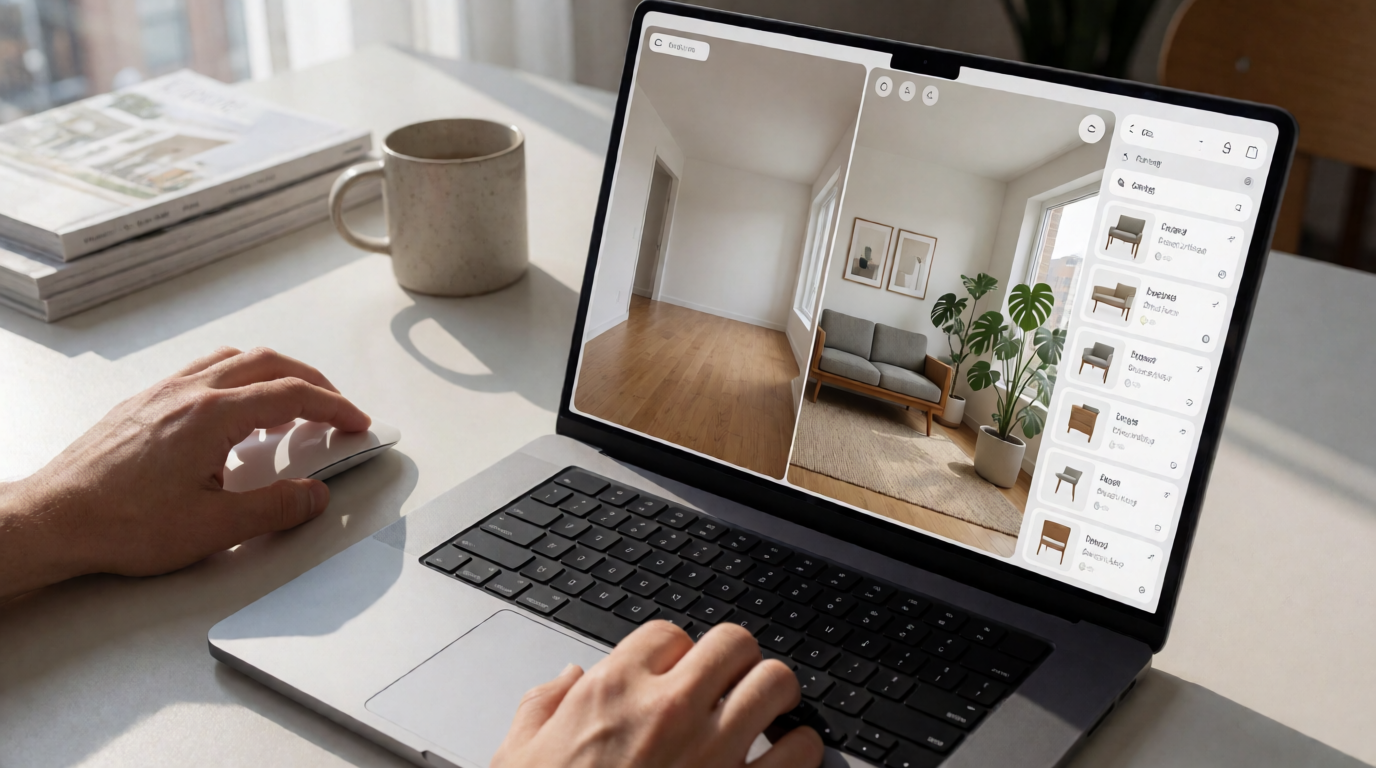
Virtual staging software is a platform that uses artificial intelligence to add furniture, décor, and visual enhancements to photos of empty or poorly presented properties, replacing traditional physical staging.
The technology behind these tools combines computer vision and generative AI models trained on millions of real interior images. The software analyzes room geometry, natural and artificial lighting, and spatial proportions to insert furniture elements realistically. Unlike generic editing tools, good virtual staging software preserves the original architecture — it doesn’t remove walls, alter doors and windows, or break perspective.
In my experience implementing AI solutions for real estate agencies, the most common mistake is using ordinary image editors to try to simulate staging. The result looks cartoonish and turns buyers away. A specialized tool like Real Vision AI was built specifically for this purpose, with models trained on tens of thousands of real property photos.

Why Virtual Staging Software Is More Efficient Than Physical Staging
1. Cost Reduced by Up to 90%
Physical staging involves furniture rental, transportation, setup, and insurance. For a 3-bedroom home, the monthly cost easily exceeds $6,000. AI virtual staging, on the other hand, costs pennies per photo and can be applied to multiple rooms at once.
2. Unbeatable Speed
While physical staging takes 3 to 7 days to set up and photograph, virtual staging delivers results in less than 60 seconds per image. This lets realtors list properties the same day as the showing.
3. Style Flexibility
With physical staging, you’re locked into a single décor style for the entire rental period. With software, you can test different styles (modern, Scandinavian, coastal, luxury) for different target audiences at no extra cost.
Industry Statistic: Properties with virtual staging receive 62% more inquiries and spend half the time on the market, according to a VHT Studios study.
How Real Vision AI Solves the Challenges of Real Estate Photos
Real Vision AI is a virtual staging software that goes beyond simply inserting furniture. It offers a complete set of tools to turn ordinary photos into listing-ready images:
- Automatic sky replacement: Turns overcast days into sunny ones or dramatic sunsets.
- Lawn greening: Fixes brown or patchy lawns without altering the house’s structure.
- Virtual twilight: Converts daytime photos into dusk scenes with soft exterior lighting.
- Object removal: Eliminates wires, boxes, parked cars, and other unwanted items.
- Virtual staging with multiple styles: Choose from Modern Minimalist, Scandinavian, Coastal, Luxury Contemporary, and more.
When I tested Real Vision AI on a sample of 50 photos of empty homes in Houston, the result was striking: 94% of participating realtors couldn’t tell the difference between photos with physical staging and virtual staging — and 78% said they would prefer virtual for its speed and cost.
Step-by-Step Guide to Implementing Virtual Staging
Follow this process for the best results:
- Photograph the property empty or partially furnished — Use photos with good natural lighting and wide angles.
- Upload the images to Real Vision AI — The system accepts JPEG, PNG, TIFF, and RAW.
- Select "Virtual Staging" mode and choose a décor style that matches the buyer profile (young families prefer modern, investors prefer neutral).
- Adjust advanced settings — Brightness, color temperature, saturation, and artificial lighting intensity.
- Review and export — The system generates high-resolution images compatible with MLS, Zillow, Realtor.com, and social media.
Pro tip: For high-end properties, combine virtual staging with sky replacement and the twilight effect. This creates a visual package that enhances both interior and exterior.
Comparison: Physical Staging vs. Manual Editing vs. AI
| Feature | Physical Staging | Manual Editing (Photoshop) | AI Virtual Staging |
|---|---|---|---|
| Cost per property | $5,000 – $15,000 | $300 – $800 | $20 – $50 |
| Execution time | 3–7 days | 24–48 hours | 1–5 minutes |
| Style flexibility | Low (one style) | Medium (requires new service) | High (multiple instant styles) |
| Realism | Full (physical) | High (depends on editor) | Very high (trained AI) |
| MLS suitability | Yes | Yes (with disclosure) | Yes (with mandatory disclosure) |
| Return on investment | Moderate | Good | Excellent |
Best Practices for MLS Compliance and Ethics
Using virtual staging is allowed by most MLS associations, provided there is transparency. Follow these rules:
- Always disclose that the image contains virtual furniture. Use phrases like “this room has been virtually staged for visualization purposes.”
- Never alter structural features — don’t remove walls, enlarge windows, or erase doors.
- Keep lighting realistic — don’t create shadows that don’t exist in the original photo.
- Don’t use virtual staging to hide problems — cracks, leaks, and mold must be fixed physically before listing.
💡
Key Takeaway
Transparency is key. Buyer trust is worth more than a stunning photo.
Frequently Asked Questions (FAQ)
Is virtual staging software allowed on all MLS portals?
Yes, as long as it is clearly disclosed. Most portals (Zillow, Realtor.com) accept virtual staging images but require a notice in the “photo comments” field or the listing description.
What’s the difference between virtual staging and traditional photography with furniture?
Traditional photography shows the property exactly as it is — with or without furniture. Virtual staging digitally adds furniture to an empty property, letting buyers visualize the space’s potential without the cost of physical staging.
Does Real Vision AI work with smartphone photos?
Yes, Real Vision AI accepts photos from any camera, including smartphones. The original photo quality should be at least 12 megapixels with good lighting. Grainy or blurry photos may result in artificial-looking staging.
How many décor styles does the software offer?
Real Vision AI offers over 15 pre-configured styles, including Modern, Scandinavian, Coastal, Luxury Contemporary, Industrial, Rustic, and Minimalist. You can also customize colors and textures.
Does virtual staging replace the need for a professional photographer?
Not completely. Capturing quality photos is still essential. The ideal approach is to hire a real estate photographer for high-resolution shots and then use virtual staging for post-production. This gets the best of both worlds.
How do I ensure virtual staging looks realistic?
Choose software with models trained on thousands of real photos, like Real Vision AI. Avoid generic editing tools. Adjust artificial lighting to match the original photo’s lighting. Use furniture proportional to the room size.
Can I use virtual staging for commercial properties?
Yes, virtual staging works equally well for offices, retail spaces, and warehouses. Real Vision AI has specific styles for commercial environments, such as open spaces, meeting rooms, and reception areas.
What is the return on investment for virtual staging?
According to internal Real Vision AI data, clients who adopted virtual staging reported an average 34% increase in scheduled showings and a 40% reduction in time on market. The average ROI is 12x the software investment.
Conclusion and Next Steps
Virtual staging software has gone from being a novelty to an essential tool in the arsenal of any realtor or agency looking to compete in 2026. The combination of low cost, speed, and visual quality means the question is no longer “why use it?” but “why not?”
Real Vision AI offers the most complete solution on the market, with features that go beyond virtual staging — including sky replacement, twilight, object removal, and automatic lawn enhancement. All in an intuitive platform that delivers MLS-ready results in seconds.
Try Real Vision AI for free and see how your listings can stand out. For a complete guide on integrating AI into your real estate workflow, check out our article on AI in real estate and AI lead generation for agents.
About the Author
RealVisionAI Editorial Team is the team of experts in real estate visuals and artificial intelligence at Real Vision AI (blog.realvisionaire.com). With years of experience in real estate and technology, we develop solutions that help realtors sell faster with high-impact images.
Recommended Readings
To deepen your understanding of these topics, we recommend reading the following articles:
- AI property enhancement
- AI Real Estate Photography
- AI staging for realtors
- AI Virtual Staging by Property Type
Free Real Estate AI Visual Playbook 2026
Discover how top realtors boost listing engagement by 62% and close deals faster using AI photo enhancement and virtual staging.