
How Much Does AI Real Estate Photo Enhancement Cost?
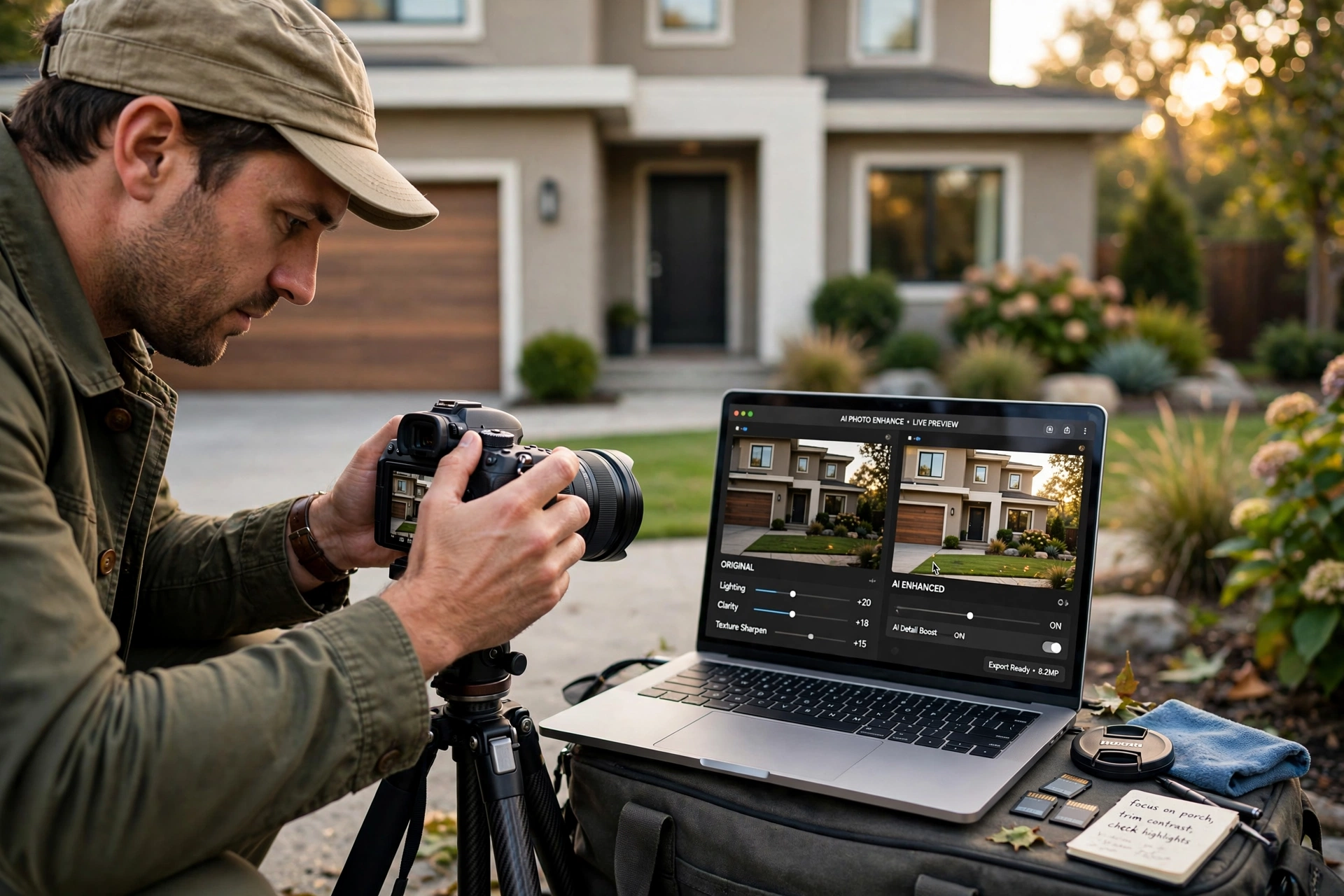
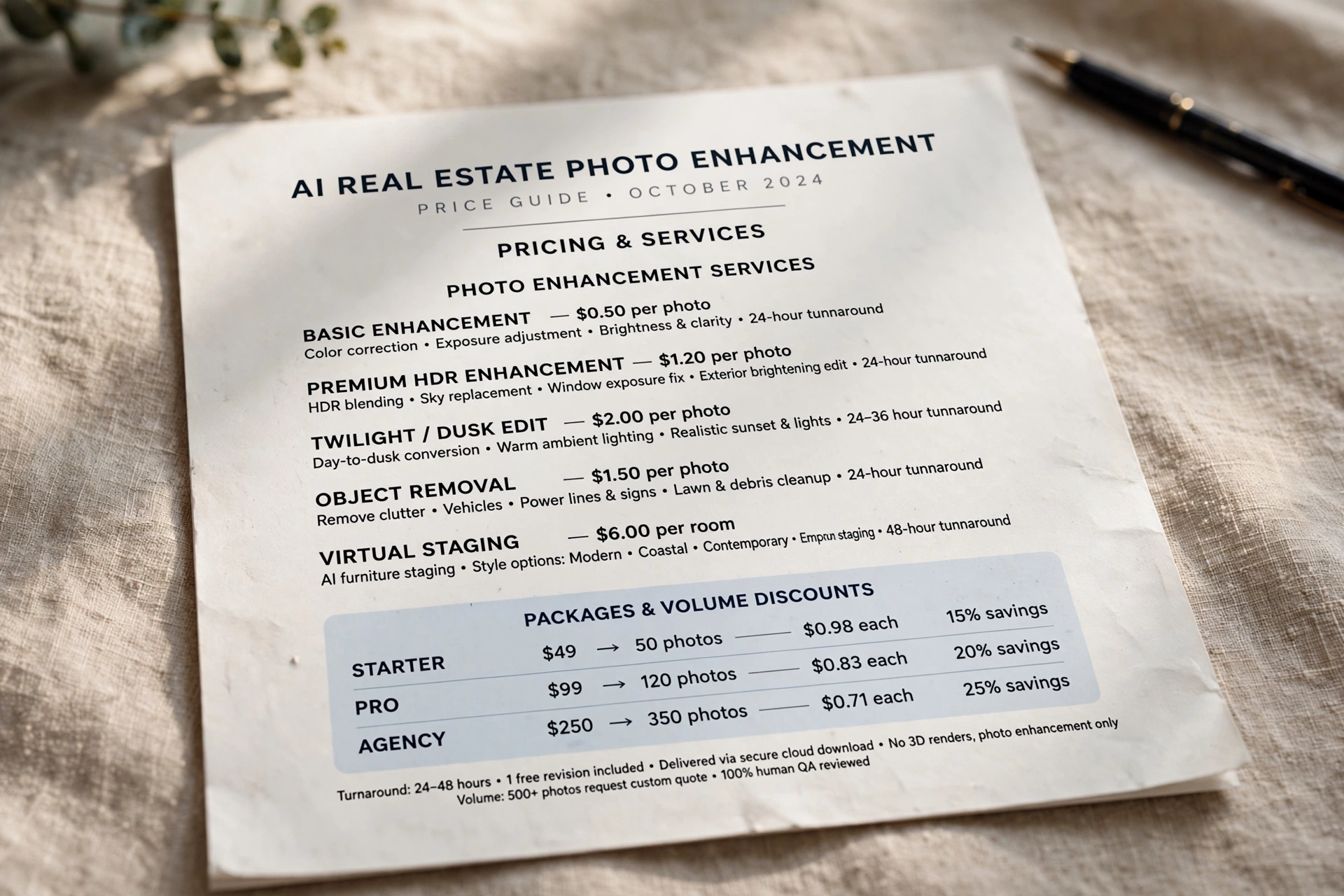
The cost of professional ai real estate photo enhancement typically ranges from $0.50 to $5.00 per image, depending on the complexity of the edit and the volume of the order. While basic brightness and contrast adjustments are on the lower end, advanced tasks like day-to-dusk conversion or object removal occupy the higher price bracket. For agencies processing hundreds of listings, subscription-based models often bring the cost per image down to under $1.00.
In my experience working with high-volume real estate photographers, the biggest mistake I see is choosing the cheapest possible option without considering the "re-edit rate." When you pay pennies for low-quality AI, you often spend hours of your own time requesting corrections, which effectively raises your cost per image far beyond what a professional service would charge. This is why understanding the tiered pricing of the 2026 market is essential for maintaining a healthy profit margin.
For a detailed breakdown of current market rates, see our AI Real Estate Photography Pricing Guide for 2026.
What Exactly Drives the Cost of AI Photo Enhancement?
To understand the pricing, we must first define what is actually happening under the hood of these tools. Most users assume AI is a "magic button," but the reality is a complex pipeline of computer vision and generative filling.
📚
Definition
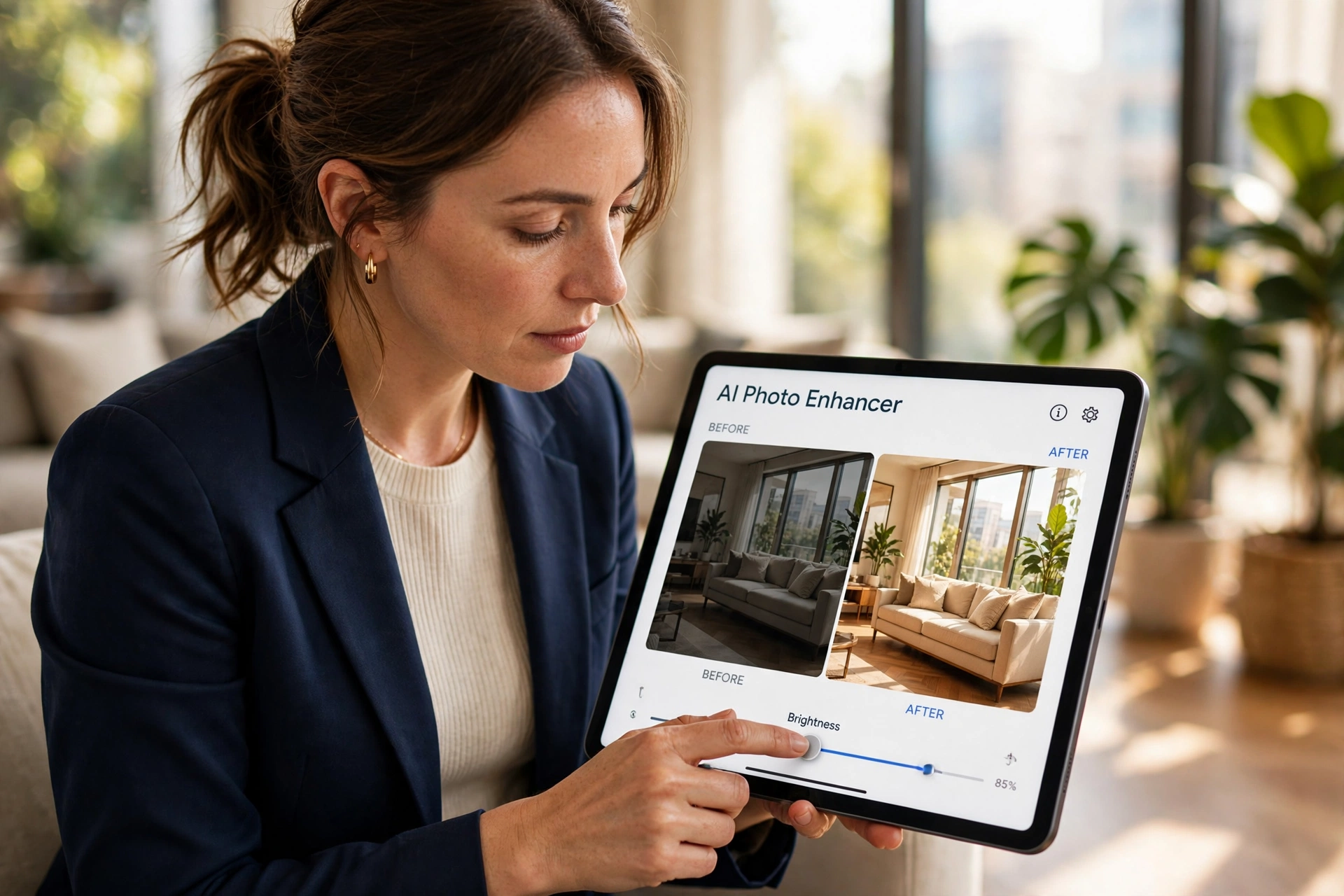
AI Real Estate Photo Enhancement is the process of using machine learning algorithms—specifically Convolutional Neural Networks (CNNs) and Generative Adversarial Networks (GANs)—to analyze a property image and automatically correct lighting, perspective, and compositional flaws to make a listing more appealing.
The cost is primarily driven by the "compute cost" and the level of human oversight. Simple enhancements, such as HDR blending or color correction, require minimal processing power. However, a day-to-dusk conversion requires the AI to synthesize a completely new sky and adjust the interior light spill, which is more computationally expensive.
According to research by Gartner, the adoption of generative AI in visual industries has shifted the value proposition from "labor hours" to "outcome quality." This means you are no longer paying for the time a human spends in Photoshop, but for the intellectual property of the AI model and the speed of delivery. When we analyze the cost structure, we see three main tiers:
- Automated Basics: Simple AI filters that handle exposure and saturation. These are often bundled into cheap monthly subscriptions.
- Guided AI Enhancement: Tools where a professional directs the AI to remove specific objects or replace a gray sky with a blue one. This requires more precise "masking."
- Full-Scale Virtual Transformation: This includes virtual staging, where the AI generates photorealistic furniture. Because this requires high-fidelity rendering to avoid looking "fake," the price point is significantly higher.
If you are just starting out, you might want to explore a Virtual Staging Software: A Complete Beginners Guide to see how these different cost tiers impact your bottom line.
Why Does Investment in AI Enhancement Impact Your Bottom Line?
The financial logic behind paying for ai real estate photo enhancement isn't about "pretty pictures"; it is about the velocity of the sale and the increase in lead conversion rates. In a digital-first market, the photo is the "first showing." If the image is dark, distorted, or cluttered, the buyer scrolls past it in milliseconds.
Data from the National Association of Realtors indicates that listings with high-quality, professionally edited photos receive significantly more inquiries than those with amateur shots. When photos are optimized, the "click-through rate" (CTR) on portals like Zillow or Realtor.com increases, which directly correlates to a shorter time-on-market.
The business impact is measurable. A property that sells 10 days faster reduces the holding cost for the seller and allows the agent to move to the next listing sooner. When you calculate the cost of a $2.00 per image enhancement against a $500,000 commission, the ROI is astronomical.
Moreover, McKinsey's research on AI in the enterprise sector suggests that companies integrating AI into their visual workflows see a dramatic reduction in operational overhead. For a real estate agency, this means replacing a slow, expensive manual editing workflow with an automated system that delivers results in seconds. This shift allows agents to focus on negotiation and closing rather than managing a queue of photo editors.
If you are wondering when exactly to make this investment, refer to our When to Use Property Photo Editing: A Professional Guide to identify the most critical moments in your listing lifecycle.
How to Implement AI Enhancement Without Overpaying
The key to maximizing your budget is to match the tool to the specific need of the property. Not every home needs a full virtual renovation; some only need a "digital cleanup."
Here is the professional workflow I recommend for maintaining high quality while keeping costs low:
- The Triage Phase: Sort your photos into "Core" (Exterior, Living Room, Kitchen) and "Supporting" (Bathrooms, Hallways).
- High-Impact Edits: Apply premium ai real estate photo enhancement—such as sky replacement and day-to-dusk—only to the Core photos. This is where the buyer's emotional connection is built.
- Batch Processing: Use automated AI tools for the Supporting photos. Simple brightness and vertical alignment are usually sufficient for a guest bathroom.
- Virtual Staging for Vacancy: Only use virtual staging for empty rooms. Filling a room that already has furniture via AI is often unnecessary and expensive.
For those seeking a streamlined approach, RealVisionAI Blog - AI Real Estate Photography & Virtual Staging provides an integrated environment where these processes happen in 12 seconds. Instead of juggling three different vendors for sky replacement, decluttering, and staging, you can centralize the workflow. This reduces the "management tax"—the time you spend uploading and downloading files across different platforms.
💡
Key Takeaway
To optimize your ROI, apply "surgical" high-end enhancements to your hero shots and use automated batch processing for secondary images.
For agents who want a step-by-step walkthrough, our Real Estate Photo Enhancement Guide for Agents provides a tactical blueprint for this process.
Comparing Your Enhancement Options
When deciding where to spend your budget, you will likely encounter three distinct paths. The "best" choice depends entirely on your volume and your brand positioning.
| Option | Pros | Cons | Best For |
|---|---|---|---|
| Manual Professional Editor | Absolute precision, human artistic eye. | Very slow, highest cost per image, scaling is difficult. | Ultra-luxury estates ($5M+). |
| Generic/Cheap AI Apps | Extremely low cost, instant results. | High "hallucination" risk, often looks "plastic," no consistency. | Low-end rentals, quick social media posts. |
| Professional AI Studio (RealVisionAI) | High fidelity, 12-second delivery, consistent brand look. | Requires a subscription or credit system. | Professional Realtors, Photography Agencies. |
The danger of the "Generic AI" route is the risk of creating misleading images. When an AI "hallucinates" a window where there isn't one or removes a structural pillar to make a room look bigger, it can lead to legal disputes or a loss of trust during the physical showing. A professional AI studio ensures that while the image is enhanced, the structural integrity of the property remains accurate.
If you are weighing these options against your monthly budget, check out the Affordable Property Photo Editing Costs: RealVision AI Guide.
Common Misconceptions About AI Pricing
Most guides get this wrong: they tell you that AI is "free" or "cheap" because the technology is automated. This is a fundamental misunderstanding of how professional AI works.
Myth 1: "Free AI tools are just as good as paid ones."
The reality is that free tools often lack the "training data" specific to real estate. A general-purpose AI might make a kitchen look like a painting, whereas a specialized tool understands the physics of light reflecting off granite countertops. You pay for the specialization, not just the automation.
Myth 2: "AI enhancement is a one-time cost."
Many believe they can just buy one software and be done. However, the models used for image processing are updated constantly. In 2026, the difference between a model from 2024 and one from today is the difference between a "filtered" photo and a "photorealistic" one. Subscription models ensure you are using the most current version of the AI.
Myth 3: "You don't need a human to check AI photos."
This is a dangerous assumption. While AI is incredibly fast, it can occasionally merge a chair into a wall or create a "ghost" limb on a person in the background. A professional workflow always includes a quick human quality check. The value of a service like RealVisionAI Blog - AI Real Estate Photography & Virtual Staging is that it minimizes these errors, but a final glance is always a best practice.
For more on how to avoid these pitfalls, read our Dicas AI Real Estate Photography Guide: Enhance Your Listing.
Frequently Asked Questions
How much does a single-image ai real estate photo enhancement cost?
For a single image, you can expect to pay between $1.00 and $5.00. The price depends on the service level. A basic "light and airy" edit might cost $1.00, while a complex "day-to-dusk" conversion or a detailed object removal (like removing a car from a driveway) will likely cost $3.00 to $5.00. Many professionals prefer credit-based bundles to lower the per-image cost.
Is virtual staging more expensive than basic photo enhancement?
Yes, virtual staging is significantly more expensive because it involves adding complex 3D assets into a 2D space. While basic enhancement focuses on correcting what is already there, virtual staging creates new content. Costs for virtual staging usually range from $15 to $30 per image, though AI-driven solutions have brought this price down considerably compared to traditional 3D rendering.
How does AI enhancement speed affect the overall cost of a listing?
Speed is a hidden cost-saver. Traditional editing can take 24 to 48 hours. If a listing is delayed by two days, the agent loses momentum. AI tools that deliver results in 12 seconds allow for "real-time" listing updates. This efficiency reduces the labor cost of managing the listing and allows the property to hit the market during peak traffic windows, potentially increasing the final sale price.
Can AI photo enhancement actually increase the selling price of a home?
While the AI doesn't change the physical house, it changes the "perceived value." High-quality visuals trigger an emotional response in buyers, making them more likely to submit higher offers. According to industry data, homes with professional visuals often sell for a premium because they are positioned as "luxury" or "move-in ready," even if the physical condition is identical to a poorly photographed home.
What is the difference between AI enhancement and traditional Photoshop editing?
Traditional editing is manual and linear; a human adjusts sliders and masks areas one by one. AI enhancement uses computer vision to "understand" the scene. It knows that a "sky" should be blue and a "floor" should be level. This allows the AI to perform complex tasks, like removing a cluttered coffee table, in seconds—a task that would take a human editor 30 minutes of meticulous masking.
Final Thoughts on AI Real Estate Photo Enhancement
Investing in ai real estate photo enhancement is no longer a luxury for high-end listings; it is a baseline requirement for competitiveness in 2026. Whether you are paying per image or using a subscription, the goal is to maximize the "visual hook" that stops a buyer from scrolling.
By balancing high-impact edits for hero shots and automated batch processing for supporting images, you can keep costs low while maintaining a premium brand image. The shift toward instant, high-fidelity AI imaging means that speed is now as important as quality.
If you are ready to stop waiting days for your edits and want market-ready visuals in 12 seconds, explore the capabilities of RealVisionAI Blog - AI Real Estate Photography & Virtual Staging. For further reading on optimizing your visual strategy, check out our Top Benefits of Professional Property Photo Editing in 2026.
Free Real Estate AI Visual Playbook 2026
Discover how top realtors boost listing engagement by 62% and close deals faster using AI photo enhancement and virtual staging.