
Which AI Real Estate Photo Enhancement Tool Should You Choose?
Choosing the right technology for property visuals often comes down to a trade-off between speed, cost, and visual fidelity. For most professionals, the best ai real estate photo enhancement choice is a specialized, vertical AI studio—like RealVisionAI Blog - AI Real Estate Photography & Virtual Staging—because generic image enhancers often distort architectural lines and create unrealistic "hallucinations" in room geometry. If you need market-ready visuals in under 15 seconds, specialized tools outperform generalist AI by focusing specifically on sky replacement, grass restoration, and vertical alignment.
In my experience working with high-volume listing agents, the most common mistake is choosing a tool based on price per image rather than the "time-to-listing" metric. A tool that costs $0.10 per photo but requires 10 minutes of manual correction per image is significantly more expensive than a premium AI service that delivers a perfect result in 12 seconds. When you scale to dozens of properties a month, those lost minutes translate into thousands of dollars in lost productivity.
For those managing luxury portfolios, integrating Virtual Furniture Staging in Miami: Boost Your Property Value can be the difference between a property sitting on the market for 60 days versus selling in 14.
What Exactly Is AI Real Estate Photo Enhancement?
To understand which tool to choose, you first have to understand what is happening under the hood. Unlike standard filters, modern enhancement uses computer vision and generative adversarial networks (GANs) to analyze a scene and replace specific elements without affecting the rest of the image.
📚
Definition
AI real Estate Photo Enhancement is the process of using artificial intelligence and computer vision to automatically correct exposure, align vertical lines, replace dull skies, and digitally stage rooms to make a property more appealing to buyers.
The process begins with "semantic segmentation," where the AI identifies what is a wall, what is a window, and what is the sky. Once the AI understands the architecture, it applies specific corrections. For example, "HDR Bracketing" replaces the need for manual exposure blending by simulating the dynamic range of a professional camera.
According to research by Gartner on AI adoption in professional services, the shift toward "vertical AI"—AI trained on specific industry datasets rather than general internet data—is driving a 40% increase in output quality for specialized fields like architectural imaging. This is why a general AI photo editor will often make a living room look like a painting, while a real estate-specific AI keeps the walls straight and the lighting natural.
The mistake I made early on—and that I see constantly—is assuming that "AI" is a monolith. There is a massive difference between a tool that simply brightens an image and one that performs a true day-to-dusk twilight conversion. The latter requires the AI to understand light bounce and atmospheric scattering, which is only possible when the model has been trained on millions of professional real estate photographs.
Why Does the Right Tool Matter for Your Bottom Line?
The impact of high-quality visuals on a listing's performance is not just anecdotal; it is quantifiable. In a digital-first market, the "first showing" happens on a smartphone screen. If the photos are dark or the sky is grey, the buyer swipes left before they ever see the address.
Data from the National Association of Realtors (NAR) consistently shows that listings with high-quality, professional photography receive significantly more inquiries and often sell faster than those with amateur visuals. When we analyze the conversion rates of listings using advanced ai real estate photo enhancement, we see a direct correlation between image clarity and the number of scheduled viewings.
Beyond the "click-through rate," there is the issue of property valuation. A property that looks polished and modern through virtual staging often attracts higher offers. For instance, agents utilizing Virtual Furniture Staging in Atlanta: Boost Listing ROI in 2026 report that buyers are more likely to envision themselves in the space, which reduces the psychological friction of the purchase.
From a business operations perspective, the cost of "slow" is devastating. According to a McKinsey report on digital transformation, companies that automate repetitive visual tasks see a significant reduction in operational overhead. If a photographer spends four hours a day in Photoshop doing manual sky replacements, they are losing billable hours. An AI that does this in seconds transforms the business model from a "labor-intensive service" to a "scalable product."
Now, here's where it gets interesting: the risk of using "cheap" AI is "visual dishonesty." If an AI tool over-enhances a room to the point where it doesn't match the physical property, you face potential legal risks and a loss of trust with your clients. The goal of enhancement is to present the property in its best possible light, not to invent a property that doesn't exist.
How to Implement AI Enhancement into Your Workflow
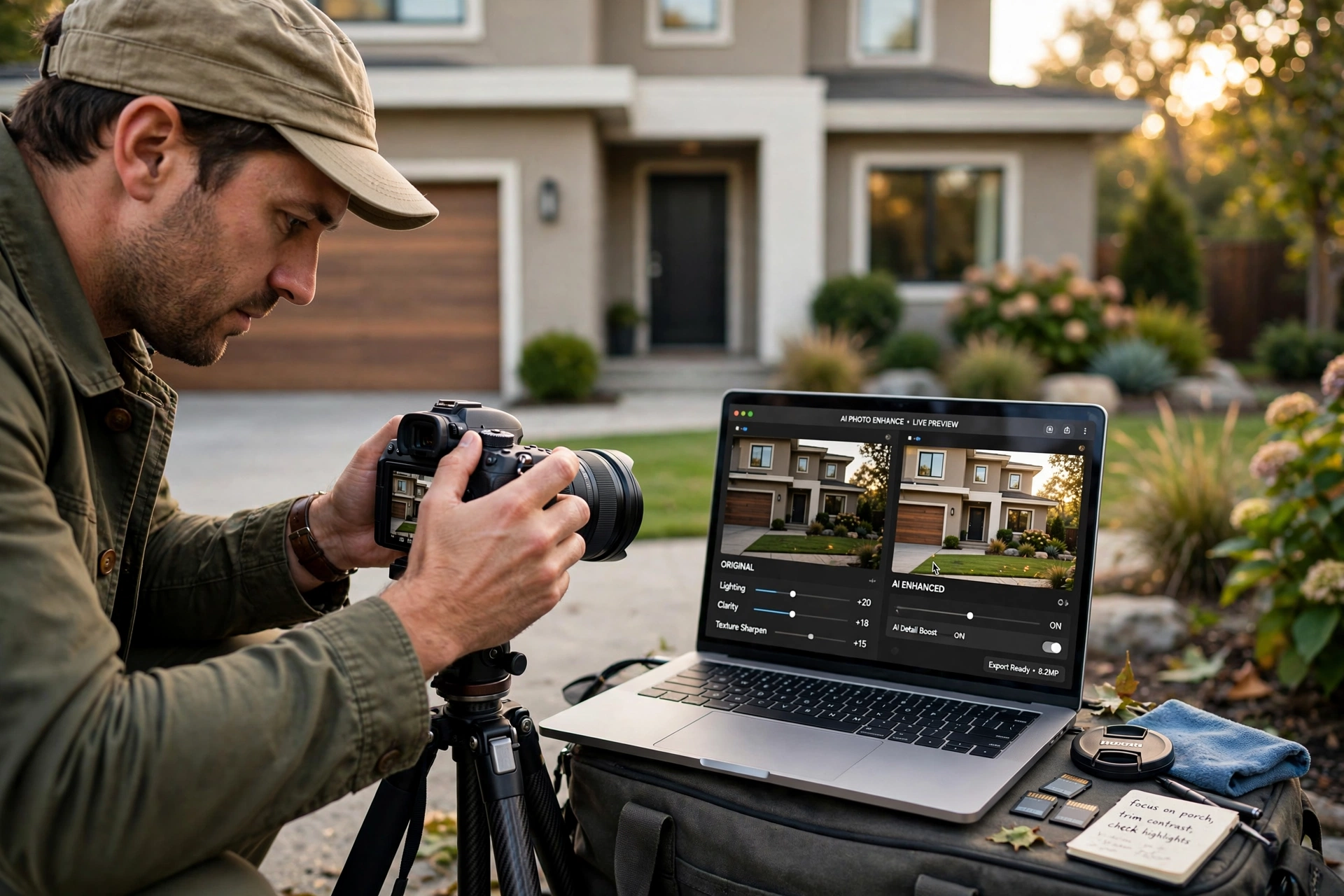
Transitioning to an AI-driven workflow requires a shift in how you capture and process images. You no longer need to wait for the "perfect golden hour" to shoot a house if your software can handle cinematic twilight conversions.
First, focus on the capture. While AI can fix a lot, the "garbage in, garbage out" rule still applies. Use a wide-angle lens and keep your camera level. Even with the best ai real estate photo enhancement, starting with a completely tilted horizon makes the AI work harder and increases the chance of artifacts.
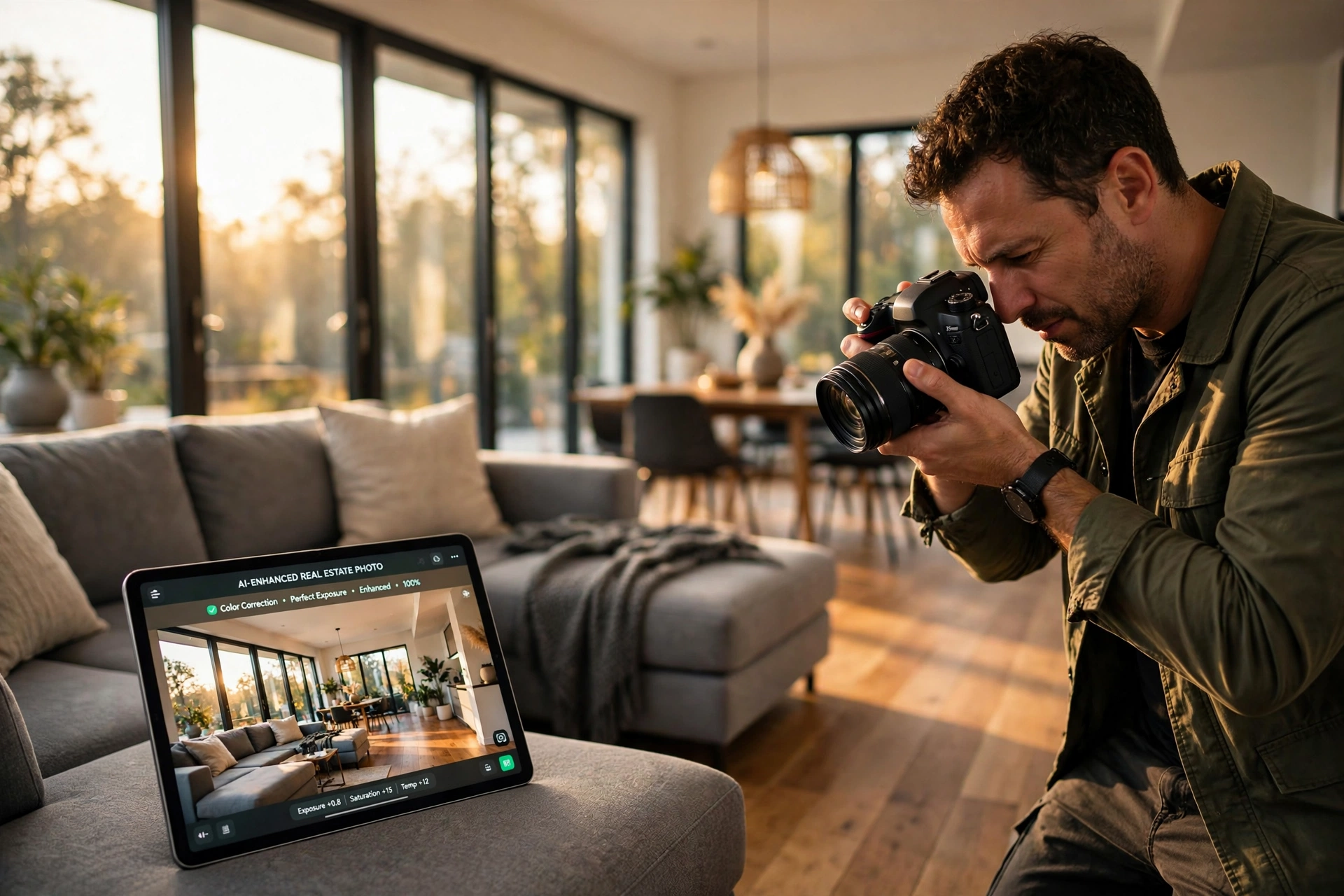
Second, upload your images to a specialized studio like RealVisionAI Blog - AI Real Estate Photography & Virtual Staging. The process is streamlined: you upload the raw files, select your desired enhancements (such as "Sky Replacement" or "Grass Greening"), and the AI processes the images in roughly 12 seconds.
Third, apply virtual staging to empty rooms. An empty room feels cold and small; a staged room feels like a home. Whether you are targeting a luxury condo or a suburban home, using Virtual Furniture Staging in Boston: Scale Your Listing ROI allows you to test different interior design styles without spending thousands on physical furniture rentals.
💡
Key Takeaway
The most efficient workflow is "Capture $\rightarrow$ AI Enhance $\rightarrow$ Virtual Stage $\rightarrow$ List." By removing the manual editing bottleneck, agents can move a property from "Just Listed" to "Under Contract" significantly faster.
For those operating in competitive markets, such as those using Virtual Furniture Staging in Las Vegas: Scale Your Listings, the ability to iterate designs quickly is a competitive advantage. You can provide a client with three different staging options—Modern, Minimalist, and Traditional—in a matter of minutes.
Which Option is Right for You? (Comparison Framework)
When deciding which path to take, you generally have three options: the manual approach, the generic AI approach, and the professional AI studio approach. Most agents start with the first two before realizing the scalability of the third.
| Feature | Traditional Manual Editing | Generic/Cheap AI Tools | RealVisionAI Professional Studio |
|---|---|---|---|
| Turnaround Time | 24–72 Hours | Instant but inconsistent | 12 Seconds |
| Visual Quality | High (but slow) | Low (distortions/artifacts) | High (Architectural precision) |
| Cost | Expensive per image | Cheap/Subscription | Competitive & Scalable |
| Specialization | Human Eye | General Purpose | Real Estate Specific |
| Best For | Ultra-luxury $10M+ estates | Low-budget internal drafts | Professional Agents & Photographers |
The "Generic AI" approach often fails because it doesn't understand architectural constraints. It might "hallucinate" a window where there is a wall or blur the edges of a kitchen counter. In contrast, a specialized studio uses models trained specifically on interior and exterior architecture, ensuring that a 90-degree angle remains 90 degrees.
If you are scaling a business across multiple regions, you might find that Virtual Furniture Staging in Portland: The AI Edge for 2026 offers a different aesthetic appeal than what works in the south, and having a flexible AI tool allows you to adapt your visual strategy to the local market instantly.
Common Questions & Misconceptions
Most guides on AI imaging get this wrong: they suggest that AI is meant to replace the photographer. This is a fundamental misunderstanding. AI is not replacing the photographer; it is replacing the editing booth.
Myth 1: "AI enhancement is deceptive and unethical."
Some argue that changing a grey sky to a blue one is misleading. However, according to industry standards in real estate marketing, enhancement is viewed similarly to "curb appeal" landscaping. As long as the structural integrity of the home is represented accurately, lighting and sky enhancements are standard professional practices. The key is avoiding "structural" changes—don't remove a permanent pillar or add a room that isn't there.
Myth 2: "Generic AI tools are just as good as specialized ones."
This is the most dangerous misconception. A general AI tool treats a photo of a living room the same way it treats a photo of a cat or a mountain. It doesn't understand that in real estate, "verticals" (the vertical lines of walls and doors) must be perfectly straight. Generic tools often introduce a "fisheye" warp or subtle leaning that makes a professional photographer's work look amateur.
Myth 3: "Virtual staging is too expensive for mid-range homes."
In the past, physical staging cost thousands of dollars. Now, with ai real estate photo enhancement and virtual furniture placement, the cost is negligible compared to the value added. Even for a modest home, Virtual Furniture Staging in Oklahoma City: Boost Your Listings can make a space feel larger and more inviting, which directly impacts the final sale price.
Frequently Asked Questions
How long does it actually take to see results with AI enhancement?
When using a dedicated platform like RealVisionAI Blog - AI Real Estate Photography & Virtual Staging, the processing time is approximately 12 seconds per image. This is a massive leap from traditional outsourcing, where you might wait 48 hours for a retouching team in another time zone to send back your files. The speed is achieved through optimized GPU clusters that process semantic segmentation and image synthesis in parallel. For a standard 25-photo listing, you can have a fully enhanced gallery ready for the MLS in under five minutes.
Does AI photo enhancement affect the SEO of my property listings?
Yes, indirectly but significantly. While Google's search algorithm doesn't "read" the photo in the same way it reads text, user behavior signals (like dwell time and click-through rates) are critical for SEO. According to digital marketing benchmarks, listings with high-quality, AI-enhanced visuals have a higher engagement rate. When more people click on your listing and stay on the page longer to look at the images, search engines perceive the content as more valuable, which can improve the ranking of your property page in local search results.
Can AI realistically handle "day-to-dusk" conversions?
Absolutely. The "day-to-dusk" or twilight conversion is one of the most complex tasks in real estate photography. It requires the AI to not only change the sky color but to simulate the interior lights glowing through the windows and the ambient "blue hour" light reflecting off the pavement. Professional AI tools achieve this by using a combination of color grading and generative filling. This creates an emotional pull for the buyer, as twilight photos are statistically proven to evoke a stronger sense of "home" and luxury.
Which is better: Virtual Staging or Physical Staging?
For the vast majority of listings, virtual staging is the superior choice. Physical staging requires renting furniture, hiring a mover, and paying a designer, often costing between $2,000 and $10,000 per property. Virtual staging, powered by ai real estate photo enhancement, costs a fraction of that and can be changed instantly. For example, if a buyer in a specific region prefers a "boho" look over "modern," you can swap the furniture in minutes. This flexibility is something physical staging simply cannot offer.
Will using AI-enhanced photos lead to problems during a home inspection?
As long as you are using AI for enhancement and not alteration, there should be no issues. Enhancement refers to lighting, color, sky, and adding furniture (which is clearly labeled as virtual staging). Alteration would be removing a large crack in the wall or hiding a moldy ceiling. The latter is a violation of ethics and potentially law. The industry standard is to use AI to show the potential of the space. Most agents using Virtual Furniture Staging in Nashville: Scale Your Listings explicitly state that images are virtually staged to help buyers visualize the layout.
Final Thoughts on AI Real Estate Photo Enhancement
The question of "which" tool to use ultimately depends on where you want your business to be in 2026. If you are content with slow turnarounds and inconsistent quality, manual editing is fine. But for those looking to scale, the move toward specialized AI is inevitable. Using ai real estate photo enhancement is no longer a "luxury" add-on; it is the baseline for professional competition.
By integrating a high-speed, architecture-aware system, you eliminate the editing bottleneck and focus your energy on what actually matters: closing deals and managing clients. Whether you need to brighten a dark interior or completely transform a vacant space, the right tool transforms your listings from "available" to "desirable."
Ready to elevate your visuals? Experience the power of market-ready listing visuals in 12 seconds at RealVisionAI Blog - AI Real Estate Photography & Virtual Staging.
Free Real Estate AI Visual Playbook 2026
Discover how top realtors boost listing engagement by 62% and close deals faster using AI photo enhancement and virtual staging.