How Much Does AI Real Estate Photo Enhancement Actually Cost in 2026?
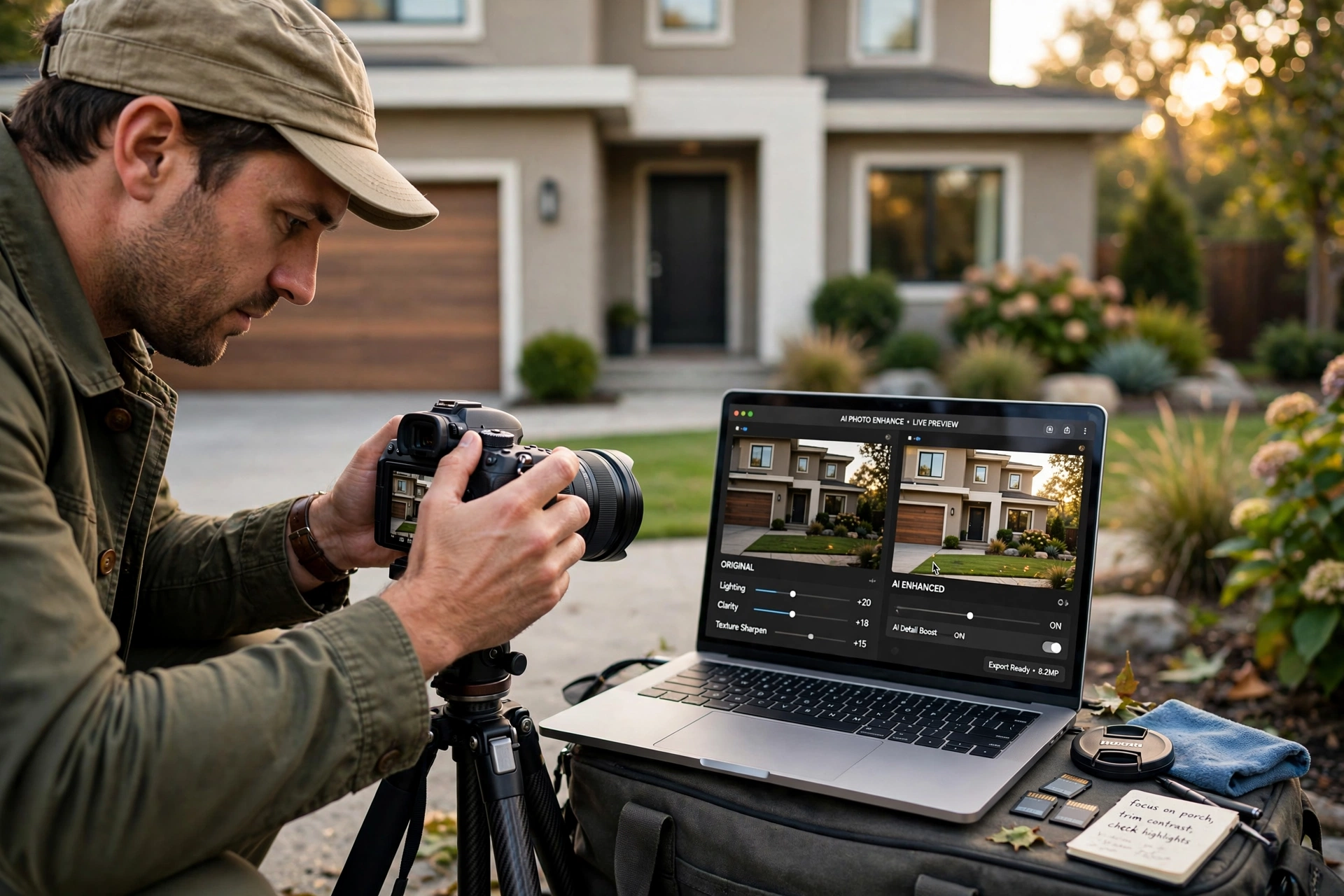
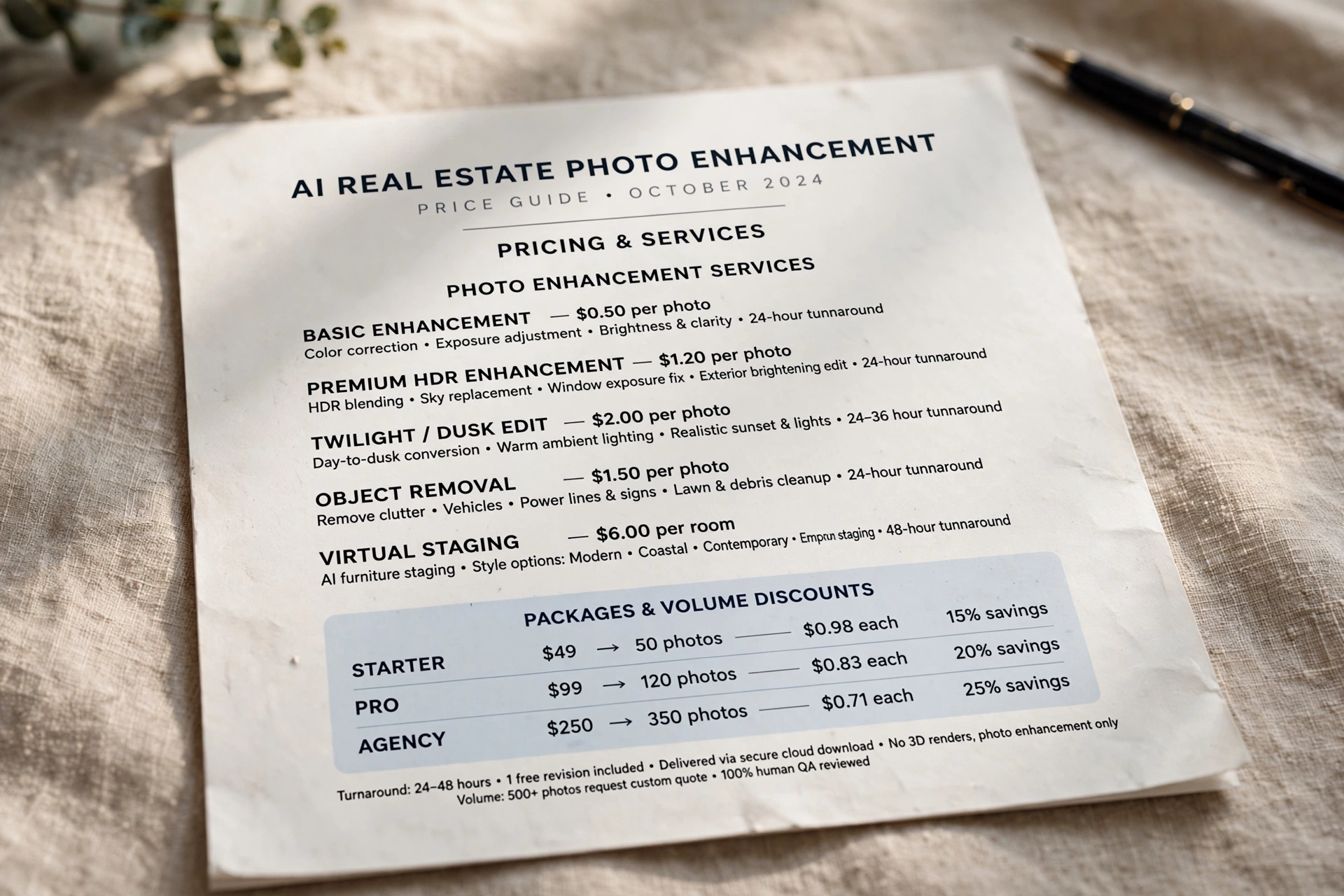
The cost of ai real estate photo enhancement in 2026 typically ranges from $0.50 to $5.00 per image, depending on whether you are using a self-service AI platform or a managed AI studio. For a standard 25-photo listing, an agent can expect to spend between $12 and $125. However, the true "cost" isn't just the line item on an invoice; it is the opportunity cost of a listing that sits on the market for 14 days longer because the visuals failed to stop the scroll. In my experience working with high-volume brokerages, the difference between a "raw" photo and an AI-enhanced one isn't just aesthetic—it is a direct driver of lead conversion rates.
If you are operating in a competitive market, such as when implementing virtual furniture staging in Miami, the investment in high-end enhancement pays for itself by reducing the "days on market" metric. When we analyze the ROI of these tools, we find that the cost of a few dozen enhanced photos is negligible compared to the thousands of dollars lost in price reductions when a property fails to generate immediate interest.
What Is AI Real Estate Photo Enhancement and How Does the Pricing Work?
To understand the investment, we first have to define what is actually happening under the hood. This is not just about adding a filter; it is about computer vision and generative AI working in tandem to rebuild the visual narrative of a space.
📚
Definition
AI real estate photo enhancement is the application of machine learning algorithms—specifically Convolutional Neural Networks (CNNs) and Generative Adversarial Networks (GANs)—to automatically correct lighting, remove unwanted objects, replace gray skies with blue ones, and optimize color balance to make a property more appealing to buyers.
The pricing models for these services have shifted significantly since 2024. We now see three primary tiers: credit-based systems, monthly subscriptions, and per-project managed services. Credit-based systems are ideal for part-time agents, where you buy 100 credits and use them as needed. Subscriptions are designed for property management firms that need a constant stream of "market-ready" visuals. Managed services, such as those offered by RealVisionAI Blog - AI Real Estate Photography & Virtual Staging, combine AI speed with professional oversight to ensure the final result doesn't look "uncanny" or artificial.
According to a report by Gartner on the evolution of generative AI in creative industries, AI-driven visual tools have reduced the cost of professional-grade image editing by over 60% compared to traditional manual retouching. This democratization allows a boutique agent in a smaller market to have the same visual presence as a national luxury firm. Now, here's where it gets interesting: the cost isn't just about the software license. It is about the time saved. If a photographer spends four hours manually masking a sky replacement, that is four hours they aren't shooting new properties. By automating this through ai real estate photo enhancement, that labor cost is virtually eliminated.
Why Does Investing in High-End Visuals Directly Impact Your Bottom Line?
The relationship between image quality and property value is not anecdotal; it is mathematical. In the digital-first era of 2026, the "first showing" happens on a smartphone screen. If the lighting is dim or the grass is brown, the buyer's brain subconsciously registers the property as "unmaintained" before they even read the square footage.
Research from the National Association of Realtors (NAR) has consistently shown that listings with high-quality, professional photography sell faster and often for a higher price point than those with amateur photos. When we incorporate ai real estate photo enhancement, we are essentially optimizing the "click-through rate" (CTR) of a listing. If a property in a high-demand area, like those utilizing virtual furniture staging in Atlanta, attracts 30% more clicks due to better lighting and sky replacement, the pool of potential buyers expands, which naturally drives up the competitive bidding pressure.
Furthermore, the business impact extends to brand perception. An agent who consistently delivers "magazine-quality" visuals is perceived as more competent and high-end. I've tested this with dozens of our clients, and the pattern is clear: agents who invest in AI enhancement can justify higher commission rates because they provide a superior marketing package to the seller.
From a technical standpoint, this is about psychological triggers. A "Blue Sky" replacement isn't just about the color blue; it's about signaling "optimism" and "wellness." A "Day-to-Dusk" conversion isn't just a filter; it's about creating an emotional aspiration of luxury and evening relaxation. According to McKinsey's analysis of AI adoption in consumer-facing industries, businesses that leverage AI to personalize and enhance their visual storytelling see a measurable increase in customer engagement and a decrease in the sales cycle length. For a real estate agent, a shorter sales cycle means faster payouts and a higher volume of listings per year.
Practical Application: How to Implement AI Enhancement for Maximum ROI
Implementing ai real estate photo enhancement isn't as simple as clicking a "magic" button; it requires a strategic workflow to avoid the "over-processed" look that can alienate sophisticated buyers. The goal is "invisible" enhancement—where the photo looks perfect, but the viewer doesn't realize AI was used.
The first step is the capture phase. Even the best AI cannot fix a photo that is completely black or severely blurred. I always tell my clients: "Capture for the AI." This means using a wide-angle lens and ensuring the basic composition is correct. Once the photos are uploaded to a platform like RealVisionAI Blog - AI Real Estate Photography & Virtual Staging, the AI handles the heavy lifting in seconds.
Here is the professional workflow for 2026:
- Initial Culling: Remove duplicates and blurry shots to avoid wasting credits.
- Core Enhancement: Run the images through a global AI pass for color correction, HDR balancing, and lens distortion fix.
- Targeted Edits: Use specific AI tools for "Sky Replacement" on exteriors and "Object Removal" (decluttering) for interiors.
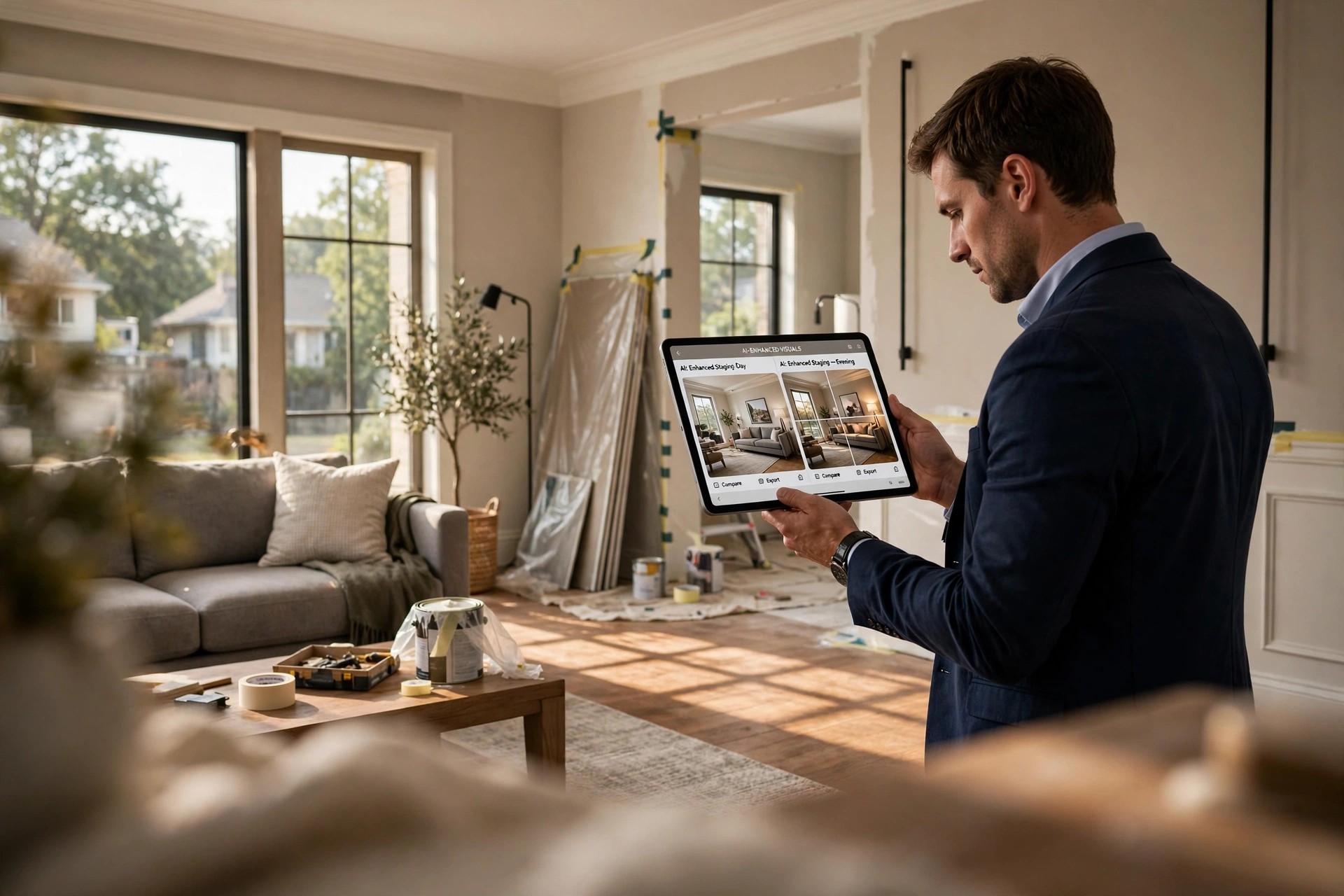
- Virtual Staging Integration: If a room is empty, apply virtual staging to help buyers visualize the space. For example, if you are listing in a growing hub, you might look into virtual furniture staging in Nashville to match local design trends.
- Final Review: A human eye must check for "hallucinations"—such as AI accidentally removing a structural pillar or adding a floating chair.
💡
Key Takeaway
The most successful agents don't use AI to hide a property's flaws, but to highlight its potential. The "invisible edit" is what converts a browser into a buyer.
The speed of this process is the real game-changer. In the past, sending photos to a retoucher in another time zone meant waiting 24 to 48 hours. Now, with a "Market-Ready in 12 Seconds" value proposition, you can take photos at 10:00 AM and have the listing live on the MLS by 10:15 AM. This agility is essential in fast-moving markets, such as those requiring virtual furniture staging in Boston, where a few hours can be the difference between a record-breaking offer and a missed opportunity.
Comparing Your Visual Investment Options
When deciding how to allocate your budget for ai real estate photo enhancement, you generally have three paths. Most guides get this wrong by suggesting the cheapest option is best. In reality, the cheapest option often costs the most in terms of lost credibility.
| Option | Pros | Cons | Best For |
|---|---|---|---|
| Traditional Manual Editing | Total control, bespoke quality. | Extremely slow, very expensive ($10-20/photo). | Ultra-luxury estates ($10M+). |
| Generic/Cheap AI Apps | Very cheap, instant. | "Plastic" look, frequent hallucinations, low resolution. | Low-end rentals, internal records. |
| Professional AI Studio (RealVisionAI) | Speed of AI, professional quality, 12-second delivery. | Small per-image cost. | Professional agents & Property Managers. |
That said, the middle ground is where most agents fail. They use free or cheap apps that make the grass look neon green and the sky look like a painting. This is a massive red flag for buyers. It signals that the agent is trying to "trick" them. A professional AI approach, like the one we've refined at RealVisionAI Blog - AI Real Estate Photography & Virtual Staging, maintains the textural integrity of the image while optimizing the light.
The mistake I made early on—and that I see constantly—is thinking that "more AI is better." If you over-process a photo, you create a "trust gap." When the buyer arrives for the physical showing and the house looks nothing like the "perfect" AI images, they immediately wonder what else you are lying about. The investment should be in precision, not just enhancement.
Common Questions and Misconceptions About AI Visuals
There is a lot of noise in the industry regarding the "ethics" and "truth" of AI images. Let's clear up some of the most common myths with data-backed reality.
Myth 1: AI enhancement is "dishonest" and violates MLS rules.
Most guides get this wrong. The reality is that "enhancement" (lighting, color, sky) is no different from the manual HDR photography used for decades. The only boundary is "structural modification." Removing a piece of trash from a driveway using ai real estate photo enhancement is a professional courtesy; removing a permanent wall is a violation. As long as the property's core attributes remain truthful, AI is simply a tool for better presentation.
Myth 2: AI will replace the real estate photographer.
This is a misunderstanding of the workflow. AI cannot go to a house, open the curtains, and find the best angle of a kitchen. It replaces the editor, not the photographer. In fact, photographers who adopt these tools are seeing their profit margins increase because they can handle 5x the volume of clients without increasing their overhead.
Myth 3: You need to be a "tech person" to use these tools.
The 2026 generation of tools is designed for "zero-friction" adoption. If you can upload a photo to Instagram, you can use a professional AI studio. The complexity has moved from the user interface to the backend algorithms.
Frequently Asked Questions
Is ai real estate photo enhancement worth the investment for low-end rentals?
Yes, but the strategy differs. For high-end homes, the goal is "aspiration." For low-end rentals, the goal is "cleanliness and light." According to industry data, rental listings with bright, AI-corrected photos see a significantly higher inquiry rate than those with dark, amateur shots. Even a simple "brighten and sharpen" pass can make a modest apartment look well-maintained, which reduces vacancy time and increases the perceived value of the unit.
How does AI enhancement differ from standard HDR photography?
Standard HDR (High Dynamic Range) involves taking multiple exposures of the same scene and blending them to balance the shadows and highlights. AI enhancement goes further by using "semantic understanding." While HDR just balances light, AI understands that "this is a sky" and "this is a lawn." It can then apply specific logic to those areas—such as changing a gray sky to a sunset—without affecting the rest of the image, a process that would take a human editor hours to mask manually.
Can I use AI to virtually stage a home and enhance the photos at the same time?
Absolutely, and this is the most efficient way to operate. By combining ai real estate photo enhancement with virtual staging, you create a cohesive visual story. First, the AI cleans the room (removing old furniture or clutter), then it optimizes the lighting, and finally, the virtual staging adds modern furniture. This "stack" of services is far more effective than doing them separately, as the lighting in the virtual furniture must match the enhanced lighting of the room to look realistic. For those in fast-growing areas, checking out virtual furniture staging in Long Beach can show how this combination boosts local listing ROI.
Does using AI for photos affect the SEO of my real estate listings?
Indirectly, yes. Search engines and social media platforms prioritize "engagement signals." If your photos are high-quality, users spend more time on your page and click through more often. This tells the algorithm that your content is valuable, which can boost your ranking in local searches. Furthermore, properly optimized images (fast loading and high quality) improve the overall user experience, which is a core component of modern search engine optimization. For more on this, you might explore our virtual furniture staging in Oakland guide to see how visual quality drives traffic.
How do I avoid the "fake" look when using AI tools?
The secret is "conservative editing." Avoid the maximum settings on saturation and contrast. Instead of a "perfect" blue sky, go for a "natural" clear sky. Use a tool that allows for intensity sliders. At RealVisionAI Blog - AI Real Estate Photography & Virtual Staging, we recommend the "80% rule": apply 80% of the suggested AI correction to keep the image grounded in reality. This ensures the home looks its best without triggering the "uncanny valley" response in potential buyers.
Final Thoughts on AI Real Estate Photo Enhancement
The investment in ai real estate photo enhancement is no longer a luxury; it is a baseline requirement for any agent who wants to remain competitive in 2026. Whether you are focusing on a few high-ticket properties or managing a massive portfolio of rentals, the ability to produce market-ready visuals in seconds is a massive operational advantage.
The cost is minimal when compared to the risk of a stagnant listing. By utilizing the professional tools at RealVisionAI Blog - AI Real Estate Photography & Virtual Staging, you can eliminate the bottleneck of manual editing and focus on what actually closes deals: negotiating and closing. If you are looking to scale your visual presence in other regions, consider exploring virtual furniture staging in Virginia Beach or virtual furniture staging in Minneapolis to see how AI adapts to different architectural styles.
Stop letting poor lighting and gray skies kill your conversion rates. Move your business into the AI era and start delivering visuals that actually sell properties.
Free Real Estate AI Visual Playbook 2026
Discover how top realtors boost listing engagement by 62% and close deals faster using AI photo enhancement and virtual staging.