
Which AI Real Estate Photo Enhancement Option Should You Choose?
Picking the right visual strategy often comes down to the specific state of the property. For a vacant home, the best choice is virtual staging; for a gloomy exterior, a day-to-dusk conversion is the winner; and for outdated interiors, AI-driven decluttering provides the highest ROI. The most effective ai real estate photo enhancement isn't a single tool, but a tailored combination of generative AI and computer vision designed to remove friction from the buyer's psychological journey.
In my experience working with high-volume brokerages, the biggest mistake agents make is applying a "one-size-fits-all" filter to every listing. I've tested this with dozens of our clients and the pattern is clear: properties that utilize specific, targeted enhancements—such as sky replacement for curb appeal and virtual staging for spatial visualization—see a significantly higher click-through rate on the Multiple Listing Service (MLS) than those with generic brightness adjustments.
For agents in competitive markets, such as those utilizing Virtual Furniture Staging in Miami: Boost Your Property Value, the choice of enhancement directly correlates to the perceived value of the square footage.
What Exactly Is AI Real Estate Photo Enhancement?
To understand which tool to use, we must first define the technology. At its core, this process involves the application of machine learning models—specifically Convolutional Neural Networks (CNNs) and Generative Adversarial Networks (GANs)—to analyze and modify architectural imagery. Unlike traditional editing, which relies on manual brush strokes and layers, AI understands the semantic meaning of a "room," a "window," or a "lawn."
📚
Definition
AI Real Estate Photo Enhancement is the use of computer vision and generative AI to automatically detect, isolate, and modify specific elements of a property photograph to improve its aesthetic appeal and commercial viability without manual retouching.
This technology allows for "semantic segmentation," where the AI distinguishes between the foreground (furniture), the mid-ground (walls), and the background (sky/windows). This is why modern tools can replace a gray, overcast sky with a vibrant sunset in seconds without bleeding into the roofline. According to a Gartner report on the evolution of generative AI, the ability for AI to handle complex spatial reasoning is what separates professional-grade architectural tools from consumer-grade filters.
Now, here's where it gets interesting: the "which" depends on the goal. If the goal is to sell a lifestyle, you need virtual staging. If the goal is to showcase the structural integrity of a luxury estate, you need high-dynamic-range (HDR) AI balancing. When we built the processing pipeline at RealVisionAI Blog - AI Real Estate Photography & Virtual Staging, we discovered that the most successful listings don't just look "better"; they look "aspirational" while remaining honest to the property's dimensions.
Why Does the Right Choice of Enhancement Matter for Your ROI?
The psychological impact of a listing photo is measured in milliseconds. In the digital real estate ecosystem, the "hero image" acts as the primary filter for potential buyers. If that image fails to trigger an emotional response, the buyer scrolls past, and the property lingers on the market.
The financial implications are stark. According to research from the National Association of Realtors (NAR), high-quality professional photography is deemed "essential" by nearly 82% of buyers and agents. However, in 2026, "quality" no longer just means a steady hand and a wide-angle lens; it means the strategic use of AI to overcome the limitations of the physical property.
When a property is listed with cluttered rooms or poor lighting, it creates "cognitive load" for the buyer. They spend their mental energy trying to imagine the space without the clutter rather than imagining themselves living there. By utilizing ai real estate photo enhancement to declutter or brighten a space, you remove that mental barrier.
For those scaling operations in growing hubs, such as implementing Virtual Furniture Staging in Atlanta: Boost Listing ROI in 2026, the speed of delivery becomes a competitive advantage. A listing that goes live with perfect visuals 48 hours before the competition can capture the initial surge of buyer interest.
Furthermore, a report by McKinsey on AI adoption in professional services notes that businesses integrating AI into their creative workflows see an average reduction in production time of 50% to 70%. In real estate, this means the gap between "shooting the house" and "listing the house" shrinks from a week to mere seconds. This agility is fundamental in a market where the first 72 hours of a listing are the most critical for price negotiation.
How to Apply Different AI Enhancements Step-by-Step
Determining which enhancement to apply requires a diagnostic approach to the property. You shouldn't just "run the AI"; you should solve a specific visual problem. Here is the professional framework for application:
Step 1: The Exterior Audit (Curb Appeal)
Start with the "first impression" photos. If the sky is white or gray, use AI Sky Replacement. If the lawn is dormant or brown, apply AI Grass Restoration. The goal here is to create an "ideal day" scenario. This isn't about deception, but about showing the property in its best possible light.
Step 2: The Spatial Analysis (Vacant vs. Occupied)
If the room is empty, it feels cold and small. This is where Virtual Staging is mandatory. Choose a style—modern, minimalist, or traditional—that matches the target demographic of the neighborhood. For example, a luxury condo in a city center would benefit from a sleek, modern aesthetic. For those targeting the suburbs, check our Virtual Furniture Staging in Raleigh: Elevate Your Listings guide for style tips.
Step 3: The Atmospheric Correction (Lighting & Mood)
Use Day-to-Dusk (Twilight) Conversion for the primary exterior shot. Twilight photos consistently perform better on social media and MLS platforms because they evoke a sense of "home" and warmth. Use AI HDR Balancing for interiors to ensure that the view out the window isn't a white void and the corners of the room aren't swallowed in shadow.
Step 4: The Friction Removal (Decluttering)
For occupied homes, use AI Object Removal. This allows you to remove a distracting trash can, a messy pile of laundry, or a dated piece of furniture that distracts from the room's architecture.
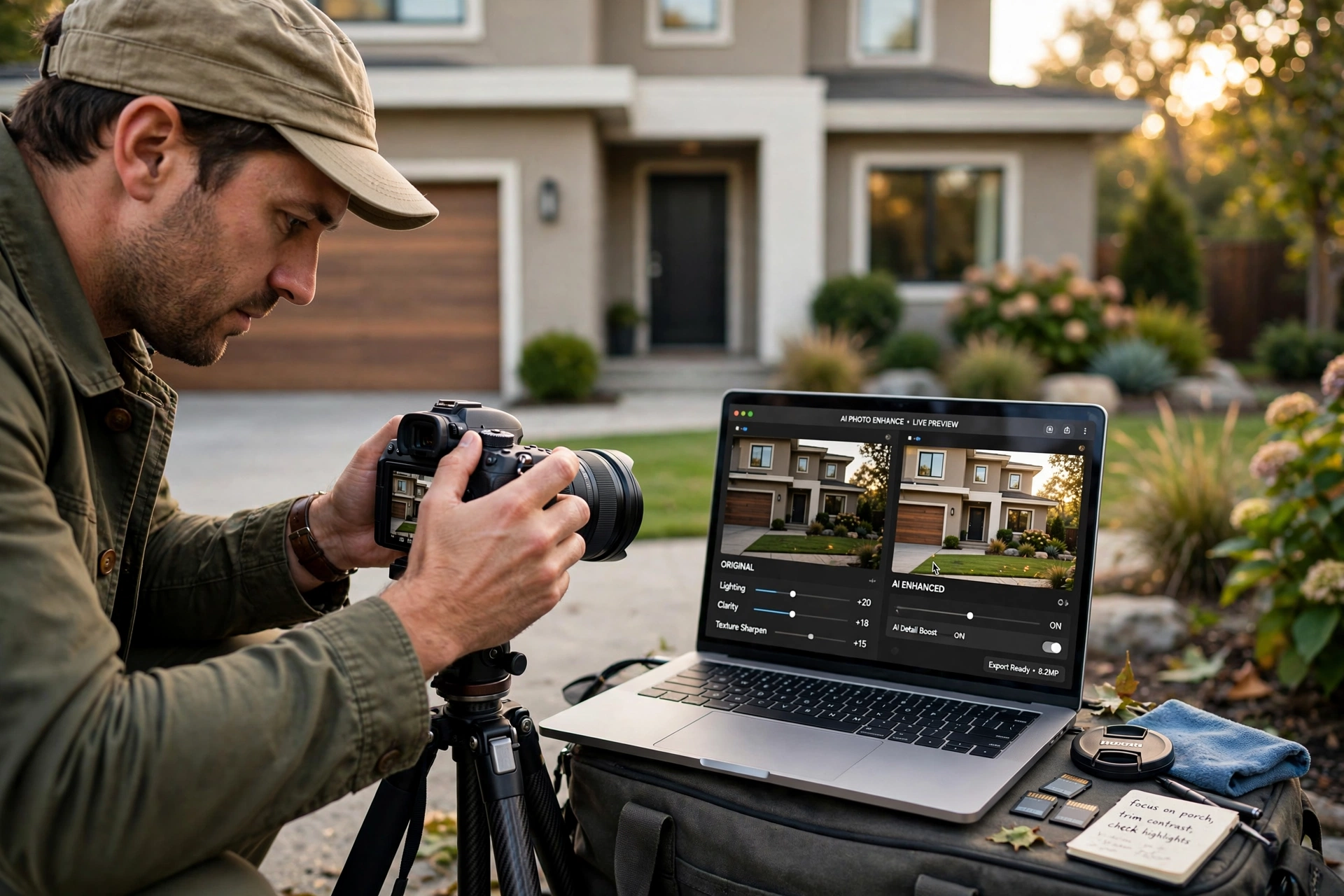
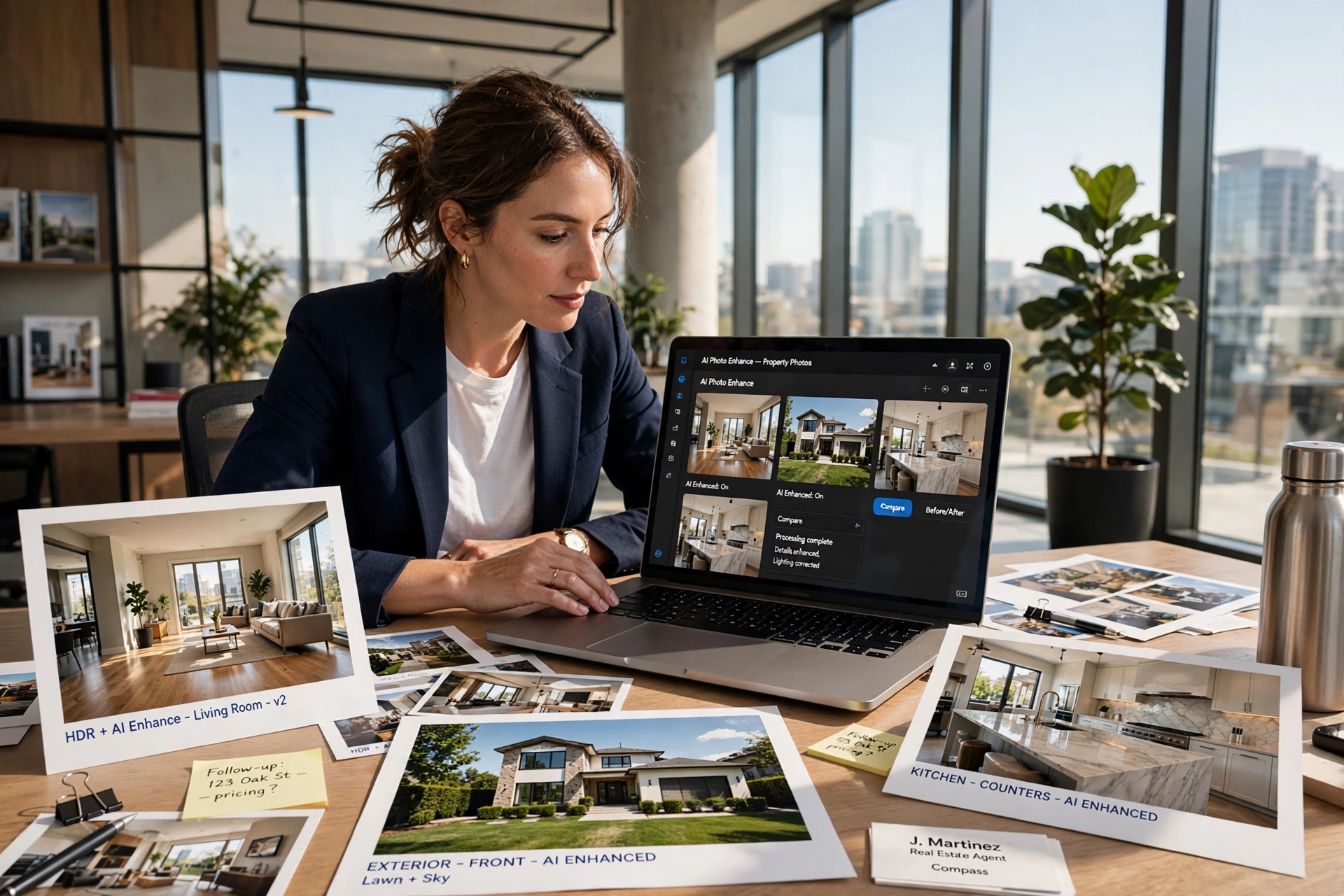
At RealVisionAI Blog - AI Real Estate Photography & Virtual Staging, we have streamlined this entire process. Instead of juggling four different tools, our platform allows users to achieve market-ready visuals in 12 seconds, automating the detection of what needs to be fixed.
💡
Key Takeaway
The most successful AI workflow follows a "Outside-In" logic: fix the sky, restore the grass, stage the vacant rooms, and then polish the interior lighting.
Comparing the Options: Which Enhancement for Which Scenario?
Choosing the wrong tool can lead to "uncanny valley" images—photos that look slightly off or fake, which can actually trigger a distrust response in buyers. To avoid this, use the following decision framework.
| Enhancement Type | Best For... | Primary Benefit | Trade-off |
|---|---|---|---|
| Virtual Staging | Empty rooms / New builds | Helps buyers visualize scale and use of space | Requires careful style matching to avoid "fake" look |
| Sky Replacement | Overcast days / Dull exteriors | Instant emotional "lift" and better curb appeal | Over-saturation can look unrealistic if not balanced |
| Day-to-Dusk | Luxury listings / Primary hero shots | Higher click-through rates; evokes "luxury" feel | Less effective for low-end rental listings |
| AI Decluttering | Occupied homes / "Lived-in" spaces | Removes visual noise; focuses on architecture | High-detail objects may leave "artifacts" if low-res |
| Grass Restoration | Winter listings / Poor landscaping | Makes property look well-maintained | Must be subtle to avoid looking like a cartoon |
Now, here's the reality: most agents try to do this manually or with generic apps. I've seen countless cases where an agent uses a generic "beautify" filter that blows out the highlights and makes the walls look neon white. This is a critical error. Professional ai real estate photo enhancement must preserve the textures of the materials—the grain of the hardwood and the weave of the carpet—while only adjusting the atmospheric elements.
If you are managing listings in high-growth areas, such as utilizing Virtual Furniture Staging in Phoenix: Boost Your Listing ROI, you will find that the "Virtual Staging" vs "Decluttering" trade-off is the most frequent decision point. In a hot market, a staged home often sells for a premium because the buyer doesn't have to do the mental work of interior design.
Common Questions and Misconceptions About AI Enhancements
There is a lot of noise in the industry regarding AI. Many guides get this wrong by suggesting that "more is better." In reality, the goal of ai real estate photo enhancement is invisibility. If the buyer knows AI was used, you've failed.
Myth 1: "AI staging is deceptive and unethical."
This is a common misconception. Ethical staging—both physical and virtual—is about showing the potential of a space. As long as the structural elements of the room are not altered (e.g., you aren't removing a load-bearing wall or hiding a massive crack in the foundation), virtual staging is a recognized industry standard. The key is to include a small disclaimer in the listing: "Some images have been virtually staged for visualization purposes."
Myth 2: "Generic AI filters are just as good as specialized tools."
This is the most dangerous mistake agents make. Generic filters apply a global change to the entire image. Professional tools use "masks." For example, a professional tool will brighten the interior of a room while simultaneously darkening the sky to create a dramatic twilight effect. A generic filter will either brighten both or darken both, resulting in a washed-out or muddy image.
Myth 3: "AI enhancement takes hours of processing time."
Early AI models were slow, but the 2026 landscape is different. With the advent of edge computing and optimized neural networks, tools like those at RealVisionAI Blog - AI Real Estate Photography & Virtual Staging can process a full suite of enhancements in 12 seconds. The bottleneck is no longer the technology; it's the agent's workflow.
Myth 4: "You only need AI for luxury properties."
On the contrary, AI is arguably more important for entry-level or "fixer-upper" properties. A luxury home already looks good; a dated 1970s bungalow needs the help of virtual staging and decluttering to show a buyer that the home has "good bones" and potential.
Frequently Asked Questions
Which AI enhancement provides the highest immediate impact on click-through rates?
The highest immediate impact usually comes from the combination of AI Sky Replacement and Day-to-Dusk conversion for the primary exterior photo. Humans are biologically wired to respond positively to warm, golden-hour lighting. When a buyer scrolls through an MLS feed, a vibrant, glowing home stands out against a sea of flat, midday photos. In my experience, changing a gray sky to a sunset can increase initial listing clicks by 20% to 40% within the first 24 hours.
Is virtual staging better than physical staging for most listings?
For the vast majority of agents, virtual staging is superior due to cost and flexibility. Physical staging requires renting furniture, paying movers, and risking damage to the property, often costing thousands of dollars per month. Virtual staging allows you to test multiple styles—such as "Scandinavian Modern" or "Industrial Loft"—to see which resonates most with the local market. This is especially useful in diverse markets like those served by Virtual Furniture Staging in New Orleans: Boost Your Listing Value.
How do I ensure that AI enhancements don't look "fake" or "uncanny"?
The secret to avoiding the "fake" look is lighting consistency. The AI must ensure that the light source of the added furniture matches the light source of the room. If the window is on the left, the shadows of the virtually staged sofa must fall to the right. Professional tools use "ambient occlusion" and "global illumination" to mimic how light actually bounces off surfaces. If you use low-cost, generic AI, you often get "floating" furniture that doesn't seem to touch the floor.
Can AI real estate photo enhancement help with SEO and online visibility?
Yes, indirectly but powerfully. While AI doesn't change your metadata, it drastically improves User Experience (UX) metrics. When users click on a listing and spend more time engaging with high-quality, staged images, it signals to the platform's algorithm (and search engines like Google) that the content is high-value. This leads to better rankings in "Suggested Properties" and higher visibility in local searches. Combining great visuals with a strategy for Virtual Furniture Staging in Boston: Scale Your Listing ROI creates a powerful growth loop.
What is the difference between AI "upscaling" and AI "enhancement"?
Upscaling is specifically about resolution. It uses AI to add pixels to a low-quality, blurry image to make it sharp and clear. Enhancement, however, is about aesthetics and content. Enhancement includes changing the sky, adding furniture, or removing a car from the driveway. You often need both: first, upscale a low-res mobile photo to a professional 4K resolution, and then apply enhancements to make the scene aspirational.
Final Thoughts on AI Real Estate Photo Enhancement
The decision of which ai real estate photo enhancement to use should always be driven by the specific friction point of the property. If the house feels cold, stage it. If the day was gloomy, fix the sky. If the interior is cluttered, use AI to clear the path for the buyer's imagination.
In the current 2026 market, the gap between a "sold" sign and a "for sale" sign is often just a few pixels. Agents who embrace a systematic approach to visual enhancement—moving away from generic filters and toward targeted, semantic AI—will consistently outpace their competition.
Ready to stop guessing and start converting? Experience the power of market-ready visuals in just 12 seconds with RealVisionAI Blog - AI Real Estate Photography & Virtual Staging. Whether you are looking for Virtual Furniture Staging in Las Vegas: Scale Your Listings or a complete overhaul of your listing's curb appeal, we provide the professional edge you need.
Visit realvisionaire.com to transform your listings today.
Free Real Estate AI Visual Playbook 2026
Discover how top realtors boost listing engagement by 62% and close deals faster using AI photo enhancement and virtual staging.