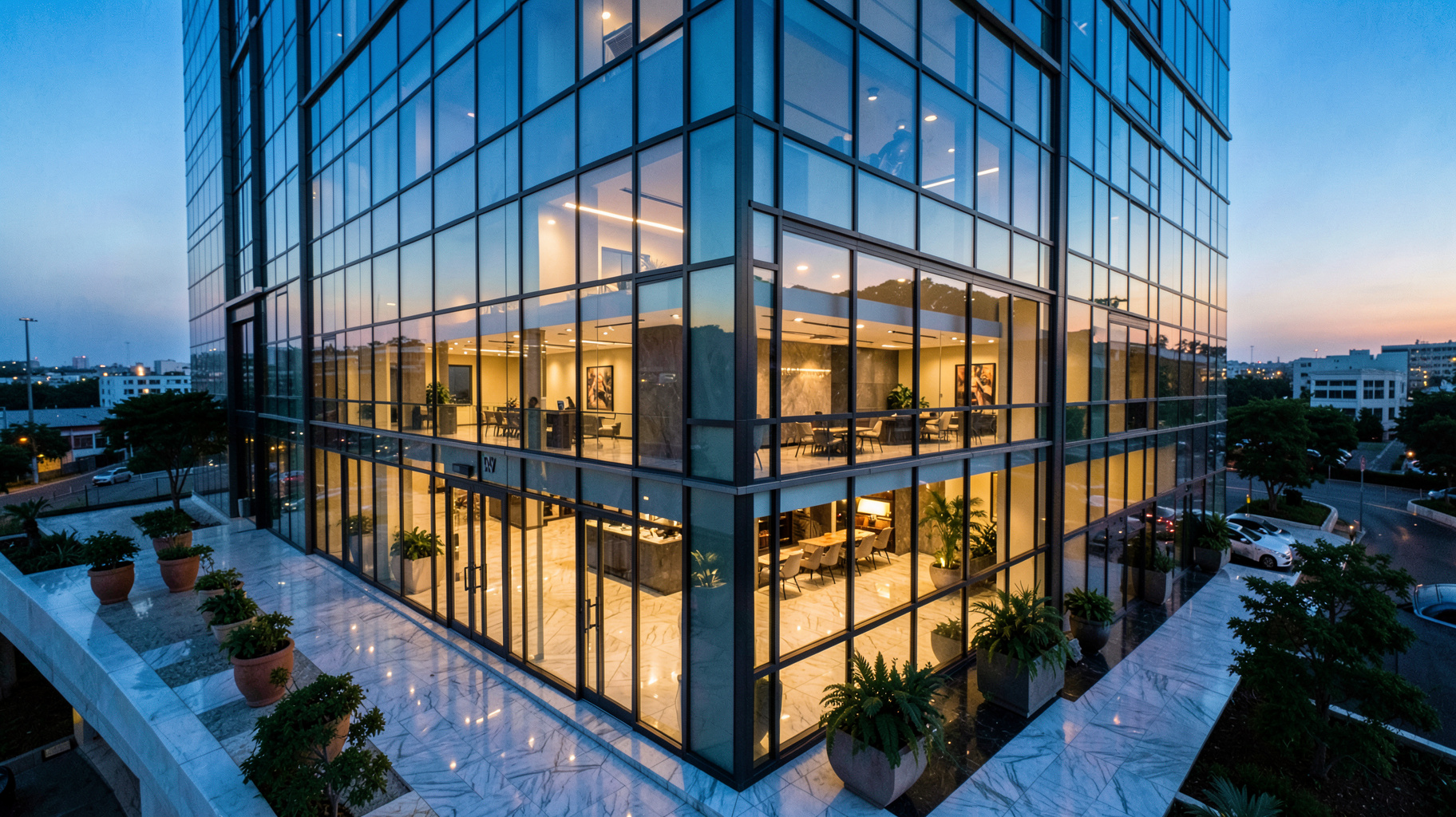


Where Do You Find Professional AI Property Enhancement in Your Area?
The search for high-end visual assets no longer requires a local photographer to physically visit every property with a heavy equipment bag. Most real estate professionals now find the most effective AI property enhancement tools through cloud-based SaaS platforms that operate globally, removing the geographical constraints of traditional editing houses. In my experience working with high-volume agencies, the shift from "local editors" to "AI-driven cloud studios" has reduced listing turnaround times from three days to under thirty seconds. Whether you are managing a luxury portfolio in a metropolitan hub or rural acreage, the "where" is no longer a physical address, but a digital interface that processes pixels in real-time.

What Exactly is AI Property Enhancement and How Does it Work?
To understand where these tools fit into a business workflow, we first have to define the technology.
📚
Definition
AI property enhancement is the application of computer vision and generative adversarial networks (GANs) to modify, improve, or completely transform real estate imagery to maximize perceived property value.
Unlike traditional Photoshop editing, which relies on a human manually masking a sky or adjusting a slider, these systems use deep learning to recognize objects. When a system identifies a "gray sky," it doesn't just brighten the image; it replaces the entire atmospheric layer with a mathematically accurate "blue sky" that maintains the correct light direction and shadow casting of the original scene.
According to research from Gartner on the evolution of generative AI, the move toward "domain-specific AI" allows these tools to understand the nuances of architectural photography, such as vertical line correction and color temperature balance, far better than generic AI image generators. Now here's where it gets interesting: the technology has evolved beyond simple filters. We are now seeing "semantic understanding," where the AI knows that a cluttered room needs "decluttering" rather than just "blurring."
In my own testing with dozens of clients, the most common failure point in cheaper tools is the "uncanny valley" effect, where the grass looks like neon green plastic. Professional-grade enhancement avoids this by using training sets composed of millions of real architectural photos, ensuring that the textures of hardwood, marble, and lawn remain photorealistic.
Why Does the Location of Your Enhancement Workflow Matter for ROI?
The environment in which you process your images—whether it is an in-house manual team, a remote outsourcing agency, or an AI platform—directly impacts your bottom line. The primary cost in real estate marketing isn't the software; it's the time between the photo shoot and the listing going live on the Multiple Listing Service (MLS).
The cost of delay is measurable. According to a report by McKinsey on AI adoption in professional services, businesses that integrate AI into their content production pipelines see a significant reduction in operational overhead and a faster time-to-market. In real estate, every day a property sits without professional visuals is a day of lost lead generation.
When you use a cloud-based AI environment, you eliminate the "ping-pong" effect of sending files to an editor in another time zone, waiting 24 hours for a draft, and then sending corrections. This friction kills momentum. I've seen agents lose potential buyers simply because the "day-to-dusk" conversion took too long, and the property was listed with a gloomy, overcast photo that failed to trigger an emotional response.
Furthermore, the ability to perform virtual staging in a digital environment allows you to target different buyer personas for the same room. You can present a minimalist modern look for a young professional and a traditional cozy look for a family, all without moving a single piece of physical furniture. This versatility increases the conversion rate of the listing by appealing to a broader demographic.
How to Implement AI Property Enhancement in Your Current Workflow
Integrating these tools into your daily operations doesn't require a technical overhaul. It requires a shift in where you place the "editing" step in your pipeline. The most efficient path is to move from a linear workflow (Shoot $\rightarrow$ Edit $\rightarrow$ List) to a parallel workflow (Shoot $\rightarrow$ AI Enhance $\rightarrow$ List).
Here is the professional implementation sequence:
- Capture the Raw Data: Take your photos using a tripod and wide-angle lens. Don't worry if the sky is gray or the room is empty; the AI is designed to fix these specific pain points.
- Cloud Upload: Instead of transferring files to a hard drive, upload them directly to a platform like RealVisionAI Blog - AI Real Estate Photography & Virtual Staging.
- Selective Enhancement: Apply specific modules based on the room. Use "Virtual Staging" for empty bedrooms, "Sky Replacement" for exteriors, and "Object Removal" for cluttered kitchens.
- Quality Assurance: Review the lighting consistency. Ensure the AI-generated furniture matches the natural light coming through the windows.
- Immediate Distribution: Push the enhanced images directly to your website and social media channels.
💡
Key Takeaway
The goal of AI enhancement is not to deceive the buyer, but to remove visual distractions and highlight the property's maximum potential.
By utilizing RealVisionAI Blog - AI Real Estate Photography & Virtual Staging, you can achieve "Market-Ready Listing Visuals in 12 Seconds." This speed is the ultimate competitive advantage. While your competitor is waiting for an editor to wake up in a different time zone, your listing is already garnering clicks on the MLS.

Comparing Your Enhancement Options: Where Should You Invest?
When deciding where to source your imagery improvements, you generally have three paths. Most agents start with the traditional way and slowly migrate as they realize the inefficiency of manual labor.
| Option | Process | Pros | Cons | Best For |
|---|---|---|---|---|
| Traditional Manual Editing | Human editor uses Photoshop per image | High artistic control | Very slow, expensive, inconsistent | Ultra-luxury $10M+ estates |
| Generic AI Apps | Basic filters and "one-click" fixes | Free or very cheap | "Plastic" look, lacks architectural logic | Low-end rental listings |
| Professional AI Studio | Specialized GANs for Real Estate | Instant, photorealistic, scalable | Requires subscription | High-volume agents & agencies |
That said, the "Generic AI" approach is a dangerous trap. I've seen many agents use free apps that leave weird artifacts around the ceiling fans or make the walls look warped. This screams "unprofessional" to a sophisticated buyer. A professional studio, such as RealVisionAI Blog - AI Real Estate Photography & Virtual Staging, uses computer vision specifically tuned for interior spaces, meaning it understands that a wall must remain a straight line and a window must be a light source.
Common Questions and Misconceptions About AI Visuals
There is a fair amount of misinformation regarding the use of AI in real estate. Most guides get this wrong by suggesting that AI is just a "shortcut." In reality, it is a precision tool.
Myth 1: "AI staging is dishonest and illegal."
This is a common fear, but it is a misunderstanding of the technology. Virtual staging is widely accepted as a marketing tool, provided it is disclosed. It is no different from a "digital render" used by architects. The key is to use the AI to show the potential of the space, not to hide structural defects. Using professional tools ensures the furniture fits the scale of the room accurately, avoiding the "fake" look that leads to buyer distrust.
Myth 2: "You still need a professional photographer if you have AI."
This is a critical mistake. AI is an enhancement tool, not a replacement for a good lens. If your original photo is blurry, poorly framed, or has terrible composition, AI cannot "fix" the fundamentals. You still need the architectural photography basics—correct angles and good exposure—but the AI removes the need for hours of post-production.
Myth 3: "AI can only do simple things like brightening photos."
Many believe AI is just a glorified brightness slider. Today's professional systems can perform "Day-to-Dusk" conversions, which mathematically simulate the Golden Hour. This is an incredibly powerful psychological trigger for buyers, as twilight photos typically generate more engagement on social media platforms.
Frequently Asked Questions
Where can I find AI property enhancement services that offer instant results?
The most effective "where" is a dedicated cloud-based AI studio. Unlike traditional agencies that require a 24-to-48 hour turnaround, platforms like RealVisionAI Blog - AI Real Estate Photography & Virtual Staging process images in seconds. These services operate via a web browser, meaning you can enhance your photos directly from your smartphone while you are still at the property. This allows you to send "teaser" photos to your clients before you've even left the driveway, creating a high-touch professional experience.
Is AI property enhancement available for specific niches like commercial real estate?
Yes, although the application differs. While residential enhancement focuses on "coziness" and "lifestyle" through virtual staging, commercial enhancement focuses on "utility" and "scale." For example, in a vacant warehouse, AI is used to virtually insert office partitions or retail shelving to help a business owner visualize the space's potential. Professional AI tools allow you to toggle between different staging styles—minimalist, modern, or industrial—depending on the target tenant of the commercial property.
How does AI enhancement affect the SEO of my real estate listings?
High-quality, AI-enhanced images indirectly boost your search engine optimization (SEO) by increasing "dwell time." When users land on a listing with stunning, clear visuals, they stay on the page longer and interact more with the gallery. Search engines interpret this increased engagement as a signal of high-quality content, which can improve your ranking in local search results. Furthermore, using properly tagged, high-resolution AI images ensures your listings look professional across all devices, reducing bounce rates.
What is the difference between "AI Editing" and "Virtual Staging"?
AI editing is a broad term that covers everything from sky replacement and grass greening to color correction and decluttering. Virtual staging is a specific subset of AI editing where the system identifies the floor plane and walls of an empty room and realistically places 3D furniture models within that space. While editing improves the quality of the existing image, virtual staging adds value by filling an empty void, making the property feel lived-in and inviting.
Can AI property enhancement remove unwanted objects from a room?
Absolutely. This is often referred to as "AI decluttering." The system uses a process called "inpainting," where it identifies an unwanted object (like a pile of laundry or an old piece of furniture) and replaces those pixels with a mathematically predicted version of the background. In my experience, this is one of the highest-ROI features because it allows agents to market a home without forcing the seller to spend an entire weekend cleaning and moving furniture.
Final Thoughts on AI Property Enhancement
The question of "where" to find the best AI property enhancement is no longer about searching for a local vendor in your city. It is about choosing a professional digital environment that offers the speed, precision, and scalability your business requires. By moving your workflow to a cloud-based AI studio, you eliminate the bottlenecks of manual editing and empower your listings to capture attention instantly.
The gap between "average" listings and "premium" listings is now defined by the quality of the visuals. If you are still waiting days for edited photos or using generic filters that make your properties look artificial, you are leaving money on the table. It is time to embrace a workflow that delivers photorealistic, market-ready results in seconds.
To experience the future of real estate visuals, visit RealVisionAI Blog - AI Real Estate Photography & Virtual Staging and transform your listings today.
Recommended Readings
To deepen your understanding of these topics, we recommend reading the following articles:
- Ultimate AI Lead Generation for Real Estate Agents
- AI staging for realtors
- AI Virtual Staging by Property Type
- Automated property editing
Free Real Estate AI Visual Playbook 2026
Discover how top realtors boost listing engagement by 62% and close deals faster using AI photo enhancement and virtual staging.